ScienceSoft Global
 Insurance
 Investment



How Much Will Your Financial Software Project Cost?
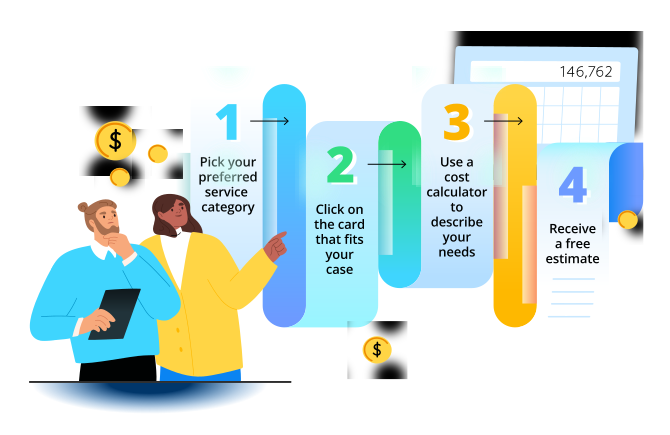
We’ve built over 200 cost calculators to help you estimate project expenses. Simply type a few words into the search bar to see the most relevant calculators — or browse the categories below to find the one that fits your project.








Data and Technology Solutions






Managed IT Service Cost Calculators




Security and Compliance Service Cost Calculators




Other Cost Calculators



Explore Our Sample Cost Ranges
Custom financial software development costs
- $150,000–$250,000 A native mobile app (for banking, payments, insurance, etc.).
- $200,000–$400,000 A client-facing web app (e.g., e-banking, investor portal).
- $200,000–$600,000 A specialized service operations solution (e.g., loan processing, insurance underwriting) of average complexity.
- $300,000–$1,500,000 Blockchain-based BFSI software (e.g., for cross-border settlements, lending).
- $800,000–$4,000,000 A large-scale process automation system (for insurance, mortgage, etc.) powered with intelligent analytics.
BFSI data analytics service costs
- $30,000–$200,000 Developing a separate data science component (for forecasting, fraud detection, prescriptive analytics, etc.).
- $100,000–$150,000 Implementing a descriptive analytics system for a particular business area (e.g., sales, underwriting, loan servicing).
- $200,000–$400,000+ Building a business intelligence solution that calculates KPIs across multiple areas (operations, finance, etc.), integrates with 3–7 corporate and external systems, and features predictive analytics using non-neural-network ML models.
- $500,000–$1,000,000+ Creating a complex analytics system powered with big data and AI/ML.
Security and compliance costs
- $10,000 One-time penetration testing of a client-facing app like a web e-banking portal.
- $8,000–$16,000 Code review of an internal BFSI application.
- $10,000–$20,000 Compliance pre-audit (for PCI DSS, NYDFS, GDPR).
- $20,000 Network security testing for a midsized BFSI organization.
- $40,000+ A phishing campaign combined with white box financial IT infrastructure pentesting.
- $45,000 QRadar implementation and user training for a BFSI company with 1K–10K employees.
Quality assurance estimates
- $5,000 One-time performance testing for a financial mobile app.
- $24,000–$72,000+ Audit of financial software QA processes and consulting on improvements.
- $20,000/month Continuous managed testing services for a BFSI organization that has 3–5 constantly evolving apps.
Managed IT support prices
- $14–$40 per ticket L1–L2 IT support.
- $3,000–$16,000+/month Financial software maintenance and L3 support.
For a more precise cost estimate, please use our online cost calculators.
How We Optimize Costs
Across our consulting and delivery services, ScienceSoft continuously identifies opportunities to simplify architectures, eliminate low-value work, automate repetitive activities, and maximize the return on technology investments. Below are some of the proven cost optimization practices we apply throughout the IT project lifecycle.
Applying AI where it delivers measurable value
When approved by the client, ScienceSoft selectively applies AI throughout the software delivery lifecycle, including requirements analysis, coding, testing, and documentation. In our experience, mature AI-assisted development can double productivity on routine coding tasks, reduce code review time by up to 40%, and lower delivery effort for the same scope by 30–70%, depending on project complexity and the share of repetitive work. All AI-generated outputs are reviewed by experienced specialists, and projects follow client-specific security, confidentiality, governance, and regulatory requirements, including strict no-AI policies.
Automating repetitive work
Whenever feasible, ScienceSoft automates software delivery, infrastructure management, testing, and security validation using CI/CD pipelines, Infrastructure as Code (IaC), automated testing, and deployment automation. For financial systems, we also automate regression testing, API validation, and compliance reporting workflows, reducing manual effort while maintaining reliability and audit readiness. Depending on the project, automated testing and deployment reduce release preparation effort by 50–80%.
Rightsizing technical decisions
Overengineered architectures, unnecessary integrations, and excessive customization increase implementation and operating costs. ScienceSoft designs solutions that meet business, regulatory, and performance requirements without unnecessary complexity. We simplify integrations, eliminate redundant components, and optimize cloud resources, databases, and storage. Through cloud rightsizing and workload optimization, our architects regularly reduce cloud infrastructure costs by 20–70% without compromising availability, resilience, security, or regulatory compliance.
Reusing proven solutions instead of reinventing them
Rather than building standard capabilities from scratch, ScienceSoft leverages proven reference architectures, security baselines, integration templates, migration playbooks, and testing assets refined across hundreds of our financial software projects. Reusing validated assets reduces custom development, shortens delivery timelines, lowers implementation risks, and allows teams to focus on business-specific capabilities such as lending workflows, payment processing, and claims automation. For common technical requirements, reuse can reduce implementation effort by up to 40%.
Eliminating low-value requirements and preventing scope creep
During discovery, ScienceSoft evaluates requirements against business benefits, implementation complexity, regulatory obligations, risks, and ROI. We identify duplicate functionality, excessive customization, and capabilities already available in existing platforms. Comprehensive discovery can eliminate 15–25% of the initially requested scope without affecting business outcomes and reduce overall development costs by up to 50%.
Throughout delivery, we monitor budgets, progress, scope changes, and project risks. Every requested change is evaluated for its business value, implementation effort, delivery impact, and compliance implications to maintain budget and schedule discipline.
Optimizing team composition
ScienceSoft assembles project teams according to solution complexity, project phase, technology stack, compliance requirements, and delivery risks. Senior architects, financial domain experts, and security specialists focus on architecture, regulatory compliance, and critical decisions, while implementation, testing, and operational activities are handled by appropriately qualified engineers. This balanced staffing model provides specialized expertise where it delivers the greatest value while maintaining cost efficiency.
Why BFSI Companies Choose ScienceSoft
- Since 1989 in IT services and software development.
- An inspired, high-performing team of 750+ IT experts.
- 4,300+ success stories.
- More than 1,500 satisfied clients.
- Quality-first approach based on a mature ISO 9001-certified quality management system.
- Robust security management supported by an ISO 27001 certification.
- Partnerships with Microsoft, AWS, and other technology leaders.
Partnerships and recognitions








Our BFSI Clients Share Their Experience With ScienceSoft



What stood out was ScienceSoft's proactive suggestions for cost-saving architecture design and tech stack solutions. Their input ensured we stayed within budget without compromising on software quality. The value we derived from partnering with ScienceSoft is definitely worth the investment.


The guys really cared about the online payment solution they developed for my company and weren’t happy until they had it perfect. They ask the right questions and look for ways to improve on an idea. Their communication was really good, and they explained their approach to all development aspects.


ScienceSoft are true engineers who think long-term and propose strategic decisions instead of micro-fixes, and, what is equally important, they carry them out as planned. From network management to SharePoint farm integration to PKI rollouts, I know I can count on them to get the job done and keep everything in order.