ScienceSoft Global



Overview of Insurance Portals
Features, Integrations, Benefits, Pricing
ScienceSoft combines 21 years of practice in web portal development with 14 years of experience in engineering custom software solutions for the insurance industry to deliver effective, secure, and visually appealing insurance portals. ScienceSoft can develop an insurance portal for agents, brokers, and customers.

Contributors

Insurance IT & AI Consultant and Lead Business Analyst, ScienceSoft

Head of AI, Principal Architect, ScienceSoft
Insurance Portals: Key Aspects
An insurance portal is aimed at introducing frictionless digital experiences for insurance customers, partners, and employees. ScienceSoft can create an agent portal with application and submission tracking for insurance agencies. Insurance portals provide users with self-service options, process automation features, and prompt, secure access to the required data and documents. ScienceSoft can automate insurance customer self-service business processes.
For insurers, intermediaries, and service providers, tailored portals bring significant improvement in operational efficiency and drive higher satisfaction and retention rates of their customers, partners, and internal teams.
Building an insurance portal may cost around $40,000–$400,000+, depending on the solution complexity and the chosen development approach. You're welcome to use our free calculator to estimate the cost for your case.
The implementation of custom insurance portal software typically takes 3–6 months. An insurance portal can bring more than 190% ROI within three years after deployment.
Main Types of Insurance Portals

A customer portal
Provide insurance customers with a personalized digital experience and self-service options and drive up to 90% increase in customer engagement and an 80+% improvement in retention.

An agent portal
Equip insurance agents with best-in-class workflow automation and collaboration tools and provide them with instant access to the required data. Achieve 40%+ increase in agent productivity and up to 4x faster policy cycle.

A supplier portal
Build close and transparent relationships with claim execution partners, eliminate redundant efforts, and unlock mutual financial gains. Securely exchange insurance data and leverage no-touch claim evaluation and settlement.
|
|
|
|
|
|
|
NB! An insurance broker portal is a distinct portal type, but when implemented on the carrier side, it effectively combines the functionality and benefits of both customer and agent portals. ScienceSoft can create an insurance broker portal to help brokers manage submissions and client relationships. When launched by a brokerage for its captive brokers, its functionality aligns more closely with agent portals, focusing on multi-carrier policy comparison, quote generation, and streamlined communication with insurers. |
|
|
|
|
|
|
|
|

Key Features of an Insurance Customer Portal
With 80%+ of insurance customers trying to solve the issues on their own before asking for help, a customer self-service portal becomes a must rather than a need for organizations aiming to excel at customer experience.
Based on ScienceSoft’s experience in customer portal development projects, we compiled a list of features that lay the foundation for a successful client portal:

Customer onboarding
- Configurable forms for customer self-registration.
- Automated processing of customer digital documents using RPA, machine learning (ML), and large language models (LLMs).
- Customer digital identity validation.
- Geography-based KYC/AML verification.
- Customers’ e-signature capture and verification.

Account management for customers
- Multi-factor authentication.
- Managing and updating personal or business information and billing details.
- Uploading documents in different formats: PDF, digital image, video, etc.
- Setting up the preferred language, communication channel, billing method, etc.
- Linking the account with social media profiles.
- Overview of the policy portfolio and a history of insurance transactions.
- A sidebar with the “recently viewed” information.
- End-to-end audit trail of account activities.

Customer self-service area
- Template-based generation of:
- Insurance applications.
- Claims.
- Requests for policy updating, cancellation, renewal, termination.
- Instant submission of applications, policy servicing requests, and claims.
- Paying insurance premiums via a selected payment method.
- Real-time monitoring of the application approval, policy issuance, payment processing, claim resolution statuses.
- Notifications on the expiring policies, due payments, personal and billing info that needs updating, etc.
- Instant messaging to communicate with the insurance specialists.
- (optional) A self-service premium calculator.

Premium payment processing
- Support for various payment methods: bank transfer, card, check, digital wallet, etc.
- Multi-currency payments, including cryptocurrency payments.
- Real-time processing of payments via the connected payment gateways.
- Scheduled customer notification and payment retry in case of payment failure.
- Automated payment reconciliation.

Content management
- Uploading, editing, and publishing informational and promotional content: data on new insurance products, discounts, knowledge articles, etc.
- Content versioning.
- Content categorization and segmentation for various customer groups.
- Personalized content recommendations for each customer.
- Creating and managing customer experience surveys and polls.

Customer support
- An AI-powered virtual assistant to provide 24/7, natural language customer support across operational, transactional, and security issues.
- A knowledge base with articles, FAQ, etc.
- A customer forum.
- Scheduling in-person appointments for policyholders.
- Customer profile management with a possibility to view and monitor customer activities on the portal.
Key Features of an Insurance Agent Portal
65%+ of insurance agents state that the availability of proper IT tools affects their employment preferences. ScienceSoft is ready to implement an agent portal with comprehensive capabilities to help you attract and retain the best talent while maximizing agent productivity. ScienceSoft can create an insurance agent portal to help agents manage policies and clients.
Below, we list the features that would form the core of a robust agent portal:

Agent relationship management
- Configurable workflow for agent self-onboarding.
- Verification of agents’ personal and billing information.
- Agent contract management.
- Calculating and tracking agent performance metrics: new policies per agent, average revenue per agent, quote rate, bind rate, quotas vs. production, etc.
- Monitoring agents’ performance compliance against the internal policies.

Agent e-learning
- Creating and managing a knowledge base for agent self-education.
- An agent onboarding tour with personalized content.
- Detailed tutorials for agent self-training.
- Forums and discussion boards for agents.
- Rule-based assignment of user-defined e-learning programs to particular agents.
- Real-time tracking of agents’ e-learning progress.

Task management
- Automated task assignments to agents based on their qualifications, availability, schedule, location, etc.
- Automated creation and updating of task lists.
- Configurable dashboards providing agents with an overview of scheduled in-person appointments, assigned tasks, their priorities and deadlines.

Workflow automation
- Rule-based lead consolidation and prioritization.
- Automated parsing of insurance applications and supporting documents.
- Automated generation of quote requests in standard formats (e.g., ACORD, EDI) and their placement with underwriters.
- Live chat to communicate with underwriters.
- Real-time tracking of underwriting progress.
- Template-based creation of personalized customer quotes, insurance policies, certificates of insurance, and invoices.
- Sending insurance documents to customers via email, messaging apps, etc. or instantly printing them.
- Automated reporting of issued policies and policy renewals to the agency management and insurer(s).

Insurance data and document management
- Secure real-time access for agents to:
- Insurance product data and coverage terms.
- Policyholder data: policies owned, billing history, claims history, and more.
- Insurance financial documents, such as premium and commission statements.
- Promotional materials: product presentations, brochures, videos, etc.
- Search engine to query and navigate insurance data and documents.
- Smart search supported by large language models (LLMs).
- Permission-based rights to view, edit, download, and share particular insurance data and documents.

Agent-customer interaction management
- Automated capture and recording of data on omnichannel agent-customer interactions.
- Monitoring customer requests and active cases (applications, policy changing requests, open claims, etc.).
- Notifications to agents on the policies nearing the expiration date to initiate interactions with policyholders on the policy renewal.
- AI-powered analysis of data on policyholders’ behavior, demographics, and current needs and intelligent suggestions on the insurance product cross-selling opportunities.
- AI-based recommendations on the proper follow-ups based on the analysis of customer interactions, e.g., suggesting the appropriate contact persons and steps to guide the policyholder through the claim process.
Key Features of an Insurance Supplier Portal
Insurers and TPAs often deal with complex supplier ecosystems comprising partners like damage inspection and estimation providers, healthcare institutions, pharmacies, home repair companies, auto repair vendors, legal advisors, and many other.
In ScienceSoft’s projects, we create supplier portals with unique functionality bound to each client’s specific needs. Below, we list the supplier portal features typically requested by our clients from the insurance domain.

Supplier onboarding and pre-qualification
- Supplier self-registration, managing business and billing information.
- AI-enabled supplier pre-qualification against the internal sourcing requirements (quality standards, sustainability, capacity, etc.) based on data provided by suppliers and data from public data sources (e.g., a credit rating platform).
- Automated supplier categorization by user-defined parameters (service category, location, strategic priority, etc.).
- Configurable supplier approval workflow.

Supplier’s working area
- Real-time monitoring of service requests from insurance organizations and policyholders.
- Uploading available customer data (current health state, home property state, auto state, etc.) and damage evaluation results and sharing them with the insurers and service providers to initiate claim payouts.
- Uploading details on the due payments.
- Automated invoice generation and submission to the insurer/TPA.
- Instant messaging tools.
- E-signature workflows.

E-procurement for carriers and TPAs
- Creating and managing preferred supplier lists (e.g., health claims, home property damage claims, auto damage claims, etc.).
- AI-based suggestions on the best-fitting suppliers to assign to particular claim cases.
- Supplier contact management.
- Template-based creation of service requests and sending them to the relevant suppliers.
- AI-powered processing of supplier invoices.
- Automated payments to suppliers.

Supplier performance monitoring
- Configurable dashboards with real-time supplier activity overview.
- AI-powered analysis of reputational, financial, operational, and other supplier risks based on internal and public data sources.
- Supplier performance monitoring against pre-defined KPIs like the percentage of services delivered on time, the average delay in service execution, the number of policyholder complaints, and more.
- Supplier rating based on supplier performance and the level of engagement.
Main Integrations for an Insurance Portal
Below, ScienceSoft shares a sample integration architecture for the insurance portal. A real list of integrations will depend on the portal type you want to implement and the specifics of your software ecosystem.
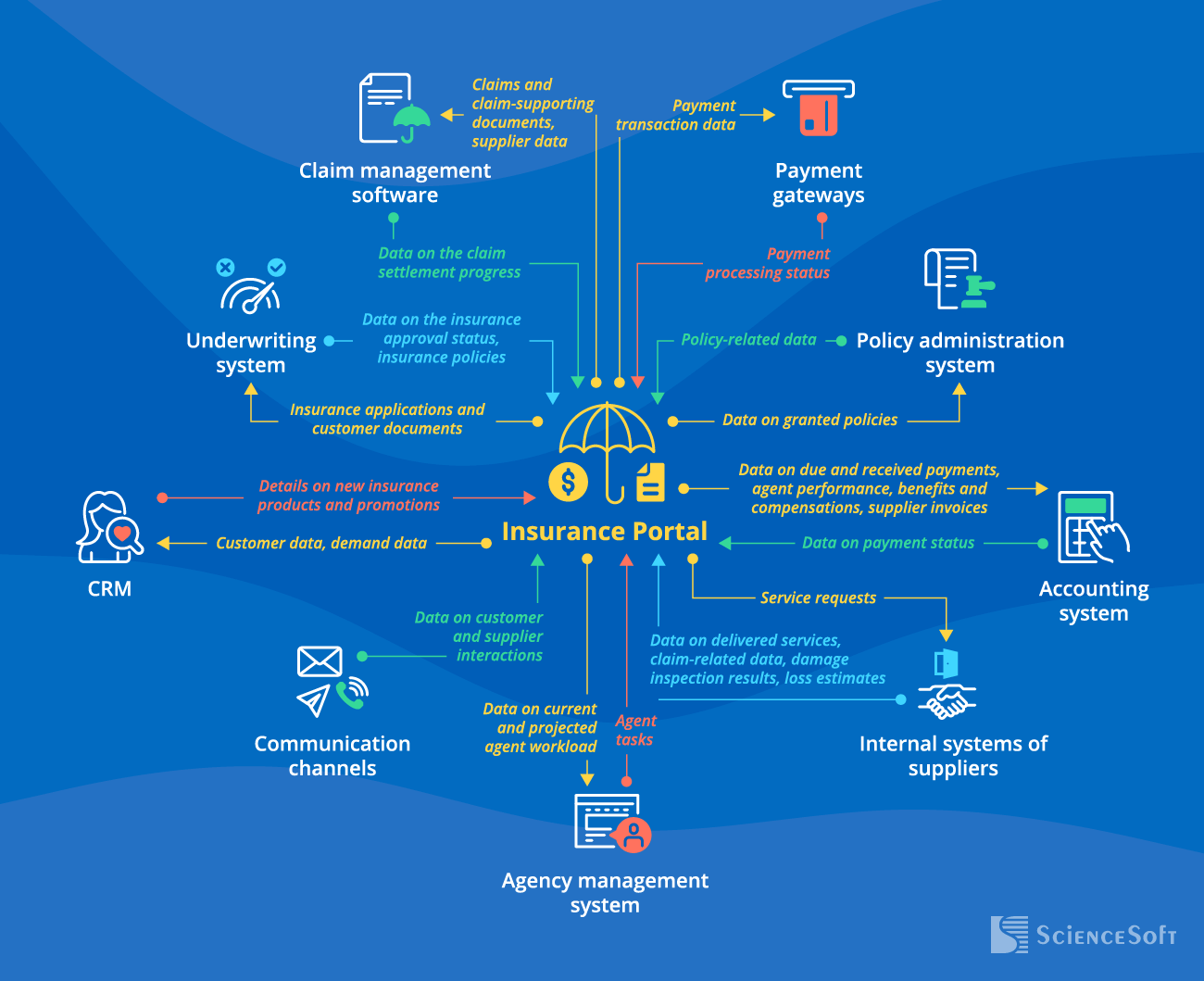
- For automated recording and centralized storage of customer data: policy-related requests, personal info, etc.
- For data-driven planning of marketing activities.
- To keep the customers and agents updated on the new products and personalized offerings.
- For faster processing of insurance applications.
- To instantly communicate insurance-related decisions to customers and agents and speed up policy submission.
- For instant claim aggregation and facilitated claim status reporting to customers.
- To provide agents with easy access to the customers’ claim histories.
- For accurate assignment of optimal suppliers to particular claim cases and data-driven claim settlement.
- For automated recording of payment transactions in the general ledger.
- For streamlined agent payroll.
- For timely payments to suppliers.
- To enable agents promptly upload, access, and share policy-related data and documents.
- For accurate planning of agent workload and streamlined task assignment to the agents.
Internal systems of suppliers
- For faster processing of service requests.
- To promptly share the available customer data with the carrier/TPA.
Communication channels
Mail systems, messaging apps, business phone systems, etc.
- To automatically maintain a full history of customer and supplier interactions.
How to Maximize the ROI for Insurance Portal Implementation

Vast self-service options for portal users
To minimize internal teams’ involvement in low-value tasks and increase operational efficiency.

Convenient UX and UI
To provide a seamless digital experience for portal users and streamline its adoption.

A mobile version
To enable portal users to easily access the required documents and track current insurance activities on the go.

Easy-to-use APIs
To ensure fast and smooth portal integration with the required corporate and third-party systems.

Robust security
To ensure that the portal solution and data it operates are protected against cyber attacks, malicious user activities, and unauthorized access and guarantee safe insurance data sharing through the portal.

Regulatory compliance
To guarantee portal adherence to the latest sectoral standards and regulations: NAIC, KYC/AML, CCPA, GLBA, SOC 1/2, IA regulations (for the KSA), GDPR (for the EU), HIPAA (for health insurance), and more.
AI-powered virtual assistants can be a strong helping hand for insurance servicing teams. When implemented with an insurance portal, a GenAI assistant can process more than 70% of customer inquiries with no human involvement, driving, on average, a 7% increase in customer satisfaction and reducing front-line employee workload by up to 50x.
Insights From ScienceSoft's Insurance IT Experts

Vital Soupel
Senior Insurance IT & AI Consultant, ScienceSoft
Trend watch
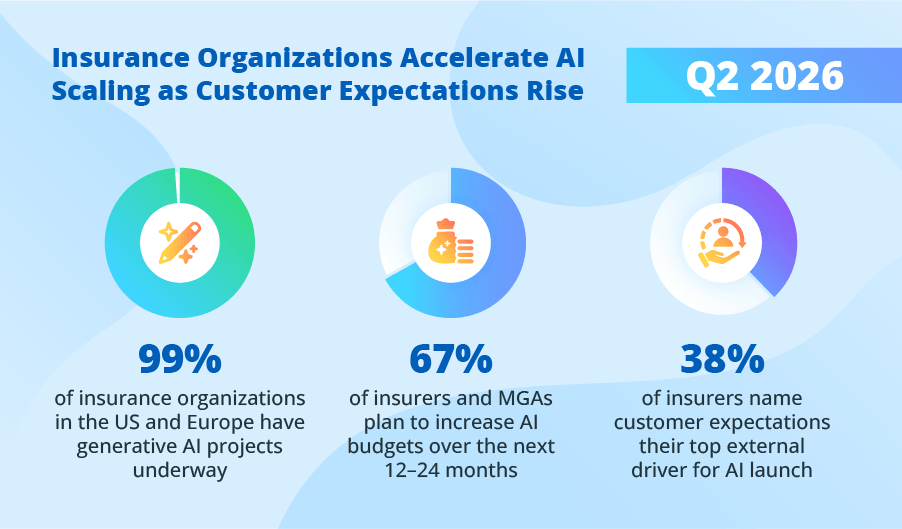
Q2 2026 Insurance AI Trends by ScienceSoft | July 2026

Zaryna Babko
Insurance IT & AI Consultant and Lead Business Analyst, ScienceSoft
Technology overview
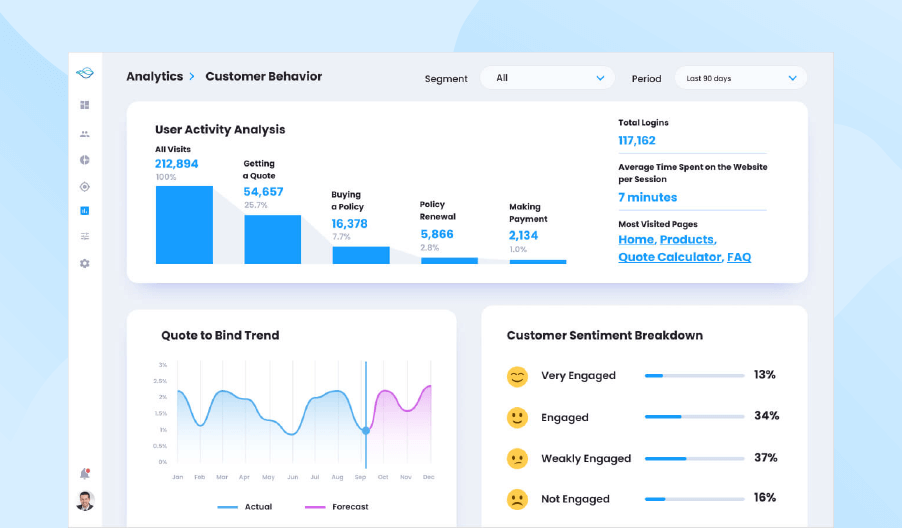
How to Excel at Customer Experience in Insurance

Olga Vinichuk
Insurance IT & AI Consultant and Lead Business Analyst, ScienceSoft

Interview
Elevating Customer Experience in Health Insurance
ScienceSoft’s Clients Say


What stood out was ScienceSoft's proactive suggestions for cost-saving architecture design and tech stack solutions. Their input ensured we stayed within budget without compromising on software quality.


Partnering with ScienceSoft for our software maintenance and evolution initiative has been an excellent experience. Over the past 18 months, their team has transformed our underwriting platform into a well-oiled machine. <...> Their communication was exemplary; unlike our previous experiences with outsourcing, we never had to chase them for updates, and they were always prompt in responding to our queries.

Damien Sewell
Head of IT Projects

ScienceSoft’s quick buy-in and readiness to take the initiative made the project faster and less stressful for everyone involved, from Capital IM’s insurance specialists to leadership. We couldn’t have asked for a better IT partner.






Custom vs. Platform-Based Insurance Portals
There are two main approaches to building insurance portals, each having its benefits and limitations. Below, ScienceSoft provides a high-level comparison of the two. Within our insurance portal consulting service, we help define the more feasible approach for your business needs.
Costs of Insurance Portal Development
Below, we provide the approximate cost estimations based on ScienceSoft's experience in insurance web portal development.

$40,000–$150,000
An insurance customer or supplier portal of average complexity.

$100,000–$250,000
A custom insurance agent portal with basic functional capabilities.

$250,000–$400,000+
Building a comprehensive insurance agent portal powered by AI capabilities.
Insurance Portal Development Services by ScienceSoft
With decades of experience in web portal development and insurance IT, ScienceSoft is ready to help you create a robust insurance portal tailored to your specific business needs and the expectations of target users.

Insurance portal consulting
We analyze your business and end users’ needs and suggest the optimal development approach. You get a feature list, UX and UI design, and tech stack for your portal, as well as an implementation plan with cost & time estimates.

Insurance portal development
We cover all aspects of portal development, from design to integration and quality assurance. You get a fully-featured portal launched within 4 months. Our teams can also handle the support and evolution of your portal.
Why Build Your Insurance Portal With ScienceSoft
-
Since 2012 in engineering custom software solutions for the insurance industry.
-
Since 2005 in web portal development services.
- Insurance IT and compliance consultants (NAIC, NYDFS, CCPA, GDPR, etc.) with 5–20 years of experience.
- 45+ certified project managers (PMP, PSM I, PSPO I, ICP-APM) who succeeded in large-scale projects for Fortune 500 firms.
- Principal architects with hands-on experience in designing complex insurance automation systems and driving secure implementation of value-adding technologies.
- 350+ software engineers, 50% of whom are seniors or leads.
- Established practices to ensure the high quality of insurance solutions and their delivery on the agreed timelines and budget, despite project constraints or uncertain requirements.