 ScienceSoft Global
 ScienceSoft Finance



Artificial Intelligence (AI) in Investments and Wealth Management
ScienceSoft relies on 37 years of expertise in artificial intelligence and 19 years in investment software development to design and build robust AI solutions for wealth management and investments. ScienceSoft can develop investment software with built-in AI capabilities.

Contributors

Principal Architect, AI & Data Management Expert, ScienceSoft

Investment IT & AI Consultant and Senior Business Analyst, ScienceSoft

Financial Technology & AI Researcher, ScienceSoft
Investment and Wealth Management AI: The Essence
Artificial intelligence for investments and wealth management helps domain professionals accurately predict market dynamics, spot profitable investments in seconds, and automatically enforce the optimal trading steps, maximizing portfolio returns and minimizing financial risks. ScienceSoft is an investment AI application development company.
When used in investments, AI eliminates up to 50% of manual investor prospecting and onboarding tasks and improves investment managers’ productivity by more than 14%. Intelligent automation of portfolio and compliance operations drives a 25–50% reduction in operational costs. AI-powered investment risk analytics help reduce portfolio volatility by 20%.
Organizations applying AI in wealth management can expect an 8%+ rise in assets under management (AUM) and over 7% growth in revenue due to enhanced advisor capacity and sharper financial planning. Automating personalized client interactions with AI helps cut servicing expenses by 30%, raise client retention, and grow the client base by 10–20% without extra engagement steps.
AI in Wealth Management and Investments: Market Info
The global market of AI for asset management was valued at $84.85 billion in 2024. It is projected to grow from $107.7 billion in 2025 to $1,168.33 billion by 2035, exhibiting at a CAGR of 26.92%. Investment and wealth management are among the largest use case segments for AI in asset management. ScienceSoft develops custom AI software for investment firms.
According to Accenture, 98% of financial advisors believe AI has a transformative impact on the wealth management industry and will reshape the way financial advice is created for, delivered to, and consumed by clients in the near future. The WEF, with reference to Deloitte, predicts that AI-driven investment tools will become the primary source of advice for retail investors by 2028, with usage rates hitting 80%.
The main driver for the popularity of AI-powered investment and wealth solutions is the increasing demand for fast, accurate, and efficient analysis of high-volume investment data, optimized portfolio performance, and improved investor experience.
How AI for Investments and Wealth Management Works
Main use cases

Investor engagement
Target investor profiling and recommendations on winning personalized investment offerings and outreach channels to attract new clients.

Investor due diligence
Analysis of investors’ identity, financial posture, and eligibility to prevent illegitimate access to trading and wealth management services. ScienceSoft can build AI agents that automate investor onboarding and suitability checks.

Investment planning
Suggestions on the optimal portfolio structures and investment strategies for each client to meet investors’ individual goals and risk appetites.

Analytics-driven portfolio design, rebalancing, optimization, and copilot-assisted decision support to maximize investment returns while adhering to clients' investment mandates.

Investment risk management
Exposure monitoring, investment risk prediction, data-driven risk assessment, and risk mitigation suggestions to enable proactive risk management and informed investment decisions.

Trading
Real-time market monitoring, trade signal detection, automated trade execution, and execution optimization to capitalize on market opportunities faster and reduce manual effort.

Investment assistance
Real-time suggestions on the next best actions for wealth managers and investors to maximize financial gains from investment and trading operations. ScienceSoft can build an AI agent for trade recommendations and route approvals.

Investor support
Automated processing of simple investor servicing requests, improving relationship managers' productivity and driving higher client satisfaction and engagement. ScienceSoft can build an AI-powered customer service chatbot for an investment firm.

Fraud and non-compliance detection
Real-time detection and flagging of fraudulent and non-compliant investment management activities to timely take protective measures and prevent financial losses. ScienceSoft can develop an AI model for investment fraud detection.
|
|
|
|
|
|
|
NB: Wealth management AI can also be helpful for administrative use cases like demand prediction, financial advisor task planning, and service price optimization. |
|
|
|
|
|
|
|
|


AI as a Critical Lever for Investment Risk Analytics
AI helps investment firms analyze risks faster and more accurately, supporting smarter investment decisions and stronger portfolio outcomes. Watch Mary Zayats, Financial IT & AI Principal Consultant at ScienceSoft, share practical insights on how to implement AI responsibly and overcome common adoption hurdles.
Architecture
ScienceSoft creates AI-powered investment solutions with scalable and secure architecture that enables smooth processing of financial data. Below, our consultants share a sample layered architecture of an AI-powered analytics platform for wealth management and investment, describing its key components and data flows. ScienceSoft can build an MCP-enabled investment platform.
Such an architecture is built around a deep learning analytics engine and can be flexibly extended with large language models (LLMs) to automate data-intensive, judgement-heavy investment management operations. ScienceSoft can build an investment analytics platform using small language models.
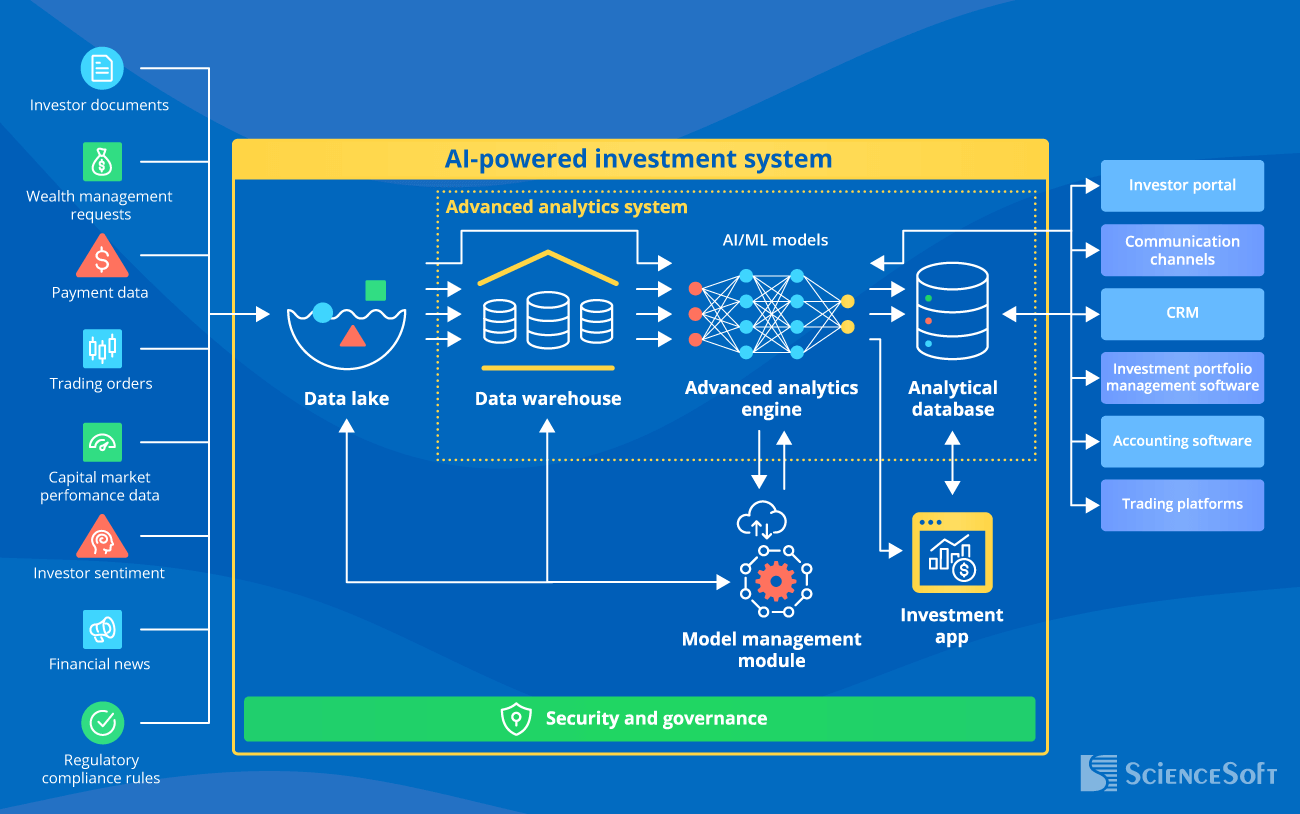
- Uploading investment-relevant data from the available sources to the data lake for storage and its instant transfer to the advanced analytics system for processing.
- Data preprocessing (sorting, filtering, enrichment, and cleansing) to improve its quality. Storing the structured, ready-to-analyze data in the data warehouse.
- AI model design, training, and tuning in the model management module (operated by data scientists).
- Analyzing investor profiles, portfolio performance, and capital market movements using an ML model. The model forecasts investor behavior and asset prices, prescribes portfolio optimization steps and profitable trading actions.
- Exporting analytical results to the analytical database for storage and to the model management module for model self-training.
- Communicating AI-based insights and AI-prescribed investment decisions to the relevant systems. Wealth managers and investors can access the analytical results via role-specific investment apps.
AI-based software integrates with:
- A wealth management company’s corporate systems (e.g., portfolio management software, CRM, an investor portal, an accounting system) and communication channels (email, messengers, etc.) to import relevant historical information and share investment-related data and decisions.
- Third-party data sources (financial data marketplaces, credit rating bureaus, banking systems, etc.; treasury software of institutional investors) to obtain available investment-relevant information.
- Trading platforms to automate asset trade execution.
Key features

Real-time investment data processing
Together with robotic process automation (RPA), deep learning, image analysis, and natural language processing technologies enable real-time aggregation and processing of multi-format, multi-channel investment-relevant data: investor documents, asset prices, stock indices, financial news, trading order heat maps, regulatory compliance rules, and more.

Predictive capital market analytics
AI continuously monitors the asset price fluctuation patterns, FX, interest, yield, and inflation rates, on-balance volumes, and other capital market performance indicators. It reveals dependencies between the indicators, predicts the market moves, considers investor sentiment, and delivers insights into emerging opportunities.

Investment portfolio planning
AI analyzes investors’ income levels, financial sustainability, risk appetites and tolerances, profitability goals, taxes, and investment histories. It suggests the proper portfolio composition (baseline asset allocation, investment duration, exposure limits, etc.) for each investor to maximize financial gains.

Investment strategy creation
AI drafts go-to investment strategies and plans taking into account user requirements. Based on the AI-generated suggestions, wealth managers can create tailored investment roadmaps for their clients, and investors can self-design trading journeys.

Portfolio optimization
AI enables real-time calculation and forecasting of all necessary performance metrics (total returns, exposures, weighted yields, average daily balances, value at risk, etc.) at the portfolio, investment, and asset class levels. It instantly spots potential risks and prescribes the optimal steps to balance and hedge the portfolio. ScienceSoft can implement AI for investment risk assessment.

AI analyzes live trading events, detects chart patterns and price change directions, and provides personalized investor guidance on the next best actions. AI for trading automation mimics investors’ behavior and can initiate position entering, adjustment, or exit when patterns signal the price trend shifts. ScienceSoft can build an AI assistant for investment transaction processing.

AI-guided customer acquisition
AI identifies the needs and preferences of target customers based on the analysis of the existing clients’ portraits, prospects’ web search histories, social media activities, and more. It suggests the investment products, outreach channels, and promotional messages that will most likely resonate with each target audience segment.

Automated investor communication
AI-enabled virtual assistants (chatbots, digital humans) instantly process investor queries and provide real-time responses in a human-like manner. They can automatically communicate portfolio performance to investors, request missing data and documents, inform clients about new investment products, and more. ScienceSoft can build an AI-powered virtual broker assistant for investment firms.

Intelligent KYC/AML verification
AI validates the identity, income, and risk data provided by investors against the data from third-party sources (e.g., credit rating platforms, bank systems). It qualifies investors against the geography-based KYC/AML requirements and screens the local sanction lists to avoid serving the blocked individuals and entities. ScienceSoft can develop an AI system for automating initial investor screening.

Fraud and non-compliance detection
AI analyzes real-time activities across investors’ accounts and instantly detects suspicious funds manipulations. It monitors investment compliance with relevant standards (SEC, FINRA, CMA, company-specific policies, etc.) and notifies the responsible parties and regulators about non-compliance cases. ScienceSoft can build AI agents for fund operations, reconciliations, NAV checks, and reporting.
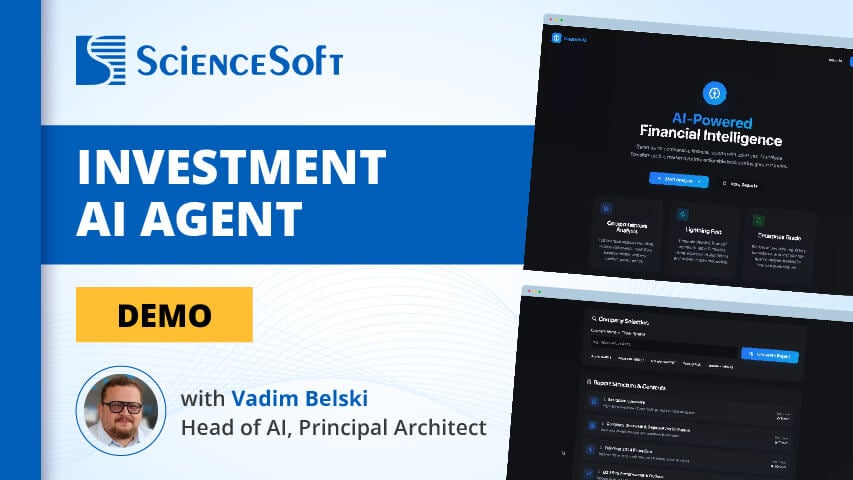
See How Agentic AI Transforms Investment Decision-Making
Watch how ScienceSoft’s AI Agent applies predictive analytics, NLP, and knowledge graph reasoning to uncover market insights and support smarter investment choices. Built on the LangChain framework and powered by OpenAI’s best-in-class LLMs, the agent boosts analyst productivity by over 50% and speeds up research by 70% while ensuring high-precision investment suggestions. ScienceSoft can integrate AI into the knowledge management system of a wealth management firm.
Technologies and Tools We Use to Build AI-Powered Investment Solutions
Generative AI
Models
- Large Language Models (LLMs)
- Small Language Models (SLMs)
- Multimodal models
- Computer vision models
- Image generation models
- ASR speech models
- TTS speech models
- Audio models
- Real-time
Model adaptation and efficiency
- Fine-tuning
- Instruction tuning
- LoRA adapters
- RAG
- Graph RAG
- Agentic workflows
AI platforms and services
- Azure OpenAI Service
- Amazon Bedrock
- Hugging Face Inference
- Oracle Cloud
- G42/Core42
Agents and Orchestration
- OpenAI Agents SDK
- OpenAI Agents
- AWS Agents
- LangChain
- LangGraph
- smolagents
- LiveKit
- Dify
- n8n
- Faiss
- ChromaDB
- Qdrant
- Weaviate
- OpenSearch
- Pgvector
- Amazon Neptune
- Graph RAG Toolkit
- Neo4j
Traditional ML
Platforms and services
- Azure Cognitive Services
- Azure Machine Learning
- Microsoft Bot Framework
- Amazon SageMaker AI
- Amazon Transcribe
- Amazon Lex
- Amazon Polly
- Google Cloud AI Platform
- Google Vertex AI
Frameworks and libraries
- Apache Mahout
- Apache MXNet
- Caffe
- TensorFlow
- Keras
- Torch
- OpenCV
- Apache Spark MLlib
- Theano
- Scikit Learn
- Gensim
- SpaCy
Addressing the Challenges of AI in Investments and Wealth Management
While 88%+ of wealth management service providers are pursuing AI initiatives, many still doubt AI’s ability to address certain operational and compliance aspects of investment and wealth management. Having decades-long expertise in AI development and investment digital transformation, ScienceSoft knows how to handle potential issues in a safe and pragmatic way.

Challenge #1: Insufficient trustworthiness of AI predictions
In the wealth management space, poor investment decisions can cause huge financial and reputational losses. It poses extremely high requirements for the accuracy of AI-delivered insights used for investment planning and hedging. The reality is that even ~80% precision of AI predictions can be hard to achieve.
Solution
Make sure you have a scalable and high-performing data management infrastructure. Being the cornerstone for deriving high-quality data from all the required sources and fast (often real-time) processing of this data, a robust data infrastructure lays the groundwork for reliable AI outputs. Our team can advise on the necessary infrastructure improvements and aid in establishing an AI-ready data management framework to ensure the smooth and accurate functioning of your intelligent investment solution.
Challenge #2: Opaque AI's decisioning logic
Wealth managers have a fiduciary responsibility to their clients and are legally obliged to provide a clear rationale behind their investment decisions. In case of AI-prescribed investments, achieving full transparency of decision-making logic may be a challenge, since most intelligent engines rely on highly sophisticated algorithms that are a ‘black box’ even for AI experts.
Solution
ScienceSoft’s AI Clients Share Their Experience



ScienceSoft’s team undertook the development of our AI-based software product from scratch and showed deep expertise in the .NET environment and AWS and Azure services. They delivered software on time and with the required quality. The team adhered to consistent communication and was proactive in offering beneficial product customizations for our clients.



ScienceSoft was to cover the end-to-end development of an intelligent invoice processing module for our product. The team used the microservices approach to ensure the system’s scalability, which is critical for us as our user base is growing. We were particularly pleased with neat alignment of the developed module with our requirements.


ScienceSoft’s team identified core errors that prevent efficient solution operations and implemented high-speed convolutional neural networks to fix them. They promptly developed new software functionality fully adhering to our requirements. We are satisfied with our cooperation with ScienceSoft and their skilled development team.
Costs of AI-Powered Software for Investments
Based on ScienceSoft’s experience, building a custom artificial intelligence solution for wealth management and investments may cost around $100,000–$1,500,000+, depending on the solution's complexity.
The major factors that affect the development budget and timelines are:
- The solution’s feature scope.
- The number and complexity of AI models.
- Performance, scalability, security, and compliance requirements for the software.
- The number and complexity of integrations.
- Requirements for the UX and UI of the investment application.
- The required development scope (MVP, a fully-featured solution).
- The sourcing model and team composition.
Here are some examples of ballpark estimates:

$100,000–$250,000
A niche AI/ML component (e.g., a risk analytics model, a signal detection algorithm, an execution optimization engine) integrated into the existing investment platform.

$250,000–$450,000
A generative AI copilot for investment specialists (advisors, brokers, portfolio managers, etc.). The underlying AI models are adapted to the investment firm’s specifics.

$600,000–$1,500,000+
A large-scale, AI-powered investment analytics system that uses traditional AI models and LLMs for predictive, prescriptive, and conversational support tasks. ScienceSoft can develop an AI conversational assistant for portfolio analysis and investor servicing.
Investment AI Consulting and Implementation by ScienceSoft
In AI implementation since 1989 and in investment software development since 2007, ScienceSoft delivers reliable AI solutions for investment and wealth management.
The value of our investment IT services is confirmed by one of the world's top 3 asset managers with $5+ trillion in AUM.

Consulting on AI for investments
Our consultants create a detailed feature set, architecture design, and tech stack for your AI solution and advise on security and compliance. You also receive a step-by-step roadmap for smooth and predictable AI implementation.

Implementation of AI for investments
With 750+ IT talents on board, we take charge of every development step, from ML model design and training to AI software integration with the required systems. You get a high-quality AI solution quickly and at the optimal cost.

About ScienceSoft's AI Practice
ScienceSoft is a global AI transformation and software development company headquartered in McKinney, Texas. We deliver tailored AI solutions for efficient wealth management and profitable investments. In our projects, we rely on robust quality management and security management systems backed up by ISO 9001 and ISO 27001 certifications.
