ScienceSoft Global



Artificial Intelligence (AI) for Insurance Underwriting
Capabilities, Architecture, Costs
ScienceSoft relies on 37 years of experience in AI engineering and 14 years in custom insurance software development to create accurate, regulator-ready AI solutions for insurance underwriting.

Contributors

Insurance IT & AI Consultant and Lead Business Analyst, ScienceSoft

Senior Insurance IT & AI Consultant, ScienceSoft

Principal Architect, AI & Data Management Expert, ScienceSoft
Insurance Underwriting AI: The Essence
Artificial intelligence for insurance underwriting drives a 65%+ reduction in underwriters’ manual routines and cuts the average underwriting decision time from days to minutes.
For complex policies, AI helps reduce underwriting cycle time by over 30% and improve risk assessment accuracy by, on average, 43%. ScienceSoft can implement AI for underwriting risk assessment in insurance. In addition, AI helps introduce personalized customer experiences and enables innovative underwriting models (e.g., behavior-based dynamic pricing) that commonly unlock up to 15% lift in revenue.
Large carriers can achieve up to a 30% improvement in portfolio performance and up to 3% better loss-ratios through AI’s ability to factor unstructured, previously inaccessible data into insureds’ risk profiles and underwriting decisions. ScienceSoft can build an LLM-based underwriting assistant that generates automated risk summaries.
AI for Insurance Underwriting: Market Info
The global market of AI in insurance is projected to grow from $14.99 billion in 2025 to $246.3 billion by 2035, exhibiting a CAGR of 32.3%. Underwriting is considered one of the largest use case segments for AI in insurance.
GlobalData names AI-assisted underwriting a key area of insurance innovation that has the potential to disrupt the entire industry. BCG, in its 2025 paper, estimates that 36% of total AI value for insurance can be captured across the underwriting function alone.
The main drivers for the popularity of AI-powered underwriting solutions are the growing demand for fast, efficient processing of large insurance data volumes, precise risk evaluation, and fair policy pricing.
How AI for Insurance Underwriting Works
Main use cases
-

Insurance application processing
- Automated intake of omnichannel insurance applications, data validation, and eligibility screening to free underwriters from tedious manual tasks and speed up quote issuance. ScienceSoft can build an AI assistant that supports underwriters with early eligibility screening.
- Intelligent application triaging to prevent underwriting leakage.
-
Risk assessment
- Fast and accurate quantification of client-specific risks to help underwriters properly price insurance and speed up policy issuance.
- Continuous capture and analysis of risk-relevant data from all available sources to proactively address loss risks and plan reserves.
-
- Matching the data provided by customers to the data available in relevant public sources. It helps spot identity fraud and document forgery and prevents illegitimate access to insurance services.
- Underwriter behavior analytics to identify non-compliant activity.



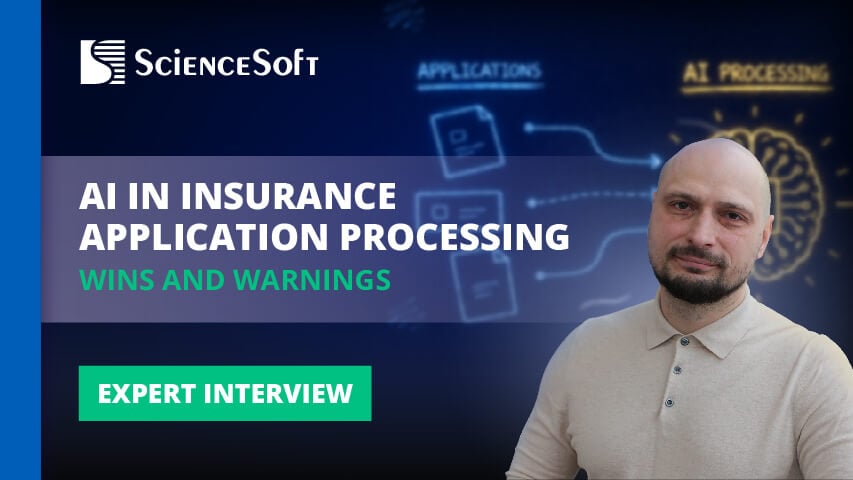
See How AI-Powered Application Intake Benefits Underwriting
Watch Vital Soupel, Senior Insurance IT & AI Consultant, outline how AI can streamline underwriting processes through automated application processing, document review, completeness checks, and decision support. ScienceSoft can provide AI-assisted decision support for underwriting in life insurance. In this video, he also explains why human-in-the-loop controls and strong audit trails are essential for trustworthy underwriting AI systems.
Key capabilities
Insurance carriers and MGAs have specific underwriting workflows and may need various degrees of AI-enabled process automation. ScienceSoft can automate insurance underwriting workflows using AI. In ScienceSoft's projects, we engineer underwriting AI solutions with unique functionality bound to each client's requirements. Here, we share a sample set of AI software capabilities we can deliver:
-

Automated data intake and processing
Intelligent image analysis, large language model (LLM), and big data processing technologies enable automated capturing and processing of insurance data in various formats: standard forms (e.g., ACORD, EDI), free-form digital text, handwritten notes, image, audio, video streams, IoT data feeds, and more.
-

Insurance application triaging
With the help of AI, insurance applications can be automatically prioritized for processing based on their expected profitability, urgency, and estimated time-to-quote. In addition, AI determines the applications that require a manual check and instantly routes them to the underwriters.
-
Risk analytics
AI offers data-driven evaluation and scoring of customer-associated economic, geopolitical, weather, and natural disaster risks. AI-powered forecasting models deliver accurate predictions on the probability of loss across particular clients, locations, periods, insurance types, etc.
-
Underwriting decision-making
AI analyzes customer documents and risk profiles and automates decision-making on insurance application approval or decline. For each approved application, AI recommends the most favorable insurance coverage terms (max amount, duration, etc.) based on the client’s risk score.
-
Insurance price optimization
AI automatically calculates the optimal insurance prices based on the analysis of complex non-linear dependencies between diverse loss risk factors, customer-specific price elasticity of demand, and profitability goals.
-
Dynamic insurance pricing
AI calculates the optimal personalized insurance prices based on real-time data on a policyholder’s health state and geographic location, driving behavior and traffic conditions, insured asset utilization and facility conditions, etc.
-
Automated communication
AI-powered virtual assistants can take over simple communication tasks that typically require underwriters’ involvement. For example, generative AI bots can request missing customer documents and communicate the estimated insurance price to the agent in a human-like manner.
-
Behavioral analytics
AI can spot customer fraud and non-compliant employee activities based on historical behavior patterns and fraud signals. It can enforce the optimal actions to mitigate the negative impact, for example, block the suspicious account or notify the employee’s supervisor.


Sample agentic AI workflows
The workflows below illustrate how specialized AI agents handle multi-step underwriting operations, access company-specific knowledge, validate outputs, and involve human experts when necessary.
Eligibility screening
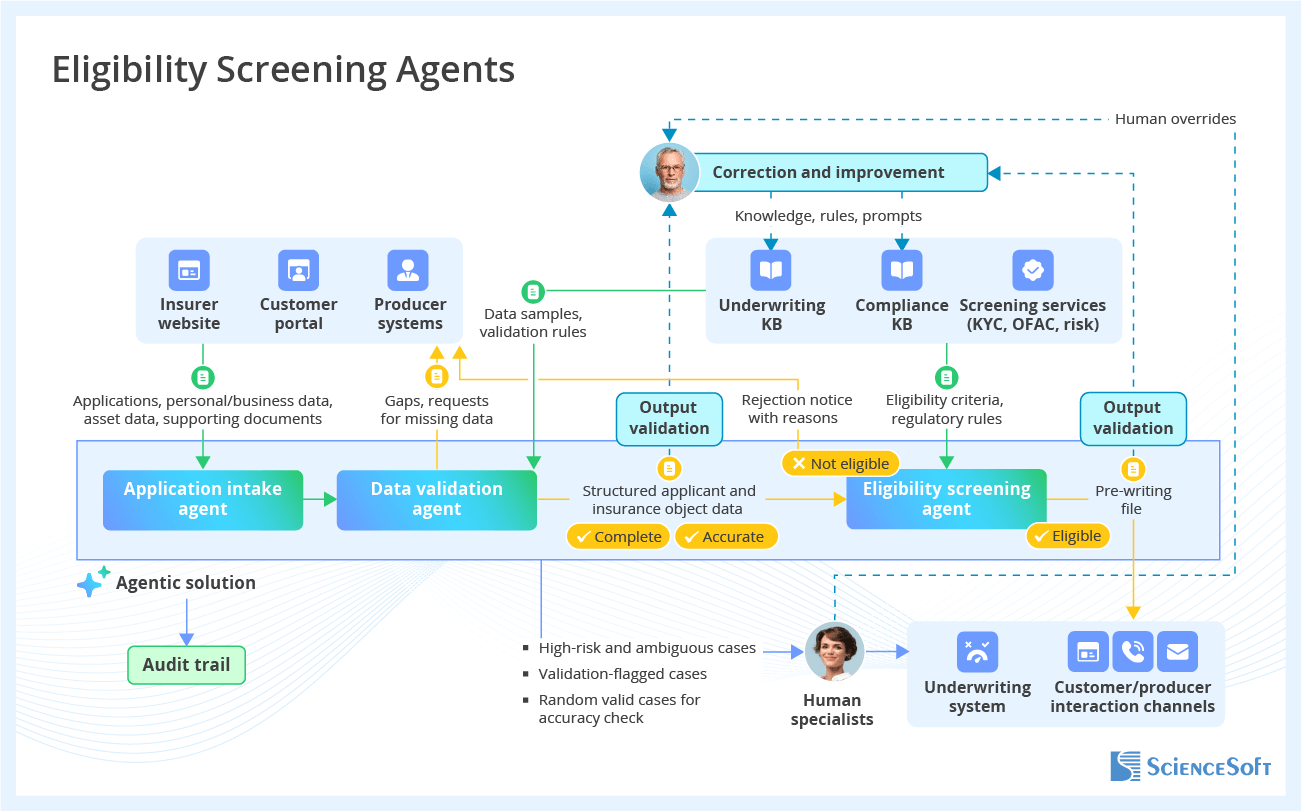
The application intake agent collects applications from insurer websites, customer portals, and producer systems. The data validation agent checks submission completeness and data consistency, identifies missing and inaccurate data, and requests additional information when needed. Once the application package is complete, the eligibility screening agent evaluates the submission against underwriting guidelines, internal compliance requirements, regulatory rules, and third-party databases (e.g., identity, sanctions, fraud). The agent generates a structured eligibility decision with clear rationales for every outcome.
Built-in validation mechanisms verify the reliability of agent outputs before they move to the next stage. Human underwriters review only high-risk, ambiguous, and validation-flagged cases and can override automated decisions when necessary. Feedback from human reviewers is used to refine prompts, business rules, and knowledge bases, driving continuous improvement of screening accuracy and decision consistency.
Risk assessment
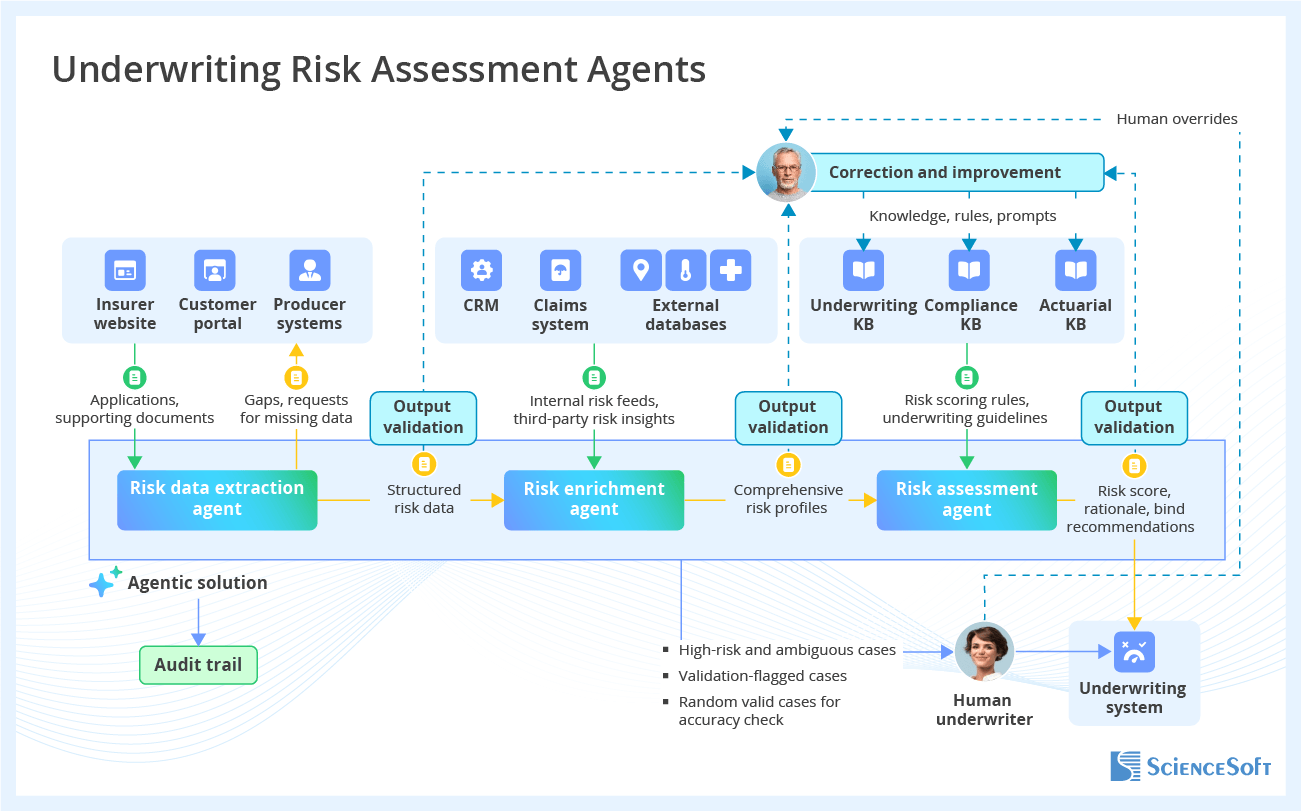
The risk data extraction agent retrieves and structures risk-related data from applications and supporting documents. The risk enrichment agent parses case-relevant data from the company’s internal systems (claims platforms, CRM) and external databases (e.g., asset, GIS, medical systems). The agents consolidate information into comprehensive risk profiles that provide a complete view of the applicant and the insured asset.
The risk assessment agent then analyzes these profiles using underwriting guidelines, actuarial models, compliance requirements, and risk-scoring rules. It generates risk scores, decision rationales, and binding recommendations. Multiple validation checkpoints ensure the reliability and consistency of outputs before recommendations reach underwriting systems. The agents escalate high-risk and complex submissions to human underwriters for review, while human feedback continuously improves AI-driven risk evaluation.
Architecture
Below, ScienceSoft’s consultants share a sample architecture of an AI-driven underwriting analytics solution with a traditional deep learning engine at its core, describing its essential components and the process of AI-assisted insurance underwriting. ScienceSoft can develop an AI-driven underwriting solution for life and health insurance.
Follow the links to explore how our architects extend this blueprint with large language models (LLMs) and agentic AI to automate data-intensive, judgement-heavy insurance underwriting operations in a safe and compliant way.
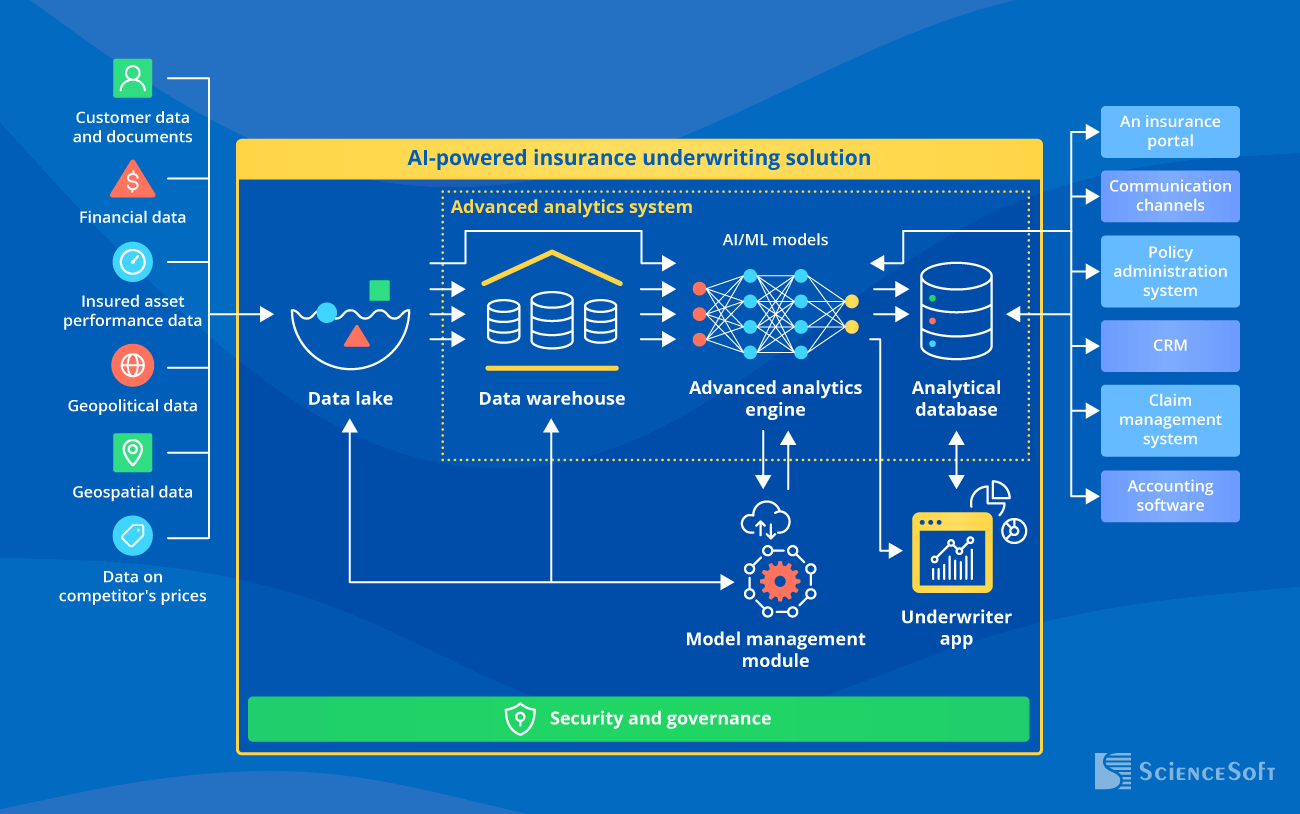
Key components and workflows for an AI-driven analytics insurance underwriting solution
An AI solution for insurance underwriting comprises the following components:
- A data lake stores structured and unstructured customer and risk-associated data and multi-format insurance documents pulled from the available sources.
- A data warehouse is needed to store the fully cleansed, structured, ready-to-analyze data.
- An advanced analytics engine has a pre-trained machine learning model (a neural network) at its core. ScienceSoft has expertise in auto insurance underwriting and machine learning, building AI-powered underwriting automation solutions. It analyzes complex dependencies between multiple loss and profitability factors and offers intelligent suggestions on optimal personalized insurance prices.
- An analytical database stores the analytical results and makes them available for further use (e.g., communicating pricing details to customers and agents, continuous AI model self-learning).
- An underwriter app with rich visualization capabilities enables underwriters to track and report the captured risk data and analytical results (exposure forecasts, price prescriptions, etc.).
- A model management module is used by data scientists to create, train, fine-tune, and monitor the performance of intelligent analytical models.
Such software integrates with:
- An insurer’s/MGA's corporate systems (e.g., CRM, claim management software, an insurance portal, a policy administration system) and communication channels (email, messengers, auto-dialing systems, etc.) to import relevant historical information and share underwriting-related data and decisions.
- Third-party data sources (credit rating bureaus, medical information bureaus, social security administration, etc.; the tracking systems of telematics providers, smart utility companies, etc.) to obtain available customer and risk-relevant information.
Hide
How Insurance Companies Benefit From AI for Underwriting
-

Large Commercial Insurance Carrier Benefits from Optimized Risk Pricing
In 2021, the Berkshire Hathaway Homestate Companies (BHHC), a US commercial insurance group with 50+ years in the domain, launched Z-FIRE, an AI-based wildfire risk assessment solution by ZestyAI.
The solution leverages 200B of diverse data points to produce commercial property-level wildfire risk scores. It relies on a proprietary AI model trained on 1,400+ wildfire events and historical loss data over a 20-year period.
With the help of AI, BHHC gets a comprehensive picture of a property’s true risk, which allows the company to improve the accuracy of policy pricing.
In 2022, BHHC expanded the use of Z-FIRE to further enhance its underwriting processes. The solution is currently used by BHHC’s underwriters in 12 wildfire-prone US states.
-

Underwriting AI Startup Raised $71M in 6 Years
An Israel-based insurtech startup Planck has developed an AI platform for commercial insurance underwriting.
The solution automates the entire insurance application processing cycle and helps generate personalized quotes in minutes rather than days. It captures and analyzes massive volumes of customer and risk-relevant data from thousands of sources and delivers comprehensive risk insights in <5 seconds. With intelligent recommendations on optimal application approval and quoting decisions, insurers get the opportunity to decrease loss ratios by 1–3%.
Planck raised $71 million in funding from 2016 to 2022. Today, the company operates globally and continues expanding its underwriting AI product range with innovative offerings.


Costs of AI-Powered Software for Insurance Underwriting

From ScienceSoft’s experience, developing a niche AI/ML component (e.g., a risk analytics model) on the existing underwriting platform may cost $100,000–$250,000.
An AI assistant for underwriting specialists, adapted to the organization’s specifics, may cost $250,000–$450,000.
A large underwriting automation system running on traditional AI and LLMs would require a budget of $600,000–$1,500,000+.
Want to understand the cost of your AI-powered software for insurance underwriting?
The major factors that affect the development budget and timelines are:
- The solution’s functional scope.
- The number and complexity of AI models.
- Performance, scalability, security, and compliance requirements for the software.
- The number and complexity of integrations.
- Requirements for the UX and UI of the underwriting application.
- The required development scope (PoC, MVP, a fully-featured solution).
- The sourcing model and team composition.
Challenges of AI for Insurance Underwriting — And Our Ways to Address Them
While 80%+ of insurance organizations are pursuing AI initiatives, many still doubt AI’s ability to address certain operational and ethical aspects of underwriting. But having decades-long expertise in AI implementation and insurance digital transformation, we know how to address these challenges.
Challenge #1: Potential biases in AI decisions
Training an underwriting artificial intelligence model to provide near-perfect risk profiling outputs may sometimes lead to overestimation of loss potential and insurance overpricing. It poses the risk of unintended discrimination against certain customers and may result in heavy legal penalties.
Solution
Solution
ScienceSoft recommends involving professional data scientists to design and train the underwriting AI model. They will help compose an appropriate training data set and accurately configure the model’s hyperparameters and initial weights to ensure that the model is not overfitted and is capable of producing ethical and explainable risk-based price suggestions.
Hide
Challenge #2: Decisioning based on outdated data
AI-powered underwriting systems need to instantly collect the latest risk-associated data to assess risks accurately, ensure appropriate insurance pricing, and take timely loss prevention measures. To achieve this, the software would need direct access to all relevant data sources (credit rating platforms, telematics platforms, weather tracking systems, etc.) and ingest new data as soon as it appears.
Solution
Solution
To obtain real-time insurance risk data, an underwriting system has to be seamlessly integrated with all relevant data sources. Secure APIs help promptly establish smooth integration between an AI-powered underwriting solution and multiple corporate and external data sources. Note that AI software connection to legacy back-office systems may require custom-built integrations. ScienceSoft can help with core system transformation and AI underwriting, with clear communication and proactive risk flagging.
Hide
Technologies and Tools We Use to Build AI-Powered Insurance Underwriting Solutions
Generative AI
Models
- Large Language Models (LLMs)
- Small Language Models (SLMs)
- Multimodal models
- Computer vision models
- Image generation models
- ASR speech models
- TTS speech models
- Audio models
- Real-time
Model adaptation and efficiency
- Fine-tuning
- Instruction tuning
- LoRA adapters
- RAG
- Graph RAG
- Agentic workflows
AI platforms and services
- Azure OpenAI Service
- Amazon Bedrock
- Hugging Face Inference
- Oracle Cloud
- G42/Core42
Agents and Orchestration
- OpenAI Agents SDK
- OpenAI Agents
- AWS Agents
- LangChain
- LangGraph
- smolagents
- LiveKit
- Dify
- n8n
- Faiss
- ChromaDB
- Qdrant
- Weaviate
- OpenSearch
- Pgvector
- Amazon Neptune
- Graph RAG Toolkit
- Neo4j
Traditional ML
Platforms and services
- Azure Cognitive Services
- Azure Machine Learning
- Microsoft Bot Framework
- Amazon SageMaker AI
- Amazon Transcribe
- Amazon Lex
- Amazon Polly
- Google Cloud AI Platform
- Google Vertex AI
Frameworks and libraries
- Apache Mahout
- Apache MXNet
- Caffe
- TensorFlow
- Keras
- Torch
- OpenCV
- Apache Spark MLlib
- Theano
- Scikit Learn
- Gensim
- SpaCy
Standards and regulations we adhere to
NAIC (including AI Principles and Model Bulletin), US state-level regulations (e.g., Colorado AI rules), NIST AI RMF, GLBA, NYDFS, CCPA, HIPAA (for health insurance), GDPR and AI Act (for the EU), IA (for the KSA), SOC 1/2, bank-grade model risk management practices (e.g., SR 11-7), and more.
Security mechanisms we work with
- Data protection: DLP (data leak protection), data discovery and classification, data backup and recovery, data encryption.
- Endpoint protection: antivirus/antimalware, EDR (endpoint detection and response), EPP (an endpoint protection platform).
- Access control: IAM (identity and access management), password management, multi-factor authentication.
- Application security: WAF (web application firewall), SAST, DAST, IAST (security testing).
- Network security: DDoS protection, IDS/IPS, SIEM, XDR, SOAR, email filtering, SWG/web filtering, VPN, network vulnerability scanning.
Underwriting AI Consulting and Implementation by ScienceSoft

Consulting on AI for insurance underwriting
Our consultants create a detailed feature set, architecture design, and technology stack for your underwriting AI solution and provide expert advice on cost optimization opportunities. You also receive a clear roadmap for risk-aware AI implementation.

Implementation of AI for insurance underwriting
As an AI transformation company with 750+ IT experts on board, we are ready to fully design and implement your custom AI underwriting software, taking charge of everything from engineering to integration to testing.
Why Build Your AI Solution for Insurance Underwriting With ScienceSoft
-
Since 1989 in AI consulting and implementation.
- Since 2012 in engineering custom software solutions for the insurance industry.
- Insurance IT and compliance consultants (NAIC, GDPR, IA, HIPAA, SOC 1/2, etc.) with 5–20 years of experience.
- 45+ certified project managers (PMP, PSM I, PSPO I, ICP-APM) who succeeded in large-scale projects for Fortune 500 firms.
- Principal architects with hands-on experience in designing complex insurance automation systems and driving secure implementation of emerging AI technologies.
- Established practices to ensure the high quality of insurance solutions and their delivery on the agreed timelines and budget, despite project constraints or uncertain requirements.








Our Clients on ScienceSoft’s AI Engineering Practices



ScienceSoft’s team undertook the development of our AI-based software product from scratch and showed deep expertise in the .NET environment and AWS and Azure services. They delivered software on time and with the required quality. The team adhered to consistent communication and was proactive in offering beneficial product customizations for our clients.



ScienceSoft was to cover the end-to-end development of an intelligent invoice processing module for our product. The team used the microservices approach to ensure the system’s scalability, which is critical for us as our user base is growing. We were particularly pleased with neat alignment of the developed module with our requirements.


ScienceSoft’s team identified core errors that prevent efficient solution operations and implemented high-speed convolutional neural networks to fix them. They promptly developed new software functionality fully adhering to our requirements. We are satisfied with our cooperation with ScienceSoft and their skilled development team.
Insights From ScienceSoft's Insurance IT Experts
-

Vital Soupel
Senior Insurance IT & AI Consultant, ScienceSoft

Trend watch
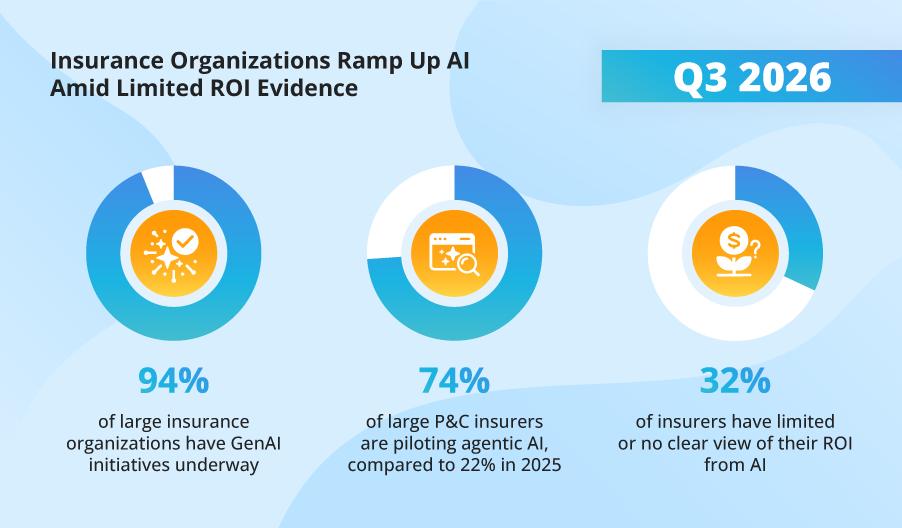
Q3 2026 Insurance AI Trends by ScienceSoft | October 2026
-

Olga Vinichuk
Insurance IT & AI Consultant and Lead Business Analyst, ScienceSoft
Technology overview
Bringing Smart Underwriting to Health Insurance
-
Olga Vinichuk
Insurance IT & AI Consultant and Lead Business Analyst, ScienceSoft
Technology overview
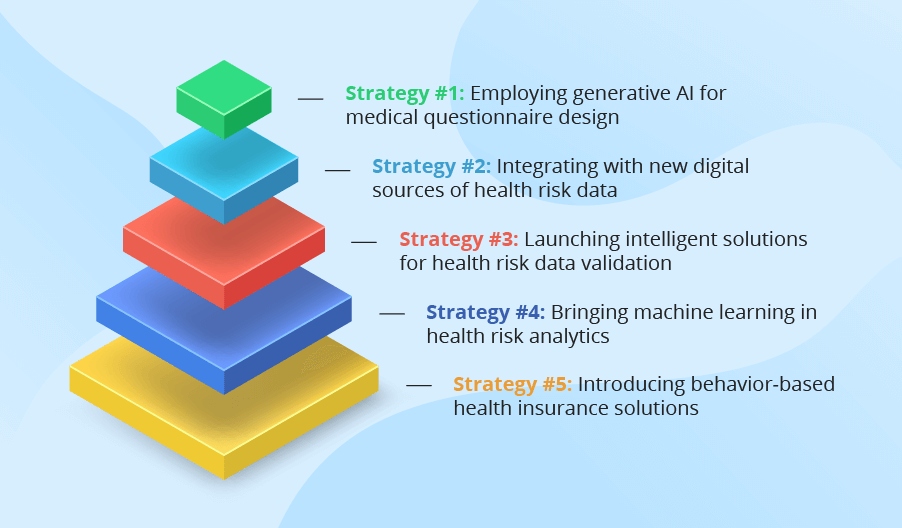
Ways to Boost Health Insurance Risk Assessment