 ScienceSoft Global



Insurance Policy Administration System
Features, Integrations, Benefits, Costs
In insurance software engineering since 2012, ScienceSoft helps insurance carriers design and build reliable policy administration systems tailored to their specific needs. ScienceSoft can develop a policy administration system for insurance carriers.

Insurance Policy Administration System: The Essence
An insurance policy administration system (PAS) automates administrative routines across the entire policy lifecycle, from issuance and endorsements to renewals or termination. ScienceSoft can automate policy lifecycle management for insurance carriers. It can record policy events, centralize policy document storage, and support ACORD-aligned policy data exchange workflows. ScienceSoft can build an MCP-compatible policy administration system.
Custom insurance policy administration software can effectively handle complex and unique policy management processes. ScienceSoft can build a policy administration system tailored to an insurance carrier's needs. Custom solutions are especially helpful for carriers with a broad and varied insurance product portfolio. ScienceSoft can build a modern policy administration system that automates policy lifecycle management and supports subscription-based models.
- Key integrations: CRM, an underwriting platform, claim management software, accounting software, etc.
- Implementation time: 9–12+ months for a custom insurance policy administration system. ScienceSoft can build a next-gen policy administration system for P&C insurance carriers.
- Development costs: $200,000–$600,000+, depending on the solution complexity. Use our online calculator to estimate the cost for your case.
Factors Driving the ROI for an Insurance PAS
Below, ScienceSoft outlines a range of important factors that help increase payback from the insurance administration solution:

Maximized automation
To eliminate time-consuming policy administration tasks like policy issuance, registering, updating, and renewal.
Customer, producer, and partner access
To minimize policy admin workload by enabling self-service access to policies for customers, brokers, agents, and claims execution partners.
System scalability
To smoothly handle periodic spikes and gradual growth in the volume of policy transactions.
No-code policy builder
To create templates for specific policy types like dental insurance, legal E&O insurance, or crop insurance.
Mobile support
To let insurance employees and policyholders access policy data and documents on the go.
Focus on security
To protect the system and data it stores there from malicious employee activities and external cyber threats.

Modern policy administration workflows depend heavily on standardized data exchange across carriers, producers, and external partners. Whether you build an enterprise policy platform or a commercial PAS, consider aligning automation with market-specific interoperability standards early in the design process to avoid inconsistent policy data structures, fragmented integrations, and inefficient information exchange. For example, PAS platforms for US P&C insurers would require alignment with ACORD standards, and systems for health payers would need compatibility with HL7, FHIR, and X12 EDI standards. ScienceSoft can build a modern PAS supporting US GAAP (ASC 944) and NAIC/state regulatory requirements for P&C insurers.
Key Features of an Insurance Policy Administration System
ScienceSoft helps insurance businesses define and implement the optimal functionality to meet each company’s unique policy administration needs. Here, we share a list of features that form the core of an all-encompassing insurance policy administration solution:

Policy quoting
- Automated aggregation and processing of requests for an insurance quote from multiple channels (an insurer's website, broker systems, email systems, third-party distribution platforms, etc.).
- Calculating personalized policy premiums based on underwriting inputs and user-defined pricing rules.
- AI-powered suggestions on the optimal premiums for each customer based on individual risk profiles and coverage scopes.
- Automated quote generation and submission to customers and producers.
- ACORD-aligned digital quoting workflows.

- Calculating premiums and taxes for each issued policy.
- Automated creation of one-time and recurring invoices and sending them to customers.
- Automatically generating and inserting QR codes and payment links in the invoices.
- Instant processing of premium payments via connected payment gateways.
- Support for various payment methods: bank transfer, card, check, digital wallet, etc.
- Real-time invoice tracking by status (sent, paid, past due, etc.).
- Dynamic, event-driven billing for usage-based and behavior-based insurance lines.

Policy issuance
- Automated capturing of policy issuance triggers (e.g., full or partial premium payment arrived from a customer) across the connected systems.
- Automated generation of insurance policies.
- Customizable policy templates for various locations, customer segments, and insurance types (health insurance, motor insurance, flood insurance, etc.).
- Standard forms (e.g., ACORD) for certificates of insurance and specialized evidence.
- Drafting non-standard policies using generative AI.
- Multi-currency and multi-language policies.
- Configurable policy approval workflow (collecting approvals of internal stakeholders and a customer).
- Policy e-signing using digital signatures.
- Scheduled and ad hoc policy submission to customers and producers.

Policy updating
- Rule-based and AI-assisted processing of customer requests for personal, business, and asset data changes.
- Data validation against trusted third-party databases (ID, employment, asset-specific, GIS, etc.).
- Automated policy updating with new customer data.
- Rule-based mass policy updating with new insurer data and changed product terms.
- Batch and personalized communication of mass policy updates to policyholders.
- Automated policy cancellation workflows.

Policy renewal
- Notifications to insurance teams and customers on policies approaching expiration dates.
- AI-supported generation and distribution of proactive customer proposals for policy renewal.
- User-defined rules for automated recalculation of insurance premiums and adjustment of coverage terms for renewed policies.
- Automated renewal quoting workflows.
- Policy renewal upon a customer’s request or renewal quote acceptance.
- Scheduled policy termination in case of quote rejection or premium non-payment.

Policy data management
- Centralized storage of policies and policy-related data: product specifications, policy terms, information about customers, customer interaction history, etc.
- Automated policy linking to the relevant customer and producer contracts.
- Search engine with filtering and metadata querying to navigate policy data and documents.
- Smart policy data search and navigation powered by large language models (LLM).
- End-to-end audit trail of employee and third-party manipulations across insurance policies.
- Permission-based policy access control.
- Policy data encryption.
- Compliance with case-relevant data protection standards: the NAIC Data Security Model Laws, CCPA, CPRA, GLBA, NYDFS (for New York), GDPR (for the EU), HIPAA (for health insurance), and more.

Self-service access to policies for third parties
- Secure access to policy data and documents for customers, brokers, agents, TPAs, adjusters, repair vendors, and other authorized third parties, enabled via role-based insurance portals and apps.
- Viewing policy information, coverage details, billing status, claims data, and related insurance documents.
- Submitting and tracking policy servicing requests: endorsements, renewals, cancellations, and more.
- Notifications about policy events, successful payments, missing documents, and compliance actions.
- Instant messaging to communicate with policy admins.
-
An AI-powered virtual assistant delivering 24/7 support across policy interactions, operational requests, and portal navigation.

Policy analytics and operational compliance
- Calculating and monitoring policy metrics like the number of policies issued by period, average policy amount, underwriting speed, new policies per agent, quotas vs. production, and more.
- Configurable analytical dashboards for various user roles: policy admins, agents, underwriters, risk analysts, etc.
- Scheduled and ad hoc reporting of selected policy KPIs.
- Automated drafting of regulatory reports.
- Statistical and AI-powered forecasting of customer demand for insurance coverage.
- Monitoring policy administration workflow compliance against internal rules and jurisdiction-specific regulations (e.g., NAIC and state DOI rules for US insurers, the Insurance Authority regulations for KSA carriers).
Important Integrations for Insurance Policy Administration Systems
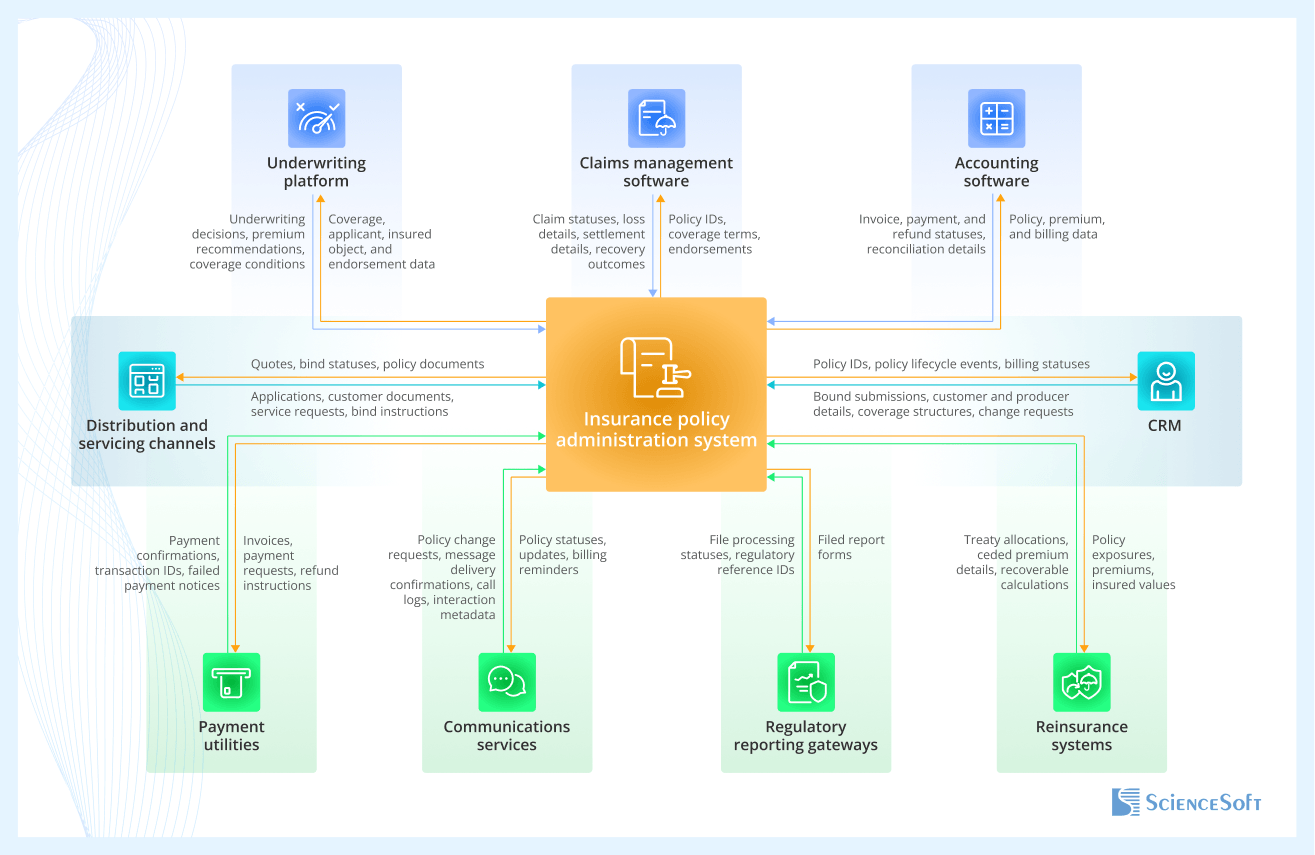
Distribution and servicing channels
The insurer’s website, customer portals and apps, agent and broker platforms, MGA portals, insurance marketplaces, etc.
To capture policy requests across channels, share personalized quotes and policy documents, and keep channel users updated on policy binding and servicing statuses.
To synchronize policy quoting, binding, and servicing with underwriting outcomes and simplify submission handling and underwriting progress tracking for policy admins.
Custom platforms or popular enterprise CRMs (e.g., Salesforce, Microsoft Dynamics 365).
To provide front-line and policy admin teams with a unified view of customer profiles and policy statuses, speed up policy issuance and customer-requested changes, and trigger policy renewal and servicing workflows.
To provide claims adjudication and settlement teams with accurate policy context and ensure claim outcomes are reflected in policy records and servicing workflows.
Payment utilities
Payment gateways, bank systems, specialized networks (ACH, e-check).
To automate premium collection, track real-time payment progress, and accelerate reconciliation.
To maintain accurate premium and billing records, share details on due and received payments, trigger billing reminders, and initiate interactions and terminations for delinquent accounts.
Communications services
Email, SMS, and messaging services, call center systems.
To automate customer and partner communications across the insurance policy lifecycle and enforce timely statutory notifications.
Regulatory reporting gateways
E.g., state DOI reporting channels.
To automate regulatory report submissions and simplify filing status tracking and audit readiness.
Reinsurance systems (for commercial and specialty carriers)
To synchronize policy and exposure data with reinsurers, automatically process ceded premium and treaty allocations, and track recoverables and reinsurance obligations.
How to Develop an Insurance Policy Administration System
Insurance policy administration software development is a way for companies to get tailored capabilities for efficient digitalization of their unique policy issuing, updating, and renewal workflows. Below, ScienceSoft's engineers outline key steps to build a custom PAS platform:
1
Business needs analysis and requirements engineering for a custom policy administration system.
2
Designing the practical functionality (including security and compliance features), architecture, technology stack, and UX and UI for policy administration software.
3
Development project planning: deliverables, team composition, schedule, budget, and risk mitigation steps.
4
Policy administration software engineering (from scratch or based on a selected low-code/enterprise platform).
5
Quality assurance of an insurance PAS platform, covering functional, performance, usability, and security testing.
6
Establishing integrations with the necessary internal and third-party systems (may involve developing custom APIs and connectors).
7
Insurance policy data migration from a previously used policy management platform or spreadsheets.
8
Drawing self-help materials (user guides, manuals) and conducting trainings for policy administrators.
9
(post-launch) Continuous support and evolution of a policy management solution.
Costs and Benefits of Insurance Policy Administration Software

From ScienceSoft’s experience, building a custom insurance policy administration system may cost around $200,000–$600,000+, depending on the solution’s complexity.
Want to know the cost of your tailored policy management solution?
Based on ScienceSoft's experience and industry case studies, tailored policy management software typically brings the following measurable benefits for midsized and large insurers:
Off-the-Shelf Software ScienceSoft Helps Implement
Below, we list the leading policy administration software market offerings and describe their capabilities and limitations. These products provide comprehensive functionality to meet the non-specific business needs across the automation of policy issuance, updating, and renewal tasks. ScienceSoft can build an AI agent for policy administration and servicing.

Oracle Insurance Policy Administration
Best for
Group insurance, including health insurance.
Features
- Template-based creation of insurance products.
- Setting up complex benefit plans for large groups and national accounts.
- Rule-based underwriting and policy updating.
- Support for dynamic quoting.
- Real-time access to policy data for employees and customers.
- Detailed audit trail of insurance transactions.
- Built-in task management functionality.
Cautions
Solution integration with your legacy internal systems is costly and time-consuming. Plus, the product may not provide compliance with the local regulations you’re subject to.

VPAS Policy Administration System by Infosys McCamish
Best for
Personal life and annuity insurance.
Features
- Automated creation and updating of insurance policies.
- Automated calculation of customer segment-specific premiums.
- Various billing methods: direct mail, EFT/ACH, credit and debit card, etc.
- Support for multiple currencies and languages.
- Tracking and reporting the essential policy metrics.
- Instant messaging for internal teams and customers.
- Compliance with AML and OFAC requirements, GLBA, SOX, and more.
Cautions
The product provides limited customization capabilities. Also, it doesn’t cover quoting and rating functionality.
When to Opt for a Custom Insurance Policy Administration System
ScienceSoft recommends building a custom policy management solution in the following cases:
|
|
You need software providing specific functionality, e.g., AI-assisted policy review or blockchain-based policy recordkeeping. |
|
|
You need a solution providing compliance with all required legal regulations, including local regulations. |
|
|
You want to leverage enhanced security of policy-related data and documents. |
|
|
You need a system that can be easily evolved with new functional and non-functional capabilities. |
|
|
You want smooth and cost-effective integration of insurance policy management software with your corporate tools. |
|
|
You have large teams involved in policy administration workflows and want to avoid high subscription costs for off-the-shelf products, which scale as the number of users grows. |

Insurance PAS Development Services by ScienceSoft

Consulting services
- Analysis of insurance policy administration needs.
- Suggesting optimal features, architecture, and tech stack for an insurance policy administration system.
- Preparing a plan of integrations with the required internal and third-party systems.
- Consulting on security and compliance.
- Implementation cost & time estimates, expected ROI calculation.

End-to-end development services
- Insurance policy administration needs analysis.
- Software conceptualization and architecture design.
- Policy administration system development.
- Integrating the solution with the required systems.
- Quality assurance.
- User training.
- Post-launch continuous support and evolution.
Why Build Insurance Policy Management Software With ScienceSoft
-
Since 2012 in engineering custom software solutions for the insurance industry.
- Insurance IT and compliance consultants (NAIC, NYDFS, CCPA, GDPR, etc.) with 5–20 years of experience.
- 45+ certified project managers (PMP, PSM I, PSPO I, ICP-APM) who succeeded in large-scale projects for Fortune 500 firms.
- 9 principal architects with hands-on experience in designing complex insurance automation systems and driving secure implementation of AI technologies.
- 350+ software engineers, 50% of whom are seniors or leads.
- Established practices to ensure the high quality of insurance solutions and their delivery on the agreed timelines and budget, despite project constraints or uncertain requirements.









Our Clients Say


ScienceSoft demonstrated a deep understanding of our requirements, and their insurtech developers needed minimal supervision.
What stood out was ScienceSoft's proactive suggestions for cost-saving architecture design and tech stack solutions. Their input ensured we stayed within budget without compromising on software quality. The value we derived from partnering with ScienceSoft is definitely worth the investment.


Partnering with ScienceSoft has been an excellent experience. Their team transformed our underwriting platform into a well-oiled machine. They identified and fixed several longstanding issues that had been causing us persistent difficulties. Their communication was exemplary; unlike our previous experiences with outsourcing, we never had to chase them for updates, and they were always prompt in responding to our queries.

Damien Sewell
Head of IT Projects

ScienceSoft’s quick buy-in and readiness to take the initiative made the project faster and less stressful for everyone involved, from Capital IM’s insurance specialists to leadership. At the end of a short yet highly productive two months, we got a secure and wholly owned property insurance solution that is fully adapted to Capital IM’s corporate practices and brand book. We couldn’t have asked for a better IT partner.









About ScienceSoft
ScienceSoft is a reliable software development company that builds policy administration systems for insurers. Since 2012, we have been helping insurance companies implement effective policy administration solutions. Being ISO 9001- and ISO 27001-certified, we apply a mature quality management system and guarantee that cooperation with us does not pose any risks to our clients’ data security.
