ScienceSoft Global


Artificial Intelligence for Virtual Front Door and Triage
Use Cases, Architecture, Costs
ScienceSoft is an AI transformation company that helps healthcare providers implement AI-powered virtual front door and triage solutions. We combine experience in healthcare IT since 2005 with AI expertise dating back to 1989.
Contributors

Senior Healthcare IT & AI Consultant, ScienceSoft

Senior Solution Architect, Healthcare, ScienceSoft
AI for Virtual Front Door and Triage: Essence
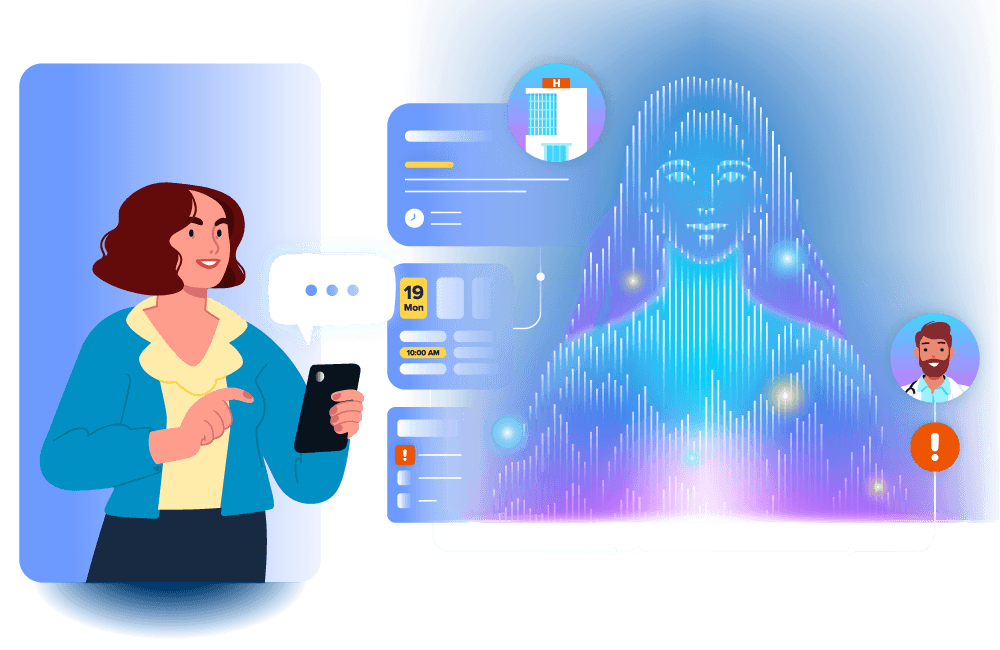
An AI-powered virtual front door is a digital entry point to healthcare services that uses conversational AI to understand patient requests and guide interactions through chat or voice. It can range from a simple chatbot that answers common questions to an AI assistant that connects with hospital systems to book appointments, check insurance coverage, and collect patient information.
What an AI Front Door May Look Like
-

Simple: AI for patient information
A chatbot or voice assistant answers questions about services, hours, and navigation using an approved knowledge base. It requires no access to patient records or transactional systems.
Reported results: Catholic Health's AI voice assistant for patient portal support resolved 57% of patient support calls without staff involvement and reduced outsourced call center workload by 50%.
-
Intermediate: AI agent for patient self-service
An AI agent connects to clinical or administrative systems to complete defined tasks, such as verifying patient identity, scheduling appointments, or checking eligibility. It can handle several related tasks, but within a bounded scope.
Estimated outcomes: 40% faster appointment booking and 50% lower scheduling costs, based on ScienceSoft's AI voice scheduler project.
-
Advanced: Integrated AI front door for patient access and triage
An integrated AI solution coordinates multiple patient access and intake workflows across departments, facilities, and channels. It can manage cross-team handoffs, support symptom intake, and escalate clinical concerns to qualified staff with structured summaries.
Estimated outcomes: 20–40% less administrative time per patient access request and 15–30% less clinical staff time per intake.


Front Door Tasks AI Can Handle
-
Administrative Q&A and facility navigation
Conversational AI retrieves information from an approved organizational knowledge base to respond to questions about visiting hours, required documents, directions, and parking. The knowledge base can be updated as hospital policies or facility information change.
-
Appointment booking, rescheduling, and cancellation
An AI assistant can understand flexible scheduling requests, such as "I'd like to move my appointment to a morning next week," and find matching appointment slots in connected EHR, practice management, or scheduling systems. It can also help verify patient identity by collecting identifying details, such as the patient's name, date of birth, and Social Security number, and checking them against hospital records along with any additional information required by the hospital. Once the patient selects and confirms an available slot, the assistant can complete the booking or change.
-
Patient registration and pre-visit intake
Conversational AI collects or updates patient demographics, contact and insurance details, medical history, and visit-specific information. It can extract data from uploaded documents, ask follow-up questions to fill gaps, and prepare structured records for review or entry into connected systems.
-
Insurance and eligibility assistance
AI can use available patient and insurance information to check coverage through connected payer services and explain eligibility results in plain language. Unclear results or questions requiring insurance expertise are referred to staff.
-
Symptom assessment and triage support
Conversational AI collects symptom information, asks relevant follow-up questions within provider-approved protocols, and prepares structured summaries for clinical review. Predefined rules flag concerning symptoms (e.g., chest pain) and trigger escalation to qualified staff rather than allowing the language model to determine patient acuity.
-
Human handoff with context
AI recognizes requests it cannot safely or reliably complete and prepares a summary of the patient's needs, information collected, and reason for escalation. The system transfers the case to the appropriate team, reducing repeated questions and manual information gathering.


Define what AI can handle independently
Whether you're planning an AI front door or expanding an existing solution, start by identifying which patient access tasks AI can complete independently and which require human judgment. Routine administrative requests, such as scheduling and information lookup, are generally easier to automate. Clinical triage is different: AI can collect symptoms, find predefined red flags, and prepare summaries for nurses, but it shouldn't independently make triage decisions. Define these boundaries and escalation rules with clinical staff. When stakeholders can see this boundary clearly, they stop worrying that AI will replace their judgment, and the conversation shifts to how much administrative work it can take off their plate instead.
How AI for Virtual Front Door and Triage Works
Consider a typical patient call to the front desk. The patient wants to reschedule an appointment, keep the same doctor, get directions via text, and receive a reminder before the visit. Then they remember another commitment and change their preferred appointment time midway through the conversation.
A front-desk employee would likely see this as a single request. But an AI assistant would need to coordinate several operations across scheduling, patient records, messaging, and other connected systems to fulfill it.
Below, ScienceSoft's experts illustrate how such an architecture can work for an AI-powered virtual front door.

At the center is an orchestrator that coordinates the conversation and decides what should happen next. It directs each task to the appropriate specialized agent or workflow and keeps track of the conversation as the patient's requests change. For example, it can move from appointment rescheduling to directions and reminders without making the patient repeat information. If a request falls outside the AI's approved scope, the system cannot understand it, predefined rules flag an urgent symptom, or the patient asks to speak to a person, the orchestrator routes the interaction to the appropriate staff with the information already collected.
Each specialized agent is responsible for one specific task or workflow, such as scheduling, insurance, or billing; the agent follows predefined rules and can access only the systems needed for that task. This makes the solution easier to control and test and reduces the chance that AI will act outside its assigned role.
The architecture also includes shared controls, such as prompt guardrails, content filtering, and escalation rules, to keep AI interactions within approved boundaries. Monitoring and analytics help providers track how patient requests are handled, identify recurring problems, and assess where staff intervention is needed. Staff corrections and overrides provide valuable feedback for improving AI behavior, routing rules, and workflows.
Design human escalation paths before building the AI itself
Work with patient access and clinical teams to identify situations that require human intervention, such as urgent symptoms, unresolved insurance questions, or requests to speak with a person. Define who should receive each request type, how to transfer it, and what happens if the responsible staff member is unavailable. Make sure staff receive enough context to continue the interaction without starting over. If nurses receive a structured ISBAR summary that they can act on within seconds, adoption will be smooth. If they get only raw chat transcripts, they will fight the system.
Technologies We Use to Implement AI for Virtual Front Door and Triage
Generative AI
Models
- Large Language Models (LLMs)
- Small Language Models (SLMs)
- Multimodal models
- ASR speech models
- TTS speech models
- Speech-to-Speech Models
- Audio models
- Real-time
Model adaptation and efficiency
- Training from scratch
- Data design
- Data labelling/annotation
- Fine-tuning
- Instruction tuning
- LoRA adapters
AI platforms and services
- Azure OpenAI Service
- Microsoft Foundry
- Amazon Bedrock
- Google Vertex AI
- Google AI Studio
- Hugging Face Inference
- Oracle Cloud
- G42/Core42
- NVIDIA AI Enterprise
Agents and orchestration
- RAG
- Graph RAG
- Agentic workflows
- OpenAI Agents SDK
- OpenAI Agents (platform/guides)
- AWS Agents
- Claude Agent SDK
- Google Agent Development Kit (ADK)
- Microsoft 365 Agents SDK (Copilot Studio)
- OpenClaw
- LangChain
- LangGraph
- smolagents
- LiveKit
- Dify
- n8n
- Faiss
- ChromaDB
- Qdrant
- Weaviate
- OpenSearch
- Pgvector
- Amazon Neptune
- Graph RAG Toolkit
- Neo4j
Healthcare-specific language models
- MedGemma
- MedLM
- BioMedLM
Traditional ML
Platforms and services
- Azure Cognitive Services
- Azure Machine Learning
- Microsoft Bot Framework
- Amazon SageMaker AI
- Amazon Transcribe
- Amazon Lex
- Amazon Polly
- Google Cloud AI Platform
- Google Vertex AI
Frameworks and libraries
- Apache Mahout
- Apache MXNet
- Caffe
- TensorFlow
- Keras
- Torch
- Apache Spark MLlib
- Theano
- Scikit Learn
- Gensim
- SpaCy
Key Challenges of Implementing AI for Virtual Front Door and Triage
Challenge #1: AI may try to handle a clinical situation that should be escalated.
Solution
ScienceSoft designs AI workflows with an explicit separation between autonomous administrative work and clinical decision-making. Provider-approved stop rules can trigger immediate escalation for defined red-flag symptoms, such as chest pain, difficulty breathing, or sudden numbness or weakness on one side of the body. In addition, a general uncertainty rule should apply: when the system cannot confidently classify or understand a situation within its approved scope, it hands the interaction to staff rather than guessing. Patients should also have a clear path to request a human representative directly.
Before launch, designated clinical experts should help define and approve escalation rules. After deployment, the AI operations team should monitor interactions and escalation logs, flag potential issues for clinical review, and work with clinical experts to refine the rules when needed.
Challenge #2: AI may fail to understand what a patient says or wants.
Solution
ScienceSoft tests AI assistants against realistic, multi-intent patient conversations rather than only ideal scripted requests. Test scenarios should include incomplete information, changes of mind, colloquial language, ambiguous requests, and cases where an administrative conversation turns clinical.
The assistant should be able to repeat back what it understood, confirm actions before executing them, maintain previously collected context, and adjust when the patient changes a request. When intent remains unclear, or confidence is insufficient, the assistant should ask for clarification or hand the interaction to staff rather than guess.
Clinical and patient access staff should participate in scenario design and review before production rollout.
Challenge #3: AI may expose PHI or access more patient data than necessary.
Solution
ScienceSoft starts by tracing where PHI may travel and be stored across the AI front door, including hospital systems, integrations, AI services, and conversation logs. For each workflow, we define what patient information AI can access. Before sharing patient-specific information or changing a patient record, the system verifies the patient's identity and access rights. AI then retrieves only the data needed for the request through integrations with restricted permissions. For example, an appointment assistant can retrieve scheduling details without accessing the patient's full medical record. These restrictions are enforced by software, not left to the AI model to decide. We also test whether AI could disclose sensitive information to unauthorized users.
To prevent PHI from reaching unapproved services or environments, we establish where patient data may be processed and stored before selecting AI models and vendors. Depending on the provider’s requirements, this may mean using HIPAA-eligible cloud services covered by appropriate business associate agreements (BAAs) or keeping AI processing within the hospital's approved cloud or on-premises environment. Where possible, we remove or mask unnecessary identifiers before sending data to AI models. We also check vendor policies on data retention, processing location, and model training, and configure integrations, logs, and monitoring tools to avoid unnecessary PHI exposure or storage.
Challenge #4: AI performance may degrade as real-world patient interactions change.
Solution
After deployment, hospitals should regularly check whether AI continues to handle patient requests correctly, follow approved rules, and escalate situations that require human intervention. Real-world conversations may reveal problems that did not emerge during pre-launch testing.
To monitor performance, ScienceSoft can build automated checks into the AI front door or connect it to existing monitoring tools. These checks compare recorded actions and their outcomes against predefined rules. For example, they can flag an appointment that AI confirmed as booked even though the scheduling system reported a failure, or a requested transfer to staff that did not go through.
Designated staff can investigate flagged cases and periodically review samples of other interactions to check whether AI correctly understood patient requests, recognized symptoms requiring clinical escalation, and verified patient identity before disclosing sensitive information. Reviews should focus more heavily on higher-risk workflows, such as symptom intake and clinical escalation, while routine requests, such as questions about hospital hours or locations, may need less frequent human review.
When reviews reveal problems, ScienceSoft can help correct the relevant rules or AI behavior, test the changes, and monitor their effectiveness after deployment.
Costs of Implementing AI for Virtual Front Door and Triage

The cost of implementing AI for virtual front door and triage typically ranges from $150,000 to $700,000+ . These ranges cover solution design and implementation and exclude infrastructure and hosting expenses, third-party licenses, AI model/API usage, and other ongoing operating costs.
At the lower end of the scope, a provider may start with an AI assistant for administrative Q&A, facility navigation, and a limited set of scheduling workflows in one channel. A larger implementation may include real-time voice AI, multichannel patient access, scheduling, eligibility, identity verification, and governed symptom intake with clinical escalation.
Want a more precise estimate?
Key cost drivers include:
- The number and complexity of patient access workflows that will incorporate AI.
- The number of patient access channels.
- Whether real-time voice conversations with AI are necessary.
- The number and complexity of integrations.
- Multilingual requirements.
- Security, PHI protection, auditability, and compliance requirements.
- Quality monitoring and human review requirements.
- Expected volume of calls, chats, and transactions and the respective solution performance requirements.
- The selected cloud, on-premises, or hybrid deployment model.
Why Choose ScienceSoft as Your Healthcare AI Partner
- In healthcare IT since 2005.
- In AI since 1989, with experience building custom AI models and adapting pretrained models to healthcare use cases.
- 750+ experts, including AI architects, MD consultants, software developers, data scientists, cybersecurity experts, integration specialists, and QA engineers.
- 150+ healthcare IT projects and an in-house PMO for predictable project delivery.
- An Architecture & Solutions Center of Excellence to design secure, scalable, and integration-ready healthcare AI architectures.
- Proficiency in HL7 v2/v3 and FHIR.
- Experience supporting compliance with HIPAA/HITECH, GDPR, Saudi PDPL, and other privacy frameworks.
- Security and quality management practices backed by ISO 27001 and ISO 9001 certifications.
Certifications, partnerships and awards
-

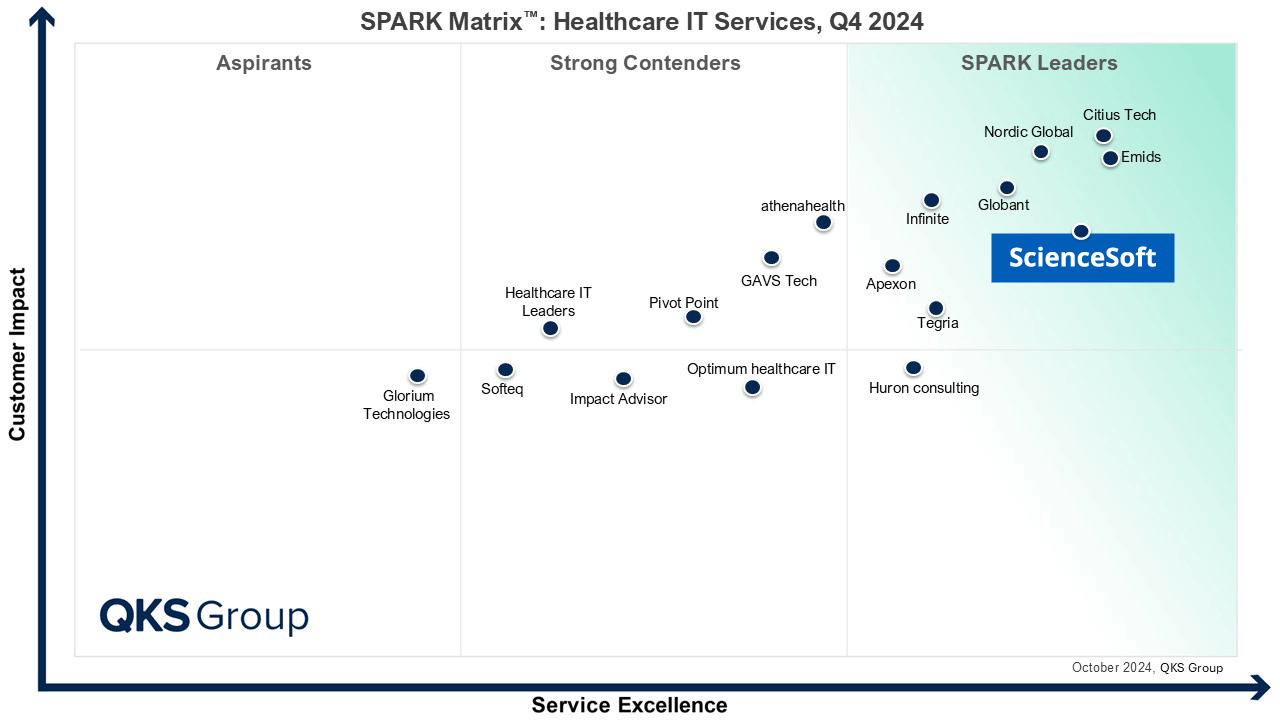
Featured among Healthcare IT Services Leaders in the 2022 and 2024 SPARK Matrix
-

Named among America’s Fastest-Growing Companies by Financial Times, 5 years in a row
-

Claude Certified Services Partner


-

Microsoft Solutions Partner for Data & AI
-

HTN Now Awards 2025/26 finalist in the Best AI Scribe Solution category
-

Recognized for Healthcare Technology Leadership by Frost & Sullivan in 2023 and 2025
-

HIMSS Gold member advancing digital healthcare
-

ISO 13485-certified quality management system
-

ISO 27001-certified security management system





What Our Clients Say


They are reliable, thorough, smart, available, extremely good communicators and very friendly. We would recommend hiring ScienceSoft to anyone looking for a highly productive and solution-driven team.



Working with ScienceSoft was a pleasure from A to Z. We are grateful for their can-do attitude, responsiveness, and straightforward communication.

Todd Nilson
MD

We are thankful for the meticulous and value-driven approach of ScienceSoft’s team. ScienceSoft proved to be a reliable vendor with a solid healthcare background, and we recommend them to everyone looking for a telehealth software development partner.