 ScienceSoft Global



Agentic AI in Healthcare
Workflow Automation Use Cases and Development Due Diligence
As an AI transformation company, ScienceSoft helps healthcare organizations implement agentic AI solutions that reduce manual workflow burden and fit healthcare requirements for PHI protection, interoperability, and auditability.
Contributors

Head of AI, Principal Architect, ScienceSoft

Senior Healthcare IT & AI Consultant, ScienceSoft
Agentic AI in Healthcare: the Essence
In healthcare, agentic AI refers to intelligent software that can plan and execute multi-step clinical and administrative workflows across connected systems (for example, scheduling appointments, running prior authentication checks, or triggering follow-up). This is a step up in complexity from single-purpose AI tools (e.g., generative AI chatbots or medical image analysis models), which have limited functionality within a single application. Agentic AI may use both GenAI and traditional machine learning models as its building blocks, but its defining feature is the ability to autonomously coordinate and execute workflow steps across systems.
Agentic AI in healthcare is rarely just one large language model acting alone: it’s usually a mix of technologies working together. GenAI helps with content-related tasks like summarizing records, drafting letters, and preparing patient communications. Traditional machine learning handles predictions and pattern detection, like identifying patients at risk of readmission, detecting potentially fraudulent claims, or forecasting appointment no-shows. Deterministic rules provide guardrails by enforcing eligibility requirements, permissions, routing logic, and compliance constraints.
What keeps these parts controlled is orchestration. The orchestration layer breaks a workflow into steps, calls the right tools or agents, tracks case status, applies approval rules, and escalates exceptions to staff. In prior authorization, for example, orchestration connects clinical data retrieval, payer rule checks, draft generation, submission tracking, and human review into one governed workflow.
Agentic AI Adoption in Healthcare
As healthcare organizations continue to seek ways to reduce manual follow-up without losing control over sensitive decisions, agentic artificial intelligence is emerging as a viable approach to workflow automation. Agentic AI is still less widespread in healthcare than generative AI, but dedicated surveys show active early adoption. In a McKinsey survey of US healthcare organizations, 19% of surveyed organizations say they have reached a mature stage of agentic AI adoption, and 51% are pursuing proofs of concept. Deloitte also notes that healthcare leaders are increasing investment in agentic AI as they work to scale beyond pilots.
For healthcare organizations, agentic AI often takes the form of agents embedded into EHR, RCM, CRM, scheduling, or contact center platforms. The strongest adoption areas are those with heavy manual follow-up, such as prior authorization, patient access, and care coordination. What makes these areas suitable for agents is the need to keep cases moving across systems, queues, and external parties, rather than simply drafting or summarizing information.
The strongest adoption drivers are tied to operational pressures rather than broad digital experimentation:
- Costs. Agents can reduce avoidable administrative effort, call-center volume, claims rework, and payer-related workload.
- Staff capacity pressure. Agents can absorb repetitive work that would otherwise require more administrative staff, nurses, or care coordinators.
- Patient access bottlenecks. Agents can help patients get to the right service faster when call queues, scheduling delays, or referral backlogs slow down appointment booking and care navigation.
- Burnout. Agents can reduce follow-up, inbox work, and documentation-related workload for admin staff and physicians while keeping human review where necessary.
Recent case studies suggest that agentic AI pays off the fastest in high-volume, rules-heavy workflows with clear system handoffs, measurable baselines, and limited clinical risk. However, these results are vendor-backed and should not be treated as universal benchmarks: actual ROI will depend on workflow volume, AI integration depth, approval rules, baseline staffing costs, and other factors.
- Prior authorization: Ascertain and The Oncology Institute reported a 95% authorization workload reduction after deploying a near-touchless AI workflow for oncology prior authorizations across TOI clinics.
- Patient access and call center automation: Hyro reports that Inova Health achieved 8.8x ROAI after deploying voice AI for appointment management, routing, FAQs, provider and location search, and prescription refill requests. Baptist Health reported nearly $1 million in savings within three months after using AI agents for scheduling, password resets, smart routing, and IT help desk workflows.
How Agentic AI Can Be Applied in Healthcare
The use cases below are practical starting points for agentic AI because they let healthcare organizations automate bounded parts of everyday workflows without handing over sensitive decisions to AI. ScienceSoft can add agentic AI capabilities to your existing EHR, RCM, CRM, scheduling, or contact center software, build a workflow-specific module, or develop an integrated standalone solution.

AI agents can check payer requirements, collect supporting records, prepare submission packets, track authorization status, and flag denials or exceptions for staff review before final submission or appeal action.

Patient access and request resolution
A patient access agent embedded in a portal or a call center can handle routine scheduling, identity checks, intake updates, request confirmations, and status questions, while routing high-risk or unclear cases to staff.

Referral management
A referral agent can assemble required records, check specialist requirements, monitor referral status, and flag missing information or stalled referrals before they turn into leakage.

Care coordination and follow-up
A care coordination agent can turn discharge instructions, care plans, and visit summaries into trackable follow-up tasks and reminders and escalate missed responses, updates, or protocol exceptions to the care team.

Clinical work queue automation
A work queue agent can triage inbox items, summarize context, detect duplicates, route tasks, and prepare drafts for review, while orders, abnormal results, diagnoses, and treatment decisions remain with clinicians.

Revenue cycle task automation
A revenue cycle agent can help staff check eligibility, resolve claim edits, track payer responses, request missing documentation, route denial follow-ups, and update case progress across RCM systems and payer portals.
What Goes Into a Healthcare Agentic AI System
Agentic AI solutions usually do not need every component to be built from scratch. You can often use cloud AI services, existing healthcare platforms such as Epic and Oracle, and data and rules already stored in your clinical or operational systems. The key question is what must be adapted to your workflows, approval rules, and constraints.

Orchestration layer
This is often the custom part of an agentic AI solution. It coordinates workflow steps, tool calls, case context, and handoffs between specialized agents in multi-agent systems. You can use off-the-shelf platforms by vendors like AWS and Microsoft to set up orchestration, but healthcare-specific approval logic and exception paths often need tailoring.

System connectors and tool calls
Some integrations can use standard APIs or existing platform connectors, while others require engineering around EHR, RCM, CRM, scheduling, contact center, or payer systems. Custom work is usually needed to expose only the right actions to the agent, support data integration, normalize data between systems, handle failed calls, and log every read or update.

Rules and workflow logic
Healthcare organizations usually already have payer protocols, task routing rules, service policies, SLAs, and access permissions. Software engineers and business analysts turn these rules into executable workflow logic that the agent can follow consistently across cases.

GenAI and machine learning (ML) components
You can integrate ready-made AI models via cloud services such as Azure OpenAI or Amazon Bedrock, or deploy certain models in a private cloud or on premises for extra security. Custom work will be needed to adapt prompts, data retrieval mechanisms, and model behavior to your workflows, documents, and terminology.

Healthcare data and knowledge sources
Useful content already exists in clinical records, payer manuals, provider directories, scheduling rules, FAQs, and internal policies. But before AI agents can rely on it, this content usually needs cleaning, strict access rules, and version control to keep outdated information out of recommendations — that’s where engineers come in.

User workspaces
In ScienceSoft’s experience, users are more likely to adopt AI when it appears where the work already happens: in an EHR panel, RCM queue, or CRM case page. In many cases, this means you can add a sidebar, dashboard, or embedded widget to an existing system instead of building a separate app. For patient-facing use cases, access is usually added through existing patient portals, mobile apps, telephony systems, or call center software.
See Agentic AI in Practice
This demo shows how agentic AI can support patient access by booking a medical appointment by phone. Vadim Belski, ScienceSoft’s Principal Architect and Head of AI, plays a patient scheduling a visit.
AI voice agent architecture
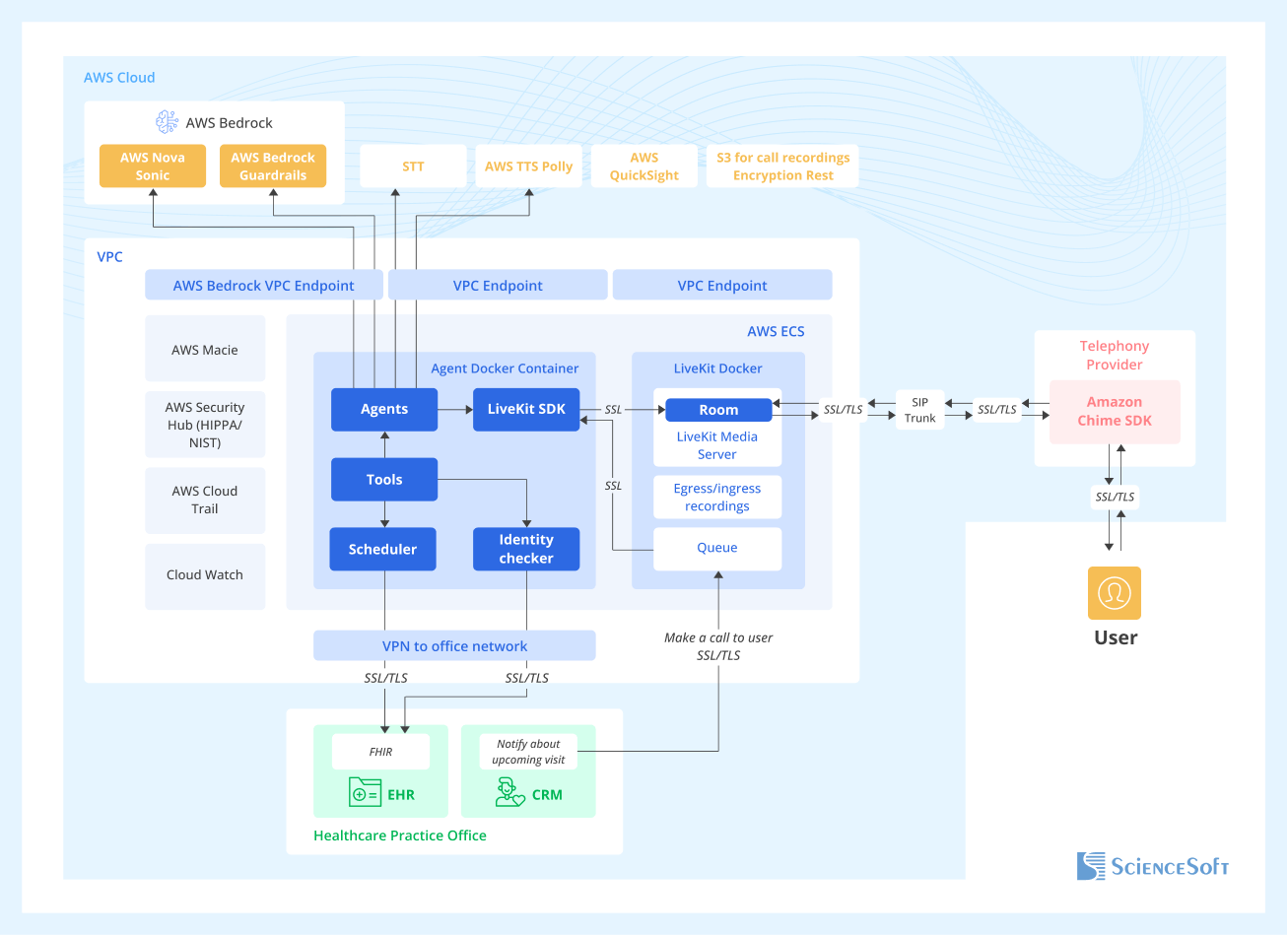
The AI voice scheduler handles voice interaction, scheduling, identity checks, and call routing. It can identify the patient’s intent, check available appointment slots, confirm the selected time, and exchange scheduling data with EHR or scheduling systems.
The solution can run in a HIPAA-eligible cloud environment or on premises, with secure EHR, CRM, scheduling, and contact-center integrations.
By ScienceSoft’s estimates, this type of AI solution can cut booking time by 40%, reduce abandonment by 30%, lower scheduling costs by 50%, and process up to 70% more calls per hour than a patient service representative.
Learn more about the project here.
Featured Expert Talk
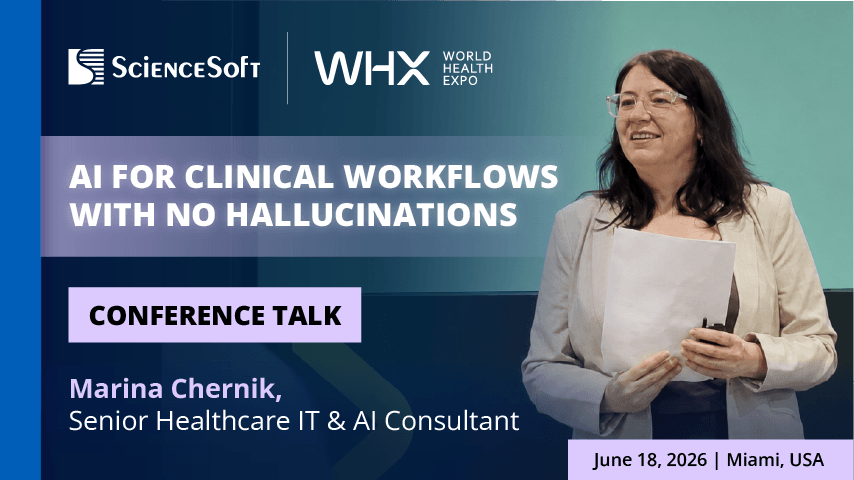
How to Keep Agentic AI Reliable in Clinical Workflows
As AI takes on multi-step healthcare workflows, reliable outputs become critical. Marina Chernik, Senior Healthcare IT & AI Consultant at ScienceSoft, explains engineering approaches to reducing hallucinations, validating AI-generated information, and keeping clinical AI actions safer and more trustworthy.
Development Due Diligence for Safe Agentic AI Implementation

Clear boundaries for agent actions
Before agentic AI is connected to any systems, its actions should be defined as clearly as any user role or workflow rule. At ScienceSoft, we usually create allowed-action maps for each agent before implementation begins, with architects, security specialists, compliance officers, and clinical or operational leads validating the technical, security, and regulatory constraints. The map should describe the agent’s operating boundaries, including system access, data access, editable records, and approval points. For example, a prior authorization agent may collect supporting clinical data, create a task to obtain a missing document, and update the case status. But it should not be able to send a submission, approve an appeal, or message a patient. Those actions should remain with staff unless the organization explicitly approves automation for that step.
Controlled access to healthcare systems
Secure AI agent frameworks do not give agents broad access to healthcare systems. If an agent connects to each healthcare system separately, its permissions, logs, and error handling can become scattered across multiple integrations. This makes it harder to control what the agent can do and harder to investigate issues later. A safer design is to route agent actions through a controlled integration layer. Instead of giving the agent broad system access, the layer exposes only workflow-specific actions, such as retrieving an encounter summary or updating referral status. As a result, every agent action follows the same access rules, logging format, and failure-handling process across connected systems.
PHI flow governance
PHI exposure in agentic AI is hard to control when your software only tracks where the agent retrieves patient data, but not where that data is copied, transformed, stored, or sent afterward. Similar to the permitted action maps, ScienceSoft recommends creating a PHI flow map for every agent workflow, showing how patient data moves through the AI pipeline, connected systems, and vendor-controlled environments. The map should be updated whenever a workflow step, connector, prompt, or logging rule changes.
Based on this map, the project team defines how the agent may use PHI at each touchpoint. Administrative safeguards assign responsibility for agent configuration, PHI-sharing approvals, incident response, and vendor access. Physical safeguards cover the workstations and environments where staff may view agent activity involving PHI. Technical safeguards enforce these rules in software through access control, encryption, audit logs, retention limits, and restrictions on PHI use in prompts, logs, embeddings, and support records.
Before rollout, PHI handling can be tested with misuse and failure scenarios derived from the PHI flow map. For example, the team can check whether unnecessary patient details enter a prompt, PHI appears in an error log after a failed connector call, identifiable text is retained in a vector database, or a technical support ticket captures the agent’s output with patient details. These tests help spot missing controls before the agent is connected to live workflows.
Workflow visibility and monitoring
Agentic AI is hard to trust when healthcare teams cannot see how a case moved through the workflow, which systems the agent called, what data was used, and where the process stopped. Visibility is needed even when the workflow does not require formal approval. Staff should be able to review agent activity, source data, status changes, escalations, and manual overrides in the work queue where they already work.
Each agentic workflow needs a monitoring owner or review group, depending on its risk and scale. They can regularly review failed actions, exception rates, PHI handling issues, and audit trail samples. In higher-risk workflows, this review may involve operational leads, clinical experts, IT security specialists, and the development team. This helps detect unsafe or inefficient patterns before they lead to delayed cases, user complaints, or audit findings.
Agentic AI in Healthcare: Cost Factors and Ranges
Healthcare agentic AI development cost ranges from $50,000+ for a bounded workflow agent to $1,000,000+ for a multi-component AI solution.

$50,000-$150,000+
A bounded workflow agent that connects to healthcare or enterprise systems and performs approved actions, such as triage, scheduling, case handling, prior authorization support, or request routing.

$300,000-$1,000,000+
A multi-agent solution with several AI-enabled components, such as an EHR or insurance claims management system enhanced with employee copilots, retrieval-augmented generation search, workflow automation, and AI analytics.
Considering Agentic AI in Healthcare?
Let’s discuss your current challenges, realistic implementation opportunities, and risks to consider before investing in agentic AI.
Technologies We Work With
Generative AI
Models
- Large Language Models (LLMs)
- Small Language Models (SLMs)
- Multimodal models
- Computer vision models
- Image generation models
- ASR speech models
- TTS speech models
- Speech-to-Speech Models
- Audio models
- Real-time
Model adaptation and efficiency
- Training from scratch
- Data design
- Data labelling/annotation
- Fine-tuning
- Instruction tuning
- LoRA adapters
AI platforms and services
- Azure OpenAI Service
- Microsoft Foundry
- Amazon Bedrock
- Google Vertex AI
- Google AI Studio
- Hugging Face Inference
- Oracle Cloud
- G42/Core42
- NVIDIA AI Enterprise
Agents and orchestration
- RAG
- Graph RAG
- Agentic workflows
- OpenAI Agents SDK
- OpenAI Agents (platform/guides)
- AWS Agents
- Claude Agent SDK
- Google Agent Development Kit (ADK)
- Microsoft 365 Agents SDK (Copilot Studio)
- OpenClaw
- LangChain
- LangGraph
- smolagents
- LiveKit
- Dify
- n8n
- Faiss
- ChromaDB
- Qdrant
- Weaviate
- OpenSearch
- Pgvector
- Amazon Neptune
- Graph RAG Toolkit
- Neo4j
Traditional ML
Platforms and services
- Azure Cognitive Services
- Azure Machine Learning
- Microsoft Bot Framework
- Amazon SageMaker AI
- Amazon Transcribe
- Amazon Lex
- Amazon Polly
- Google Cloud AI Platform
- Google Vertex AI
Frameworks and libraries
- Apache Mahout
- Apache MXNet
- Caffe
- TensorFlow
- Keras
- Torch
- OpenCV
- Apache Spark MLlib
- Theano
- Scikit Learn
- Gensim
- SpaCy
ScienceSoft as a Partner for Agentic AI in Healthcare
- Since 2005 in healthcare software engineering.
- Since 1989 in AI development.
- 150+ healthcare IT projects completed in collaboration with providers, healthtech companies, and life sciences organizations.
- 750+ IT professionals, including AI solution architects, software engineers, data scientists, MD consultants, and regulatory experts who shape agentic AI from both technical and healthcare workflow perspectives. Over 50% of our experts are senior or lead-level specialists.
- In-house PMO and Architecture & Solutions Center of Excellence to support predictable delivery, responsible risk management, and cost-aware architecture of AI solutions.
- Experience designing HIPAA/HITECH-aligned PHI handling for agentic AI: limiting PHI in prompts and retrieved context, controlling model outputs, preventing PHI leakage in logs or embeddings, setting retention rules for agent memory, etc.
- Hands-on experience with healthcare interoperability and terminology standards, including HL7, FHIR, Da Vinci PAS, X12 EDI, RxNorm, SNOMED CT, LOINC, ICD-10, CPT, and HCPCS.
- Design approach shaped by healthcare workflow regulations, including CMS prior authorization rules, ONC HTI-1 expectations for certified health IT and AI transparency, and FDA considerations for clinical decision support.
Client Testimonials


ScienceSoft delivered a fully customized AI medical chatbot PoC in just two weeks. The attention to detail in the chatbot design, and especially the pitch deck, was amazing — with this kit on hand, we are ready to go into investor discussions confidently. I’m genuinely grateful to ScienceSoft for their hard work and would absolutely recommend them to anyone looking for top-notch results in health tech.


bioAffinity Technologies hired ScienceSoft to develop automated data analysis software for detection of lung cancer using flow cytometry. In addition to the solid technical expertise shown by ScienceSoft, its developers demonstrated a profound understanding of laboratory software specifics and integrations. I am particularly impressed by the cooperative nature of ScienceSoft’s team. They are reliable, thorough, smart, available, extremely good communicators and very friendly.

King Saud University approached ScienceSoft to explore the possibility of developing a mobile solution for the early identification of a specific medical condition. The resulting Proof of Concept exceeded expectations, and we sincerely appreciated the way it was delivered. We found ScienceSoft to be dependable and forward-thinking, and we would confidently recommend them for high-responsibility projects.
Certifications and awards
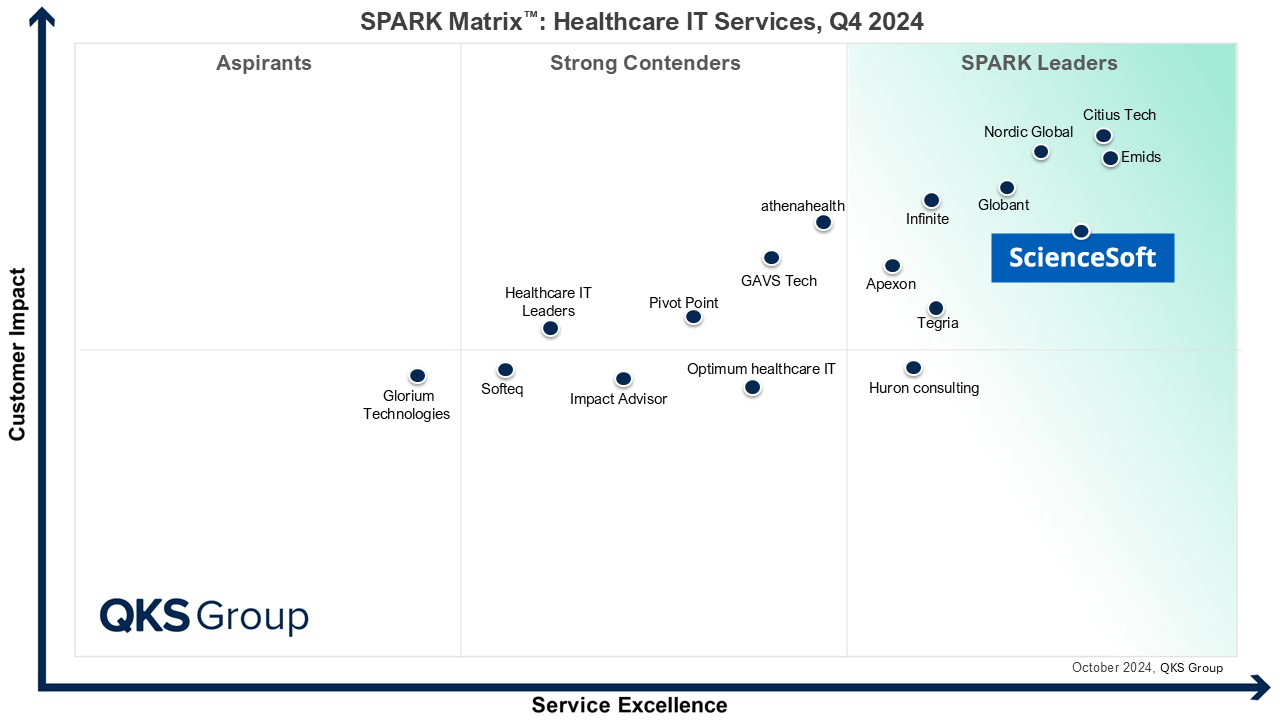
Featured among Healthcare IT Services Leaders in the 2022 and 2024 SPARK Matrix
Recognized for Healthcare Technology Leadership by Frost & Sullivan in 2023 and 2025

Named among America’s Fastest-Growing Companies by Financial Times, 5 years in a row
Four-time finalist across HTN Awards programs
Named among Becker’s Telehealth Companies to Know in 2026
Named Leading Healthcare Software Provider 2026 at GHP’s Healthcare & Pharmaceutical Awards
HIMSS Gold member advancing digital healthcare

ISO 13485-certified quality management system
ISO 27001-certified security management system
