 ScienceSoft Global



Electronic Case Reporting (eCR) for Public Health Agencies
Integration Options, Architecture, Costs
In healthcare IT since 2005, ScienceSoft helps public health agencies make electronic case reporting work within their existing surveillance environments. We adapt eCR processing to local data structures, program workflows, and interoperability requirements.
Contributors

Senior Solution Architect, Healthcare, ScienceSoft

Senior Healthcare IT & AI Consultant, ScienceSoft
Electronic Case Reporting at a Glance
Electronic case reporting (eCR) software solutions for public health agencies support the processing and integration of electronic initial case reports (eICRs) and Reportability Responses (RRs) into surveillance systems and public health workflows. They can connect shared national eCR infrastructure with an agency’s EDSSs, program databases, and local data structures.
The national eCR infrastructure already handles much of the core reporting flow. The Association of Public Health Laboratories (APHL) operates APHL Informatics Messaging Services (AIMS), a platform that receives eICRs and works with the Reportable Conditions Knowledge Management System (RCKMS) to apply jurisdiction-specific reporting criteria. AIMS then routes relevant reports to the appropriate public health agency, where CDC’s Data Integration Building Blocks (DIBBs) tools can support common processing and review tasks. What varies from one public health agency to another is how these shared components connect to local surveillance systems, data models, and workflows.
Depending on its current setup, a public health agency (PHA) may:
- Rely mainly on shared CDC/APHL capabilities when its existing surveillance environment can already support the required eCR intake, review, and downstream use.
- Add a targeted integration when one EDSS or program workflow needs custom connectors, field or terminology mappings, transformations, or routing rules.
- Add a custom eCR processing and integration layer when several program-specific systems require coordinated transformation, routing, matching, exception handling, or case updates. Such solutions may also include governed AI tools for extracting data from unstructured records, detecting likely case duplicates, or summarizing data.
ScienceSoft can design and implement these custom integration and processing components while keeping the shared eCR foundation and existing surveillance systems intact.
Implementation time: 2–10+ months, depending on project scale.
Development costs: from $30K for a focused integration; $250K–$500K+ for a multi-system processing and integration layer.
How Custom eCR Processing Fits Into Existing Surveillance Environments
Public health agencies may need to bring eCR into surveillance environments that already receive case-related data through electronic lab reporting (ELR) and other reporting channels. Additionally, different programs may rely on different EDSSs, databases, or work queues. The architecture below shows how an agency-specific processing and integration layer can adapt incoming eCR data to these existing systems and help reconcile it with the case information already there.
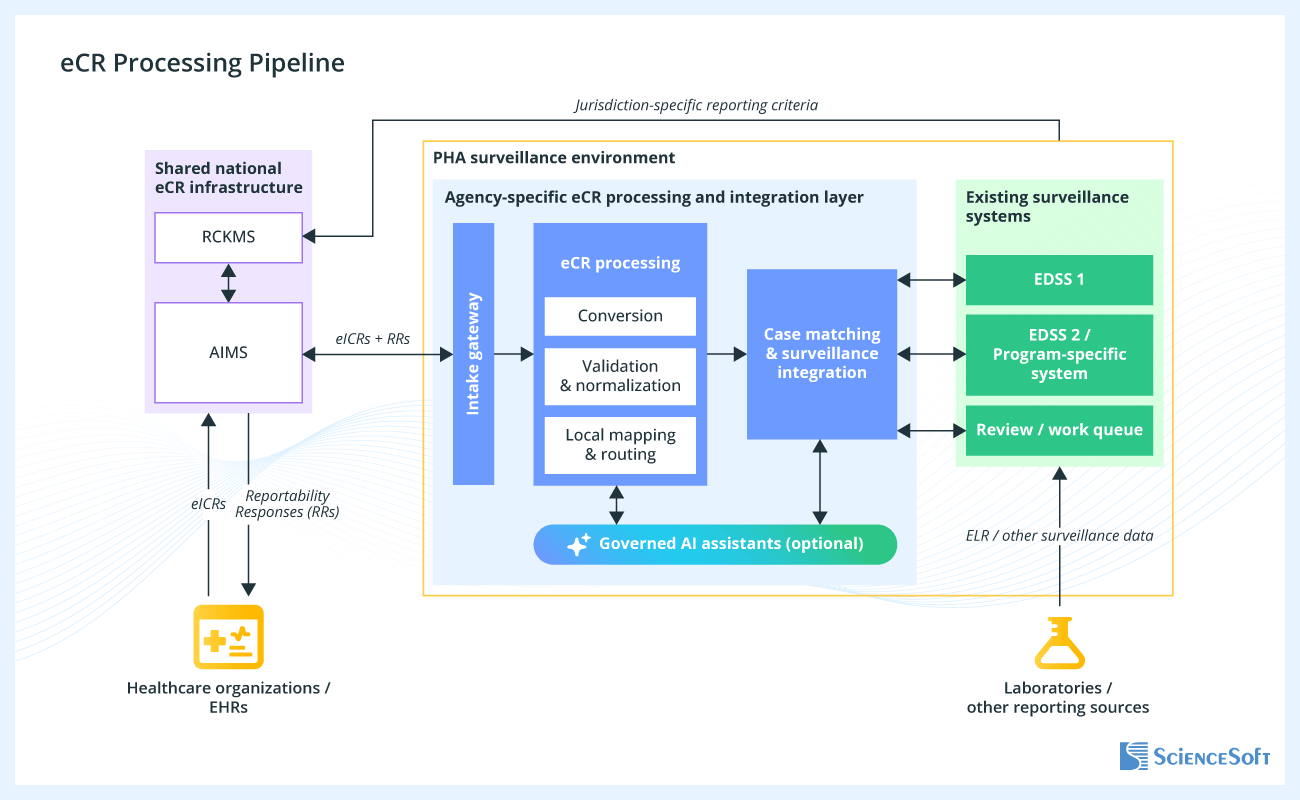
Healthcare organizations send electronic initial case reports (eICRs) to AIMS. AIMS uses RCKMS to evaluate each report against jurisdiction-specific reporting criteria. It then returns a Reportability Response (RR) to the sender and forwards the relevant eICR and RR to the appropriate public health agency.
Inside the PHA environment, the agency-specific eCR layer can convert supported formats where needed, validate and normalize incoming data, and apply local mappings and routing rules. Before creating or updating a case, it can compare the incoming eCR with existing patient and case records. Those records may already contain data received through ELR or other reporting channels, so matching helps the agency update an existing record where appropriate instead of creating a parallel one.
Once the report has been processed and matched, the resulting data can be sent to the appropriate system or review queue. Optional governed AI assistants can support selected review or matching tasks, while conversion, validation, mapping, and routing remain part of the deterministic processing flow.
Choose the architecture based on how fragmented your surveillance environment is
I wouldn’t recommend building a full-scale processing layer to every PHA. If you have only one EDSS that can already accept eCR data with a small amount of mapping, a focused integration will be a much cleaner design. And most likely cheaper, too.
The processing layer starts making sense when you need to prepare the same data differently for several destinations. For example, your communicable disease programs may use different surveillance systems. In that case, the same eICR may need to go to more than one of them, but each system might demand its own mappings, routing logic, and case matching rules. At that point, putting the shared processing in one place and maintaining it centrally is usually cleaner than building those rules separately into every integration.
Agency-Specific eCR Processing and Integration Capabilities
ScienceSoft can engineer the capabilities below to connect incoming eCR data with local surveillance systems and workflows. They can be implemented as a custom system integration, an extension to existing eCR or surveillance tooling, or part of a broader eCR processing solution.

eCR intake, validation, and normalization
Custom intake logic can check eICRs and Reportability Responses for missing or malformed data, unsupported values, and other issues before the data enters surveillance workflows. It can also normalize incoming content into a consistent internal format and keep the source message available for review and troubleshooting.

Local mapping and routing
Configurable mappings can translate incoming fields, codes, and terminology into the agency’s data models. Routing rules can then use condition and reportability information to send data to the appropriate EDSS, program-specific system, or review queue. Reports involving multiple conditions can feed more than one program workflow.

Patient and case matching
Incoming eCR data can be compared with existing patient and case records using identifiers, demographics, encounter information, laboratory data, and other matching attributes. Likely matches can be linked automatically where agency policy and confidence thresholds allow, while ambiguous matches are sent for staff review.

Case creation and updates
Once the right patient and case are identified, mapped eCR data can create a new surveillance record or update an existing one without manual re-entry. Later eICRs can add new laboratory results, diagnoses, encounter details, or other clinical information to an existing case as the patient record evolves.

Data quality checks and exception handling
If an eCR tool detects missing required data, malformed values, failed mappings, or other processing problems, it diverts the report to an exception queue. Staff can inspect the affected fields and source message, correct configurable rules where needed, and reprocess the report without creating duplicate downstream records.

Reporter management and feed monitoring
eCR coordinators can monitor incoming volumes, routing failures, unmatched reports, and recurring data quality issues by healthcare organization. During onboarding, they can review test submissions and track whether a reporter is ready for production exchange. Monitoring tools can also highlight deteriorating feed quality or repeated errors that require follow-up.
How AI Can Support Electronic Case Reporting
ScienceSoft helps public health agencies apply AI where it can reduce manual review effort or identify patterns that can’t be detected by deterministic rules. It is most useful in workflows that involve interpreting narrative or inconsistently structured clinical content, identifying non-obvious duplicates and case matches, or detecting deterioration in feed quality.
AI capabilities can be added as narrow, controlled extensions to the existing surveillance environment. Depending on the use case and selected models, ScienceSoft defines data boundaries, audit controls, confidence thresholds, and human review for AI-generated outputs that may affect surveillance records or workflows.

Assisted eCR review
GenAI can help staff review lengthy eICRs by summarizing condition-relevant details and answering questions about a specific report, such as symptom onset, hospitalization, or reported laboratory findings. Responses stay grounded in the source eICR/RR and link back to the supporting data, while staff remains responsible for decisions that affect surveillance records.

Patient matching and duplicate detection
Probabilistic matching models can compare incoming eCR data with existing patient and case records, including records populated through ELR and other reporting channels. They can identify suspicious record clusters using demographic and clinical similarities and present the matching and conflicting attributes side by side so staff can review potential merges.

Narrative extraction and coding
NLP models can extract useful information from narrative or inconsistently coded content and suggest standardized values for downstream use. This may include symptoms, occupations, exposure details, or other concepts that are difficult to capture with fixed mappings alone. Low-confidence suggestions can be routed for staff review before they affect surveillance data.

Feed quality anomaly detection
ML models can monitor eCR feeds by healthcare organization and flag unusual patterns such as sudden drops in report volume, increases in missing fields, new code values, or changed field formats. This can help eCR coordinators spot deteriorating feed quality earlier and focus follow-up on the organizations or data elements causing the issue.
Electronic Case Reporting Development Best Practices

Roll out eCR integration in stages
For PHAs with several programs or legacy surveillance systems, the processing and integration architecture does not have to support every destination in the first release. The agency can establish the shared eCR processing foundation and connect it to one high-priority EDSS or program workflow first. Other integrations can follow as their mappings, routing rules, and operational processes are prepared and validated.
To make this rollout practical, keep the shared intake and normalization flow separate from destination-specific mappings and connectors. Then, adding another EDSS or program does not require redesigning how incoming reports are received and prepared. The agency can extend the same foundation with new routing rules and integrations, test each destination independently, and reduce the risk of disrupting workflows that are already in production.
Prepare for evolving eCR standards and formats
eCR specifications and supported exchange formats evolve over time, and agencies may need to process different versions during transition periods. The eCR flow should therefore be designed to handle format-specific differences early, before the data goes further.
A practical approach is to convert incoming reports into one consistent internal data structure before downstream processing begins. When a format or version changes, the agency can update the intake and conversion logic without redesigning every mapping and routing rule or surveillance system integration that depends on the processed data. This also keeps testing more focused: teams can verify the updated conversion first and then confirm that existing downstream workflows still produce the expected results.
Keep terminology and sender-specific mappings configurable
Standards-based eICRs still require local interpretation. Different healthcare organizations and EHRs may populate equivalent data differently, while the PHA may also need to translate incoming codes and values into its own surveillance data model, program categories, and downstream system fields.
For this reason, it’s better to keep these crosswalks, terminology mappings, and sender- or destination-specific transformations in a configurable and versioned mapping layer rather than hard-coding them separately into individual connectors or processing flows. Informatics staff can then adjust how incoming data is interpreted or translated for a target surveillance system without changing the surrounding code. Version history would also show which mapping rules were applied when earlier reports were processed.
Preserve end-to-end lineage and make reprocessing easier
An electronic case report does not always produce a final result on the first pass. The agency may later correct a mapping rule, receive an updated report for the same case, or need to reprocess earlier data after an integration change. If the system cannot tell which surveillance record came from which source report, reprocessing can create duplicates or make it difficult to understand why a particular value appeared in the EDSS.
To avoid this, keep a traceable link from each source eICR and Reportability Response to the surveillance record or records it creates or updates. If staff later correct a mapping rule and reprocess an earlier report, the integration should know which existing output belongs to that source report and update it rather than creating another case. This lineage also makes it much easier to trace questionable EDSS data back to the message and transformation that produced it.
Technologies We Use to Build Software for Public Health Agencies
Front-end programming languages
Languages
- HTML5
- CSS
- JavaScript
JavaScript frameworks
- Angular JS
- React JS
- MeteorJS
- Vue.js
- Next.js
- Ember.js
Low-code development
- Microsoft Power Apps
- Microsoft Power Automate
- App Engine Studio (ServiceNow)
- Bubble.io
Clouds
- Amazon Web Services
- Microsoft Azure
- Google Cloud Platform
- DigitalOcean
- Rackspace Technology
DevOps
Containerization
- Docker
- Kubernetes
- Red Hat OpenShift
- Apache Mesos
Automation
- Ansible
- Puppet
- Chef
- Saltstack
- HashiCorp Terraform
- HashiCorp Packer
CI/CD tools
- AWS Developer Tools
- Azure DevOps
- Google Developer Tools
- GitLab CI/CD
- Jenkins
- TeamCity
Monitoring
- Zabbix
- Nagios
- Elasticsearch
- Prometheus
- Grafana
- Datadog
Databases / data storages
SQL
- Microsoft SQL Server
- Microsoft Fabric
- MySQL
- Azure SQL Database
- Oracle
- PostgreSQL
NoSQL
- Apache Cassandra
- Apache Hive
- Apache HBase
- Apache NiFi
- MongoDB
- Microsoft Fabric
Cloud databases, warehouses, and storage
AWS
- Amazon S3
- Amazon Redshift
- Amazon DynamoDB
- Amazon DocumentDB
- Amazon RDS
- Amazon ElastiCache
Azure
- Azure Data Lake
- Azure Blob Storage
- Azure Cosmos DB
- Azure SQL Database
- Azure Synapse Analytics
- Kinect DK
- Azure RTOS
Google Cloud Platform
- Google Cloud SQL
- Google Cloud Datastore
Other
- Microsoft Fabric
Integration
- Oracle
- Talend
- Tibco
- Boomi
- MuleSoft
- Informatica
- Azure Integration Services
- AWS Integration Services
Generative AI
Models
- Large Language Models (LLMs)
- Small Language Models (SLMs)
- Multimodal models
- Computer vision models
- Image generation models
- ASR speech models
- TTS speech models
- Speech-to-Speech Models
- Audio models
- Real-time
Model adaptation and efficiency
- Training from scratch
- Data design
- Data labelling/annotation
- Fine-tuning
- Instruction tuning
- LoRA adapters
AI platforms and services
- Azure OpenAI Service
- Microsoft Foundry
- Amazon Bedrock
- Google Vertex AI
- Google AI Studio
- Hugging Face Inference
- Oracle Cloud
- G42/Core42
- NVIDIA AI Enterprise
Agents and orchestration
- RAG
- Graph RAG
- Agentic workflows
- OpenAI Agents SDK
- OpenAI Agents (platform/guides)
- AWS Agents
- Claude Agent SDK
- Google Agent Development Kit (ADK)
- Microsoft 365 Agents SDK (Copilot Studio)
- OpenClaw
- LangChain
- LangGraph
- smolagents
- LiveKit
- Dify
- n8n
- Faiss
- ChromaDB
- Qdrant
- Weaviate
- OpenSearch
- Pgvector
- Amazon Neptune
- Graph RAG Toolkit
- Neo4j
Healthcare-specific language models
- MedGemma
- MedLM
- BioMedLM
Traditional ML
Platforms and services
- Azure Cognitive Services
- Azure Machine Learning
- Microsoft Bot Framework
- Amazon SageMaker AI
- Amazon Transcribe
- Amazon Lex
- Amazon Polly
- Google Cloud AI Platform
- Google Vertex AI
Frameworks and libraries
- Apache Mahout
- Apache MXNet
- Caffe
- TensorFlow
- Keras
- Torch
- OpenCV
- Apache Spark MLlib
- Theano
- Scikit Learn
- Gensim
- SpaCy
eCR Implementation Costs
The costs of building or implementing electronic case reporting software solutions can start at around $30,000 for a focused integration with an existing surveillance system and reach $250,000–$500,000+ for a broader agency-specific processing and integration layer. The cost depends mainly on how many surveillance systems and program workflows need to be connected, how complex their interfaces and legacy constraints are, how much custom mapping and routing logic is required, and how sophisticated the matching, exception handling, monitoring, and AI-assisted workflows need to be.
Note: These ranges are illustrative and cover implementation work such as custom engineering, integration, configuration, and testing. They do not include ongoing cloud and AI usage, third-party software or integration-platform licenses, long-term maintenance and support, or broader organizational costs associated with eCR onboarding and change management.

From $30,000
For a focused eCR integration
Assumes a narrow integration scope, such as connecting eCR to one surveillance system or program workflow where the main gaps are local mappings, routing, or interface adaptation. The primary cost drivers are the target system’s integration options and the complexity of local data formats.

$250,000–$500,000+
For a multi-system eCR processing and integration layer
A broader scope is typically needed when eCR must work across several EDSSs or program systems, especially in fragmented or legacy-heavy environments. Cost grows with the number and diversity of downstream systems, the amount of shared processing and case reconciliation logic required, and the complexity of exception handling workflows.
ScienceSoft: An Experienced Partner for Public Health Software Development
- Since 2005 in healthcare software engineering.
- Mature quality management and security management systems backed by ISO 9001 and ISO 27001 certifications.
- Proficiency in implementing clinical and public health software with HIPAA compliance where applicable, as well as alignment with NIST security guidance, FIPS 140-3 cryptography, and relevant CDC security and interoperability requirements.
- Hands-on experience with healthcare interoperability standards and formats (HL7 v2/v3, FHIR, CDA) and clinical coding vocabularies (e.g., ICD-10, SNOMED CT, LOINC).
- 9 principal architects to design secure integration architectures for reliable data exchange between eCR components, EDSSs, clinical and laboratory systems, including legacy public health applications.
- In-house Project Management Office (PMO) to support predictable delivery and controlled integration of eCR capabilities into connected surveillance environments.
- Experience applying AI to healthcare workflows with appropriate data controls, traceability, and human review for AI-assisted use cases.
Certifications and awards
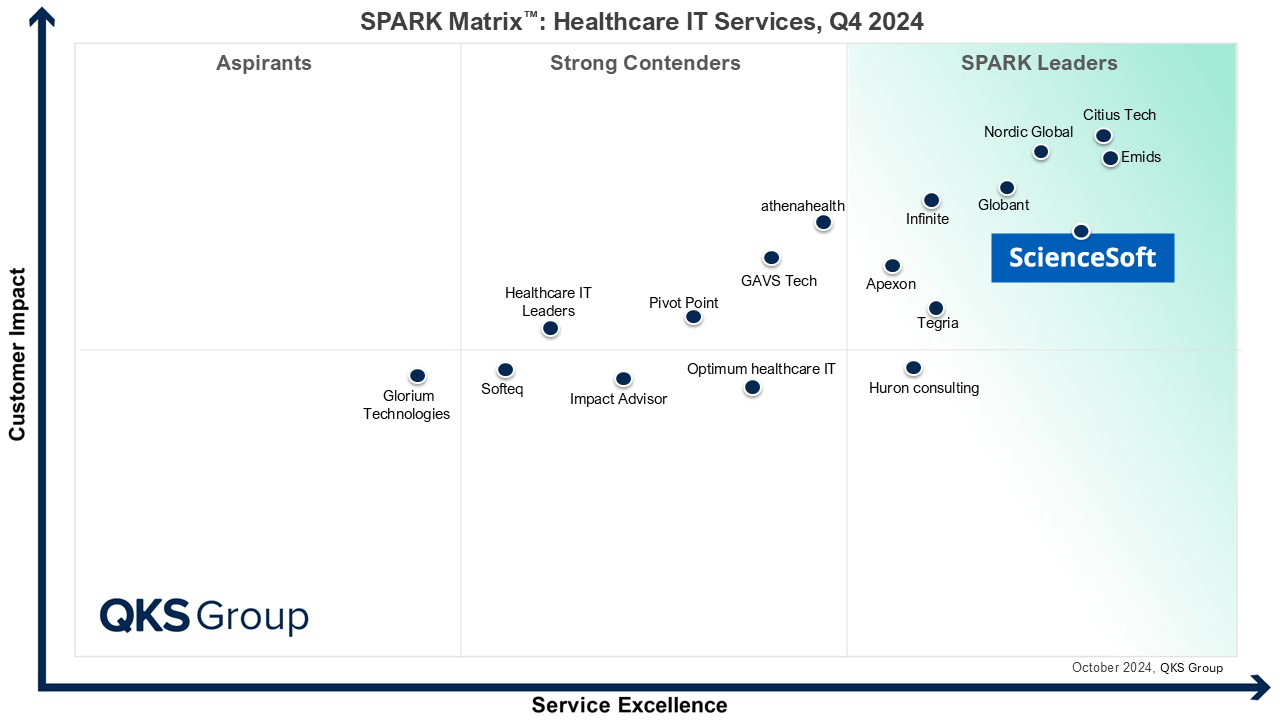
Featured among Healthcare IT Services Leaders in the 2022 and 2024 SPARK Matrix

Recognized for Healthcare Technology Leadership by Frost & Sullivan in 2023 and 2025

Named among America’s Fastest-Growing Companies by Financial Times, 5 years in a row

Four-time finalist across HTN Awards programs

Named among Becker’s Telehealth Companies to Know in 2026

Named Leading Healthcare Software Provider 2026 at GHP’s Healthcare & Pharmaceutical Awards

HIMSS Gold member advancing digital healthcare

ISO 13485-certified quality management system

ISO 27001-certified security management system
Our Clients Say



In just four months from project kickoff, they successfully migrated us to a modern, modular Microsoft-based telehealth platform featuring virtual consultations, care coordination, and seamless data exchange with partner systems, including robust EHR integrations.



We were pleased to see that ScienceSoft approached our ecosystem with a good understanding of healthcare operations and the HIPAA Security Rule.


I am particularly impressed by the cooperative nature of ScienceSoft's team. They are reliable, thorough, smart, available, extremely good communicators and very friendly. We would recommend hiring ScienceSoft to anyone looking for a highly productive and solution-driven team.

We found ScienceSoft to be dependable and forward-thinking, and we would confidently recommend them for high-responsibility projects.
