 ScienceSoft Global



Laboratory Software Development Services
ScienceSoft creates custom laboratory software that helps diagnostic centers in improving operational efficiency and supports research labs in enhancing data quality and accelerating scientific discovery. We design systems that ingest outputs from a wide range of lab equipment, support diverse molecular data formats, and offer efficient automation, data consolidation, and useful analytics.
Laboratory software development services include design, development, modernization, support, and evolution of solutions for diagnostic and Life Sciences R&D laboratories.
Essential components of laboratory software ecosystems include a laboratory information management system (LIMS), an electronic laboratory notebook (ELN), a laboratory execution system (LES), laboratory analytics software, and more.
Custom laboratory software helps overcome the following common limitations of off-the-shelf solutions:
- Lack of built-in support for domain-specific data formats, e.g., for handling flow cytometry or sequencing outputs.
- Inability to integrate specific lab equipment, e.g., high-throughput analyzers.
- Complexity of integration with already implemented lab informatics software from other vendors, or with on-premises legacy systems.
Why Choose ScienceSoft for Your Laboratory Software Project
- 21 years in healthcare IT, with 150+ projects, including LIS, LIMS, and research lab platforms.
- Experience in achieving compliance with HIPAA, GCP, GLP, FDA regulations (incl. 21 CFR Part 11), and CAP/CLIA.
- Architects with 10–20 years in healthcare IT, to design scalable, secure, and interoperable lab platforms.
- Since 1989 in AI, to automate tasks like sample routing.
- Proven in high-complexity environments: legacy integration, cloud migration, and multi-lab orchestration.
Certifications and awards
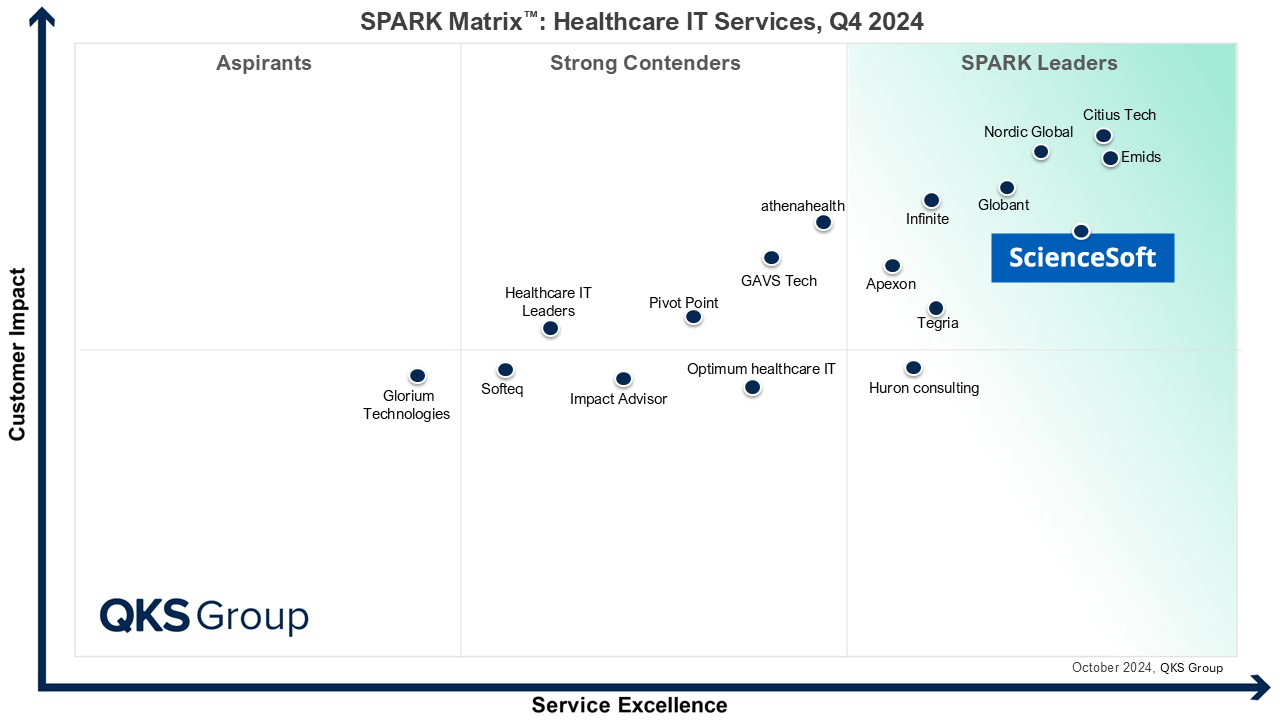
Featured among Healthcare IT Services Leaders in the 2022 and 2024 SPARK Matrix

Recognized for Healthcare Technology Leadership by Frost & Sullivan in 2023 and 2025

Named among America’s Fastest-Growing Companies by Financial Times, 5 years in a row

Four-time finalist across HTN Awards programs
Named among Becker’s Telehealth Companies to Know in 2026

Named Leading Healthcare Software Provider 2026 at GHP’s Healthcare & Pharmaceutical Awards
HIMSS Gold member advancing digital healthcare

ISO 13485-certified quality management system

ISO 27001-certified security management system
Laboratory Solutions We Build, Support, and Improve
Clinical and diagnostic laboratories (CLIA/CAP environments)
This software automates test order processing, sample routing, and test report generation and sharing. It can also provide test result interpretation, appointment scheduling, billing, inventory management, and operational analytics.

Laboratory execution systems (LES)
This software enforces SOP execution, captures instrument data in real time, performs compliance deviation checks, and automates lab documentation and reporting. Moreover, it can verify reagent validity, instrument calibration, sample identity, etc.

These systems keep compliance documentation and automate tracking of nonconformances and executing corrective and preventive actions. They can also cover staff training, equipment validation, and audit preparation.

Document management systems (DMS)
These systems store regulated documents (such as SOPs, policies, validation protocols, and maintenance logs) under strict version control. It also routes documents for approval, schedules periodic reviews, and preserves audit trails for inspections.

This software (standalone or integrated into lab devices) captures analyzer data, processes and interprets it, generates test reports, and offers diagnostic insights. It can also monitor device performance and ensure compliance with regulations.

With these portals, patients can schedule appointments, pay for lab services online, view test results, and access help and information. Meanwhile, lab teams can analyze patient satisfaction and promote loyalty programs.

This software enables automated charge capture and patient billing, medical coding, claim submission, and denial management. It also supports real-time claim and payment tracking and offers financial performance analytics.
Research, life sciences, and pharmaceutical laboratories (GLP/GCP environments)

These systems support tracking samples, capturing analyzer output, and generating lab reports. They can also cover QA/QC, equipment maintenance, inventory and supply management, waste disposal and compliance control, staff training, and more.

This software enables collaborative experiment designing and execution, research data analysis, documenting, and reporting. It can also support sample tracking, inventory management, and equipment scheduling, and offer advanced scientific data analytics capabilities.

Scientific data management system (SDMS)
These laboratory informatics solutions automatically aggregate experimental data from all laboratory systems, standardize, structure, and validate it. This enables efficient search, advanced analysis, collaborative review, and easy sharing.
Cross-functional and operational support software

This software analyses aggregated laboratory data to deliver test result interpretations or identify patterns and root causes of deviation in experimental data. It can also provide suggestions on quality control, operational and financial performance optimization, and more.

Lab instrument middleware
These systems provide vendor-neutral connectivity for lab analyzers. It standardizes analyzer outputs, runs real-time QC and delta checks, posts verified test results to LIS/LIMS, and auto-releases compliant logs and reports. It can also flag calibration or reagent errors and track testing throughput and turnaround time.
Lab system orchestration engines
This software consolidates all lab tools (instruments, LIS/LIMS, a patient portal, finance and supply chain systems, etc.) into one coordinated ecosystem that shares clean, up-to-date information automatically. It orchestrates all lab workflows and optimizes them through consolidated data analysis.

Sample management software
This software supports sample barcoding and labeling, tracks samples from collection to disposal in real time, and maintains chain-of-custody records. It can also arrange courier pickups, coordinate sample routing across multiple labs, control storage and transportation temperature, and more.

This software enables real-time tracking of laboratory supplies, supports barcode or RFID scanning, and sends low-stock and expiry alerts. It can also keep compliant inventory audit trails, automate ordering, and optimize resource utilization.

Such solutions forecast lab inventory demand, automate purchasing, track deliveries, and maintain batch traceability for regulatory compliance. It can also control supplier performance and provide analytics for cost and disruption management.
AI Capabilities for Laboratory Software and Their Typical Use Cases
AI functionality addresses common lab challenges like manual variability, sample throughput, and decision support in high-complexity environments. Its key benefits include:
- Minimizing human efforts on processing of large testing datasets such as next-generation sequencing (NGS) data.
- Deeper insights through pattern recognition and predictive analytics, for example, predicting bacterial sensitivity to antibiotics based on mass spectrometry data.
- Letting users control systems and even generate custom automation code using natural language commands.
Listed below are the AI use cases that ScienceSoft’s customers find most valuable in diagnostic and research lab settings.

- Querying and updating lab records (ELN, LIMS, inventory, and instrument data), designing experiments, and analyzing data through natural-language chat.
- Guiding lab staff on SOP execution with verbal prompts, timers (e.g., for incubations or media changes), in-workflow checkpoints (e.g., for filling in mandatory date fields), and voice note capture.
- Generating code for custom data analysis and workflow automation.

AI for sample analysis
- Image-based analysis of lab samples, such as automated colony counting on culture plates, blood cell differential counting, prescreening pathology slides and flagging tumor cells for analyst review, etc.
- Pattern recognition in analyzer output, e.g., analyzing flow cytometry data to quantify immune cell subsets, NGS data to detect pathogenic gene variants, or mass spectrometry data to forecast bacterial antibiotic sensitivity.

AI for quality control
- Real-time detection of test result biases caused by poor instrument calibration, sample contamination, delayed sample analysis, etc.
- Identifying trends in assay, column, or instrument performance to predict and prevent test failures.
- Detecting consistent patterns in lab quality deviation data and advising on appropriate corrective actions.

Intelligent sample routing
- Real-time automatic balancing of instrument and staff loads to optimize testing turnaround times.
- Identifying upcoming workload peaks and proactively moving samples between laboratory centers and analyzers.
- Identifying urgent samples based on patient data and prioritizing them for testing.

- Predicting instrument failures, recalibration or service needs by analyzing sensor output and diagnostic logs in real time.
- Identifying optimal wear thresholds that match the workload and prevent both premature and overdue maintenance.
- AI-enabled remote monitoring, self-diagnostic, and auto-recovery of lab analytical systems, such as HPLC.
- AI agent for guiding field service staff.

Experimental data analytics and reporting
- Automated processing and interpretation of experimental data (e.g., analyzing large compound screening data, filtering out noisy or failed wells, plotting dose-response curves, and spotting hits for potential drug candidates).
- Automated report generation (compound screening summaries, gene expression profiles, assay performance metrics, etc.).
Main Factors Influencing the Cost of Lab Software Development
The cost of a lab software development project can vary widely, from $200,000 to over $3,000,000. It depends on the scope of lab automation, the integration complexity with lab devices, the number of external systems connected, and the demand for advanced analytics features.
The following are examples of what a lab software ecosystem could involve at various scales, along with estimated project costs.
Services ScienceSoft Offers for Diagnostic and Life Sciences R&D Labs

Consulting on laboratory software implementation
We define functional priorities, integration scope, and compliance needs. Our architects design a scalable, secure system architecture and recommend modernization or consolidation strategies. Deliverables include a detailed project roadmap with phased budgets, timelines, and mitigation plans for identified technical and regulatory risks.

Custom laboratory software development
We deliver full-cycle development of LIS, LIMS, ELN, and other lab software, ensuring smooth integration with lab instruments, legacy tools, and external systems. All software is validated against regulatory requirements (e.g., HIPAA, CLIA, 21 CFR Part 11) and documented for audit-readiness.

Low-code development to cut lab software costs
With low-code technologies like Power Apps, we can build drag-and-drop tools that let lab managers modify data intake forms and automated workflows. Additionally, low-code can be used to create adapters for mapping instrument data into the LIMS. This reduces development costs and makes the software more agile for functionality tweaks.

Lab software support, monitoring, and troubleshooting
We handle technical issues, monitor and optimize software performance, regularly test security controls, apply patches, and update system components. We can also provide L1 support to handle simple user issues (such as technicians’ questions about LIMS use), or L2 or L3 level support to resolve queries involving technical software problems.

Lab software modernization and evolution
We fix legacy issues in existing software to enhance automation, better integrate ecosystem components, aggregate all data, and eliminate silos. When needed, we also connect the software with new instruments and services, and add new features, including analytical and automation AI modules.
Get a Custom Quote for Your Laboratory Software Project
Looking to make your lab more efficient, reduce turnaround time, enhance staff performance, and accelerate research with compliant software? ScienceSoft’s specialists with solid lab software expertise are here to help.
Sample Architecture for a Lab Software Ecosystem
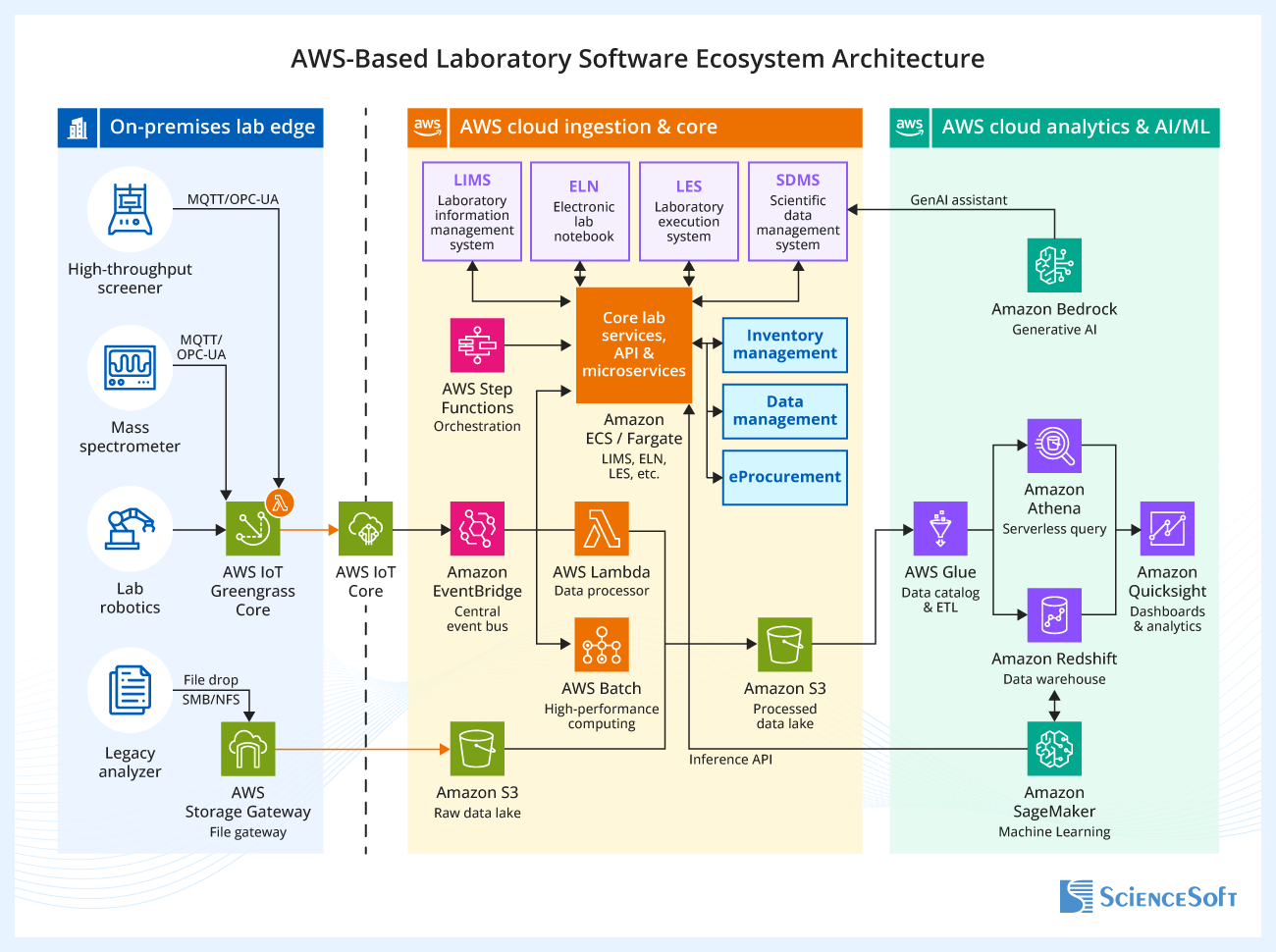
Below is a modular, cloud-native, event-driven reference architecture for a laboratory software ecosystem on AWS. It fits many lab setups (e.g., hospital lab networks, reference labs, and research institutions) and supports phased modernization while legacy systems remain in use. This modular design lets IT teams modernize one workflow (e.g., ingestion, QC, reporting) at a time without a full system replacement.
Lab data capture at the edge
Lab instruments stream run readings through an on-premises edge gateway that buffers messages during short outages and forwards them to a cloud device hub (AWS IoT Core) when connectivity returns. Legacy analyzers export result files and run logs to an on-premises file gateway, which caches data locally and uploads it to the raw data lake (Amazon S3).
This hybrid capture approach supports mixed instrument fleets, preserves traceability from instrument output to stored records, and reduces interface rewrites during lab expansion.
Workflow orchestration and core lab services
Device hub messages, new raw-lake objects, and core services emit events (e.g., run completion, QC failures, or result release) to a central event bus (Amazon EventBridge), which routes them to the appropriate workflow and service. A workflow orchestrator (AWS Step Functions) coordinates event-driven workflows and dispatches tasks to containerized microservices that run on a container platform (Amazon ECS and AWS Fargate).
These services deliver LIMS, ELN, LES, and SDMS functions behind a Core Lab Services API that standardizes orders, specimens, results, and audit records. Integration adapters connect the Core Lab Services API with EHR systems and referral labs for order intake, result delivery, and acknowledgements. The adapters translate HL7 v2 and FHIR payloads into the canonical model and back, so acknowledgements and status updates are consistent across partners.
Systems exchange data through synchronous API calls and through event messages that capture workflow status changes, delivery acknowledgements, and error conditions. This pattern reduces point-to-point interfaces, supports reliable retries, and keeps changes isolated when new instruments, partners, or workflows appear.
Data processing and canonicalization
Raw instrument streams and uploaded files land in the raw data lake, then serverless data processors (AWS Lambda) validate payloads in real time and flag out-of-range values. Raw zones retain original instrument files for reruns and regulatory review.
Compute-heavy transformations run as batch or high-performance compute jobs (AWS Batch), which can parallelize workloads and provision capacity on demand (e.g., for spectral deconvolution and image feature extraction). Lambda and burstable Batch capacity keep compute spend aligned with workload peaks. Clean outputs land in the processed data lake (Amazon S3), aligned to a canonical lab data model with versioned mappings for test codes, units, and reference ranges. Lineage metadata records the source, applied mapping with version, and timestamps to support traceability and safe reuse.
Analytics and AI enablement
In a processed data lake (Amazon S3), a data catalog and ETL layer (AWS Glue) define schemas for governed data discovery and reuse. Serverless SQL queries (Amazon Athena) run on lake data, and a data warehouse (Amazon Redshift) stores curated reporting datasets for recurring dashboards (Amazon QuickSight) (for turnaround time, QC drift, instrument utilization, reagent consumption, etc.). Athena supports exploration pay-per-query without warehouse resizing, and Redshift covers repeatable reporting workloads.
An inference layer (Inference API) connects machine learning models (Amazon SageMaker) and a GenAI assistant (Amazon Bedrock) to provide predictions and recommendations. This layer also lets IT teams update AI models without changing workflow logic or integrations.
How We Handle the Common Challenges in Laboratory Software Projects
Challenge #1. Fragmented workflows due to a lack of system and instrument integration
It's common for labs to use several separate, non-integrated solutions (e.g., for sample and inventory management), and external services (e.g., for billing). Moreover, these systems may vary across departments and locations (e.g., they can use different LIMS), and often face interoperability or legacy issues. Integrating them can be a major challenge, as well as connecting complex lab equipment from different manufacturers. If integration is ineffective, it results in a fragmented ecosystem, poor automation, and the inability to implement efficient data analytics.
Solution
Solution
Our laboratory informatics software can integrate with legacy sources using custom adapters that fetch data and map outdated fields to standard formats such as FHIR. For analyzers, we develop custom middleware that receives and parses instrument output formatted according to outdated protocols like ASTM E1381/E1394. The middleware applies transformation rules and forwards validated test results to the LIMS. Our engineers can also build laboratory orchestration tools that consolidate all equipment and systems into one to fully automate all processes (equipment setup and control, data processing, analytics, etc.).
Hide
Challenge #2. Inadequate support for molecular data formats
Labs working with cell and gene therapies, ADCs, or RNA-based treatments must interpret complex molecular data. These may include flow cytometry datasets (e.g., FCS with MIFlowCyt-compliant metadata), chromatographic profiles, gene expression matrices, or sequence files in formats like FASTA and FASTQ. Moreover, since biotech continues to evolve rapidly, software systems must not only support the data formats currently used in the lab but also be architecturally ready to accommodate new types of biomolecular structures, markers, and assay readouts.
Solution
Solution
As a laboratory software development company, ScienceSoft develops systems that support molecular data formats used in biomedical research, e.g., FCS for flow cytometry data. Moreover, our architects design lab software to support adaptation to new data types. For example, this can be done by building format-agnostic data ingestion layers. In this case, components that process raw instrument output are designed as isolated, reusable modules. When new compound classes or diagnostic markers are introduced, only a lightweight parser module and a metadata map need to be added; no changes to the entire system are required.
Hide
ScienceSoft’s Clients Say


bioAffinity Technologies hired ScienceSoft to help in the development of automated data analysis software for the detection of lung cancer using flow cytometry.
Our project required a large amount of industry-specific methodology and algorithms to be implemented into our new software connected to EHR/LIS systems, which the team handled well. In addition to the solid technical expertise shown by ScienceSoft, its developers demonstrated a profound understanding of laboratory software specifics and integrations.



During our cooperation, ScienceSoft proved to have vast expertise in the Healthcare and Life Science industries related to the development of desktop software connected to laboratory equipment, a mobile application, and a data analytics platform.
They bring top-quality talents and deep knowledge of IT technologies and approaches in accordance with ISO 13485 and IEC 62304 standards. I would certainly recommend ScienceSoft as a reliable partner in IT consulting.


Working with ScienceSoft was a pleasure from A to Z. Their deep knowledge of the healthcare industry specifics and DICOM standard helped us create the back end of the software for our ultrasound scanner.
We are grateful for their can-do attitude, responsiveness, and straightforward communication. RIVANNA already witnessed tangible benefits of our cooperation.

Looking to Build or Evolve Your Lab Software?
