ScienceSoft Global



Virtual Reality for Medical Education
Overview
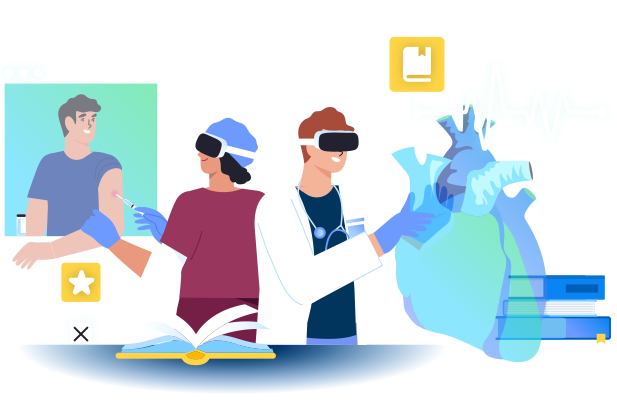
Virtual reality (VR) technology transforms medical education because it provides a realistic environment to learn from experience and apply knowledge. VR-based medical education proved to be more effective than traditional methods and safe for students and patients.

About ScienceSoft
Founded in 1989, ScienceSoft is a global software development and AI transformation company with over 750 employees on board. Our experience in healthcare and education industries helps us develop professional virtual reality software for medical education. In our VR projects, we employ robust quality and data security management systems, supported by ISO 9001 and ISO 27001 certificates.
Market Overview of VR for Medical Education
The global virtual reality in medical education and training market was valued at $3.88 billion in 2024 and is projected to reach $11.07 billion by 2032, with a 13.5% CAGR. Being one of the key investors in VR-based learning, the healthcare industry leverages the technology due to the rise of the geriatric population and the growing need for highly skilled medical professionals.
Use Cases of VR for Medical Education

Anatomy and physiology learning
VR enables students to explore anatomically accurate 3D models of organs, tissues, vessels, and systems at any scale and from any angle. Unlike static atlases or cadaver labs, VR allows dynamic visualization of physiological processes (e.g., blood flow, nerve signaling), layered dissection, and repetition without material limits.
Business value:
-
Faster knowledge retention compared to textbook-based learning
-
Reduced dependency on cadaver labs and physical materials
-
Scalable training across campuses and remote cohorts

Procedural and clinical skills medical training
VR enables hands-on simulation of tasks ranging from basic nursing tasks to complex interventions without patient risk. Scenarios can be adjusted for difficulty, complications, and time pressure, allowing repeated practice and objective performance assessment.
Business value:
-
Reduced training-related risks and liability
-
Measurable skill progression through analytics
-
Faster onboarding of clinical staff

Medical social skills learning
VR simulations allow learners to practice communication with AI-driven virtual patients representing diverse ages, conditions, cultural backgrounds, and emotional states. Scenarios include patient intake, informed consent, delivering diagnoses, and de-escalation in stressful situations.
Business value:
-
Improved patient satisfaction and reduced clinical errors
-
Standardized assessment of soft skills across learners
-
Lower costs vs. standardized patient programs

Medical equipment and device training
VR simulations replicate the operation of medical devices such as imaging systems, ventilators, infusion pumps, and diagnostic equipment. Learners can train on normal operation, error scenarios, and emergency situations without occupying real equipment or disrupting care delivery.
Business value:
-
Shorter learning curves for new staff
-
Reduced equipment downtime and training costs
-
Consistent training across locations

Emergency and high-risk scenario simulation
VR allows training for emergency scenarios that are difficult or unsafe to simulate in real life (mass casualty events, ICU crises, surgical complications, or equipment failure during procedures).
Business value:
-
Improved clinical readiness under pressure
-
Better team coordination and decision-making
-
Compliance with emergency preparedness requirements

Certification and competency validation
VR can be used not only for training, but also for formal assessment and certification of medical professionals. Learners complete standardized VR scenarios where their actions, timing, decisions, and outcomes are automatically tracked and scored against predefined criteria.
Business value:
-
Standardized skills assessment across locations and cohorts
-
Reduced reliance on subjective evaluations and in-person examiners
-
Verifiable training outcomes for regulators, accreditors, and insurers
Why Organizations Choose Custom VR Over Off-the-Shelf Solutions
Many off-the-shelf VR training tools cover isolated scenarios. Custom VR medical education platforms allow organizations to:
-
Align training with internal protocols and curricula
-
Integrate with LMS, EHR, and analytics systems
-
Scale content, users, and scenarios over time
-
Own and evolve intellectual property
This is where ScienceSoft typically delivers the most value.
Architecture of VR Medical Education Software
Virtual reality medical education software consists of three key parts: a database web server, which stores 3D models and scenarios, a web administration panel, which enables database management and scenario editing, as well as a client VR application.

The most complex element of the architecture – the client VR application – includes the following modules:
- VR visualization module builds the entire VR environment. Its physics simulator – realized via NVIDIA Flex – applies the laws of physics to all 3D models used in the VR scene. The AI submodules control virtual autonomous characters who play the roles of patients, assistants and tutors.
- Scenario editing module enables editing of the sequences of the scenarios that are stored in the relevant database.
- Scenario simulation system allows a user to interact with the scenario and its content.
- Built-in quiz and test data is an optional load of tasks aimed at verifying a medical student’s knowledge. It can require verbal answers as well as practical steps.
- Learning analytics module uses predefined criteria to assess a medical student’s performance. It can share data with the Learning Management System when integration is in place.
Advanced Features of VR Medical Education Software

Artificial Intelligence, trained specifically to create realistic virtual patients.

Possibility to have a learning session with multiple students simultaneously.

Learning session with a virtual instructor or a cooperative session, where a student and an instructor both use VR.

Possibility to create multiple new scenarios and 3D models and upload them to the database.
Technology Stack
3D modeling
- Autodesk Maya
- Autodesk 3ds Max
- Substance Painter
- Photoshop
VR engine
- Unreal Engine
- Unity
- CRYENGINE
- Amazon Sumerian
Clouds
- Amazon Web Services
- Microsoft Azure
- Google Cloud Platform
- DigitalOcean
- Rackspace Technology
Cloud databases, warehouses, and storage
AWS
- Amazon S3
- Amazon Redshift
- Amazon DynamoDB
- Amazon DocumentDB
- Amazon RDS
- Amazon ElastiCache
Azure
- Azure Data Lake
- Azure Blob Storage
- Azure Cosmos DB
- Azure SQL Database
- Azure Synapse Analytics
- Kinect DK
- Azure RTOS
Google Cloud Platform
- Google Cloud SQL
- Google Cloud Datastore
Other
- Microsoft Fabric
Implementation Costs of a VR Medical Education Solution
For each VR project, ScienceSoft calculates the cost of VR software development first.
General cost drivers
- Method of acquiring/creating key art assets (Photoshoot, 3D CAD rendering, Video shoot).
- Number of 3D models (in case of 3D CAD rendering).
- Number of AI-controlled virtual patients.
- Number of user roles.
- Number and complexity of education scenarios.
Additional solution costs
- VR equipment.
- Development of a learning analytics module.
- Possible integrations with:
- Learning Management System (LMS).
- Content Management System (CMS).
Operational costs
- Cloud services (costs depend on the volume of stored data, bandwidth, and a cloud services provider’s pricing policy).

From ScienceSoft’s experience, the cost of VR software for medical education varies from $120,000 to $360,000.
Want to know the cost of your VR medical education solution?
Get a Cost Estimate for Developing Healthcare VR Software
Please answer a few questions about your business needs, and our consultants will get back to you with a custom cost estimate.

Success Stories of VR for Medical Education

Taiwan’s top higher education institution – Taipei Medical University
partnered with HTC in 2019 to create VR software for anatomy learning. The final solution is now referred to as the "world's largest VR anatomy class", since it offers more than 4,000 highly detailed anatomical 3D models and supports up to 300 online students. The University's staff reports that the solution helps students gain a more in-depth understanding of anatomy, thus providing a solid knowledge basis for a specialist in any medical field.
Ohio State College of Medicine
developed a VR solution that draws on the potential of AI technology. VR software lets medical students hold realistic conversations with virtual patients, who have various backgrounds and even different levels of English language proficiency. The VR solution proved to be not only extremely helpful in the learning process but also very cost- and time-effective since it substitutes the need for real-life practice with multiple specifically trained community members.
The Challenge of VR for Medical Education

One of the biggest challenges in VR-based medical education is creating realistic, interactive virtual patients. For training to be effective, learners must engage with patients that respond in a lifelike and contextually appropriate manner. Achieving this requires advanced AI capable of interpreting and generating both verbal and non-verbal communication, including tone, gestures, and facial expressions.
High-quality AI ensures that scenarios feel authentic, helping students build critical clinical reasoning, decision-making, and communication skills in a safe, risk-free environment.
VR for Medical Education: Consulting and Development by ScienceSoft
Your guarantee of a successful VR medical education project is in ScienceSoft’s 30 years in 3D modeling, 21 years in healthcare IT, and experience in developing LMS and VR training solutions. Our top priority is driving project success no matter what, while adhering to the agreed timeline and budget and swiftly responding to any uncertainties.

VR for medical education: consulting
- Concept productization.
- Long-term road-mapping.
- Scalable architecture design.
- Technology stack definition.

VR for medical education: development
- UX and UI design.
- 3D modeling, VR development, and QA.
- Hardware and software integration.
- Continuous support and evolution.
Trusted by Healthcare Leaders