 ScienceSoft Global



Q3 2026 Healthcare AI Trends: Adoption Outpaces Proof of Value, Agents Scale, Health Systems Buy Governance Software



Related topics:
8 min read
Last updated:
A global AI transformation and healthcare IT consulting company, ScienceSoft works with healthcare providers and healthtech companies on AI adoption, implementation, and scaling. Drawing on findings from our Q3 2026 Healthcare IT Market Watch, we identified five shifts that may shape healthcare AI over the next 12 months.
Key takeaways:
- Healthcare providers keep scaling AI, but measuring its value is still a challenge. Without established ways to quantify AI impact, providers may struggle to tell whether successful pilot results justify wider deployment.
- Health systems are beginning to buy dedicated AI governance software. However, AI governance across the broader market remains much less mature.
- AI chatbots are becoming a new route to care. General-purpose (e.g., Gemini) and provider-owned AI assistants can now connect patients to provider search and booking.
- Some healthcare AI agents are reaching production scale, primarily in administrative workflows. Providers remain cautious about letting autonomous agents move into tasks requiring clinical judgment.
- Diagnostic AI validation is becoming a shared effort. 12 US health systems will evaluate AI-enabled diagnostic workflows and turn what works into shared practices.
Healthcare AI Keeps Scaling, but Value Measurement Is Not Keeping Up
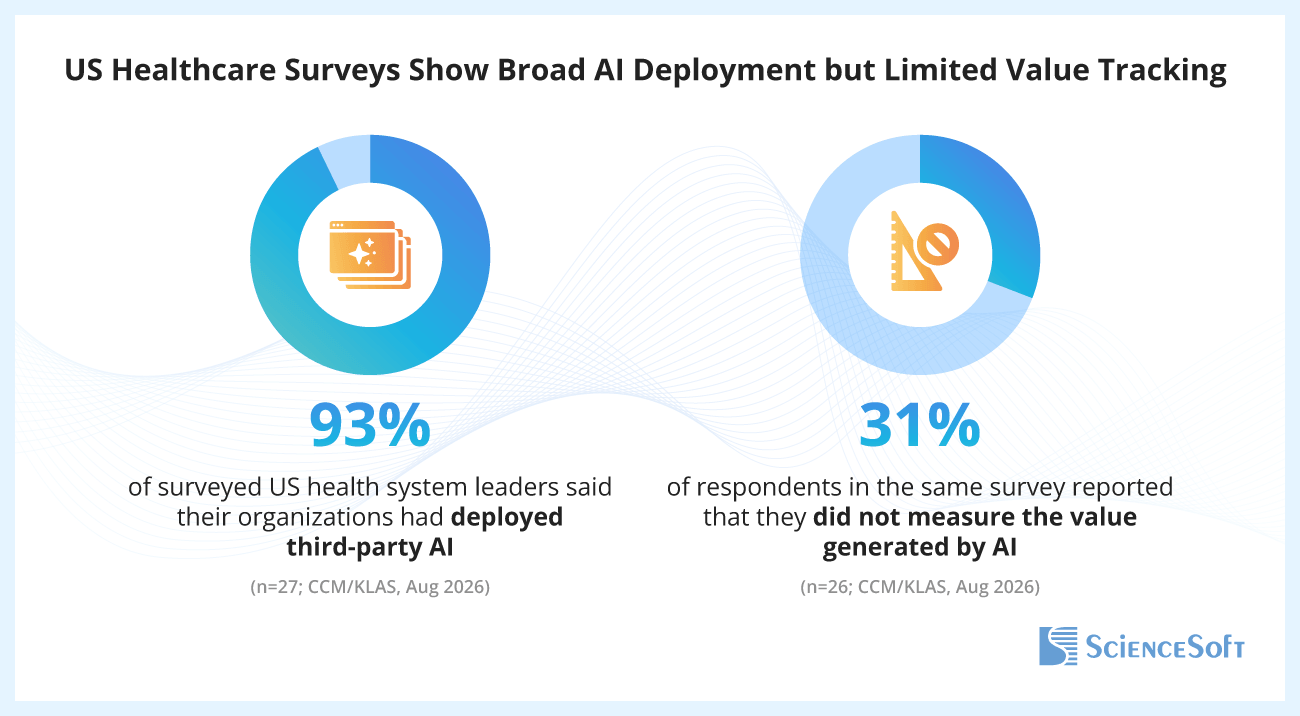
AI use in healthcare is already widespread, while consistent ways to prove its business impact are much less established. More than 90% of health systems surveyed by CCM and KLAS had deployed third-party AI, while nearly a third had not started measuring AI value.
This gap persists even among advanced AI adopters. In a survey of 64 US healthcare finance leaders, Deloitte found that among the 44% of organizations already scaling GenAI across multiple functions, only 18% consistently measured AI's impact on revenue growth or cost savings.
AI's value can be difficult to measure because the technology usually changes one task, while the outcomes providers care about depend on the wider workflow. An AI model may increase accuracy or save time on one step without improving the final clinical, operational, or financial result.
A Black Book survey shows that healthcare organizations often measure the AI itself more closely than its downstream effects. Among 230 US and EU healthcare leaders, 76% said their organizations monitored ML model accuracy after deployment, while only 32% tracked clinical outcomes and 28% tracked changes in staff workload. In the same survey, 68% had encountered at least one ML model that met its accuracy target but still increased staff workload, false-positive alerts, or care utilization.
In ScienceSoft's experience, missing evidence on an AI tool’s downstream effects can affect business decisions, especially about AI scaling. A pilot can look successful on local metrics, and giving them too much weight can lead to unnecessary investment in a wider rollout.
A successful AI pilot doesn’t automatically make the case for scaling.
For example, let’s say a provider’s goal is revenue increase, and an ambient scribe saves three minutes per visit on average. The actual saving may be smaller on some visits if the physician needs more time to review and correct the AI-drafted note. And even if those three minutes are saved, they don’t automatically become three minutes of extra patient capacity. The clinic may still be limited by appointment schedules, room availability, or nursing coverage.
So I’d start with the outcome you actually want from the AI. If it’s more patient capacity, see whether the time saved really lets clinicians take more appointments. If it’s less after-hours charting, measure that instead. If it’s lower operating costs, look for costs that actually decrease. Then compare that benefit with what it costs to implement and run the AI before deciding whether to expand it.

Senior Healthcare IT & AI Consultant, ScienceSoft
Health Systems Start Buying AI Governance Software, but the Broader Industry Is Far From Maturity
Dedicated AI governance software is beginning to appear across multiple health systems. NewYork-Presbyterian, an academic health system, adopted the AI Management System (AIMS) from healthcare AI software vendor Signal 1 to extend its existing governance framework. MercyHealth, a nonprofit health system, selected Vitea's platform for enterprise AI governance.
Yet industry-wide AI governance remains much less mature. Black Book surveyed 230 US and EU healthcare leaders and found that 78% of their organizations ran AI or ML in sustained production, but only 19% had complete AI lifecycle controls.
ScienceSoft sees these purchases as an early sign that AI governance is becoming a separate software-buying decision for providers with growing AI portfolios.
When should you consider paying for a centralized AI governance platform? When the governance process becomes a burden, basically. If you only have a few models for local tasks, you’re likely doing fine with your existing tools. Building a governance hub starts to make sense when you have so many AI tools that governance work is spread across multiple systems and teams that have to coordinate regularly. In that case, having one place for all that work would remove a pretty significant administrative burden.
Smaller and midsize providers are less likely to reach that level of complexity soon, which is why I don’t expect AI governance software to become a common purchase for them in the near term.

Head of AI, Principal Architect, ScienceSoft
AI Assistants Are Becoming a New Route to Finding and Booking Care
Provider search and appointment booking are starting to appear inside general-purpose AI interfaces. Zocdoc, an appointment booking platform, connected its marketplace to Gemini. There, users can describe the care they need, see relevant providers, real-time availability, and insurance options, and start booking through Zocdoc. Existing Zocdoc providers were automatically enabled, so they did not need a separate Gemini integration. Moreover, through its Care Access Network, Zocdoc can use the same provider connection to make appointments bookable through other AI platforms and search engines.
This creates a new patient access question for providers. Traditionally, they have tried to bring patients to their own websites, apps, and call centers to find and book care. If patients increasingly start that search inside Gemini or another AI assistant, some provider discovery may happen before they ever reach a provider-owned channel.
Atlantic Health is testing the opposite approach: bringing conversational AI into a channel it controls. Its PatientGPT, now in beta, is embedded in the health system’s MyChart patient portal and connected to its EHR. Patients can ask AI health questions, get guidance based on their records, find appropriate care, and connect to Atlantic Health services, including same-day virtual primary care.
ScienceSoft sees these developments as an early sign that AI may change where patients begin looking for care. But there is not yet evidence that a substantial share of patient acquisition is moving away from provider-owned channels.
I don’t think providers need to assume right now that AI assistants will become a major source of patients. I would treat them as an emerging acquisition channel and watch actual demand. If a third-party AI platform starts sending meaningful appointment traffic in your market, you can test whether those referrals reach patients you would not otherwise acquire, match patients to services properly, and produce completed visits.
A provider-owned AI assistant is a different case. It’s less about expanding reach and more about offering an extra patient engagement channel. For patients, the appeal is that the provider stands behind the quality of the medical advice, unlike with a general-purpose chatbot, and they can move directly from questions about their symptoms to booking.
Senior Healthcare IT & AI Consultant, ScienceSoft
Healthcare AI Agents Reach Production Scale in Administrative Tasks
Healthcare AI agents are now appearing at production scale, with some handling hundreds of thousands of patient interactions, specifically in routine administrative and financial workflows. A regional health system, WellSpan Health, says its GenAI agent Ana manages more than 160,000 patient calls each month. Ana handles inbound patient calls and primary care scheduling. WellSpan plans to extend Ana to post-discharge follow-ups and chronic disease check-ins and also to test voice AI tools that support clinicians with triage.
Cedar, a patient financial platform for healthcare providers, reports its Kora AI billing agents have handled more than 600,000 inbound conversations to date, with 40% of inbound calls fully resolved without a human agent. The agents can explain bills, collect insurance information, and help patients complete payments, while clinical and out-of-scope issues go to staff.
However, when the agent’s work involves clinical or coding decisions, providers are much more cautious about how much autonomy they allow it. An EHR vendor, Oracle Health, added coding capability to its Clinical AI Agent but kept the final decision with clinicians, who review and confirm suggested codes before submission. Built into Oracle Health EHR, this voice-enabled assistant also captures clinician-patient conversations, drafts notes, and surfaces relevant chart information.
ScienceSoft also sees healthcare client interest in AI agents mostly for clearly defined administrative workflows such as medical coding, scheduling, or revenue cycle management.
Health Systems Are Turning Diagnostic AI Validation Into Shared Work
12 US health systems, including Advocate Health, Northwell Health, and Sutter Health, formed the Diagnostic AI Consortium with clinical AI company Aidoc to evaluate AI-enabled diagnostic workflows across member sites. Aidoc will provide the infrastructure the consortium uses to deploy and monitor AI. The group plans to measure AI safety, output quality, and speed to diagnosis, then turn what works into shared implementation and governance practices. The consortium expects to begin sharing what it learns in 2027.
Aidoc describes it as a first-of-its-kind initiative in which providers are jointly developing practices for validating diagnostic AI. Initiatives like this could change the trajectory of clinical AI development because better AI models are only part of the challenge. Another barrier is proving that their results can be reproduced across different healthcare organizations.
An AI accuracy score does not automatically travel with the model.
For example, a model tested at a large referral center may see a very different mix of patients at a community hospital. If the condition is much rarer there, the same model can produce far more false alarms for every true case it finds.
That is why the consortium’s most valuable result may be the validation method another hospital can actually repeat, not another accuracy number. How can it retest the model on its own recent cases? How can it measure missed urgent findings and unnecessary follow-ups?
A repeatable method travels further than an accuracy number.

Healthcare IT & AI Consultant, ScienceSoft
References
NewYork-Presbyterian Adopts Signal 1's AI Management System to Advance Healthcare Innovation and Enhance Patient Safety (NewYork-Presbyterian, August 3, 2026).
Mercyhealth Selects Vitea to Responsibly Scale AI Across Its System (Vitea, August 11, 2026).
Healthcare Machine Learning Hits Production Scale as Governance Falls Behind, Black Book's Fourth Annual Report Finds (Black Book Research, August 13, 2026).
Validation and Trust: The Governance of AI Solutions at Health Systems (UPMC Enterprises, August 6, 2026).
Momentum Isn’t a Metric: Many Healthcare CFOs Report They Need Clearer Proof of AI Value (Deloitte, August 12, 2026).
Zocdoc Brings Seamless, Real-Time Appointment Booking to Gemini (Zocdoc, August 12, 2026).
Zocdoc Enters Its Next Chapter, Expanding Beyond Its Marketplace to Power Access to Care Everywhere (Zocdoc, September 16, 2026).
Atlantic Health and K Health Launch Innovative AI Platform to Improve Access to Care Across New Jersey (Atlantic Health, August 11, 2026).
WellSpan Expands Hippocratic AI Partnership to Support Clinical Operations and Improve Patient Experience (WellSpan Health, July 30, 2026).
Cedar Launches Agentic Platform to Help Providers Collect from Healthcare’s Fastest-Growing Payer: Patients (Cedar, August 13, 2026).
Oracle Health Expands Clinical AI Agent with Coding, Dictation, and Chart Review (Oracle, August 19, 2026).
Twelve US Health Systems and Aidoc Unite to Form Diagnostic AI Consortium (Aidoc, August 11, 2026).
Version History
Browse earlier quarterly editions of our healthcare AI trends report:
