ScienceSoft Global



AI for Prior Authorization Automation
Use Cases, Architecture, Costs
With healthcare software engineering experience since 2005, ScienceSoft helps healthcare providers implement AI for prior authorization automation. Our solutions reduce manual work in request preparation, submission, tracking, and appeals while keeping clinical decisions and final approvals under staff control.
Contributors

Senior Solution Architect, Healthcare, ScienceSoft

Head of AI, Principal Architect, ScienceSoft
AI for Prior Authorization Automation: Essence
AI for prior authorization automation helps healthcare providers prepare, submit, and manage authorization requests with less manual chart review, data re-entry, payer portal work, and status follow-up. Depending on the organization’s needs, AI can support the process from the moment a clinician places an order until the request is approved, denied, withdrawn, or escalated for appeal.
Why Providers Strive to Automate Prior Authorization
CMS estimates that requesting prior authorization currently takes providers an average of 13 hours per week and costs approximately $20–$50 per hour. According to CMS, this represents about 700 hours and $34,000 in administrative work per provider annually — time and resources that could otherwise support patient care be spent directly on patient care.
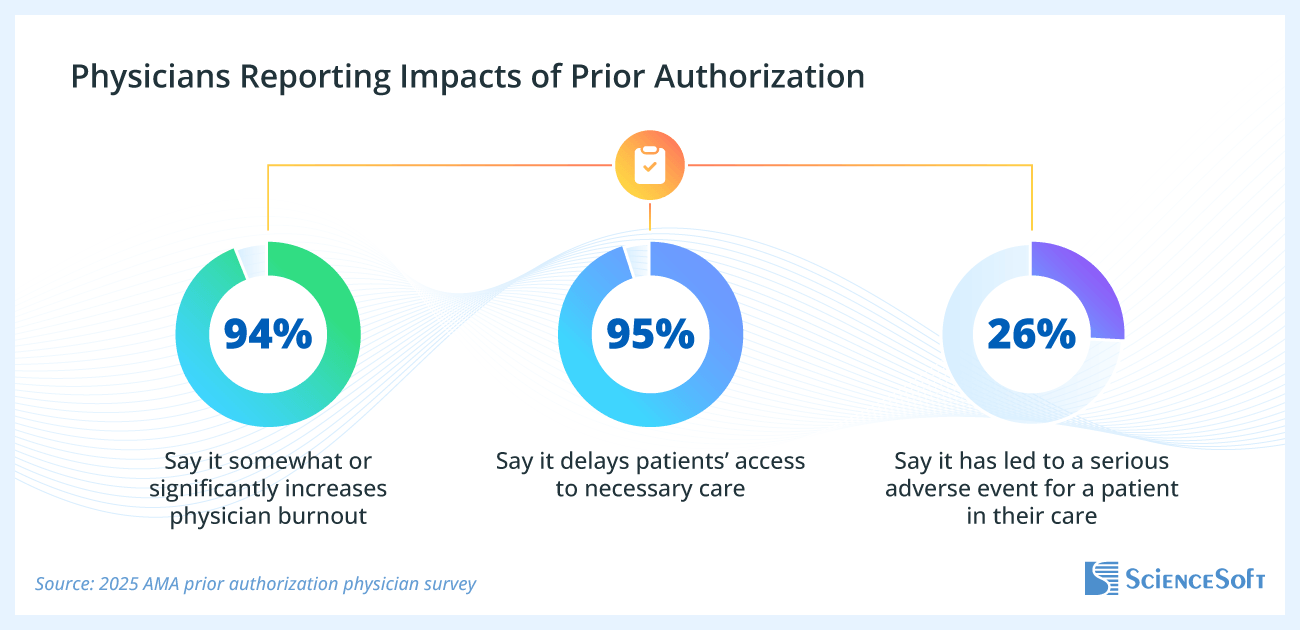
The 2025 AMA prior authorization survey illustrates the broader impact. 94% of surveyed physicians report that the process somewhat or significantly increases physician burnout. At the same time, 95% report that prior authorization delays patients’ access to necessary care, while 26% say it has led to a serious adverse event for a patient in their care.
Despite this burden, electronic support remains limited. Only 24% of surveyed physicians report that their EHR offers electronic prior authorization for prescription medications, while phone remains the most commonly used method for completing prior authorizations for medical services.
Where Healthcare Providers Usually Start
Implementing AI for prior authorization automation does not necessarily mean replacing the hospital’s existing authorization management software or revenue cycle platform. ScienceSoft can build targeted AI components within current workflows or create a shared authorization automation layer that connects multiple systems, service lines, and payers.
- Entry level: AI-assisted request preparation. A hospital starts with one high-volume service line, such as diagnostic imaging or surgery. An AI agent retrieves relevant information from the EHR, prepares a structured authorization summary, prepopulates required fields, and identifies missing documentation. Authorization specialists review the prepared request and continue submitting it through the existing payer portal or clearinghouse workflow.
- Mid-scale: Integrated submission and status management. An AI-assisted request preparation module is connected to the EHR, authorization work queue, clearinghouse, and selected payer APIs. The system can check authorization requirements, prepare and validate requests, and submit them electronically while tracking payer responses. Ambiguous requests and clinical documentation are reviewed by staff.
- Enterprise level: Centralized prior authorization orchestration. A shared prior authorization layer serves multiple hospitals, facilities, departments, and payer contracts. The platform may support medical and pharmacy benefit workflows, API-enabled payers, X12 transactions, clearinghouses, and controlled portal automation. It can centralize authorization work management, denial and appeal handling, and operational analytics.
Prior Authorization Metrics AI Can Improve

Order-to-submission time
Faster preparation of authorization requests by reducing manual chart search, data entry, and documentation assembly.
Specialist handling time
Less staff effort spent finding clinical evidence, completing forms, checking status, and preparing follow-ups.

First-pass approval rate
More complete and consistent requests, with required clinical evidence identified before submission.
Additional-information requests
Fewer payer requests caused by missing documentation, incomplete fields, or inconsistent information.
Authorization-related care delays
Earlier requirement checks and better status visibility help reduce procedures postponed because authorization is incomplete or unresolved.
Appeal preparation time
Faster denial review and appeal drafting through automated retrieval and summarization of relevant clinical evidence.
How AI for Prior Authorization Automation Works
Common use cases

Prior authorization requirement discovery
AI checks whether a planned test, procedure, treatment, or medical device requires prior authorization under the patient’s health plan. Where electronic payer connections are available, it can retrieve the applicable requirements directly during order entry. For other payers, it can use approved policy databases, clearinghouses, or portal integrations. If the requirements are unclear or conflicting, the case is routed to staff for review.

Clinical data extraction and request prepopulation
AI retrieves relevant information from the patient’s EHR, such as diagnoses, clinical notes, and test results. It then uses this information to prepopulate the payer’s required fields or questionnaire and links each entry to the original source record. For example, an advanced imaging request may require evidence of symptoms, prior imaging, and conservative treatment. AI can locate and summarize this supporting information for staff review.

Documentation completeness checks
Before submission, AI compares the request with the payer’s requirements and checks whether all necessary information is present and consistent. It can verify diagnosis and procedure codes, required clinical documentation, and service details such as dates or quantity. If information is missing or inconsistent, it flags it for staff review. Rule-based checks are used for clearly defined requirements, while AI helps interpret clinical notes and other unstructured records. AI does not create information to complete missing fields.

Electronic request submission
After an authorized staff member reviews and approves the request, the system submits it through the best available channel. This may include a payer API, clearinghouse, electronic healthcare transaction, authorization management platform, or controlled payer portal integration. Each submission receives a unique identifier and remains linked to the original order, staff approval, and payer response. This helps the provider track the full authorization history.

Status tracking and response routing
AI monitors submitted requests and presents payer responses in a centralized work queue, regardless of how they were received. Staff can see whether a request is under review, approved, or needs further action. Based on the response, AI can notify the authorization specialist, clinician, or scheduler and update the related service status.

Processing requests for additional information
When a payer requests additional information, AI summarizes what is needed and searches the permitted parts of the EHR for relevant records. It can then prepare a response package, identify documents that could not be found, and route the case to staff for verification and submission. Every statement and document in the prepared response remains linked to its original source. This allows staff to confirm where the information came from before sending it to the payer.

Authorization lifecycle integrity
The solution must detect changes in date, provider, facility, code, units, or order after authorization and determine whether an update, extension, or new request is needed.

Denial analysis and appeal drafting
When a request is denied, AI can summarize the payer’s reason and compare it with the original submission, applicable payer policy, and available patient records. It can then prepare an appeal draft with relevant clinical information, supporting documents, a treatment timeline, and the applicable coverage or documentation criteria. AI also highlights information that still requires input from a clinician. Qualified staff review and approve the final appeal.

Work queue prioritization
AI can help staff organize authorization requests based on factors such as the planned service date, urgency, and payer deadline. It can also flag cases that are more likely to require additional follow-up. These recommendations help staff decide which requests need attention first without automatically deprioritizing other patients’ cases.

Prior authorization analytics
AI-supported analytics help healthcare providers identify recurring problems by payer, service line, or denial reason. For example, analytics may reveal that requests regularly wait for signed notes, a payer repeatedly asks for the same attachment, or payer responses remain unprocessed. They can also show whether denials are commonly related to eligibility, missing documentation, or clinical criteria and how appeal outcomes vary across payers and services.
Reference architecture
The diagram below shows an EHR-embedded prior authorization automation and orchestration layer that works on top of the hospital’s existing EHR, clinical, scheduling, and revenue cycle systems. It represents a scalable target architecture: providers can start with selected capabilities, such as AI-assisted request preparation, and add more automation over time. The architecture is vendor- and cloud-agnostic — each component represents a capability that can be implemented on the hospital’s existing stack. The AI model layer is also replaceable, allowing different commercial or open-weight models to be selected or swapped as cost, performance, security, and deployment needs evolve.
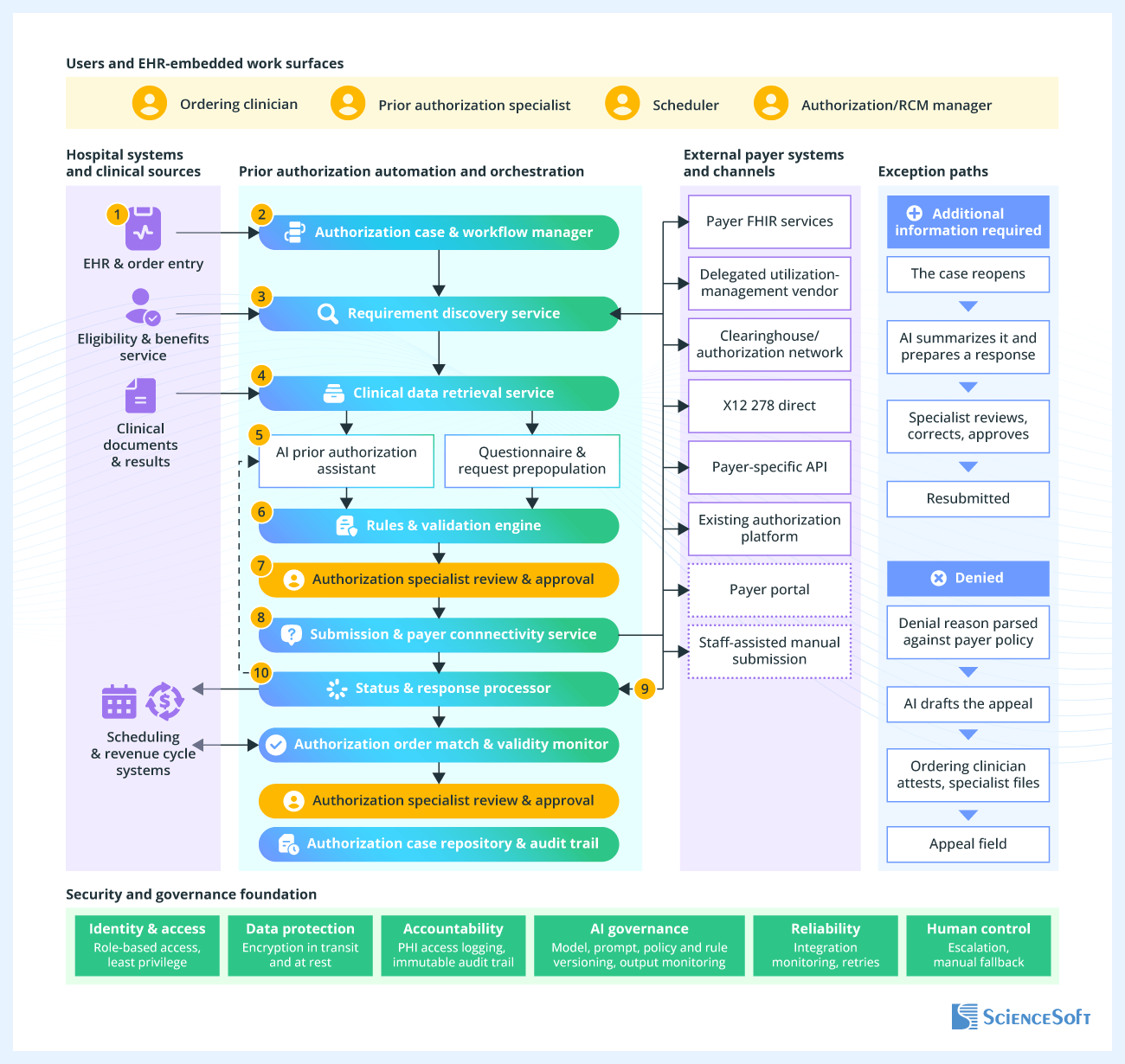
Here is how a typical prior authorization workflow would run in this setup:
- Order placement. The workflow starts when a clinician places an order in the EHR.
- Case creation. The EHR passes the order, coverage, and planned service details to the workflow management service, which creates and coordinates the authorization case.
- Requirement discovery. The requirement discovery service confirms the patient’s plan, checks whether prior authorization is needed, determines whether the payer or a delegated vendor makes the decision, and retrieves the applicable requirements and supporting-document needs.
- Clinical data retrieval. The solution collects relevant clinical information from the EHR and other hospital systems. Notes, reports, results, and attachments remain linked to their original sources.
- AI preparation. AI identifies and summarizes the clinical evidence relevant to the request and uses it to prepopulate the payer’s questionnaire and authorization fields. Every AI-generated statement remains linked to its source so staff can verify it.
- Rules validation. A deterministic rules engine checks the prepared request against explicit payer and hospital requirements, such as required fields, codes, and consistency with the original order. This separation is deliberate: AI interprets clinical text, while rules handle checks with exact answers.
- Specialist approval. The authorization specialist reviews the prepared request, checks source records, corrects AI-generated answers where necessary, and resolves missing or contradictory information. Nothing is submitted until the specialist approves it.
- Request submission. The solution sends the approved request through the best available channel for the payer or delegated vendor. It prioritizes payer FHIR services and clearinghouses, while payer portals and staff-assisted submission serve as fallback routes.
- Payer response. The payer or delegated vendor returns an acknowledgment, status update, approval, denial, or request for additional information. Depending on the channel, responses may arrive automatically or need to be retrieved by the solution.
- Status processing. The status processor converts the payer response into a consistent internal status and distributes it to the EHR, authorization work queue, scheduling and revenue cycle systems, and management dashboard.
The proposed architecture also supports several capabilities beyond the main workflow, including:
- Post-approval authorization monitoring. A match and validity monitor compares what was approved with what is booked and, later, what was actually performed, helping catch mismatches before they lead to a claim denial.
- Exception handling. Requests for additional information and denials loop back through the same case, AI-assisted preparation, validation, and specialist approval gate.
- Auditability and traceability. A shared authorization case record preserves the original order, payer requirements, supporting evidence, AI and staff versions, submission history, payer responses, and the model, prompt, policy, and rule versions used. This supports audits, error investigation, and ongoing AI evaluation.
- Security and governance. Across the architecture, controls enforce role-based, least-privilege access, encrypt PHI in transit and at rest, protect credentials, log access, and require specialist approval before payer submission.
Store three versions of every answer: what the AI wrote, what the specialist corrected, and what was finally sent. Most teams keep only the final one, so they cannot say whether the model is getting better or worse. The difference between the draft and the approved text is labelled data that costs you nothing: it shows which fields the model gets wrong, and for which payer. After a few months, you can see where staff always make the same correction, and the screen can mark those fields for a careful check while the rest pass quickly. So, the review gate is not only a control — it is also the thing that makes the model better, and nobody has to sit and label data.
Technologies We Use to Implement AI for Prior Authorization Automation
Key Challenges of Implementing AI for Prior Authorization Automation
Challenge #1: AI may use incorrect or outdated payer requirements
Solution
We control requirement retrieval by using an approved source hierarchy and checking the patient’s plan before applying any rule. The solution can query payer FHIR services, clearinghouses, payer or vendor APIs, and a version-controlled internal policy repository, with payer websites treated as a lower-priority source. It records where each requirement came from and which payer, plan, and service it applies to, so it can route uncertain or mismatched results to staff instead of using them automatically.
The solution also treats payer responses, portal content, and other external information as untrusted input rather than absolute truth. It checks new payer information against the case context and provider-held records, including the confirmed plan and previously established requirements. If the sources conflict, AI flags the discrepancy and presents the supporting evidence for staff review instead of automatically continuing the disputed action. External payer content is processed as data, not as instructions that can trigger system actions.
Challenge #2: AI may extract the wrong clinical information or create an unsupported statement
Solution
We keep every AI-extracted clinical fact linked to the exact note, report, or result it came from. This allows authorization staff to open the source record and confirm that the AI understood the information correctly: for example, that a diagnosis was confirmed rather than merely suspected, or that a treatment was completed rather than only planned.
The validation engine automatically checks AI-generated content against structured EHR data where available. It matches diagnosis and procedure codes to the current order, verifies patient and provider details against authoritative EHR fields, and checks dates against the relevant encounter. This helps prevent AI from using information from the wrong patient, provider, order, or period.
The system also verifies that every referenced report or attachment actually exists in the patient record before it can be included in the request. This prevents the AI from mentioning a test result or document that is absent or incomplete.
When the record contains conflicting, outdated, or low-confidence information, the system highlights it for staff instead of presenting it as established fact. For example, it may flag conflicting notes or outdated information that may no longer be relevant.
If a payer asks for information that is not documented in the record, the AI leaves the field unanswered rather than generating a plausible response. This prevents unsupported clinical claims from being added simply to complete the form.
Finally, authorized staff review the proposed clinical statements and approve the request before submission.
Challenge #3: AI-assisted authorization workflows may be difficult to audit and evaluate
Solution
ScienceSoft creates a unified authorization case record that captures the full history of each request, from the original order through payer submission, decision, and appeal. This allows the hospital to reconstruct what happened, investigate errors, and evaluate AI performance.
The record includes:
- The originating order, to confirm that the AI used the correct patient, service, diagnosis, and provider.
- Payer requirements and their source, to verify that the correct policy, plan, and effective period were applied.
- Extracted clinical facts with source links, to check whether the AI interpreted the patient record accurately.
- Validation flags, to show which missing or conflicting information was detected and resolved.
- AI-generated, staff-edited, and final versions, to measure how often and how extensively staff correct AI outputs.
- Review and approval history, to confirm that required human oversight took place.
- Submission details and payer responses, to distinguish content errors from transmission, routing, or payer processing issues.
- Requests for information and appeals, to reveal recurring gaps in AI-prepared submissions.
- Model, prompt, policy, and rule versions, to identify whether an issue was linked to a particular system update.
Together, these records help the hospital determine whether a problem originated in the source data, payer requirements, AI output, validation logic, staff review, integration, or payer processing. They also support compliance reviews and performance comparisons across payers and service lines.
Costs of Implementing AI for Prior Authorization
The cost of implementing AI for prior authorization automation typically ranges from $100,000 to $1,000,000+.
At the lower end, a healthcare provider may implement AI-assisted clinical data extraction and request preparation for one service line and a limited number of payers. Staff continue reviewing requests and submitting them through existing channels. At the higher end, an organization may implement an enterprise prior authorization orchestration layer covering multiple hospitals, service lines, payer connections, electronic submission channels, status automation, additional-information workflows, appeals, and centralized analytics.
These estimates cover solution design and implementation. They exclude third-party platform licenses, clearinghouse charges, payer network fees, cloud infrastructure, AI model usage, and ongoing support.
Key implementation cost drivers
- The implementation scope, including the number of hospitals, facilities, and service lines covered.
- The number of prior authorization workflows covered.
- Staff review, approval, and escalation requirements.
- Appeal preparation and supporting-document workflows.
- The number and complexity of integrations with hospital and external systems, such as EHR, RCM, and payer platforms.
- The number of payers and health plans covered and the variation in their authorization rules and submission requirements.
- Payer policy collection and update processes.
- The structure and accessibility of clinical documentation.
- The need to process scanned or externally supplied documents.
- The number and complexity of rules used to validate prior authorization requests, such as required fields, codes, and consistency with the original order.
- Request volumes and case-processing performance requirements, such as expected throughput, peak loads, and target processing time per authorization case.
- High availability and disaster recovery needs.
- The selected deployment model (cloud, hybrid, or on-premises).
- Security, compliance, auditability, and data retention requirements.
Why ScienceSoft
- In healthcare IT since 2005.
- 150+ healthcare IT projects.
- Experience supporting compliance with HIPAA/HITECH, GDPR, PDPL, and other applicable regulations.
- Deep knowledge of interoperability standards such as HL7 v2 and FHIR.
- Strong security and quality management practices backed by ISO 27001 and ISO 9001 certifications.
- Experience supporting compliance with HIPAA/HITECH, GDPR, PDPL, and more.
- 750+ experts, including AI, software engineering, security, and QA specialists, backed by an Architecture & Solutions Center of Excellence.
- Experience in selecting, adapting, and fine-tuning AI models for healthcare-specific data and workflows.
Certifications and awards
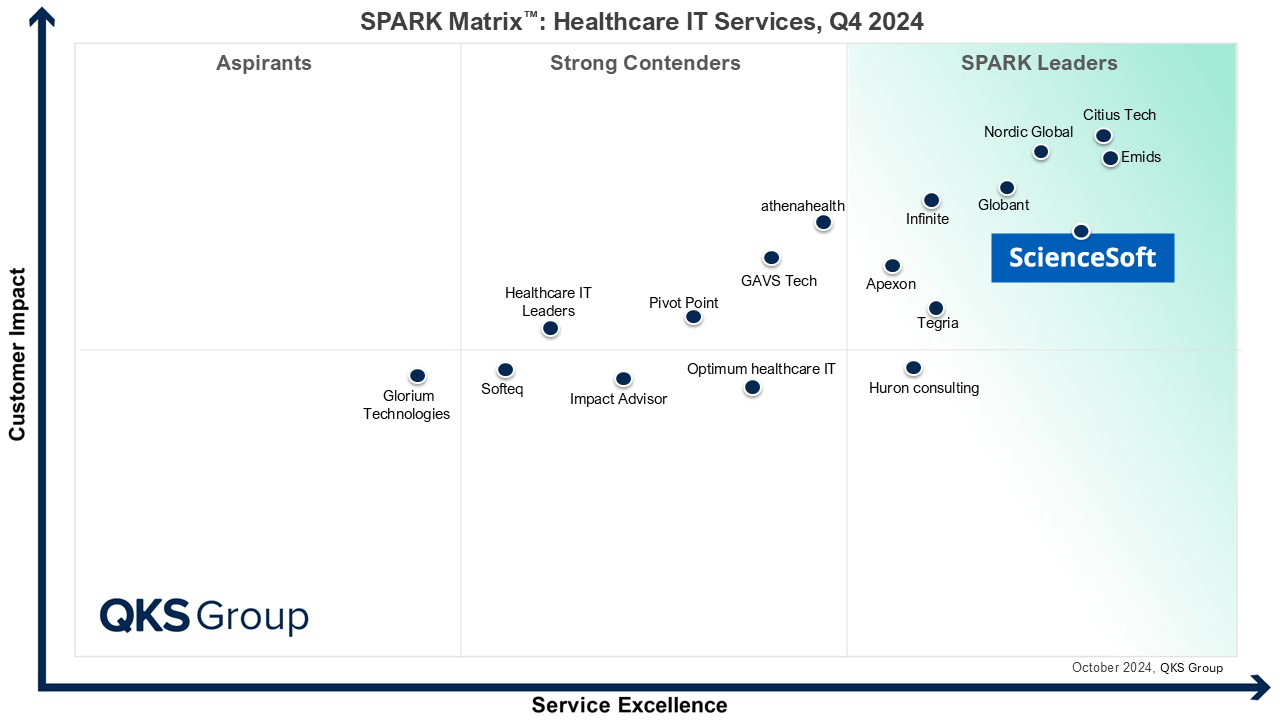
Featured among Healthcare IT Services Leaders in the 2022 and 2024 SPARK Matrix

Microsoft Solutions Partner for Data & AI

Named among America’s Fastest-Growing Companies by Financial Times, 5 years in a row

HTN Now Awards 2025/26 finalist in the Best AI Scribe Solution category

Shortlisted in the Best Use of AI for Healthcare category at The 2026 A.I. Awards
Recognized for Healthcare Technology Leadership by Frost & Sullivan in 2023 and 2025

HIMSS Gold member advancing digital healthcare

ISO 13485-certified quality management system
ISO 27001-certified security management system
Our Clients Say

They collaborated with our medical professionals with great professionalism and care <…>. We found ScienceSoft to be dependable and forward-thinking, and we would confidently recommend them for high-responsibility projects.


Todd Nilson
MD

We are thankful for the meticulous and value-driven approach of ScienceSoft’s team. ScienceSoft’s project manager, business analyst, QA and software engineers were always friendly and ready to answer our questions or solve any ad-hoc issues.

ScienceSoft has been a competent partner for medical software development. We would recommend them as a trustworthy vendor. They are reliable, thorough, smart, available, extremely good communicators and very friendly.


Working with ScienceSoft was nothing but a learning experience <…>. They’re very responsive and very knowledgeable. I recommend ScienceSoft for any needs and will work with the company again if needed in the future!