 ScienceSoft Global



Healthcare Application Maintenance and Support Services
ScienceSoft is a healthcare software support company with 21 years of experience managing clinical and patient-facing systems. Our clients improve care workflow continuity, resolve application issues faster, and reduce the load on their internal IT teams.

Healthcare application support and maintenance services help healthcare organizations keep clinical software reliable and compliant while reducing the workload on internal IT teams.
ScienceSoft adapts healthcare application support processes to clinical workflows, PHI handling rules, and audit expectations of healthcare organizations. This affects how we access data, document support work, and release changes.

Strict PHI access controls
We limit support teams’ access to live PHI, log all support actions involving sensitive data, and handle patient records in line with HIPAA and other applicable privacy regulations during troubleshooting.

Audit-ready support documentation
We document incidents, changes, approvals, vulnerability fixes, and SLA results so our healthcare clients have a full compliance evidence pack for audits.

Issue prioritization and change management based on clinical impact
We assess issues by their possible impact on care, run regression tests to prove fixes don’t impact clinical workflows, and follow controlled procedures for routine and emergency changes.
Healthcare Software Maintenance Services by ScienceSoft

L0 support (self-service)
Users should be able to quickly find answers to common application-related questions without opening a ticket. To enable effective self-service, we create and continuously maintain convenient manuals, FAQs, how-to instructions, and searchable knowledge bases. We can also implement a narrowly scoped, secure AI chatbot to help users find the right next steps within approved internal knowledge.

ScienceSoft's L1 help desk takes over high-volume user support for everyday issues that affect the operations of healthcare applications. For example, ScienceSoft can support EHRs and practice management systems around the clock. L1 agents resolve access issues, help users navigate the software, and troubleshoot common application problems that can be safely handled without deeper engineering involvement. More complex cases are escalated to L2/L3 with full context for advanced troubleshooting and fixes.

ScienceSoft provides operational support for healthcare applications, including EHR/EMR-connected systems (e.g., eRx), patient-facing apps, and administrative solutions. The L2 team resolves incidents, monitors and troubleshoots integrations and cross-application issues, and applies approved system configurations. When a case requires code changes, major performance optimization, or vendor-led remediation, the L2 team escalates it to L3.

ScienceSoft delivers engineering support for healthcare software. Our L3 team performs code-level fixes, app enhancements, and advanced performance tuning for systems with high availability requirements. ScienceSoft can also maintain medical device software, handling code-level changes under our ISO 13485-certified quality management system. We also resolve interoperability issues across HL7/FHIR APIs, interface engines, EHR integrations, payer and partner connectivity, and device or imaging data exchange.

ScienceSoft provides infrastructure and DevOps support to keep healthcare applications secure, resilient, and scalable. Our team sets up observability solutions and backup and disaster recovery (DR) operations. With security, compliance, and uptime requirements built into every change, we implement infrastructure automation, cloud migration, and cost optimization.

ScienceSoft helps healthcare organizations continuously upgrade and future-proof their applications in line with changing user needs, business priorities, and regulations. We update existing modules, develop new features, set up integrations, and modernize proprietary and platform-based software systems, including healthcare app migration to the cloud or newer technology stacks. We also help evaluate software evolution initiatives, prioritize them by feasibility and expected value, and roll out controlled changes that improve interoperability, performance, and longevity of healthcare applications.

Application security services
We help secure healthcare applications and protect ePHI through security engineering, code reviews, detection and response support, and risk-based security testing. ScienceSoft also provides vulnerability management, covering security gap detection, remediation, and tracking. To improve resilience against cyber incidents, we establish backup and restore procedures, DR runbooks, downtime plans, and recovery testing.

Compliance support
ScienceSoft helps healthcare organizations maintain compliance with regulatory requirements. We conduct security and compliance pre-audits, provide a prioritized remediation plan, and implement HIPAA- and HITECH-aligned controls.
What Support Tasks Do You Plan to Outsource?
Whether you lack in-house skills for a specific job or need more resources for routine support, we are ready to listen and co-shape a realistic plan with IT roles, responsibilities, and time coverage that suits your needs. It’s free and non-binding.
Governance and Change Controls for Healthcare Application Support Services
For us, governance and change controls are a framework that we follow to deliver safe and reliable service. At the start of cooperation, we agree on the approved rules and procedures for routine maintenance of clinical systems. Whenever a change can alter clinical workflows, content, decision logic, or other aspects of care delivery, it moves under the client’s clinical governance and formal approval. This model lets us take full responsibility for day-to-day support while ensuring that clinically significant changes receive the right oversight.
What we handle independently
High-volume support requests and routine incidents, including:
- Access issues (password resets, MFA/SSO recovery, account unlocks).
- User-side connectivity issues affecting application access (e.g., VPN session problems).
- Basic workstation and peripheral issues (e.g., scanners, printers, webcams, microphones).
- Application navigation and user guidance.
What we manage under approved rules
Software maintenance that doesn’t alter clinical workflows or content, including:
- Investigating incidents around EHR-adjacent systems.
- Monitoring and troubleshooting of integrations (HL7/FHIR, DICOM, APIs).
- Coordinating vendor escalation.
- Applying configuration or code-level fixes.
What requires clinical governance
L2/L3 support activities that are subject to the client’s clinical governance and formal change approval, including:
- Implementing changes to clinical workflows and content (e.g., order sets, documentation templates).
- Updating care policies and clinical logic (e.g., CDS rules, alerts, care pathways).
- Transforming or migrating ePHI.
- Altering patient-facing application functions.
Why Partner With ScienceSoft for Healthcare IT Support Services
- In software engineering and IT consulting for healthcare since 2005.
- In IT support services since 2007.
- 150+ projects for the healthcare industry, including IT support, digital transformation, software modernization, evolution, and integration.
- 750+ IT specialists, including ITIL-certified professionals, certified cloud experts, DevOps engineers, cybersecurity specialists, in-house MD consultants, and solution engineers with healthcare backgrounds.
- Flexible time coverage: 24/7, 12/5, 12/7, 8/5, after-hours support, or mixed schedules.
- Experience with data privacy regulations (HIPAA, GDPR) and interoperability requirements (21st Century Cures Act and ONC rules, where applicable).
- Proficiency in healthcare data exchange standards (FHIR, HL7, CCDA, XDS/XDS-I, USCDI) and clinical terminologies (SNOMED CT, LOINC, RxNorm, ICD-10, CPT).
- Ready to sign a BAA (Business Associate Agreement), NDA, or similar privacy agreements.
- KPI-based collaboration, transparent SLAs and reporting, flexible pricing models, and ISO 27001-certified security management.
Certifications and awards
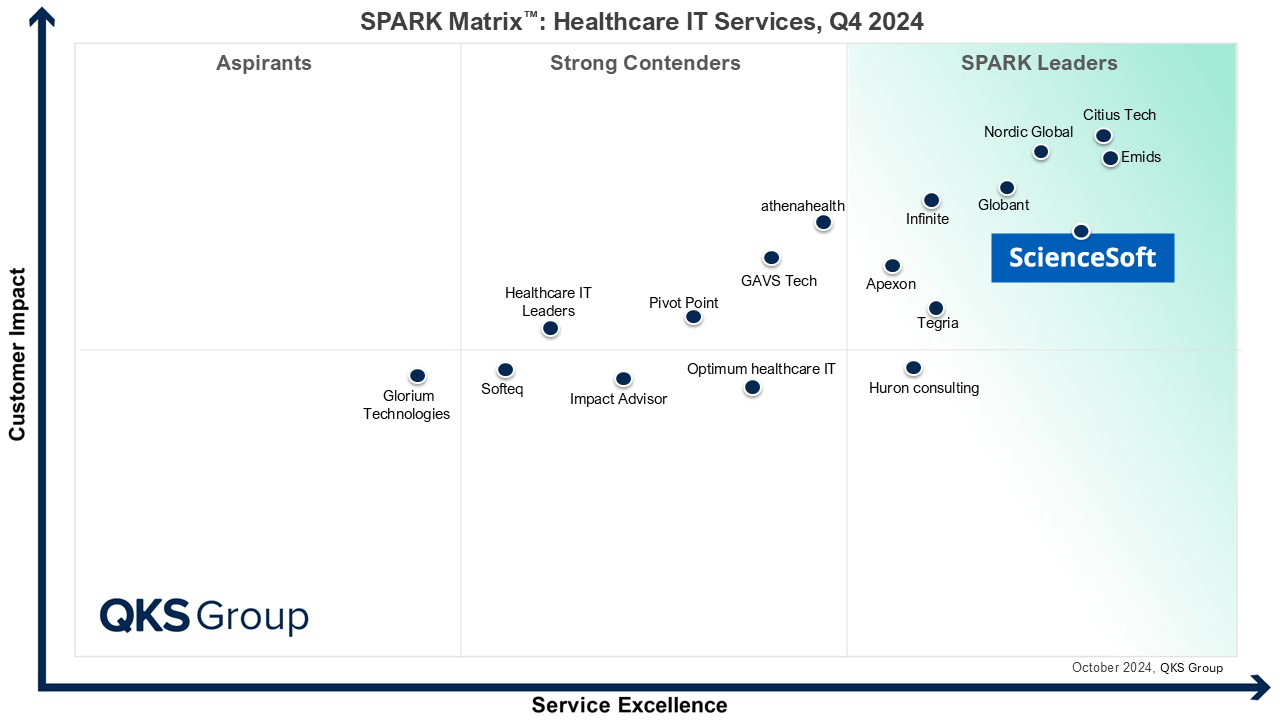
Featured among Healthcare IT Services Leaders in the 2022 and 2024 SPARK Matrix
Recognized for Healthcare Technology Leadership by Frost & Sullivan in 2023 and 2025
Named among America’s Fastest-Growing Companies by Financial Times, 5 years in a row
Four-time finalist across HTN Awards programs
Named among Becker’s Telehealth Companies to Know in 2026
Named Leading Healthcare Software Provider 2026 at GHP’s Healthcare & Pharmaceutical Awards
HIMSS Gold member advancing digital healthcare
ISO 13485-certified quality management system
ISO 27001-certified security management system
What Our Clients Say


Our clients in healthcare rely on Qventive for the support and administration of essential software solutions such as EHR and practice management systems. Timely assistance and resolution are imperative in this field, so when we were faced with a large influx of support requests, having ScienceSoft step in for 24/7 help desk was a lifesaver. Their team quickly adapted to our processes and understood our clients’ expectations from the start.



ScienceSoft’s L1 team has already become a valuable asset to ScribeAmerica. We needed full transparency in service provisioning, and we appreciate their regular reporting and clear communication with our IT operations managers. It’s also valuable to us that ScienceSoft keeps finding new ways to free our L2 team’s load.

ScienceSoft helped us stabilize and enhance a critical Python integration that synchronizes course progress and grades between Canvas and Populi. Their team ramped up quickly, expanded the script to meet new requirements, and kept it compatible with ongoing API changes. I appreciated their transparency, technical expertise, and consistent communication.














FAQ About Healthcare Software Maintenance Services
How do you integrate into a healthcare IT environment without compromising compliance and operational continuity?
For healthcare clients, we typically operate as a tightly governed extension of their internal IT teams. We align our support work with the confidentiality, integrity, and availability requirements of the HIPAA Security Rule (or other similar regulations) and with your internal security and audit policies. At ScienceSoft, this approach is reinforced by our ISO 27001- and ISO 27701-certified ISMS, HIPAA-focused security practices, and contractual compliance controls such as BAAs and DPAs. In practice, this means:
- We access your systems through approved, named accounts and tight security controls (e.g., RBAC, MFA/SSO, VPN, and audit logging), aligned with HIPAA safeguards and NIST guidance for secure remote access.
- We work within your existing IT stack (including tools for ticketing, escalation, change management, monitoring, logging, and incident response).
- We maintain application uptime while preserving interoperability across APIs, interfaces, and downstream data flows, including FHIR R4, HL7, DICOM, and USCDI-based exchange.
- We follow controlled maintenance practices, including testing in dedicated environments, scheduled maintenance, rollback planning, patch verification, and governed change execution with documented controls and audit support.
How do you protect PHI/ePHI during support activities?
If our work involves access to PHI/ePHI, we operate under a Business Associate Agreement (BAA) or NDA with defined permitted uses, safeguard obligations, and disclosure limits. Our support processes are designed to minimize PHI exposure. If access to sensitive data is necessary, we keep it controlled and auditable. In practice:
- We use least-privilege, role-based access approved by your organization, with named accounts only and no shared credentials.
- Privileged access can be time-limited and granted only for a specific ticket or task.
- Before any password reset, SSO/MFA change, or access escalation, we follow your identity verification procedures.
- We keep tickets PHI-light by default: users are guided to avoid patient identifiers, and screenshots and attachments are handled under strict rules.
- When PHI is necessary for troubleshooting, we use secure channels and document only the minimum information required for resolution and audit purposes.
How do you account for patient care impact in incident handling and SLAs?
Our medical application support teams assess incident severity by its impact on patient care and clinical workflows, not only by system availability. We also monitor critical user journeys to catch “silent failures” — issues that may look resolved technically but still affect care, such as a telehealth visit starting successfully while audio is not being recorded.
For recurring issues, we use agreed-upon runbooks that outline step-by-step, repeatable actions validated with your team (e.g., restarting services, collecting logs, checking interface queues, or applying standard configuration fixes). Any changes that could affect system stability, integrations, or clinical workflows are carried out only under your explicit requirements for change approvals, scheduling, and rollback availability. When a high-urgency event occurs, we follow the predefined escalation path (paging on-call teams, coordinating with vendors, and supporting downtime communications) and provide regular updates until service is fully restored.
We support transparency and audit-ready traceability by documenting actions, access used (when relevant), and handoffs in your ITSM, and by reporting on SLA performance, trends in arriving tickets, recurring root causes, and recommended improvements.

Still Have Questions About Healthcare Application Support?
Cost Factors for Healthcare System Support Services
The costs of outsourcing hospital application support and maintenance typically range from $5,000 to $50,000+ per month. The software maintenance pricing mainly depends on the following factors:
- The types of applications in scope and their complexity.
- The required support team composition and level of expertise.
- SLA requirements, including response and resolution times, uptime targets, and coverage hours (8/5, 12/5, 24/5, 24/7, or after-hours-only support).
- The expected volume of support work (typically reflected in support ticket volume, volume of change requests, and the pace of routine maintenance and enhancements).
- Compliance and governance requirements.
- The quality of the existing documentation and knowledge transfer needed for efficient onboarding and stable service delivery.
Use our cost configurator to get a free, non-binding ballpark estimate tailored to your case. Our team will share an initial estimate within 24 hours.
Healthcare App Support With Predictable Results and Measurable Performance
As an ISO 9001-certified vendor, ScienceSoft tracks support quality against clear targets.
Technologies We Work With
Front-end programming languages
Languages
- HTML5
- CSS
- JavaScript
JavaScript frameworks
- Angular JS
- React JS
- MeteorJS
- Vue.js
- Next.js
- Ember.js
Mobile
- iOS
- Android
- Xamarin
- Apache Cordova
- Progressive Web Apps
- React Native
- Flutter
- Ionic
Low-code development
- Microsoft Power Apps
- Microsoft Power Automate
- App Engine Studio (ServiceNow)
- Bubble.io
Platforms
Monitoring tools
- Zabbix
- Nagios
- Prometheus
- Elastic Stack
- Grafana
- Datadog
Containerization
- Docker
- Kubernetes
- Red Hat OpenShift
- Apache Mesos
Infrastructure automation
- Ansible
- Puppet
- Chef
- HashiCorp Terraform
- HashiCorp Packer
CI/CD tools
- GitLab CI/CD
- Jenkins
- TeamCity
- Bamboo
Clouds
- Amazon Web Services
- Microsoft Azure
- Google Cloud Platform
- DigitalOcean
- Rackspace Technology
Databases / data storages
SQL
- Microsoft SQL Server
- Microsoft Fabric
- MySQL
- Azure SQL Database
- Oracle
- PostgreSQL
NoSQL
- Apache Cassandra
- Apache Hive
- Apache HBase
- Apache NiFi
- MongoDB
- Microsoft Fabric
Cloud databases, warehouses, and storage
AWS
- Amazon S3
- Amazon Redshift
- Amazon DynamoDB
- Amazon DocumentDB
- Amazon RDS
- Amazon ElastiCache
Azure
- Azure Data Lake
- Azure Blob Storage
- Azure Cosmos DB
- Azure SQL Database
- Azure Synapse Analytics
- Kinect DK
- Azure RTOS
Google Cloud Platform
- Google Cloud SQL
- Google Cloud Datastore
Other
- Microsoft Fabric
