ScienceSoft Global


Security Testing for Generative and Agentic Artificial Intelligence
ScienceSoft combines AI engineering and cybersecurity expertise with experience in regulated industries such as healthcare, insurance, and investment. Our experts adapt attack scenarios to your risk context and keep testing controlled and non-disruptive.

Contributors

Cybersecurity Director and Principal Architect, ScienceSoft

Head of AI, Principal Architect, ScienceSoft
Artificial intelligence (AI) security testing is aimed at identifying security risks introduced or amplified by generative AI (GenAI) and autonomous AI systems.
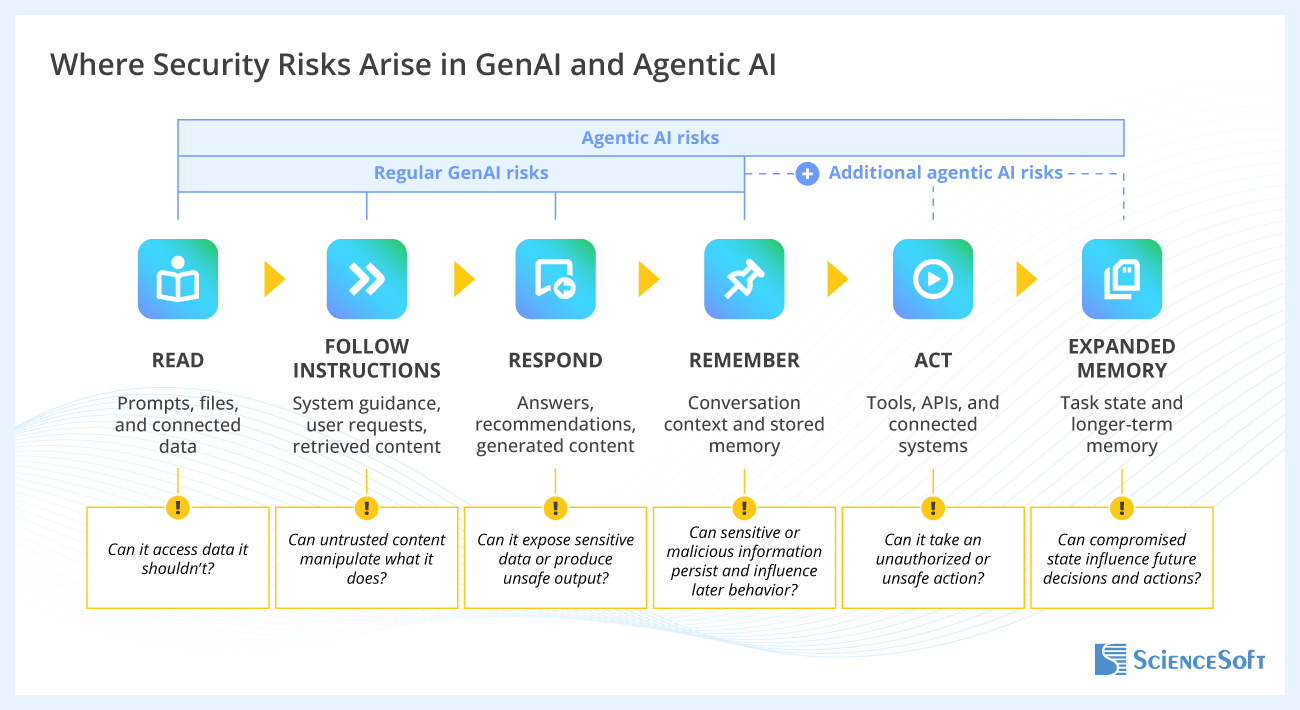
GenAI solutions can follow malicious instructions in prompts or retrieved content, expose sensitive data, and generate unsafe or policy-violating outputs. Agentic AI’s autonomy creates an even broader, more dynamic attack surface because AI agents can plan and execute multi-step tasks, use external tools, access enterprise systems, and collaborate with other agents. Without effective safeguards, attackers may abuse these capabilities and make the AI take unauthorized or unsafe actions.
Don’t stop at AI pentesting
Penetration testing for AI can uncover exploitable attack paths, for example, prompt injection that could lead to unauthorized access or privilege escalation.
Pentesting may miss weaknesses that do not look like exploitable vulnerabilities, such as insufficient validation of AI decisions before downstream execution, excessive agent privileges, or improper data masking. Adversarial red teaming and architecture reviews help uncover these broader weaknesses. But a comprehensive assessment doesn't have to happen all at once: you can prioritize it and carry it out in phases that fit your risk profile and budget.
What We Test
ScienceSoft’s security testing services span the full attack surface of GenAI and agentic AI solutions. For each individual engagement, we customize the testing scope and simulate realistic attack and abuse scenarios under controlled testing conditions.
-

AI behavior and prompt-level security
ScienceSoft tests the AI solution’s resistance to:
- Prompt injection, jailbreaking, and attempts to extract system prompts.
- Agent goal hijacking and manipulation of intended AI behavior.
- Unsafe or policy-violating responses triggered by adversarial prompts.
- AI-generated outputs that may trigger unsafe execution in downstream application components.
-
Sensitive data protection and access control
Our team detects data security gaps such as:
- Sensitive data exposure through prompts, responses, logs, memory, or integrations.
- Excessive permissions, access control weaknesses, and insufficient tenant isolation.
- Weaknesses in regulated data handling, such as improper masking, logging, retention, or sharing.
-
RAG, memory, and knowledge base security
ScienceSoft tests the AI solution for:
- Unauthorized or excessive access to data from connected sources through retrieval-augmented generation (RAG).
- Knowledge base poisoning and manipulation of retrieved context.
- Memory or context poisoning that influences later AI responses or agent actions.
-
Agentic workflow and tool-use security
Our team finds agentic AI weaknesses that may lead to:
- Unauthorized or unsafe actions through APIs, plugins, connectors, MCP (Model Context Protocol) servers, and other integrated tools.
- Bypass of approval gates or human-in-the-loop controls for high-risk actions.
- Cost, rate-limit, or resource abuse caused by agentic workflows.
-
Application, infrastructure, and AI supply chain security
ScienceSoft also checks the software stack and third-party components around the AI solution for:
- Vulnerabilities in application code, APIs, third-party libraries, and packages.
- Vulnerabilities in third-party models, MCP servers, plugins, and connectors.
- Insecure configurations, exposed secrets, and weaknesses in cloud, container, or infrastructure-as-code deployments.
-
Not sure what your AI security testing should cover?
Plan my testing scopeShare a high-level overview of your AI solution. Our security experts will help identify the relevant attack surface, prioritize the risks, and shape the testing scope.


Shouldn’t the LLM provider handle AI security?
Yes, the LLM provider is responsible for securing its own model infrastructure, but if the LLM is plugged into your applications and data sources, it’s your responsibility to make sure that it doesn’t cause problems on your side. Providers like OpenAI and Anthropic “secure” their LLMs in the sense that if you send something to their models, that data shouldn't get leaked to outsiders. But those models can still misbehave in a million other ways on your side: they can expose information to the wrong people, follow malicious instructions, or trigger unsafe actions through connected systems. ScienceSoft’s assessment focuses on this client-specific layer to verify that your GenAI and agentic AI solutions are secure in your actual business environment.
What Sets ScienceSoft Apart As an AI Security Partner
- 37 years in AI engineering.
- 23 years in cybersecurity.
- 750+ experts, including Certified Ethical Hackers, cloud security experts, compliance consultants, and AI engineers and architects. Over 50% of our IT professionals are senior- and lead-level experts.
- Proficiency in NIST, CIS, PTES, and OWASP security practices and methodologies.
- ISO 27001-certified information security management, complemented by ISO 27701 privacy controls.
- Experience with healthcare software compliance (HIPAA/HITECH, FDA requirements for medical devices and SaMD), financial software compliance (PCI DSS, NYDFS, SOX, SEC, GLBA), and data privacy regulations such as GDPR and CCPA.


Our Clients Say



Their engineers went beyond standard test procedures and identified several risks that would have been easy to overlook. The reporting was clear, practical, and focused on the real level of risk.



We really liked how comprehensive but to-the-point the reports were. ScienceSoft's experts were also eager to share their knowledge and readily answered our questions, so we managed to handle the detected issues in no time.


We were pleased to see that ScienceSoft approached our ecosystem with a good understanding of healthcare operations and the HIPAA Security Rule. Importantly, the investigation did not cause any service disruptions or pose a risk to our clients’ data privacy.


In the three years of cooperation, they have always provided excellent service. Plus, like Interprefy, ScienceSoft has an ISO 27001 certification, so we felt secure giving their team access to our environment for gray-box testing.
How AI Security Testing Works at ScienceSoft
-
1.
Discovery and scoping

Instead of using a standardized testing checklist, ScienceSoft first examines your AI environment to determine what needs security testing and why. We look at the GenAI and agentic AI solutions to be tested, their role in business workflows, user roles, data types, deployment model, integrations, actions agents can take autonomously or with approval, and relevant industry and regulatory risks. We also identify the sensitive data the solutions may process, such as PHI, PII, or financial records. This gives us the context needed to define a testing scope that reflects how your AI is actually used.
ScienceSoft is ready to sign a non-disclosure agreement (NDA) or its equivalent before any project discussions to protect confidential information.
Security testing itself requires safety controls
Some companies worry that security testing could disrupt day-to-day operations or trigger unintended AI actions. We account for that risk from the start. Before testing, we agree on clear testing boundaries and rules of engagement. We use non-destructive scenarios and, where appropriate, controlled test environments to simulate attacks. The goal is to get realistic evidence of security weaknesses without putting business operations at unnecessary risk.

-
2.
Attack surface review
ScienceSoft maps the AI attack surface to understand where the solution can receive instructions and data, access resources, connect to other systems, and trigger actions.
We review:
- AI orchestration and retrieval: prompt orchestration, RAG pipelines, vector databases, and memory.
- Tools and integrations: APIs, plugins, MCP servers, connected systems, and third-party services.
- Identity and access controls: how identities, roles, and permissions are managed and enforced.
- Logging and traceability: how AI interactions, retrieval events, tool calls, and agent actions are recorded.
- Data and execution flows: how data moves through the solution and how AI actions are triggered and executed.
The review also traces sensitive data across prompts and retrieved context, logs and memory, model provider environments, and downstream systems to identify where it enters, persists, and leaves the AI solution.
ScienceSoft documents the attack surface, data flows, and security-relevant components and exposure points. These findings become the basis for threat modeling, where we identify realistic attack, misuse, and control-failure scenarios.
-
3.
AI threat modeling and test planning
Based on the mapped attack surface, ScienceSoft identifies what could realistically go wrong and how. This includes deliberate attacks, misuse of legitimate AI capabilities, and failures of safeguards such as access controls, anonymization, or approval gates.
For example, healthcare AI testing may include attempts to retrieve another patient’s records through a chatbot, expose excessive PHI through RAG results, or bypass data anonymization rules.
ScienceSoft prioritizes the scenarios by risk and translates them into a focused security test plan.
-
4.
Security testing execution
ScienceSoft examines the security of the AI solution across its behavior, data access, permissions, integrations, application components, and supporting infrastructure.
Our team combines automated scanning and prompt fuzzing with expert review and hands-on testing. Some weaknesses can be identified directly in configurations, permissions, data handling, logging, or dependencies; others require adversarial testing to verify how the AI behaves under manipulation or whether a security boundary can be crossed.
The result is evidence-backed findings showing which security gaps are present and, where relevant, how they can affect the AI solution in practice.
-
5.
Reporting
ScienceSoft prepares a security testing report that documents the completed tests and confirmed vulnerabilities. For each finding, the report provides the details needed to reproduce the issue, explains its potential impact and likelihood of exploitation, and recommends remediation measures.
-
6.
Remediation and validation
Upon request, ScienceSoft can help the client’s team implement the recommended fixes. After remediation, ScienceSoft retests the affected areas to verify the fixes and confirm they didn't create new vulnerabilities.







AI Security Testing Costs
GenAI and agentic AI security testing costs range from $5,000 to over $33,000, depending on AI autonomy, number of agents and integrations, attack surface, and testing depth.
Here are approximate costs:
- Testing a simple GenAI application. Example: An LLM-based underwriting assistant that summarizes submissions and prepares risk summaries. Typical testing cost starts at $5,000.
- Testing a connected agentic workflow. Example: An insurance fraud-detection agent that retrieves claims data, uses connected systems, and routes suspicious cases for review. Typical testing cost starts at $7,000.
- Testing a multi-component AI platform. Example: An AI-powered healthcare command center combining multiple AI capabilities, data sources, integrations, and automated workflows. Typical testing cost is $23,000–$33,000+.
AI Security Testing Tools
Frameworks and methodologies we apply
Threat modeling and attack scenario development
- MITRE ATLAS
AI security testing and red teaming
- OWASP AI Testing Guide
- OWASP GenAI Red Teaming Guide
AI vulnerability classification and severity scoring
- OWASP GenAI LLM Top 10
- OWASP Top 10 for Agentic Applications
- OWASP AIVSS
MCP security testing
- OWASP MCP Top 10
AI risk management
- NIST AI RMF
- NIST AI 600-1: Generative AI Profile
Security and compliance mapping
- OWASP GenAI Security Industry Framework Crosswalk
Tools we use for AI penetration testing services
Prompt fuzzing and jailbreak testing
- NVIDIA garak
- Promptfoo
- Microsoft PyRIT
- DeepTeam
MCP server scanning
- mcp-scan
Web app and API security testing
- BurpSuite
- OWASP ZAP
Dependency and software composition analysis
- OWASP Dependency-Check
- Trivy
Model artifact and AI supply chain scanning
- Protect AI ModelScan
- Fickling
Static code analysis
- DeepTeam
- Semgrep
- CodeQL