 ScienceSoft Global


Pre-Visit Record Collection
How to Optimize Operational Workflows and Automate Patient Data Exchange Across Disparate Systems
Preparing outside records for specialist visits becomes labor-intensive when they must be manually collected and checked across scattered systems. As a healthcare software engineering and AI transformation company, ScienceSoft helps providers identify gaps in EHR and HIE workflows and address them with integrations, custom automations, and AI tools.

Contributors

Senior Solution Architect, Healthcare, ScienceSoft

Head of Healthcare IT & AI Practice, ScienceSoft
ScienceSoft: A Trusted Partner in Improving Pre-Visit Record Preparation
- Since 2005 in healthcare software engineering.
- Since 1989 in machine learning, with experience designing generative and agentic AI solutions.
- 150+ successful healthcare IT projects.
- Healthcare IT consultants with 5–15 years of experience, including professionals with clinical backgrounds.
- 30+ senior solution and technology architects with expertise in designing complex healthcare integrations.
- Practical experience with healthcare data exchange standards, including HL7 v2/v3, FHIR, C-CDA, and DICOM.
Impact of Outside Record Gaps Before Visits
Before specialist consultations, staff may need prior notes and test results from outside providers. Missing documents can mean repeated calls to referring offices and extra checks. Even when records arrive, clinicians may struggle to find information relevant to that visit.
In a KLAS survey of over 33,000 clinicians, 47% reported difficulty quickly finding important patient information from outside organizations.
Why Outside Record Preparation Still Takes Extra Work
Even when EHR and health information exchange (HIE) connections provide access to some outside records, they may not cover all the steps needed to prepare information for a visit. The resulting gaps can leave staff retrieving records through other routes, checking what is missing, or manually reconciling external findings against local EHR evidence.
-

Gaps in outside record connectivity
A clinic may receive MRI or pathology reports from outside partners through its EHR, but interoperability gaps may leave the actual images or digitized pathology slides inaccessible. So, staff must use partner portals or request separate transfers before visits.
-
Manual pre-visit record searches
The EHR and retrieval service may support searches for records held by other providers, but scheduled visits don't trigger them. Staff must start eligible record searches patient by patient before they can review the results and identify missing documents.
-
Pre-visit record checks lack coordination
Outside records may arrive via multiple routes (through the EHR, fax inboxes, image-sharing services, etc.). If incoming documents, pending requests, and clinician-defined requirements for each visit aren’t tracked together, staff must compare record-by-record what was received with what the visit needs to follow up on gaps.
-
Outside findings need reconciliation
If clinicians need to incorporate external record data required for ongoing care (e.g., new diagnoses or medication changes), they may have to manually compare the findings with the local EHR data, verify dates, check for duplicates, and enter relevant updates to the patient chart, which is a labor-intensive process.


Technology Options for Streamlining Outside Record Preparation
Automate pre-visit outside record searches using your existing systems
Best when: Staff spend substantial time manually searching for outside records before appointments, even though the existing EHR and exchange service (HIE) can retrieve them.
ScienceSoft can automate pre-visit outside record searches by making each upcoming appointment trigger automated HIE queries for required patient materials from other participating providers. This way, staff no longer need to run these queries manually, patient by patient.
Where the existing EHR or HIE service supports automation triggers, ScienceSoft can set up this functionality without developing new software. The team configures the available search triggers, record retrieval timing, and staff notifications and then tests the workflow at selected clinics before a wider rollout.
If the EHR and the HIE’s retrieval service support the necessary APIs but cannot automatically initiate searches, ScienceSoft can develop a small targeted appointment-to-query adapter. The adapter can identify eligible appointments, match them to the correct patient records, submit authorized retrieval requests, and pass query outcomes to the existing staff workflow.
For example, at a multi-site specialty practice, staff may work through appointments several days in advance and manually run an HIE query for each eligible patient. With the supported configuration or adapter, these queries can start automatically. The workflow confirms whether the exchange service retrieves the available documents and makes them accessible through the EHR's existing chart review tools. Staff can then check which documents actually arrive and follow up on unsuccessful requests instead of launching each search manually.
Key challenge: Queries may still fail, finish too late for the visit, or return no documents. A completed job does not necessarily mean that the expected records were retrieved.
Mitigation strategy
Mitigation strategy
Pilot the workflow using patients with and without network matches, rescheduled visits, and short-notice appointments. Verify that authorized queries run at the intended time and that retrieved documents appear in the EHR view used by staff. When the service exposes reliable job and timing signals, job status monitoring can alert the responsible team when a query fails or remains pending beyond the chart-preparation cutoff, allowing staff to use the existing follow-up process. Because not every missing document generates an error, these alerts complement staff checks of the records actually received.
Implementation timelines: 4–12 weeks to configure and pilot existing pre-visit query functions. If a small appointment-to-query adapter is needed, the pilot may take 8–16 weeks, provided the required vendor APIs are available. If the provider uses different EHR systems across its clinics, each may require separate configuration and testing, extending the timeline.
Hide
Connect a missing outside record source
Best when: Staff has to open outside portals for documents or diagnostic images that the provider's EHR and HIE connections do not make accessible. Connecting these missing record sources pays off especially well when this manual gap affects many visits or referral partners.
If an imaging partner supports electronic transfer but no existing connector links its image-sharing service to the provider's EHR or imaging system, ScienceSoft can build a focused adapter. The adapter would make the partner's studies accessible through the provider's EHR or image viewer.
For example, a multi-site orthopaedic group receives MRI reports, but staff can access the images only on the referring hospital’s portal. With a custom adapter enabling scan transfer, the record team avoids the hospital portal for successfully retrieved images, while specialists can review the scans during consultations rather than only reports.
Key challenge: The partner’s portal may let staff view a record or scan without offering a supported interface to transfer it. Inconsistent patient or study identifiers pose another risk.
Mitigation strategy
Mitigation strategy
ScienceSoft confirms with the partner's team a compatible record receiving method. Where the portal supports study retrieval, our adapter can match incoming studies to the correct patient and examination, reducing the risk of misfiled scans. It also flags failed transfers and uncertain matches, so staff can request missing images or resolve uncertainties before the consultation.
If the partner's portal only allows viewing, the provider may still receive the studies through a supported DICOM transfer from the partner’s PACS to its existing imaging system or through an established image-sharing service. If neither provider-to-provider route is available, patient-authorized record sharing may offer another way to obtain the images, provided the patient can access diagnostic-quality studies. ScienceSoft can then build an adapter that imports patient-shared image files into the provider's imaging system.
Implementation timelines: 8–16 weeks to implement and pilot a connection between one outside-records source and an existing EHR or imaging system. Additional interfaces or complex patient and study matching may extend the timeline.
Hide
Automate AI-assisted pre-visit record completeness checks and follow-ups
Best when: Medical records teams spend substantial time manually checking outside documents against open requests and visit requirements across EHRs, fax inboxes, or image-sharing services.
When existing EHR work queues and document-intake software cannot coordinate this work across channels, ScienceSoft can add a pre-visit orchestration module. It checks pre-visit records accessible through supported EHR, fax, and image-sharing interfaces, then generates tasks for missing items. To further minimize manual effort, the module can be enhanced with AI.
For example, a regional oncology group uses two EHRs after acquiring practices. Imagine a consultation booked in EHR A when its referral mentions a prior CT scan. The report is already in EHR B, but the actual scans are missing from the image exchange service. So, staff must manually determine what the visit still lacks across these systems, then request the missing images.
In the pre-visit orchestration architecture shown below, a rule engine tracks clinician-approved document requirements, accessible records, and outstanding requests. An LLM-based document processing component classifies incoming documents, extracts study references and possible sources from unstructured notes, and suggests matches to patients, visits, and outstanding requests. Staff verifies AI-suggested matches and approves AI-drafted requests while the system tracks responses and outstanding materials against the same appointment. One shared task queue replaces separate spreadsheets and repeated manual checks for request status.
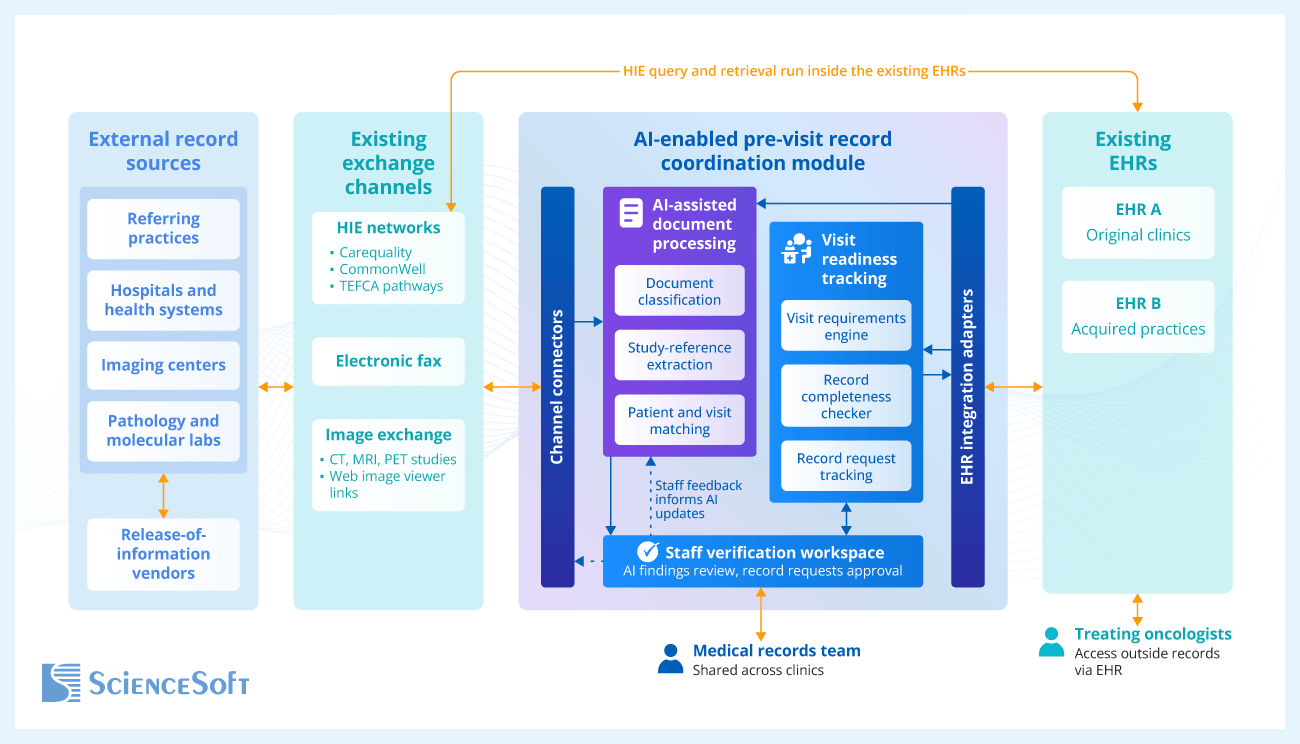
This architecture is designed to solve three recurring problems: 1) fragmented visit preparation across EHRs and exchange channels, 2) uncertainty about which records a consultation still needs, and 3) manual matching of incoming records to outstanding requests.
The design gives each appointment one preparation case across the existing EHRs and record exchange channels. With the clinic-approved record completeness rules separate from exchange connections, the provider can update consultation requirements centrally rather than modify workflows in both EHRs. With AI that matches patients and extracts study details, staff doesn’t need to manually check every unstructured note.
Key challenge: Document listings may not prove files are accessible, and AI may misidentify patients or studies. Rule-defined completeness cannot guarantee that the entire clinical history is available.
Mitigation strategy
Mitigation strategy
The pilot verifies document access, evaluates AI classification, extraction, and matching accuracy, and compares staff handling time with the manual process. We also ensure that AI escalates uncertain record matches to staff for verification, while inaccessible records remain open for follow-up.
Implementation timelines: 3–6 months for a pilot covering one EHR, one specialty, and a limited set of existing record retrieval channels. A two-EHR workflow with shared follow-ups and AI-assisted referral extraction may take 6–10 months or longer. A separate discovery phase and EHR vendor approvals can extend the overall schedule.
Hide
Implement AI-assisted selective import of outside clinical data to the EHR
Best when: Clinicians with high referral volume manually enter data (such as diagnoses and medication changes) from outside records in different formats into local EHR because the system’s built-in import tools do not support the relevant sources or data types.
Clinicians may need selected findings in the active chart for ongoing care, while other outside information remains useful for reference. To facilitate the process, ScienceSoft can implement a selective import extension that turns outside record findings into EHR updates clinicians can review and implement. The tool maps structured information to EHR import routes and can also use AI to extract diagnoses and medication changes from unstructured notes. The care team confirms which proposed updates belong in the problem list (including diagnoses), medication list, or other active chart fields before the EHR records them.
Consider a multi-site practice that follows patients after hospital discharge. A discharge summary lists a new medication and a changed dose, potentially conflicting with the local medication list. With the extension, a clinician doesn’t need to manually edit the medication list to keep it current for subsequent care. They check source-linked EHR updates suggested by the system against current orders and patient-reported use and accept valid changes.
Key challenge: A separate import tool can remove retyping but still leave clinicians checking another inbox and switching between applications. That extra work can erode the time saved by automation.
Mitigation strategy
Mitigation strategy
ScienceSoft designs the import experience around the team's existing pre-visit chart prep workflow. Where the EHR supports patient-context launch, clinicians can access proposed updates from the chart instead of monitoring another application. This keeps the new process close to routine care and limits extra navigation.
Implementation timelines: 12–20 weeks to pilot one structured clinical data category in one EHR, provided the approval and update route is supported. Several categories or AI extraction from notes may take 20–32 weeks. Additional EHRs may extend delivery.
Hide
Let's Find the Right Path for Outside Records
ScienceSoft's healthcare business analysts and architects are ready to help you identify gaps and burdensome manual steps in record retrieval, pre-visit checks, and chart updates. Together, we can explore native EHR capabilities, possible new integrations, and automation, including impactful AI use cases, then decide on practical next steps. The initial consultation is free and nonbinding.

What Our Healthcare Customers Say


ScienceSoft quickly gained a deep understanding of our service model and daily operational workflows. In just four months from project kickoff, they successfully migrated us to a modern, modular Microsoft-based telehealth platform featuring virtual consultations, care coordination, and seamless data exchange with partner systems, including robust EHR integrations.



Our project required coordination with multiple companies and individuals. ScienceSoft worked well with everyone. ScienceSoft has been a competent partner for medical software development. We would recommend them as a trustworthy vendor. They are reliable, thorough, smart, available, extremely good communicators and very friendly.

Todd Nilson
MD

They created comprehensive project documentation, feature lists, and worked out thorough recommendations to help us improve the stability and performance of our solution. ScienceSoft’s project manager, business analyst, QA and software engineers were always friendly and ready to answer our questions or solve any ad hoc issues.
