 ScienceSoft Global



Help Desk Services for Healthcare
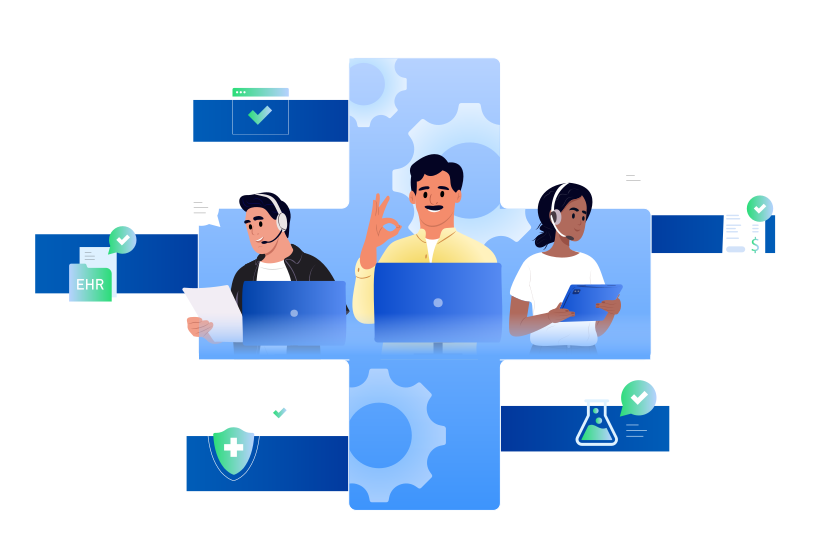
An ISO-certified healthcare help desk company, ScienceSoft delivers 24/7 IT support aligned with HIPAA requirements (BAA available). With 19 years of help desk expertise and 21 years in healthcare IT, ScienceSoft delivers outsourced support that strengthens IT reliability, improves staff experience, and keeps digital initiatives moving.
Contributors

Help Desk Department Manager, ScienceSoft

Compliance Officer, Healthcare and Finance IT & AI Compliance Consultant, ScienceSoft
A healthcare help desk is an IT support service that provides technical expertise alongside knowledge of clinical workflows and healthcare regulations necessary to maintain compliance and uninterrupted digital workflows within medical organizations. Specially trained healthcare service desk agents can support a wide range of user groups:
- Clinicians (nurses, physicians).
- Administrative staff (billing, registration).
- External partners (labs, pharmacies, imaging centers, and payers).
- Patients accessing services through online portals and apps (separate verification scripts and workflows apply).
- Employees at public health agencies, life sciences organizations, medical device providers, healthcare software companies, and in other adjacent fields.
Clear governance and responsibility boundaries
We understand how strictly healthcare organizations have to manage access to their systems and data. HIPAA, internal policies, and audit requirements leave no room for ambiguity, so our medical help desk services are built around risk management, least privilege access, and clear hand-off rules.
We support clinical systems operationally (access, availability, integrations) but never change clinical workflows or data without the healthcare organization’s governance and approvals. It allows you to retain full control over anything that could impact patient care, while our team ensures operational continuity.
Multi-Tiered Help Desk Services for Healthcare Organizations

Tier 1 (L1): Frontline support and basic troubleshooting
- Performing identity checks before any access or role change (following the procedures approved by your organization).
- Resolving access issues, including resetting passwords, restoring SSO access, unlocking accounts, and assisting with MFA recovery.
- Assigning and reclaiming licenses, addressing activation errors, and analyzing license usage for optimization decisions.
- Managing the access lifecycle (onboarding new users, updating access when roles change, and timely deprovisioning) based on the organization’s approval workflow and audit requirements.
- Helping users navigate applications and apply personalization options (without changing clinical content or system configuration).
- Troubleshooting standard application issues, such as frozen screens, image loading problems, and basic performance issues.
- Resolving common peripheral issues, such as printing errors and undetected USB cameras or external microphones.
- Performing baseline network fixes to restore Wi-Fi, VPN, virtual desktop, scanner, or printer connectivity.
- Managing and updating self-service resources and the IT knowledge base (KB).
- Capturing information about more complex or high-impact issues and escalating them to the designated owner, according to the rules approved by the healthcare organization.
- Coordinating onsite support through your internal teams or local providers with end-to-end accountability until service is restored.
- Providing clear expectations on resolution timelines and regularly updating users on ticket status.

Tier 2 (L2): System configuration and integration support
- Configuring enterprise platforms and core healthcare IT systems (e.g., setting up and updating schedule templates, referral and billing work queues, notification rules).
- Provisioning and tuning role-based access at the application level.
- Monitoring healthcare integration interfaces (e.g., HL7/FHIR feeds between EHR, LIS, RCM, and patient-facing systems, and DICOM connections between imaging modalities, PACS, and viewers).
- Handling cross-application and integration issues between systems such as EHRs, lab systems, imaging viewers, CRMs, and other platforms.
- Executing targeted data fixes and bulk updates that affect only administrative attributes (without clinical data manipulation).
- Collecting evidence and preparing structured hand-off summaries for Level 3 or in-house clinical IT teams when issues appear to stem from product defects, clinical configuration, or platform performance limitations.
- Converting resolved L2 issues into L1 playbooks and knowledge base articles.

Tier 3 (L3): Code changes, infrastructure management, and software vendor coordination
- Managing software vendor escalations and patches when issues are traced to third-party product bugs or platform limitations.
- Applying code changes and advanced configurations to fix defects or tune the performance of custom healthcare applications and non-clinical software.
- Designing, implementing, and tuning observability and alerting for healthcare IT systems.
- Supporting migrations and major upgrades of healthcare applications and platforms (such as telehealth systems, RCM platforms, imaging solutions, and EHR-adjacent modules) in coordination with software vendors and internal clinical IT teams where required.
- Refactoring or repairing integrations (APIs, HL7/FHIR interfaces, DICOM routes, SFTP/EDI exchanges) between clinical, financial, and patient-facing systems.
- Documenting fixes and sharing expertise with L2 and L1.
Responsibility Split Between ScienceSoft and Your Teams
What we handle independently
High-volume support requests and common incidents: password and MFA recovery, workstation and peripheral troubleshooting, Wi-Fi and VPN connectivity issues, “how do I…?” navigation help, and first-response triage.
What we manage under your approved rules (co-owned)
Issues with clinical and enterprise platforms: incident triage for EHR, monitoring and first-line troubleshooting of interfaces (HL7/FHIR/DICOM/API), evidence collection, vendor escalation, and approved configuration or code-level fixes within the contracted scope.
What we never change without approval
Clinical workflows, clinical content, and care policies, from order sets and documentation templates to clinical decision-making logic. When needed, we can implement approved changes as part of L2/L3 work, but only after your clinical governance signs off.
Priority and escalation aligned to clinical impact
In healthcare, the same “IT issue” can be routine in one department and critical in another. ScienceSoft aligns with your team on a priority model that factors in patient-care impact and clinical workflow disruption, not only technical symptoms.
When a high-urgency incident is detected, ScienceSoft triggers the agreed escalation path (for example: paging on-call teams, notifying vendor support, coordinating downtime communications), and provides frequent, structured updates until service is restored.
Healthcare IT Solutions ScienceSoft Supports
The list below shows the environments ScienceSoft commonly supports. The exact depth of support (triage only, troubleshooting, or configuration) is defined in the service scope and issue escalation matrix we agree on.
Clinical and diagnostic systems






Operational and business management














Why Healthcare Organizations Partner With ScienceSoft
- In healthcare software development, testing, and IT consulting since 2005.
- In IT support services since 2007.
- In ITIL-compliant ITSM since 2008.
- Hands-on experience with healthcare data protection regulations, including HIPAA, HITECH, and GDPR.
- Working experience with interoperability and coding standards, such as HL7/FHIR, XDS/XDS-I, SNOMED CT, ICD-10, and CPT.
- 150+ projects for the healthcare industry.
- Multilingual support: English, Spanish, German, French, Polish, Turkish, Czech, and other languages.
- Flexible time coverage: 24/7, 12/5, 12/7, 8/5, after-hours support, or mixed schedules.
- Ready to sign a BAA (Business Associate Agreement).





What Our Clients Say


Our clients in healthcare rely on Qventive for the support and administration of essential software solutions such as EHR and practice management systems. Timely assistance and resolution are imperative in this field, so when we were faced with a large influx of support requests, having ScienceSoft step in for 24/7 help desk was a lifesaver. Their team quickly adapted to our processes and understood our clients’ expectations from the start.



ScienceSoft’s L1 team has already become a valuable asset to ScribeAmerica. We needed full transparency in service provisioning, and we appreciate their regular reporting and clear communication with our IT operations managers. It’s also valuable to us that ScienceSoft keeps finding new ways to free our L2 team’s load.

ScienceSoft helped us stabilize and enhance a critical Python integration that synchronizes course progress and grades between Canvas and Populi. Their team ramped up quickly, expanded the script to meet new requirements, and kept it compatible with ongoing API changes. I appreciated their transparency, technical expertise, and consistent communication.
Flexible Engagement Models for Healthcare IT Help Desk

Full Outsourcing: Managed Healthcare Help Desk Services
For organizations looking to offload IT support, ScienceSoft delivers end-to-end help desk services with SLA-backed delivery, HIPAA-aligned controls, and regular ITSM reporting for full visibility.

Co-Sourcing: Shared Responsibility with Your IT & Clinical Teams
For organizations that need extended coverage without outsourcing sensitive functions, ScienceSoft operates as an extension of internal IT and clinical IT teams, handling defined scopes, after-hours support, or operational overflow.
Choose Your Custom Healthcare Help Desk Model
Managed help desk or shared responsibility — we tailor the service scope and issue priority model to your needs. We guarantee transparent, KPI-based collaboration, flexible pricing, and ISO 27001-certified security management.
Help Desk for Healthcare Industry With Predictable Results and Measurable Performance
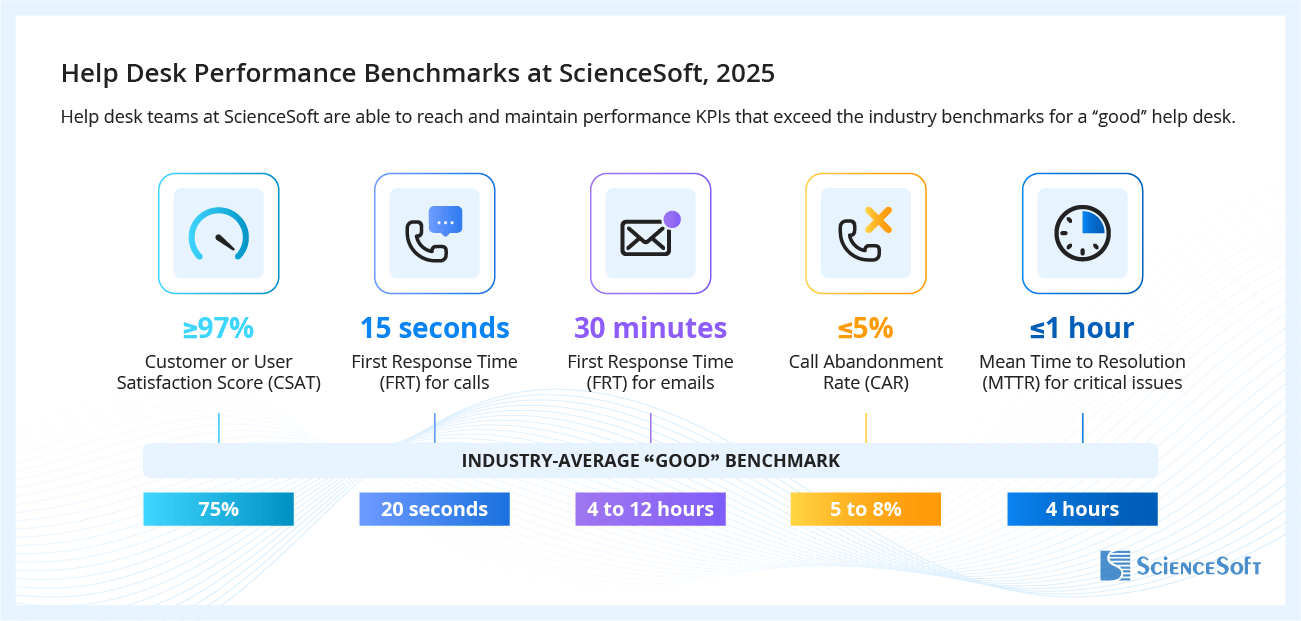
As a quality-driven, ISO 9001-certified vendor, we commit to measurable outcomes for healthcare clients and to surpassing commonly accepted “good” industry benchmarks. In our help desk projects, we typically achieve ≥97% CSAT, 15-second first-response time on calls, and ≤1 hour MTTR for critical issues (when issues don’t involve third-party dependencies), with an average 99% SLA compliance across response and resolution metrics.
How We Make Outsourced Help Desk a Worthy Investment for Our Clients

ScienceSoft designs client-specific SLAs with clearly defined support scope, responsibilities, and exit terms. We align service levels with real operational needs and adjust them over time to ensure consistent service quality.

Quick help desk launch
ScienceSoft ensures a fast help desk launch through pre-trained agents, structured onboarding, and ready-to-use runbooks and escalation matrices. For a clearly defined initial scope (e.g., a single facility, service line, or a limited app set), we can complete knowledge transfer and tool setup and begin handling tickets in as little as two weeks.

ScienceSoft’s help desk agents analyze root causes, gather user feedback, automate routine tasks, and continuously refine workflows to prevent recurring issues and reduce ticket volume over time.

ScienceSoft takes a data-driven approach to infrastructure cost optimization. When tasked with cloud infrastructure management as part of L3 support, our engineers analyze usage patterns, performance metrics, and billing data to identify overspending and recommend the most effective ways to reduce cloud expenses.
Privacy by design
Recent healthcare IT outsourcing research shows that providers and healthtech companies increasingly rely on external partners to support complex EHR, telehealth, and cloud environments. At the same time, concerns about data privacy, security risks, and staying HIPAA-compliant remain a key factor shaping outsourcing decisions.
At ScienceSoft, we treat compliance as a design requirement. Our healthcare support runs under an ISO 27001-certified security management system, with a dedicated Data Protection Officer and Compliance Officer who monitor global regulations. Our help desk agents are trained in HIPAA and data security and receive additional support from our security and compliance teams.
Help Desk Pricing
Healthcare help desk costs depend on several factors, including:
- Support tiers (L1–L3).
- The complexity of your clinical and administrative systems.
- Monthly ticket volume.
- Coverage hours (24/7, 12/7, 12/5, after-hours only).
As a ballpark, healthcare L1 support pricing at ScienceSoft ranges from $8 to $14 per ticket for support packages of 201–1,000 tickets per month.
Get the Cost Estimation for Healthcare Help Desk Services
Answer a few simple questions to help our healthcare IT consultants better understand your help desk needs and calculate the quote for you.

Tools and Technologies We Work With
Alongside the tools listed below, ScienceSoft’s support engineers can work directly in your existing ticketing and IT operations environment. This typically includes integrating with your healthcare help desk software, knowledge base, secure remote support tooling, identity provider (for SSO/MFA), and monitoring and alerting systems.
Ticketing systems
- ServiceNow
- Jira
- Redmine
- OTRS
- Zendesk
- Freshdesk
Monitoring tools
- Zabbix
- Nagios
- Prometheus
- Elastic Stack
- Grafana
- Datadog
Platforms
Remote collaboration
Connection
- VPN
- RDP
- TeamViewer
Communication
- Microsoft Teams
- Zoom
- GoToMeeting
DevOps
Containerization
- Docker
- Kubernetes
- Red Hat OpenShift
- Apache Mesos
Automation
- Ansible
- Puppet
- Chef
- Saltstack
- HashiCorp Terraform
- HashiCorp Packer
CI/CD tools
- AWS Developer Tools
- Azure DevOps
- Google Developer Tools
- GitLab CI/CD
- Jenkins
- TeamCity
Monitoring
- Zabbix
- Nagios
- Elasticsearch
- Prometheus
- Grafana
- Datadog
Clouds
- Amazon Web Services
- Microsoft Azure
- Google Cloud Platform
- DigitalOcean
- Rackspace Technology
Front-end programming languages
Languages
- HTML5
- CSS
- JavaScript
JavaScript frameworks
- Angular JS
- React JS
- MeteorJS
- Vue.js
- Next.js
- Ember.js
Mobile
- iOS
- Android
- Xamarin
- Apache Cordova
- Progressive Web Apps
- React Native
- Flutter
- Ionic
Databases / data storages
SQL
- Microsoft SQL Server
- Microsoft Fabric
- MySQL
- Azure SQL Database
- Oracle
- PostgreSQL
NoSQL
- Apache Cassandra
- Apache Hive
- Apache HBase
- Apache NiFi
- MongoDB
- Microsoft Fabric
Cloud databases, warehouses, and storage
AWS
- Amazon S3
- Amazon Redshift
- Amazon DynamoDB
- Amazon DocumentDB
- Amazon RDS
- Amazon ElastiCache
Azure
- Azure Data Lake
- Azure Blob Storage
- Azure Cosmos DB
- Azure SQL Database
- Azure Synapse Analytics
- Kinect DK
- Azure RTOS
Google Cloud Platform
- Google Cloud SQL
- Google Cloud Datastore
Other
- Microsoft Fabric
