en flag +1 214 306 68 37

AI Transformation and IT Services for Health Insurers

An AI transformation and software engineering company with experience in insurance since 2012, ScienceSoft provides full-cycle AI & IT services to help health payers modernize and upgrade their operations. Having first-hand experience in healthcare IT, we create solutions that enable secure integration with healthcare providers and align with HIPAA requirements.

IT Services and Solutions for Health Insurers - ScienceSoft

Transformation Opportunities for Health Insurance Organizations

Faster enrollment and claims processing

Challenge. Manual enrollment processing, claims adjudication, and benefit verification create operational backlogs, driving up administrative costs and delaying coverage confirmation and claims payments.

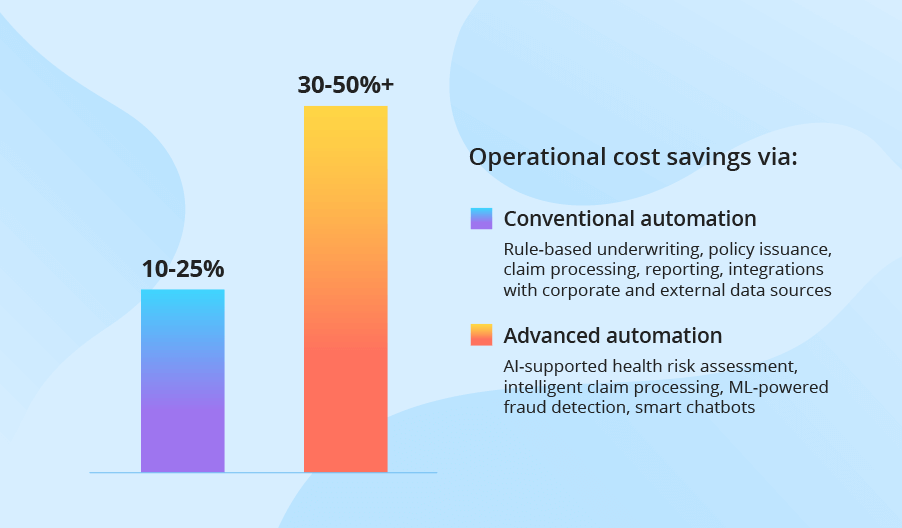
Change. AI engines can validate enrollment, claims, and benefits data, review supporting multi-format evidence, and coordinate eligibility checks across systems. They can also prepare coverage and adjudication recommendations to support human decision-making. Agentic AI has the potential to automate 60–80% of claims and enrollment processing activities, accelerating workflows and cutting administrative costs by 20–50%.

Quicker prior authorization decisions

Challenge. Slow clinical data exchange and repeated back-and-forth between payers and providers delay prior authorizations, consume administrative capacity, and postpone members' access to care.

Change. AI can extract relevant data from clinical evidence, check data completeness, and match submissions against applicable clinical criteria. AI agents and assistants can follow up on missing data and prepare case packages for qualified reviewers. With these capabilities, payers can automate 40–60% of care preparation activities, speeding up prior authorizations without taking medical necessity decisions out of human hands.

More effective fraud detection

Challenge. Payers relying on manual or rule-based claims processing may overlook sophisticated provider, member, and network fraud schemes or detect them too late, leading to inflated payments and complicating financial recovery.

Change. AI can detect common fraud schemes, such as upcoding and phantom billing, and uncover organized fraud rings by spotting suspicious relationships between members and providers. It can also identify manipulated evidence, including AI-generated documents and media files. AI assistants can prepare investigation packages and recommend response actions. For some payers, such capabilities brought a 3–5% reduction in claims leakage.

Improved member and provider experiences

Challenge. Manual handling of routine member and provider inquiries slows responses, hampers service experiences, and can delay members' access to care. It also strains service teams and pulls staff away from complex requests.

Change. Self-service AI assistants can help members understand their benefits, navigate care options, and resolve authorization inquiries without involving staff. For providers, AI can assist with eligibility verification and claims status checks. Insurance contact center employees can use AI to analyze complex requests, retrieve case-relevant data, and prepare responses. These capabilities can improve first-contact resolution, shorten response times, and boost member and provider satisfaction.

Insurance IT & AI Consultant and Lead Business Analyst

Health payers today face growing pressure to speed up access to care while keeping medical costs under control and protecting against fraud. So, while using AI to speed up work and cut related administrative costs is valuable, the biggest opportunities lie where AI improves both operational efficiency and the quality of material decisions. For example, prior authorization AI can both speed up reviews and prevent unnecessary medical expenses through more accurate clinical assessments. Similarly, claims fraud AI can both streamline evidence checks and uncover hidden fraud signals that could otherwise lead to improper payments. We look for these combined benefits when advising payers on where AI makes sense, which technologies to use, and which initiatives to prioritize for early value.

AI & IT Services for Health Insurance Companies

AI transformation

Technology and delivery consulting

Software engineering

Software modernization

Managed IT services

Security and compliance services

AI transformation

  • AI transformation consulting for health insurance organizations: use case discovery, opportunity prioritization, AI readiness assessment
  • AI transformation strategy development
  • AI governance and operating model design
  • AI implementation: development of AI solutions, AI integration into existing systems, enterprise AI scaling
  • AI portfolio and program management
  • AI adoption and organizational change support

Technology and delivery consulting

Software engineering

Software modernization

Managed IT services

Security and compliance services

Software Solutions for Health Insurance Organizations

ScienceSoft engineers multi-functional systems to transform the entire health insurance process as well as specialized solutions that automate particular operational areas. Here are some of the solutions we deliver:

Core operations management solutions

Enrollment management software

Software that automates member onboarding, eligibility verification for particular health plans, and creating enrollment records in compliance with HIPAA. It can automate the processing of EDI 834 transactions and can be integrated with federal and state marketplaces to handle ACA, VA, and Medicare enrollments.

Solutions that enable actuarial teams to analyze demographic, provider, and loss run data, model financial risks, and calculate plan-specific premiums. Such solutions can be powered by machine learning (ML) models to forecast claim expenses based on disparate data like population health stats, utilization patterns, and healthcare costs.

Software designed to automatically process insureds’ health and socioeconomic data, evaluate individual and group risks, and calculate personalized health insurance premiums. It applies user-defined rules and AI algorithms to assign the optimal risk-adjusted premiums. Custom solutions can automate risk adjustment under HCC coding and other specialized models.

Systems that automate the entire policy lifecycle, from issuance through endorsement to renewal or cancellation. They offer centralized storage and rule-based updating of member plan details, coverage limits, and benefit structures. Such solutions let payers automatically generate explanations of coverage (EOC), including EOCs for complex plans like Medicare Advantage.

Software used to automate claim capture, validation, adjudication, and payment. It can process EDI 278 prior authorization requests and EDI 837 claim transactions, generate EDI 835 remittance advice and explanations of benefits (EOB), and handle out-of-network reimbursement and dispute resolution workflows under the No Surprises Act (NSA) rules. Such solutions can apply LLM and image analysis tools for multi-format claim evidence processing and fraud detection.

Collaborative digital platforms for insurance and healthcare teams to manage innovative health plans and care programs for insureds with chronic diseases. Such software includes monitoring and analytics modules to track interventions, evaluate treatment outcomes, and identify gaps in care. Payers and providers can handle prior authorizations and medical necessity reviews via role-based utilization management dashboards.

Compliance and reporting systems

Software that monitors operational compliance with the necessary legal frameworks (HIPAA, AML/KYC, HEDIS, CMS, NAIC, NICB, etc.). It tracks service events, transactions, and data access logs and notifies responsible employees about compliance breaches. Such software also automates the creation of regulatory reports.

Administrative software

Specialized solutions that automate health insurers’ back-office functions, such as document management, medical billing, premium payment processing, reimbursement payments, and general accounting. Such solutions can include AI-supported analytics for accurate detection of payer- and provider-induced fraud, waste, and abuse (FWA).

Generative AI solutions

Conversational AI solutions that help health insurance professionals retrieve, analyze, and summarize operational data, draft communications and documents, and get suggestions for handling complex cases. Customer-facing AI assistants provide 24/7 support, answer questions about coverage and benefits, guide members through enrollment and claims submission, and deliver personalized plan recommendations.

Agentic AI systems

Solutions that use generative AI and workflow automation to dynamically coordinate multi-step insurance operations across systems and people with minimal human intervention. AI agents can use large language models (LLMs), ML algorithms, and rule-based engines to complete tasks, trigger approved actions across systems, coordinate information exchange, and escalate complex cases to responsible employees.

Relationship management and engagement solutions

Software that helps health insurers centralize insured information, manage omnichannel leads, and plan customer service (handling enrollments, claims inquiries, support cases, and more). CRMs automate quote generation, policy and claim status updates, personalized policyholder communication (emails, text messages), and reporting. They can include AI-supported customer behavior analytics and service planning.

Health insurance customer portals and apps

Web and mobile solutions that give members secure access to their insurance plans, digital policies, and benefit summaries. Insureds can apply for coverage, pay premiums, file claims, and track claim resolution statuses via an app. Built-in AI assistants can guide insureds through self-service operations and provide 24/7 user support. Such apps can also offer personalized care reminders and integrations with telehealth services.

Partner network management systems

Solutions that make it easier for health payers to manage relationships with healthcare providers and pharmacy partners. These systems can automate the creation and updating of partner contracts, verify healthcare organizations’ credentials in compliance with NCQA standards, and track partner performance based on tailored KPI sets.

Healthcare provider portals

Web platforms that provide self-service options, secure access to insured policy data for eligibility verification, and live communication tools for healthcare providers. Providers can file prior authorization requests and claims, share utilization and specialty care details, track claim settlement statuses, and open disputes for denials. The portal can be integrated with providers’ billing systems to automatically import reimbursement invoices.

Health insurance marketplaces

Digital platforms that allow individuals and businesses to compare multiple health plans and enroll in the best-fitting programs, including federal options (Medicare, Medicaid, etc.). They automate open and special enrollment transactions, process premium payments, and calculate premium subsidies based on IRS guidelines.

Data management and analytics solutions

Electronic data interchange (EDI) software

Software that enables HIPAA-compliant transmission of protected health information (PHI) between insurers and healthcare providers using ANSI X12, FHIR, and HL7 protocols. Such software automatically converts multi-format insurance-relevant data to and from standardized electronic formats (CSV, JSON, etc.), maps data flows between payer and provider systems, and auto-validates the sent and received data.

Solutions that let health payers automate the calculation, forecasting, and reporting of tailored metrics across sales, customer experience, underwriting, claims, and risk management areas. Such systems can provide ML-powered predictive analytics and intelligent suggestions on optimizing service workflows, insurance decisions (policy pricing, claims triaging), and financial plans (cash prediction, loss reserving).

Software for alternative health insurance models

Software that helps payers manage behavior-based health insurance programs. Such solutions collect data on insureds’ health-related behaviors from consumer health apps and analyze policyholders’ adherence to treatment, fitness, and preventive care targets. They dynamically adjust premiums and distribute rewards based on predefined rules.

Software that automates payouts based on predefined events (e.g., a pandemic outbreak, policyholder ICU hospitalization, changes in insured health indicators). It continuously analyzes data from customers’ wearables and public health databases and enforces payments upon trigger events. Such solutions can employ smart contracts for instant, fully automated payouts.

Need a Reliable Partner for Your Technology Initiative?

Share your digital goals with ScienceSoft, and our consultants will provide you with pragmatic advice on achieving them. We are ready to sign an NDA before discussing sensitive details.

Our Clients Say

What stood out was ScienceSoft's proactive suggestions for cost-saving architecture design and tech stack solutions. Their input ensured we stayed within budget without compromising on software quality. The value we derived from partnering with ScienceSoft is definitely worth the investment.

Partnering with ScienceSoft has been an excellent experience. Their communication was exemplary; unlike our previous experiences with outsourcing, we never had to chase them for updates, and they were always prompt in responding to our queries.

Star Star Star Star Star

Engaging ScienceSoft this way saved us a lot of precious time and resources. Their quick buy-in and readiness to take the initiative made the project faster and less stressful for everyone involved, from Capital IM’s insurance specialists to leadership. We couldn’t have asked for a better IT partner.