 ScienceSoft Global



AI-Enabled Healthcare Call Center Automation
Capabilities, Guardrails, and Costs
With 20+ years of healthcare IT experience, ScienceSoft implements AI solutions for healthcare call centers to speed up patient scheduling, documentation, and outreach while respecting data privacy laws (e.g., HIPAA, GDPR, PDPL) and organizational policies.
Contributors

Senior Healthcare IT & AI Consultant, ScienceSoft

Head of AI, Principal Architect, ScienceSoft
AI-Enabled Healthcare Call Centers: Summary
AI-enabled healthcare call center automation helps clinics and hospitals handle high patient call volumes without increasing administrative headcount. Voice AI agents can answer routine patient questions, schedule appointments, and provide call transcriptions and summaries, reducing hold times, repeat calls, and after-call documentation efforts for admin personnel.
AI call center solutions typically integrate with the healthcare organization’s existing systems, such as EHR/EMR, scheduling, CRM, and contact center software, knowledge base, and communication channels. Built-in guardrails are essential to ensure that AI stays within approved workflows (intake, routing, and documentation only) and escalates to staff when identity cannot be verified, required details are missing, or a patient is in danger.
Initial implementation costs for an AI call center typically range between $150,000–$700,000 for most midsize healthcare organizations, with $150,000–$300,000 possible for a smaller-scale agent copilot or AI scheduling agent, and $300,000–$700,000+ for broader patient self-service capabilities.
Use our free online calculator to get a cost estimate for your case. ScienceSoft develops contact center AI voice agents for healthcare organizations to automate patient calls and improve response times.
Healthcare Call Centers: AI Capabilities
ScienceSoft typically implements AI-powered healthcare call center solutions as a custom set of functional modules integrated with an organization’s contact center stack and patient access systems. This approach helps healthcare providers modernize call handling without replacing the tools their teams already rely on, avoid unnecessary IT spend, and implement only the capabilities that measurably improve intake, routing, and documentation workflows.

Patients can book, reschedule, or cancel appointments through a conversational voice agent that guides them through short, structured questions. The assistant checks real-time availability via scheduling or EHR integration, confirms the chosen slot, and sends SMS, email, or voice confirmations from approved templates. When identity cannot be verified or when rules prevent safe completion, AI transfers the patient to a human agent with a call summary.

Patient request handling
AI voice assistants can handle non-urgent administrative requests from patients, such as inquiries about referral status, billing, or prior authorization follow-ups. The assistant asks a short set of required questions to authorize the patient and capture intent, pulls available context from integrated systems (if needed), and either resolves the request in accordance with approved guidelines or creates a case for staff review in CRM or ticketing software.

Answering common questions
Callers can get consistent answers to common access questions such as clinic hours, directions, procedure preparation, and required documents. The AI assistant retrieves responses from an approved knowledge base and can send links or checklists by SMS or email when allowed. If the question falls outside approved content, AI routes the call to a human agent.

Proactive outreach and follow-ups
In addition to answering calls, AI voice agents can also call the patients with standard follow-ups, confirmations, reminders, and more. Automatic outreach calls can be triggered by upcoming visits, missed appointments, or incomplete pre-visit steps, and patient responses are recorded back to scheduling or CRM. When a patient needs human help, the assistant transfers the call or creates a follow-up task with the conversation summary.

AI copilots for human agents
Call center agents can use live AI call transcription or past call summaries to confirm names, dates, and instructions, reducing the need for repeated questions. The copilot can also suggest approved answers and next steps based on the conversation context and can prefill disposition fields and draft notes for staff approval after the call.
Essential AI Guardrails

Patient identity checks
The AI assistant verifies the caller’s identity (e.g., using a combination of DOB, ZIP, phone, SSN, MRN, or a one-time code) and proceeds only when the match confidence is high. It detects ambiguous matches and likely proxy callers and switches them to a human agent with a summary of the call. This prevents unsafe actions, such as changing appointments or sharing account information with an unverified caller.

Safe escalation handoffs
When confidence drops or rules require human involvement (e.g., urgent symptoms), the system escalates the call to the appropriate queue instead of guessing. The caller can also request to speak with a human to trigger an escalation. Agents receive a handoff packet with caller intent, captured data fields, and a brief summary, so that patients don’t have to repeat themselves. When queues are overloaded or after hours, escalation can create a callback task instead of keeping the caller on hold.

Structured task execution
Each call type follows a checklist-style flow that relies on separate tools for each key operation (ID verification, scheduling, etc.). One tool validates patient details in the EHR, another checks available time slots, and another records bookings. This clear separation improves safety and oversight: limited permissions reduce risk, audit logs capture every action, and strict boundaries prevent AI from going “off script” and improvising.

Integration-backed answers
Answers and actions are grounded in the systems your teams already trust, such as scheduling, EHR, CRM, and an approved knowledge base. To prevent guessing and hallucinations, the AI assistant retrieves answers strictly from approved sources or transfers the call to a human if the information is insufficient. However, the AI assistant reads only the minimum data needed for a given task, rather than having access to the whole record.

Human documentation reviews
Transcripts and AI-generated summaries are treated as drafts and presented to agents for review during case wrap-up before being saved to the CRM or the EHR. Standardized templates define the data formats for each call or record type. AI audit trails let compliance and IT teams trace how documentation was produced. For a deeper look at AI-assisted structuring and governance of patient record artifacts, see ScienceSoft’s guide to AI for patient records management.

Configuration ownership and change control
The assistant’s behaviors are managed through role-based administration, so IT, contact center operations, and compliance each control their part of the system. Workflow changes, prompt or script updates, escalation rules, and approved sources are versioned and promoted through an approval process. Support for rollbacks allows teams to quickly revert changes that degrade safety or containment.

PHI minimization, retention, and redaction
The AI infrastructure is configured to store only what is operationally necessary and to apply retention rules aligned with call recording and documentation policies. Transcripts and summaries can be redacted in analytics and QA views to reduce unnecessary PHI exposure while preserving investigatory value. Data handling rules are applied consistently across voice and digital channels.

HIPAA-ready model and vendor boundaries
The solution can be deployed so that PHI is processed only within approved environments and through cloud or AI vendors that follow appropriate contractual terms (for example, a BAA). Encryption is applied in transit and at rest, and access is segmented by environment. AI model settings are configured so that customer data is not used to train shared models, reducing the risk of secondary use.
See How It Works in Practice
Conversational AI Assistant for Seamless Service Automation
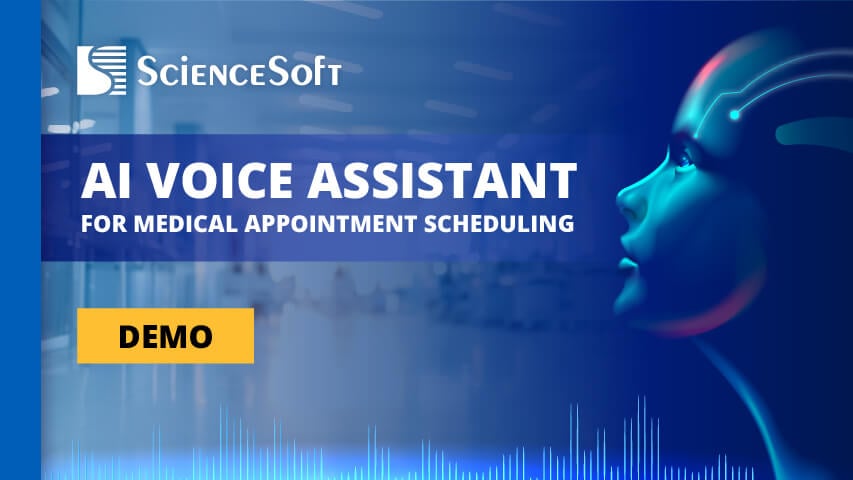
See how ScienceSoft’s AI voice assistant solution helps a patient schedule a visit in a natural voice conversation. Featuring Vadim Belski, ScienceSoft’s Principal Architect and Head of AI.
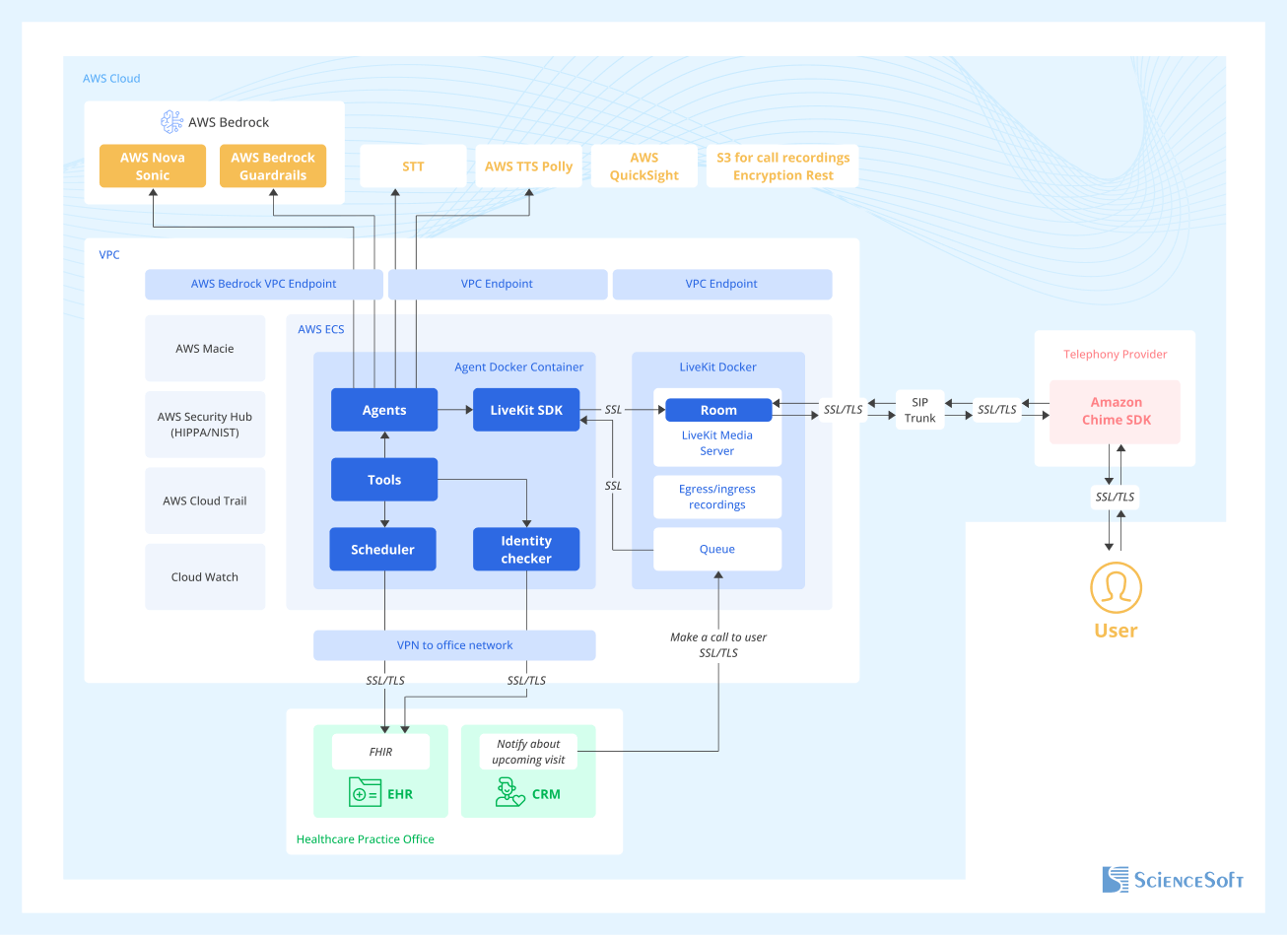
Powered by Amazon Nova Sonic and integrated with LiveKit Media Server, the assistant can book, reschedule, or cancel appointments, verify identity, and exchange data with scheduling and EHR systems via FHIR APIs during the conversation. Although the showcased version runs on AWS, the architecture is portable and can be implemented on other cloud platforms or hosted in your own data center. The solution is estimated to cut booking time by 40%, reduce abandonment by 30%, lower scheduling costs by 50%, and process up to 70% more calls per hour than a patient service representative.
Study the agent’s architecture below or follow the link to get a technical breakdown of the system.
Utilizing AI Capabilities in a Healthcare Call Center: Development Tips
Below are practical tips from ScienceSoft’s experts for implementing AI in healthcare contact center operations. The recommendations are designed to keep automation governed, integrations dependable, and improvements easy to measure from the first phase onward.

Choose an MVP that delivers value even when humans keep answering calls
A practical MVP usually improves agent-handled calls first, and then automates one narrowly defined patient flow. For example, live transcription and AI drafts for wrap-up notes can reduce after‑call work immediately. When this module proves stable, a single self‑service journey that goes through a voice AI agent (such as appointment changes) can greatly reduce peak load. This approach produces savings even if only a portion of calls are fully automated.
Build the pilot around a stable system of record
ScienceSoft recommends picking a first set of workflows that can be executed through systems that already have clean ownership and predictable APIs (typically scheduling and CRM or case management). When “the source of truth” is clear, it becomes easier to control what the assistant can do, what it cannot do, and how outcomes are recorded.
Use retrieval-based answers instead of model retraining or fine-tuning
For FAQs and agent guidance, ScienceSoft recommends using retrieval-based AI (often called RAG) that drafts responses only from approved sources such as SOPs, scheduling policies, and billing FAQs. If the assistant cannot find an answer in approved content, it should switch to a safe fallback and route to staff. This reduces hallucination risks and gives you the ability to update reference knowledge whenever needed, which is significantly faster than retraining the model itself. The same retrieval-based approach is often used in healthcare chatbots.
Plan testing around real call conditions
ScienceSoft recommends validating AI voice agents early using realistic call audio, accents, background noise, and the exact phrasing callers use. This quickly reveals whether flows are too long, which questions confuse callers, and where the system should hand off to humans. Catching these issues in a pilot prevents expensive rewrites after rollout.
Featured Expert Talk
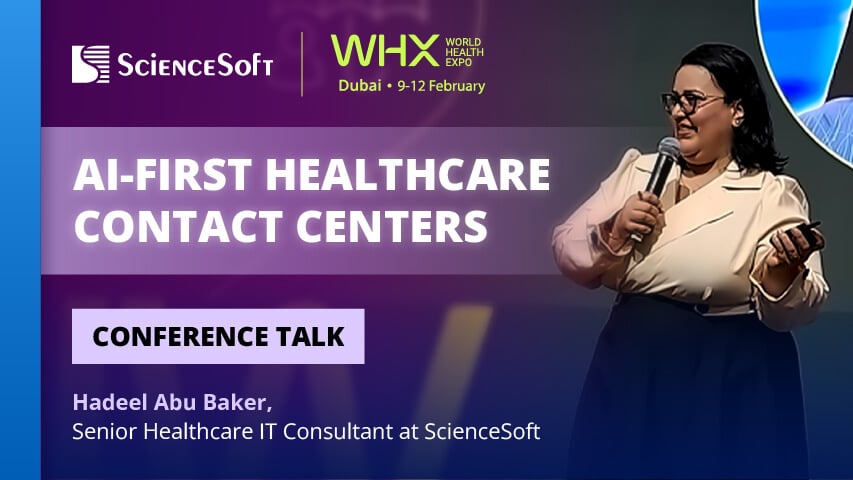
AI Agents First: Operating Model for Healthcare Contact Centers | Presentation at WHX Dubai 2026
Presentation by Hadeel Abu Baker, Senior Healthcare IT Consultant at ScienceSoft. Hadeel explains how AI in contact centers can complete patient requests end to end and how the AI-first operating model can improve patient access, reduce manual workload, and scale service quality.
How Much It Costs to Implement AI For Healthcare Call Centers
The cost of implementing a custom AI-enabled healthcare call center automation solution typically falls between $150,000 to $700,000+, with costs driven by call types covered, self-service scope, and governance requirements. Note that this estimate doesn’t include software license costs or ongoing usage fees for commercial AI models and infrastructure.

$150,000–$300,000
Agent-assist MVP that supports patient access representatives during live calls with real-time transcription, wrap-up notes, and call scripts. It reduces after-call typing and time spent searching for the right wording.

$300,000–$700,000
A scalable voice AI agent that can handle several high-volume call scenarios (e.g., appointment scheduling and reminders) end-to-end: answering or making calls, updating records in connected systems, and handing off uncertain or complex cases to humans.

$700,000+
Enterprise-scale automation that extends voice AI beyond a few scenarios to many departments, sites, and call types. May include QA workflows and in-depth analytics for continuous solution tuning.
Our Clients in Healthcare Say


I’m genuinely grateful to ScienceSoft for their hard work and would absolutely recommend them to anyone looking for top-notch results in health tech.


ScienceSoft has been a competent partner for medical software development. We would recommend them as a trustworthy vendor. They are reliable, thorough, smart, available, extremely good communicators and very friendly.

They collaborated with our medical professionals with great professionalism and care <…>. We found ScienceSoft to be dependable and forward-thinking, and we would confidently recommend them for high-responsibility projects.








Why Choose ScienceSoft for Healthcare Call Center Automation
- Since 1989 in AI enablement.
- Since 2005 in healthcare software engineering and IT consulting.
- 150+ successful healthcare software projects delivered for clinical and administrative workflows.
- An in-house Project Management Office and an Architecture and Solutions Center of Excellence to keep delivery predictable and build secure, cost-aware software infrastructures.
- Proficiency in aligning AI-enabled software with HIPAA, HITECH, GDPR, and PDPL expectations.
- Expertise in healthcare data interoperability standards, including HL7, FHIR, X12.
- An official Microsoft Solutions Partner and Cloud Solution Provider and an Amazon Web Services Select Tier Partner.
Certifications and awards
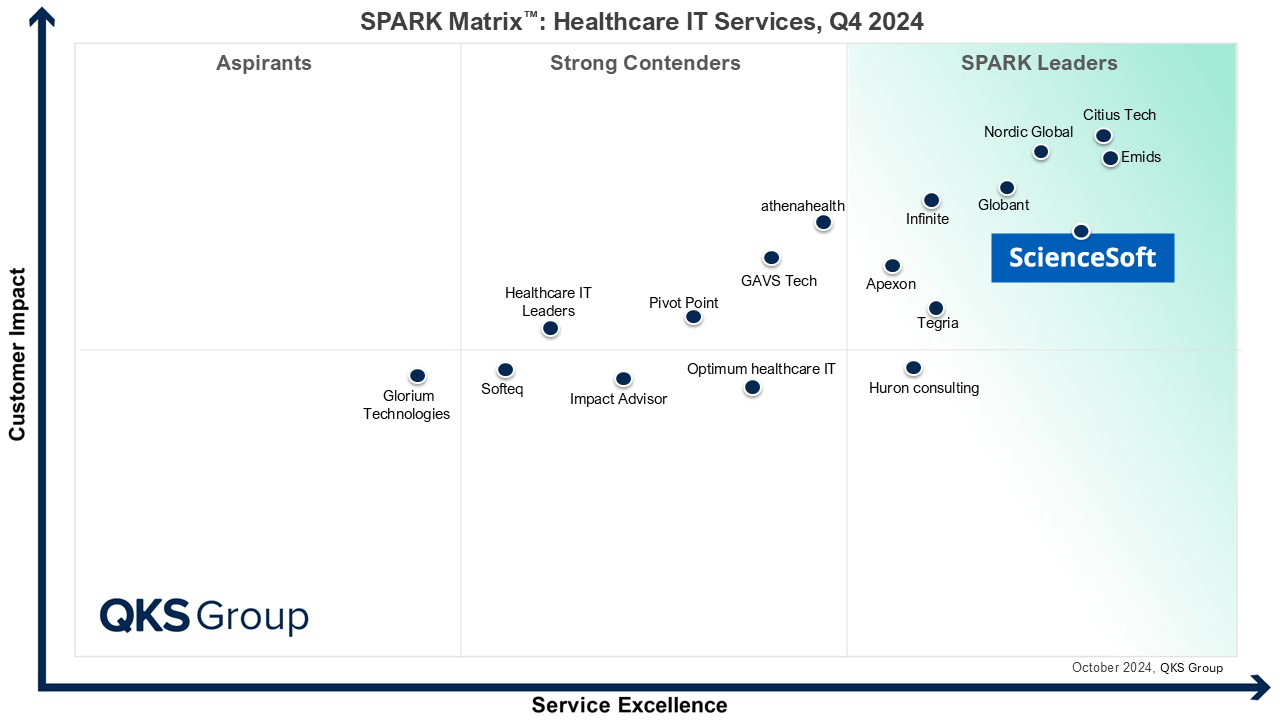
Featured among Healthcare IT Services Leaders in the 2022 and 2024 SPARK Matrix

Microsoft Solutions Partner for Data & AI

Named among America’s Fastest-Growing Companies by Financial Times, 5 years in a row
HTN Now Awards 2025/26 finalist in the Best AI Scribe Solution category

Shortlisted in the Best Use of AI for Healthcare category at The 2026 A.I. Awards
Recognized for Healthcare Technology Leadership by Frost & Sullivan in 2023 and 2025
HIMSS Gold member advancing digital healthcare
ISO 13485-certified quality management system
ISO 27001-certified security management system
