ScienceSoft Global



Veterinary Software Development Services
In healthcare IT since 2005, ScienceSoft engineers custom software solutions for veterinary practices and commercial applications for veterinary software providers.
Veterinary software development services include the design, development, evolution, support, and maintenance of custom solutions and commercial apps for veterinary practice management, diagnostics, and client communication.
Why Engineer Veterinary Software With ScienceSoft
- Since 2005 in engineering clinical and administrative software for healthcare and life sciences.
- 150+ successful projects for organizations and software providers in the domain.
- An in-house Project Management Office (PMO) to keep software development projects predictable in scope, timeline, and budget.
- An Architecture & Solutions Center of Excellence to design secure, cost-aware, and scalable software architectures.
- Since 2012 in cloud and SaaS development to deliver successful veterinary platforms and help software vendors launch robust online products with faster feature delivery and smooth integrations.
- Microsoft Solution Partner and AWS Advanced Tier Services Partner.
Certifications and awards
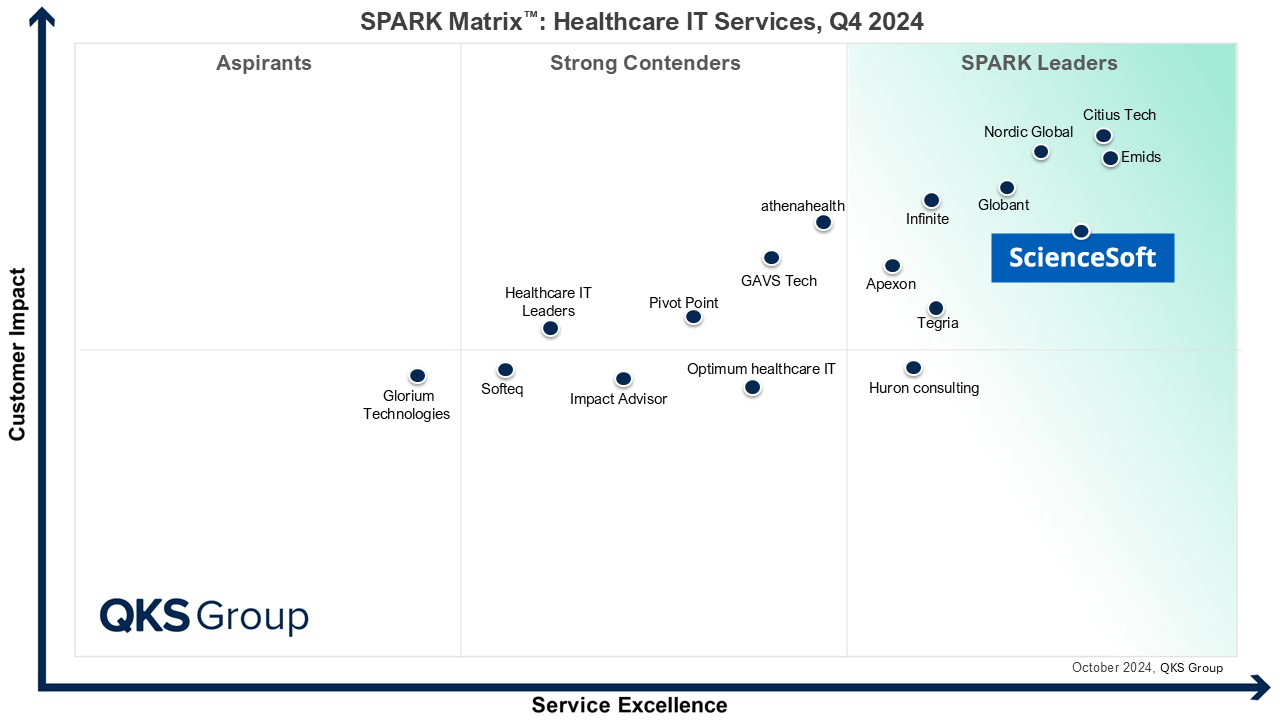
Featured among Healthcare IT Services Leaders in the 2022 and 2024 SPARK Matrix
Recognized for Healthcare Technology Leadership by Frost & Sullivan in 2023 and 2025

Named among America’s Fastest-Growing Companies by Financial Times, 5 years in a row

Four-time finalist across HTN Awards programs
Named among Becker’s Telehealth Companies to Know in 2026

Named Leading Healthcare Software Provider 2026 at Global Health & Pharma’s Healthcare & Pharmaceutical Awards

HIMSS Gold member advancing digital healthcare

ISO 13485-certified quality management system

ISO 27001-certified security management system
Veterinary Solutions We Develop, Support, and Maintain

Veterinary practice management systems (PIMS/PMS)
We deliver custom PIMS solutions for single clinics and multi-location groups, covering scheduling, digital medical records, treatment plans, billing, in-clinic pharmacy and inventory, and operational reporting. For veterinary software providers, ScienceSoft builds SaaS-ready PIMS platforms with configurable workflows, multi-tenancy, and extensible APIs.

We develop telehealth modules and standalone platforms for video visits, async consultations (chat + photos or videos), and structured follow-ups. These solutions can be configured to support VCPR-aware workflows (e.g., triage vs. telemedicine) and can integrate with pet wearables and home monitoring for chronic care and post-op recovery.

Client portals and mobile apps
We engineer portals and mobile apps that let pet owners book appointments, complete intake forms, access visit summaries and vaccination history, receive reminders, request refills, pay invoices, and message the clinic. For product vendors, ScienceSoft can deliver white-label, multi-tenant client apps with consistent UX across clinic brands.

Veterinary diagnostic lab and imaging software
We build software for laboratory and imaging workflows (order intake, specimen or study tracking, result validation, and structured reports) to enable vet clinics to submit orders and access findings online. When needed, we can implement DICOM-ready imaging or PACS integrations and unified result delivery back to the PIMS.

Pharmacy, inventory, and controlled substance management
We engineer centralized medication management software that connects prescribing, dispensing, stock updates, and procurement. These solutions can include expiry tracking, audit logs for sensitive medications, and integrations with online pharmacies and suppliers.

RFID solutions can link tagged animals, cages, instruments, and high-value equipment to digital records, enabling vet clinics to quickly identify patients, locate critical assets, track access to sensitive medications, and reduce losses and manual checks.

Analytics and data management platforms
Our engineers build analytics layers that consolidate data across locations and systems to track revenue, visit volume, utilization, no-shows, inventory turns, and care outcomes. For veterinary software providers, ScienceSoft can implement embedded analytics, benchmarking, and data export APIs while maintaining tenant-level data separation.
AI Capabilities for Veterinary Software
ScienceSoft integrates secure, transparent AI capabilities into veterinary software to enhance workflows that benefit most from automation, such as documentation, client communication, and routine administrative tasks.

AI-assisted visit documentation and charge capture
AI can convert voice recordings from appointments or free text into structured SOAP-style notes, pre-fill routine fields (history, meds, vitals), and suggest billable services and supplies based on the documented actions. The value is faster documentation, more consistent records, and fewer missed charges, while vets remain in full control of final entries.

AI-supported scheduling and intake
Voice- or text-based AI agents can offload front-desk employees by answering client calls or messages to schedule appointments, complete basic intake forms, and identify high-risk patients before routing the case to the clinical staff. This reduces call abandonment rate and delays in care without letting AI take over autonomous triage or diagnostics.

AI-generated discharge instructions and client communication
AI can draft discharge notes, home-care instructions, and follow-up messages in clear, client-friendly language (or, when needed, in multiple languages). It can also help standardize post-op and chronic care reminders, reducing callback volume and improving adherence without adding to the workload of front-desk teams.

AI-assisted imaging pre-screening and worklist prioritization
A veterinary image recognition engine can pre-screen studies to flag cases that may need priority review, highlight regions of interest, and support QA in reporting workflows. The business impact is faster turnaround and reduced risk of missing time-sensitive findings, especially when caseloads spike.
Request a Custom Quote for Your Veterinary Software
Tell us about your initiative, and ScienceSoft’s team will prepare a free, no-obligation cost estimate. All information will be kept strictly confidential, and we are ready to sign an NDA before you share any sensitive data.
Veterinary Software Development Services by ScienceSoft

Software implementation consulting (for veterinary practices)
We help you shape a clear vision for your veterinary solution. Working with your team, our experts define the optimal feature map, suggest cost-efficient architecture and technology options, and advise on implementing security and compliance frameworks relevant to your jurisdiction. You receive a detailed project roadmap with realistic time and cost estimates, plus a practical risk management plan.

Software product consulting (for veterinary software providers)
We help veterinary software providers refine their product vision and MVP scope, validate must-have features against real clinical workflows, and design UX that works well for vets, nurses, and front-desk staff. Our consultants plan the cloud architecture, key integrations, and rollout stages to support predictable delivery, cost efficiency, and a product foundation that can grow with new modules, partners, and customer segments.

End-to-end veterinary software development
We handle the full development lifecycle for your veterinary solution or product: from requirements gathering and UX design to architecture, development, integrations, testing, and release. Along with the source code, we deliver comprehensive technical and user documentation and offer post-launch support to resolve any remaining issues.

Veterinary software modernization
We are ready to modernize legacy veterinary systems or outdated software products with minimal disruption to existing clinical workflows. We eliminate common issues such as slow performance, scattered data, technical debt, and weak integrations, and improve the UX for vet clinic teams. We can also add new modules, upgrade cloud infrastructure, and introduce time-saving AI features.

Low-code development for veterinary software modules
If you need to extend your existing veterinary software ecosystem without a significant investment, we can use low-code platforms (e.g., Microsoft Power Apps) to quickly add new back-office components or connections between modules. Such platforms include intuitive drag-and-drop process builders, enabling your non-technical staff to adapt software logic to your practice’s workflows or emerging regulations over time.

Veterinary software support, monitoring, and troubleshooting
We can keep your veterinary apps stable, secure, and up to date through continuous monitoring, troubleshooting, and planned maintenance. Our team detects and fixes performance bottlenecks, configuration issues, and data inconsistencies, while helping you stay aligned with regulations. We also help our clients optimize cloud consumption, resulting in up to 75% in cloud cost savings.
Sample Architecture for a Veterinary Software Ecosystem
Below, ScienceSoft’s solution architects show a high-level schema of a software ecosystem typically used at large-scale veterinary practices. For smaller clinics, the presence of extra tools and integrations aside from PIMS will depend on the clinic’s IT maturity and business needs.
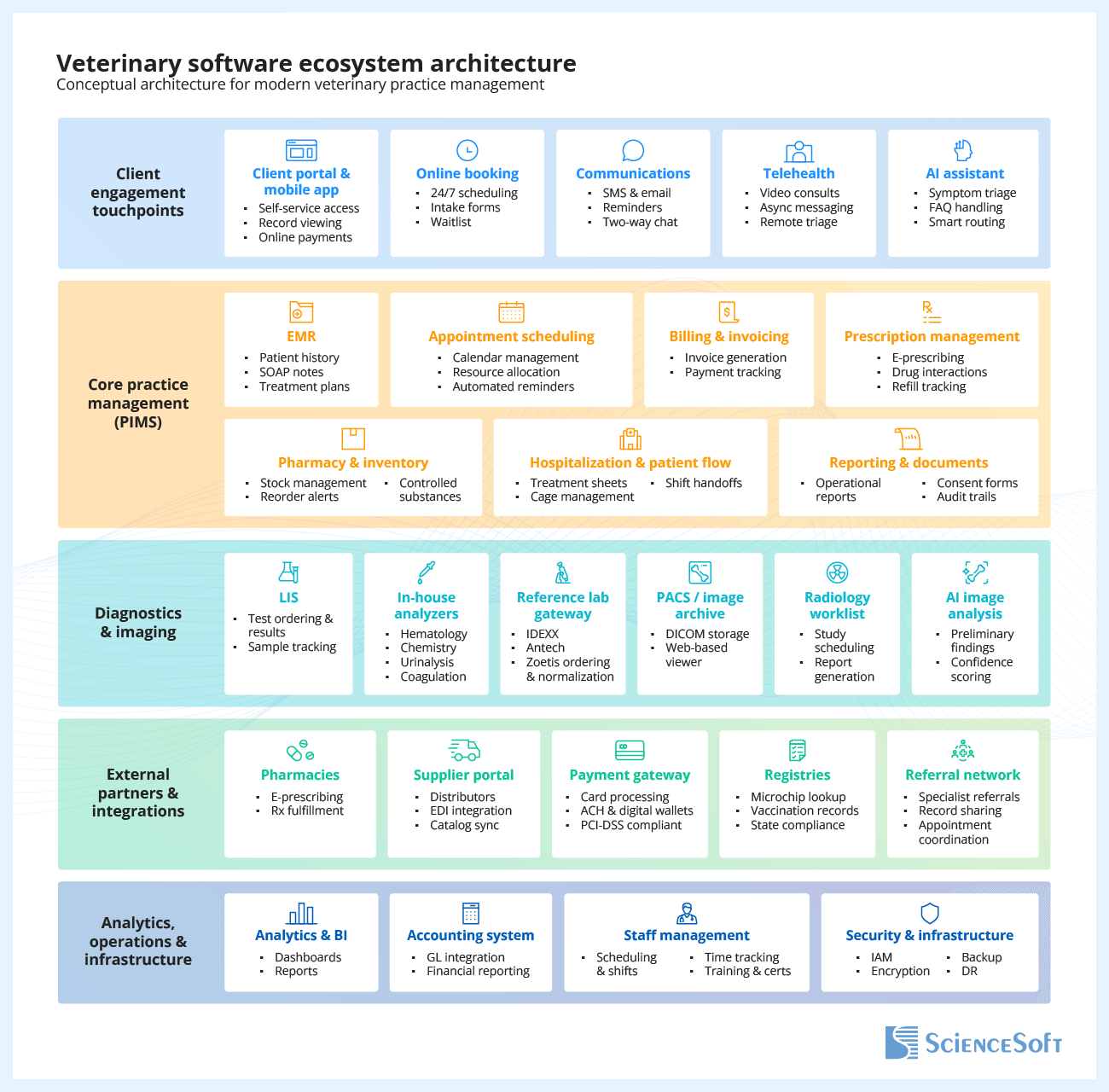
In the veterinary ecosystem shown on the diagram, the veterinary practice management system (PMS/PIMS) serves as the central information hub. It may include built-in modules for medical records, appointment scheduling, billing and invoicing, pharmacy and inventory, prescription management, hospitalization and patient flow boards, and basic financial and operational reporting.
Client-facing tools (portals, mobile apps, and other booking and communication channels) sync with the PIMS to support online appointment scheduling, messaging, reminders, and access to key visit information. An AI assistant, which can be deployed separately or as part of any of these channels, can offload administrative staff by answering FAQs and routing requests to booking tools, front desk, or telehealth, while passing the collected context back into the PIMS. If a clinic supports virtual visits, a telehealth platform pulls appointment context from the PIMS and returns consultation notes and shared media to the patient record to keep documentation complete.
For diagnostics, the PIMS exchanges orders and identifiers with connected lab and imaging systems. In return, it receives lab results, study images (directly or via links), and diagnostic reports that are automatically attached to the relevant patient record, reducing manual uploads and copy-paste.
Medication and supply workflows connect the PIMS to external partners as needed. The PIMS transmits prescription information to external pharmacies or e-prescribing services and receives validation, fulfillment status, and refill-related updates. Procurement platforms receive purchase orders for clinic stock and return confirmations and fulfillment updates that help track expected deliveries.
Financial workflows typically stay centered in the PIMS: invoices created in the system are routed to a payment gateway for checkout and online payments, with payment confirmations flowing back to keep balances accurate. Periodically, the accounting system receives exports from the PIMS for bookkeeping and financial reporting, while operational work continues in the PIMS without disruption.
The PIMS also connects to external registries to look up microchip information and support vaccination or compliance record checks where required, and to referral networks to coordinate specialist referrals and exchange medical records and referral reports.
How We Handle Common Issues in Veterinary Software Projects

Challenge #1. Integrating many disconnected systems into one workflow
Veterinary teams often have to work with disconnected systems that use disparate data models. This leads to compatibility issues and the need for manual data entry.
Solution
Challenge #2. Balancing security, compliance, and growth
Veterinary systems handle sensitive client and patient data, payment information, and lab results and images. Many practices also need strong internal controls for medication handling and controlled substances. Security and compliance must scale as you add locations, users, and new modules (like telehealth or AI).
Solution
Challenge #3. Keeping telehealth and prescribing workflows compliant across jurisdictions
Telehealth rules can differ by state and country, especially around establishing a veterinarian-client-patient relationship (VCPR) and what is allowed remotely. This becomes even more complex when remote workflows intersect with prescribing and controlled substances, including state PDMP reporting requirements.
Solution
What Our Clients Say


ScienceSoft has been a competent partner for medical software development. We would recommend them as a trustworthy vendor. They are reliable, thorough, smart, available, extremely good communicators and very friendly.



We appreciate their proactive communication and commitment to quality. With ScienceSoft on our side, we can fully focus on delivering tailored healthcare solutions to our clients. Highly recommend them!

They delivered a fully customized AI medical chatbot PoC in just two weeks, which was unbelievable. The attention to detail in the chatbot design, and especially the pitch deck, was amazing - with this kit on hand, we are ready to go into investor discussions confidently.