 ScienceSoft Global



AI for Patient Scheduling Optimization
Use Cases, Architecture, Costs
With experience in healthcare software engineering since 2005, ScienceSoft helps hospitals implement AI for patient scheduling optimization. We help healthcare providers create faster scheduling workflows that reduce call center workload, improve provider slot utilization, and enable patients to book, reschedule, cancel, and confirm appointments with less friction.

Contributors

Senior Healthcare IT & AI Consultant, ScienceSoft

Senior Solution Architect, Healthcare, ScienceSoft
The Essence of AI for Patient Scheduling Optimization
AI for patient scheduling optimization helps healthcare providers automate and improve appointment booking, cancellation, waitlist management, and provider slot allocation. It can support patient-facing workflows across phone, patient portal, mobile app, web chat, SMS, and email, helping schedulers and patient access teams manage appointment demand more efficiently.
Where healthcare providers usually start
Implementing AI for patient scheduling usually means adding secure automation components to the systems hospitals already use, not replacing them. ScienceSoft can add AI-assisted self-service functions to existing reminders and patient portals, implement an AI chat or voice agent, or build a full-scale scheduling optimization layer connected to the enterprise EHR and patient access workflows.
- Entry-level: AI for self-service rescheduling and cancellation. You let patients cancel or reschedule via a secure reminder link sent via SMS, email, or notifications in the portal or app. The AI component checks what the patient is allowed to do, shows only eligible slots from the scheduling system, confirms the change, and triggers waitlist outreach when a slot opens.
- Mid-scale: AI-assisted contact center. An AI voice or chat agent is placed between the IVR or contact center platform and the EHR or PMS scheduling layer. It handles routine appointment requests through controlled booking, cancellation, and rescheduling tools, while exceptions go to staff with the conversation history and patient context.
- Enterprise-level: scheduling optimization layer. A central AI orchestration layer connects the EHR or PMS, referral system, CRM, patient portal, contact center, and messaging channels. It monitors open slots, cancellations, waitlists, referrals, follow-up needs, and no-show risk signals to trigger outreach, recommend suitable slots, update source systems, and show access managers where capacity is lost.
How AI Affects Patient Access and Utilization

Lower call center workload
AI can handle routine appointment booking, rescheduling, cancellation, and confirmation requests, helping patient service representatives focus on complex cases, exceptions, and patients who need human support.

Faster appointment booking
AI reduces the back-and-forth usually needed to find a suitable appointment time. It can check available slots in real time, filter them by visit type, provider, location, and patient preferences, and offer the best-matching options immediately, so the patient can confirm an appointment within the same interaction.

Reduced call abandonment
AI voice agents can scale to handle multiple patient interactions simultaneously, helping hospitals reduce wait times and missed scheduling opportunities during demand peaks.

Better patient experience
AI can guide patients through scheduling instead of making them search through slots, forms, or phone menus on their own. The assistant can understand natural-language requests, narrow down suitable appointment options, offer alternatives when the preferred time is unavailable, and complete or escalate the request without making the patient restart the process in another channel.

Improved provider slot utilization
AI for patient scheduling optimization can help hospitals make better use of available provider time by filling open slots faster, reducing unused appointment capacity, and routing patients to suitable providers, locations, or time windows. This can improve KPIs such as slot fill rate, third-next-available appointment, cancellation recovery, and staff productivity.

Lower no-show rates
AI-supported scheduling workflows can help hospitals reduce avoidable missed appointments by identifying visits that need earlier confirmation, stronger reminders, easier rescheduling, or staff outreach. This can improve no-show rate, booking completion rate, patient attendance, and provider schedule predictability.

More effective waitlist management
AI can help hospitals turn cancellations and newly opened slots into completed visits faster. By matching available slots with suitable waitlisted patients and triggering timely outreach, hospitals can improve waitlist conversion, slot fill rate, cancellation recovery, and patient access to earlier appointments.

Reduced scheduling costs
By automating high-volume, routine interactions and improving slot utilization, AI for patient scheduling optimization can reduce administrative costs and better utilize patient access resources.
How AI for Patient Scheduling Optimization Works
Common use cases

AI-assisted appointment booking
Patients can use an AI scheduling assistant to book appointments through phone, portal, mobile app, SMS, or web chat. The assistant identifies the patient’s intent, collects required information, verifies identity if needed, determines the appropriate visit type, checks provider availability, offers suitable appointment slots, and creates the booking in the integrated scheduling system.

Appointment rescheduling and cancellation
AI can help patients reschedule or cancel appointments without waiting for a patient access representative. The assistant verifies the patient, retrieves existing appointment details, checks applicable cancellation or rescheduling rules, offers alternative slots, updates the appointment in the EHR or PMS, and sends a confirmation through the preferred communication channel.

No-show prediction and prevention
Predictive models can estimate no-show risk using historical and current data, such as appointment type, specialty, lead time, prior attendance history, communication history, location, and weather or transportation factors if permitted. The output can be used for staff review or as an automation signal. For example, high-risk appointments may receive additional reminders, confirmation calls, transportation guidance, waitlist backup options, or manual outreach.

Appointment slot optimization
AI can recommend appointment slots based on both patient preferences and operational priorities. For example, the system can consider provider availability, visit type, clinical urgency, patient location, appointment duration, room or equipment needs, provider productivity rules, and expected no-show risk. The goal is not simply to find an open slot but to help hospitals use appointment capacity more effectively while keeping the scheduling workflow convenient for patients.

Waitlist automation
AI can help manage waitlists by matching newly opened appointment slots with eligible, available patients who are likely to accept the slot. The system can rank waitlisted patients based on configured rules, such as urgency, requested provider, preferred location, appointment type, availability window, and prior response behavior. The AI scheduling assistant can then offer the slot via SMS, portal notification, app push, email, or an outbound call, and update the schedule once the patient accepts.

Referral and follow-up scheduling
AI can help convert referral orders, discharge follow-up instructions, care plans, or clinician recommendations into scheduling actions. For example, the assistant can review the discharge instructions to see that a patient needs a cardiology follow-up within two weeks, offer available appointment options, and complete the booking after confirmation. This can help hospitals reduce referral leakage and improve follow-up completion.

AI-powered analytics
AI-powered analytics can analyze scheduling, utilization, and patient interaction data to show where appointment capacity is lost and why. For example, it can reveal whether access issues are caused by underused provider slots, frequent late cancellations, high no-show risk, low waitlist conversion, or referral scheduling delays. These insights help hospitals adjust scheduling rules, reminder workflows, waitlist logic, and patient outreach strategies based on real access and utilization patterns.
Providers sometimes think of AI scheduling as a very front-end question: can an AI agent answer calls or messages? Sure, it can. But imagine a typical conversation: a patient wants to reschedule an appointment, keep the same doctor, and get a reminder the day before. Then they recall another commitment and change the preferred slot in the middle of the call.
For a human at the front desk, that would’ve been just a regular request. But for an AI agent, it is a dozen different tasks that each need clear rules and fallbacks. Can we verify the person? Is this slot actually bookable for this visit type? Do we have to run an eligibility check again for the new appointment? What happens if the EHR update fails halfway through?
That is why I warn providers against seeing AI as just a voice bot or a chat widget. It is a chain of small, controlled actions that must work reliably behind every simple patient conversation. I wrote about this in more detail in our article on AI-first healthcare contact centers, where we look at how these workflows should be connected and governed.
Reference Architecture
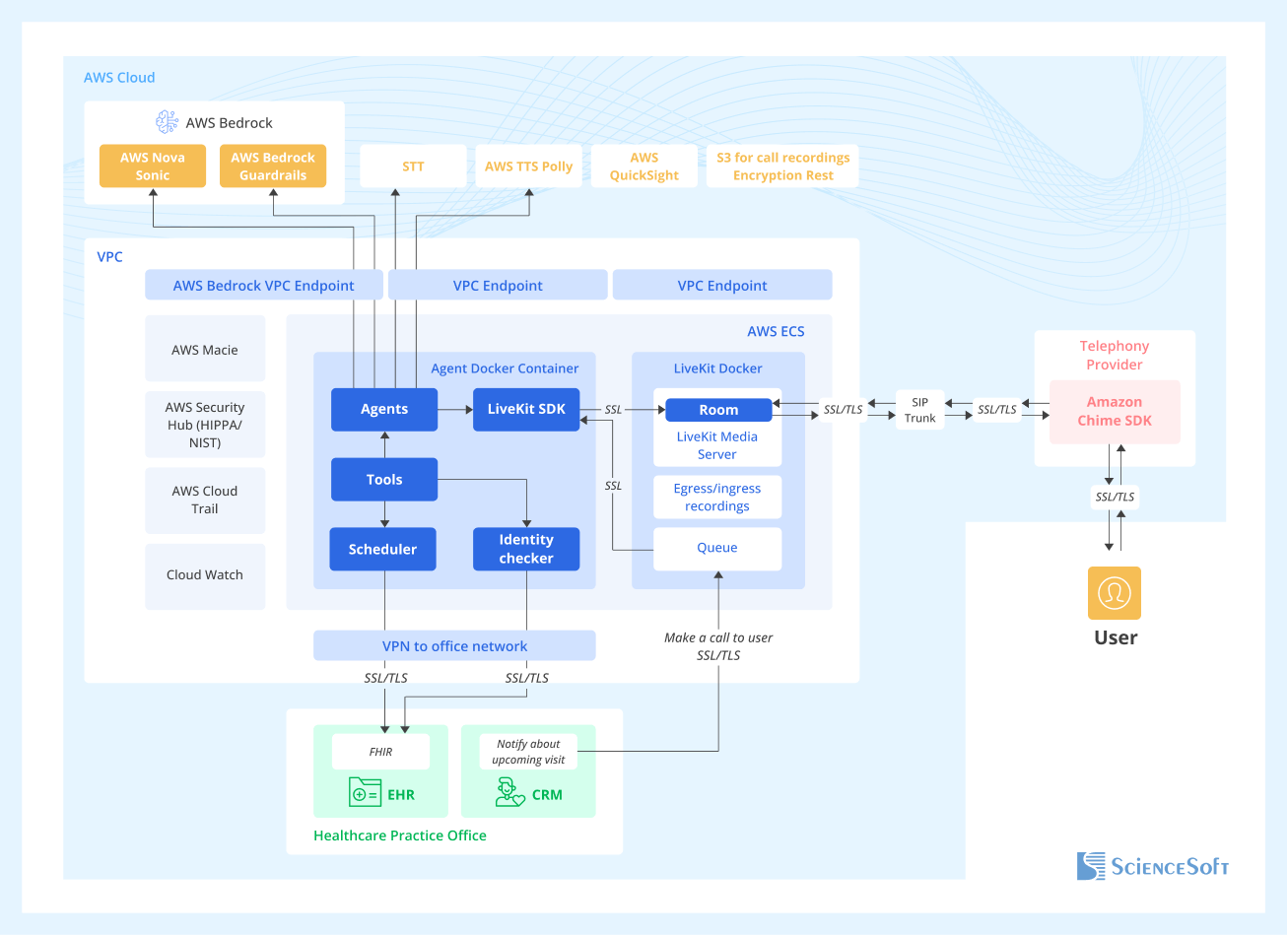
Below, ScienceSoft’s solution architects present the architecture of an appointment scheduling AI voice agent that we built for a recent project. The architecture is technology-agnostic, meaning that specific AI models, third-party tools, and cloud services can be adapted to each care provider’s requirements, budget, cloud strategy, and compliance constraints.
Check in-depth architecture description
The solution is deployed in a HIPAA-aligned AWS environment and connects to EHR and CRM systems through FHIR-based APIs.
When a patient calls the dedicated scheduling number, the call is first received through Amazon Chime SDK. The call is then transferred to the LiveKit Media Server via SIP trunking. LiveKit creates a separate real-time session for each call and connects two participants in this session: the patient and the AI voice agent. This setup allows the assistant to listen, respond, and act during the same conversation without noticeable back-end delays.
The AI voice agent uses a speech-to-speech Amazon Nova 2 Sonic model to understand the patient’s request and respond in natural language. At the start of the call, the assistant asks whether the patient wants to book, reschedule, cancel, or clarify an appointment. Before accessing or changing appointment details, the AI assistant verifies the patient’s identity. For example, it may ask for the patient’s name, date of birth, and the last four digits of their SSN, and compare this information with records in the connected EHR or CRM. If verification fails, the call is transferred to a patient service representative.
Once the patient is successfully verified, the assistant collects scheduling details, such as preferred physician, specialty, appointment date, and time. It then uses dedicated tools to check provider availability, retrieve suitable appointment slots, book, reschedule, or cancel an appointment, or update appointment data in the connected hospital systems. For example, the availability tool retrieves open provider slots, and the booking tool writes the confirmed appointment back to the scheduling system or EHR. Each tool is limited to one specific operation and receives access only to the systems and data needed for that operation. This keeps the AI assistant’s actions controlled and reduces the risk of wrong bookings, incorrect appointment changes, or unnecessary access to patient information.
Once the appointment is created or changed, the assistant confirms the details to the patient during the same call. It can also retrieve a booking ID and read it to the patient.
All AI-patient interactions pass through the AI safety and guardrails layer, implemented in this reference architecture with Amazon Bedrock Guardrails. This layer checks whether the patient’s request is within the assistant’s allowed scheduling scope, helps detect suspicious or manipulative inputs, and prevents the assistant from exposing unauthorized PHI. If the conversation becomes unclear, sensitive, or outside the approved workflow, the assistant escalates the call to staff.
The system records conversations and stores call data in an encrypted Amazon S3 bucket to support transcript generation, compliance reviews, patient engagement analytics, quality monitoring, and controlled model improvement. Audit and monitoring services, such as AWS CloudTrail, Amazon CloudWatch, AWS Security Hub, and Amazon Macie, help track system activity, detect security risks, and protect sensitive data.
The architecture is designed to scale horizontally. Each AI voice agent instance handles one call at a time, while additional instances can be launched automatically to support high call volumes. This allows the organization to process many scheduling calls at once without increasing the workload on patient service representatives.
Hide
Conversational AI Assistant for Patient Appointment Scheduling
Explore how conversational AI can support end-to-end appointment scheduling in healthcare. Built around a real-time speech-to-speech model, the AI voice agent can understand patient requests, verify identity, check appointment availability in connected hospital systems, and complete booking, rescheduling, or cancellation workflows without staff involvement. The solution can be scaled to handle high call volumes and help healthcare organizations reduce the cost of routine patient engagement.
Often, teams are tempted to perfect the conversation side of an AI scheduler first: how naturally it speaks, how well it understands intent, or how smoothly it handles patient questions. But in real hospital workflows, the bigger question is whether the assistant can safely act across the systems where scheduling actually happens.
Before tuning prompts, I recommend checking the integration layer: how the system retrieves real-time slot availability, books or reschedules appointments, handles interrupted calls or chats, and writes confirmed changes back to the EHR, PMS, or scheduling system with an audit trail. FHIR can be part of this setup, especially for Slot and Appointment resources, but it is not a universal shortcut. In practice, hospitals may also need proprietary EHR APIs, HL7 v2 interfaces, vendor-specific scheduling rules, licensing checks, and latency testing.
Only after this transaction flow is reliable should teams optimize the conversation experience. Otherwise, the AI may sound impressive but still create operational risk: duplicate bookings, outdated slot offers, failed write-backs, or appointment changes staff cannot trace.
Key Challenges of Implementing AI for Patient Scheduling Optimization
Challenge #1: AI may take incorrect scheduling actions or offer unsuitable appointment slots.
Solution:
ScienceSoft designs AI-powered patient scheduling workflows so that the AI assistant cannot freely modify appointment data or apply scheduling rules on its own. Instead, the assistant performs scheduling actions through controlled backend tools, such as identity verification, slot search, booking, rescheduling, cancellation, confirmation, or staff escalation. Each tool has a defined purpose, access permissions, and validation rules, so the AI cannot act outside the approved scheduling process.
However, controlled tools alone are not enough. Scheduling errors can still happen if the assistant does not account for real hospital constraints. For example, a slot may look available but be unsuitable for a specific visit type, location, provider, room, equipment, referral status, or patient eligibility rule. To prevent this, ScienceSoft validates each scheduling action against predefined rules and real-time system checks before an appointment is created or changed. When the request is complex, identity verification fails, required data is missing, or the patient asks a clinical question, the case is routed to staff because the AI assistant no longer has enough verified information or predefined rules to complete the action safely.
Challenge #2: AI may disclose PHI to an unauthorized person or reveal more patient data than needed.
Solution:
ScienceSoft starts by defining what patient data the AI assistant is allowed to access at each step of the scheduling workflow. In patient scheduling, the assistant may need to work with sensitive details, such as patient identity, appointment history, provider information, visit type, location, or communication preferences. If these data flows are not designed carefully, the assistant may expose PHI before the patient is verified or reveal more information than the scheduling task requires.
To reduce this risk, we design the workflow so that patient data is disclosed gradually and only when needed. Before accessing or changing appointment details, the assistant verifies the patient using hospital-approved identifiers. If verification fails, the interaction is transferred to a patient service representative.
After verification, the assistant still does not receive broad access to the EHR, PMS, CRM, or scheduling system. Each scheduling action is performed through a permissioned backend tool that exposes only the data required for that task. For example, a slot-search tool does not need unrelated clinical or billing data, and a cancellation tool does not need access to the full patient record. We also add an AI safety and guardrails layer to check whether the request is within the approved scheduling scope, detect suspicious inputs, and filter responses that could expose unauthorized PHI.
Challenge #3: Predictive scheduling models may be inaccurate or unreliable.
Solution:
ScienceSoft treats predictive scheduling outputs as decision-support signals first, not as automatic instructions for changing the schedule. This is important because no-show prediction, waitlist matching, demand forecasting, and slot optimization depend heavily on the hospital’s actual scheduling data and local workflows.
Before building or deploying a predictive model, we assess whether the hospital has enough usable historical data for the target use case. This may include appointment history, cancellations, no-shows, booking lead time, visit types, specialties, locations, provider schedules, reminder history, waitlist outcomes, and referral scheduling data. If the data is incomplete, inconsistent, or fragmented across systems, the first step is data preparation rather than model automation.
When the data is suitable, we design models with explainable input factors, test them on historical scheduling data, and validate the outputs against local operational expectations. At the first stage, a no-show score or waitlist recommendation can help staff prioritize reminders, outreach, or manual review. Only after the model proves reliable in the hospital’s environment should its outputs be connected to automated workflows, such as additional reminder sequences or waitlist backup offers.
Technologies We Use to Implement AI for Patient Scheduling Optimization
Foundation LLMs
- Amazon Nova
- Anthropic Claude
- OpenAI GPT
- Google Gemini
- Meta Llama
- Mistral
Real-Time voice AI models and APIs
- Amazon Nova 2 Sonic
- OpenAI Realtime API
- Google Gemini Live API
- Voice Live API
GenAI platforms and AI services
- Amazon Bedrock
- Microsoft Foundry
- Google Vertex AI
- vLLM
Agentic AI frameworks, orchestration tools, and guardrails
- Amazon Bedrock Agents
- Amazon Bedrock Guardrails
- Microsoft Foundry Agent Service
- Microsoft Agent Framework
- OpenAI Agents SDK
- Vertex AI Agent Builder
- LangGraph
- NVIDIA NeMo Guardrails
- Azure AI Content Safety
- Google Model Armor
Telephony, real-time media, and voice communication platforms
- Amazon Connect
- Amazon Chime SDK
- LiveKit
- Twilio
- Azure Communication Services
- SIP
- WebRTC
Healthcare interoperability standards, protocols, and APIs
- HL7 FHIR
- FHIR Schedule
- FHIR Slot
- FHIR Appointment
- IHE FHIR Scheduling
- HL7 v2
- SIU messages
- SMART on FHIR
- OAuth 2.0
- OpenID Connect
- Epic APIs
- Oracle Health APIs
Healthcare data and FHIR platforms
- Amazon HealthLake
- Azure Health Data Services
- Google Cloud Healthcare API
Communication APIs and notification services
- Amazon SES
- Amazon SNS
- Amazon Pinpoint
- SendGrid
- Azure Communication Services
- Firebase Cloud Messaging
ML frameworks, optimization solvers, and MLOps tools
- XGBoost
- LightGBM
- CatBoost
- Google OR-Tools
- Gurobi
- OptaPlanner
- Amazon SageMaker AI
- Azure Machine Learning
- Google Vertex AI
- Databricks MLflow
- Feast
BI and analytics platforms
- Power BI
- Amazon QuickSight
- Looker
Cloud security, monitoring, and compliance tools
- AWS CloudTrail
- AWS CloudWatch
- AWS Security Hub
- Amazon Macie
- AWS KMS
- Azure Monitor
- Azure Key Vault
- Microsoft Defender for Cloud
- Microsoft Purview
- Microsoft Sentinel
- Splunk
- Google Cloud Audit Logs
- Google Cloud Security Command Center
- Google Cloud DLP
- Google Cloud KMS
- Splunk
Costs of Implementing AI for Patient Scheduling Optimization
The cost of implementing AI for patient scheduling optimization typically ranges from $50,000 to $1,000,000+ and depends mainly on the scope of AI-assisted scheduling workflows, the number of patient access channels, integration complexity, optimization requirements, validation needs, and compliance controls.
At the lower end, healthcare organizations can implement an AI assistant that supports appointment confirmation, cancellation, or simple rescheduling through one patient access channel, such as a portal chatbot, website chat, or SMS flow, with basic EHR or PMS integration. At the upper end, healthcare providers can build a multichannel AI scheduling optimization layer with real-time voice AI, patient self-scheduling, waitlist automation, no-show prediction, staff dashboards, and integrations across multiple hospital systems. These ranges cover the design and implementation work and exclude third-party software platform licenses, cloud hosting, and AI model usage.
Key implementation cost drivers include:
- The number and complexity of AI scheduling use cases.
- The number of patient access channels covered.
- The number and complexity of integrations with hospital systems.
- Whether real-time voice scheduling is included.
- The complexity of scheduling rules.
- The need for predictive and optimization models.
- The quality, structure, and accessibility of historical scheduling data.
- Security, compliance, consent management, and auditability requirements.
- The need for staff-facing dashboards and analytics.
- The chosen deployment model and operating setup.
- The need for multilingual support.
- The expected volume of calls, chats, or scheduling transactions.
Why Choose ScienceSoft as Your Healthcare AI Partner
- In healthcare IT since 2005.
- In AI since 1989, with experience building custom AI models and adapting pretrained ones to healthcare use cases.
- 750+ experts, including AI architects, MD consultants, software developers, data scientists, cybersecurity experts, and QA engineers. Over 50% of our people are senior and lead-level specialists.
- 150+ healthcare IT projects and an in-house PMO to keep complex healthcare IT projects predictable, transparent, and aligned with scope and timelines.
- Architecture & Solutions Center of Excellence to design secure, scalable, and integration-ready architectures for healthcare AI initiatives.
- Proficiency in healthcare interoperability standards, including HL7 v2 and v3, FHIR, SMART on FHIR, and C-CDA.
- Experience supporting compliance with HIPAA/HITECH, GDPR, Saudi PDPL, and more.
- Strong security and quality management practices backed by ISO 27001 and ISO 9001 certifications.
Certifications and awards
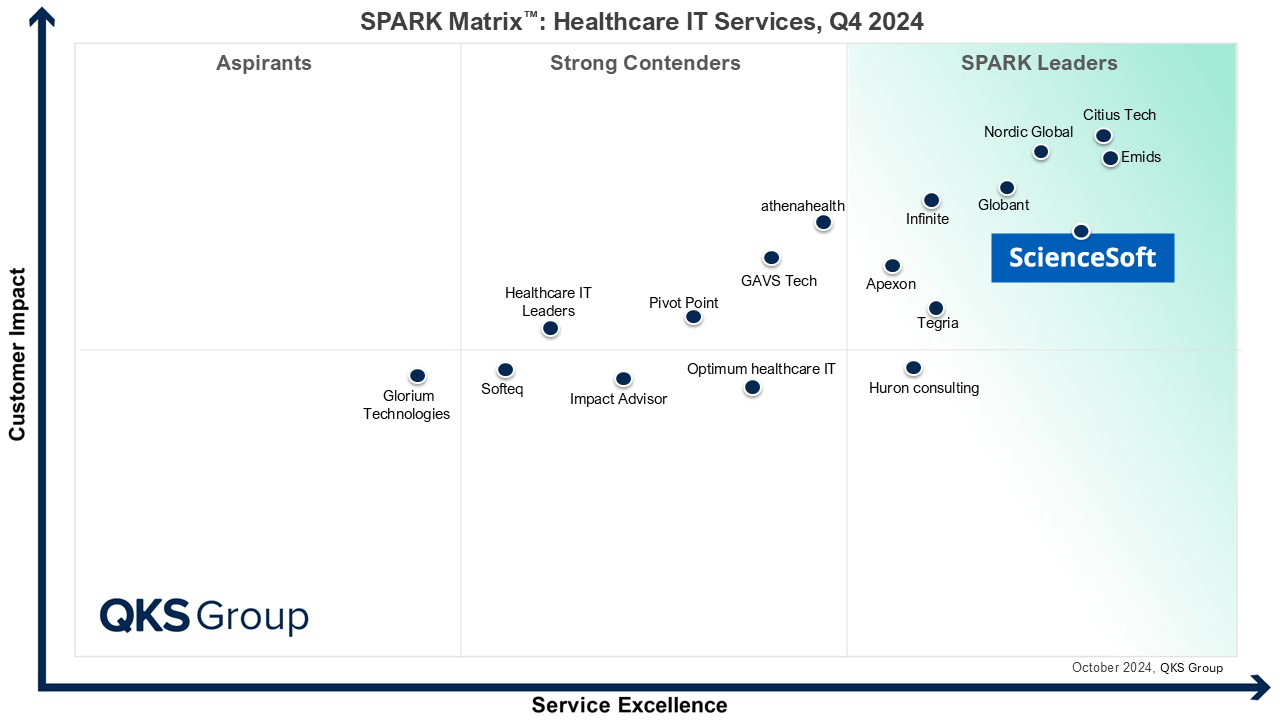
Featured among Healthcare IT Services Leaders in the 2022 and 2024 SPARK Matrix

Recognized for Healthcare Technology Leadership by Frost & Sullivan in 2023 and 2025

Named among America’s Fastest-Growing Companies by Financial Times, 5 years in a row

Four-time finalist across HTN Awards programs

Named among Becker’s Telehealth Companies to Know in 2026

Named Leading Healthcare Software Provider 2026 at GHP’s Healthcare & Pharmaceutical Awards
HIMSS Gold member advancing digital healthcare

ISO 13485-certified quality management system
ISO 27001-certified security management system
What Our Clients Say


I am particularly impressed by the cooperative nature of ScienceSoft’s team. Our project required coordination with multiple companies and individuals. ScienceSoft worked well with everyone. They are reliable, thorough, smart, available, extremely good communicators and very friendly.



I’m genuinely grateful to ScienceSoft for their hard work and would absolutely recommend them to anyone looking for top-notch results in health tech.

We found ScienceSoft to be dependable and forward-thinking, and we would confidently recommend them for high-responsibility projects.


Working with ScienceSoft was a pleasure from A to Z. We are grateful for their can-do attitude, responsiveness, and straightforward communication.

We appreciate their proactive communication and commitment to quality. With ScienceSoft on our side, we can fully focus on delivering tailored healthcare solutions to our clients. Highly recommend them!
