 ScienceSoft Global



Web and Mobile Hospital Apps
Fast Launch and Evolution of Secure Hospital Software
Being ISO 13485-certified, ScienceSoft is ready to develop or modernize web and mobile hospital apps of any complexity. We deliver robust medical solutions that streamline hospital workflows, help improve patient and business outcomes, and drive high ROI.

Web and mobile apps for hospitals help deliver care to patients and enhance hospital workflows using digital tools and advanced technologies. Since 2005 in healthcare IT, ScienceSoft is ready to develop, evolve, and support hospital apps that drive better care outcomes and improve patient and staff satisfaction. ScienceSoft is a software development company that builds hospital apps to support clinical and admin workflows.
Key Use Cases of Hospital Apps
The market of hospital management solutions is expected to grow at a CAGR of 6.33% during 2025−2035. Here are the medical specialties where hospital applications proved to be the most efficient:

Primary care

Pediatrics

Cancer care


Transplantology

Physiotherapy

Allergology

Plastic surgery

Phytotherapy
Chiropractic
Hospital Applications ScienceSoft Works With
Hospital apps empower healthcare providers to cut administrative, supply chain, patient care costs; they help efficiently manage staff and patients, handle intensive data flows. ScienceSoft can automate hospital workflows through custom software that reduces manual administrative work. Below, we list three main types of hospital apps ScienceSoft works with.

Care planning and coordination apps
- Diagnostic applications
- Digital workplaces for doctors and nurses
- Care coordination apps
- Drug prescription assistance software
- Medication administration software
- Medical image management software
- Lab management software
- DICOM viewer and medical image analysis software
- AR/VR for surgery planning and medical staff training
- Healthcare CRM

Hospital workflow apps
- EHR
- Admission, discharge, and transfer (ADT) systems
- Hospital information system (HIS)
- Revenue cycle management (RCM)
- Practice management software
- Incident management software
- Medical HR and staff management software
- Medical training and education (incl. VR)
- Healthcare data analytics solutions
- Hospital inventory management and asset tracking software
- Healthcare data analytics

Patient-centered hospital apps
- Digital therapeutics (DTx)
- Telemedicine apps
- Remote patient monitoring apps
- Healthcare AI chatbots
- Patient engagement apps
- Patient portals
- Chronic disease management
- Inpatient and outpatient care apps
Haven’t Found the Hospital App You Need?
Drop us a line, and ScienceSoft’s team will get back to you with a custom solution designed to fit your unique needs.
See Hospital Apps in Action
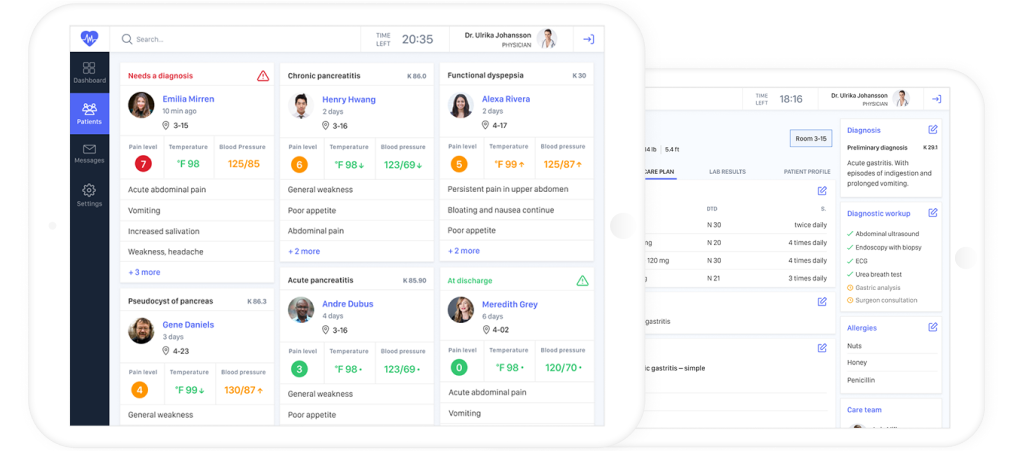
Hospital App Demo
To get an idea of how your hospital app may look, ScienceSoft invites you to take a guided tour of a tablet hospital app for a physician.
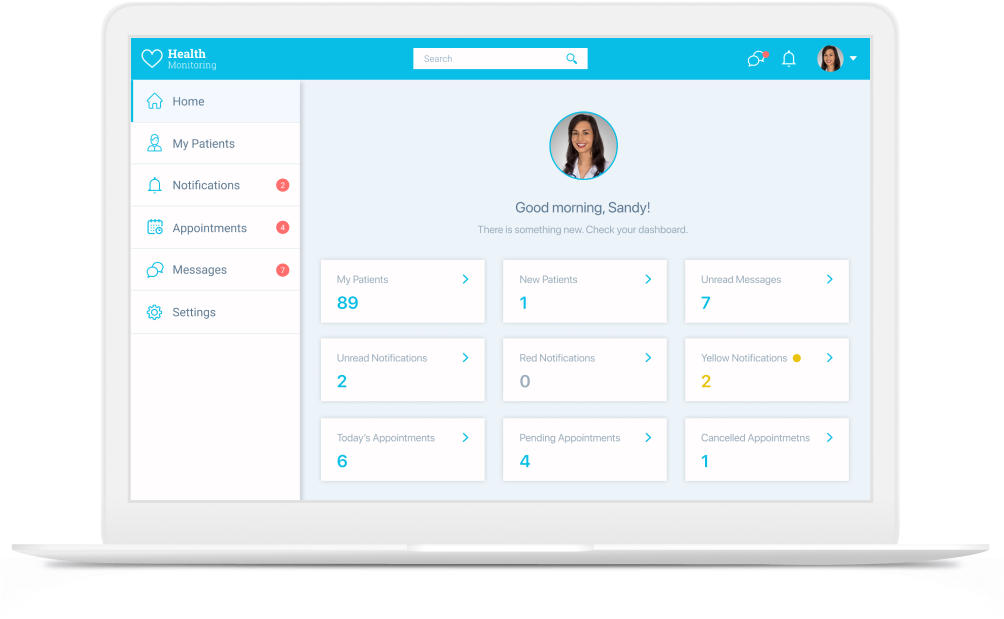
Telehealth App with Remote Patient Monitoring
Check out ScienceSoft’s demo of a telemedicine app with remote patient monitoring functionality that helps track outpatients’ recovery and adjust the therapy.
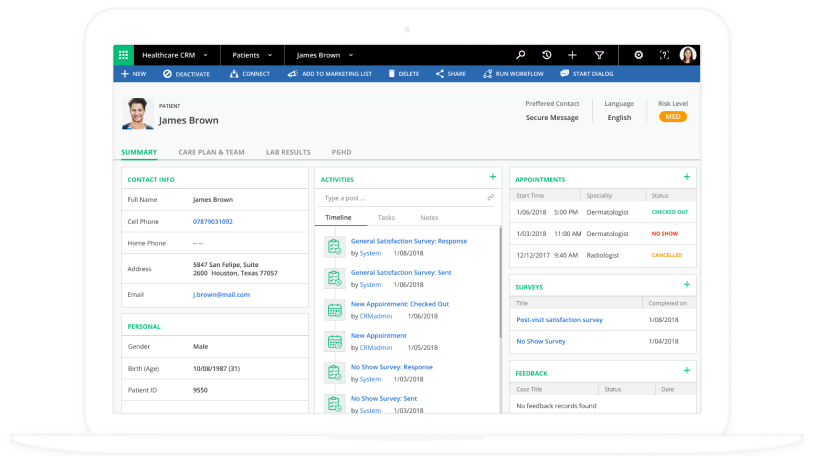
Hospital CRM Demo
ScienceSoft’s demo showcases how Dynamics 365-based hospital CRM enables continuous patient support and guidance, fosters engagement, and provides insights into a patient’s needs.
ScienceSoft, a Mature Developer for Your Hospital App
- Since 1989 in the IT market and since 2005 in healthcare IT.
- ISO 13485, ISO 9001, and ISO 27001 certifications.
- Vast experience in developing apps compliant with HIPAA, HITECH, NCPDP standards, FDA QMSR and ONC requirements, IVDR, MACRA, MIPS, CEHRT, SAFER.
- Working expertise with healthcare standards and clinical terminologies (e.g., HL7, ICD-10, CPT, SNOMED CT, XDS/XDS-I).
- Experience in FDA submission and CE marking.
Certifications and awards
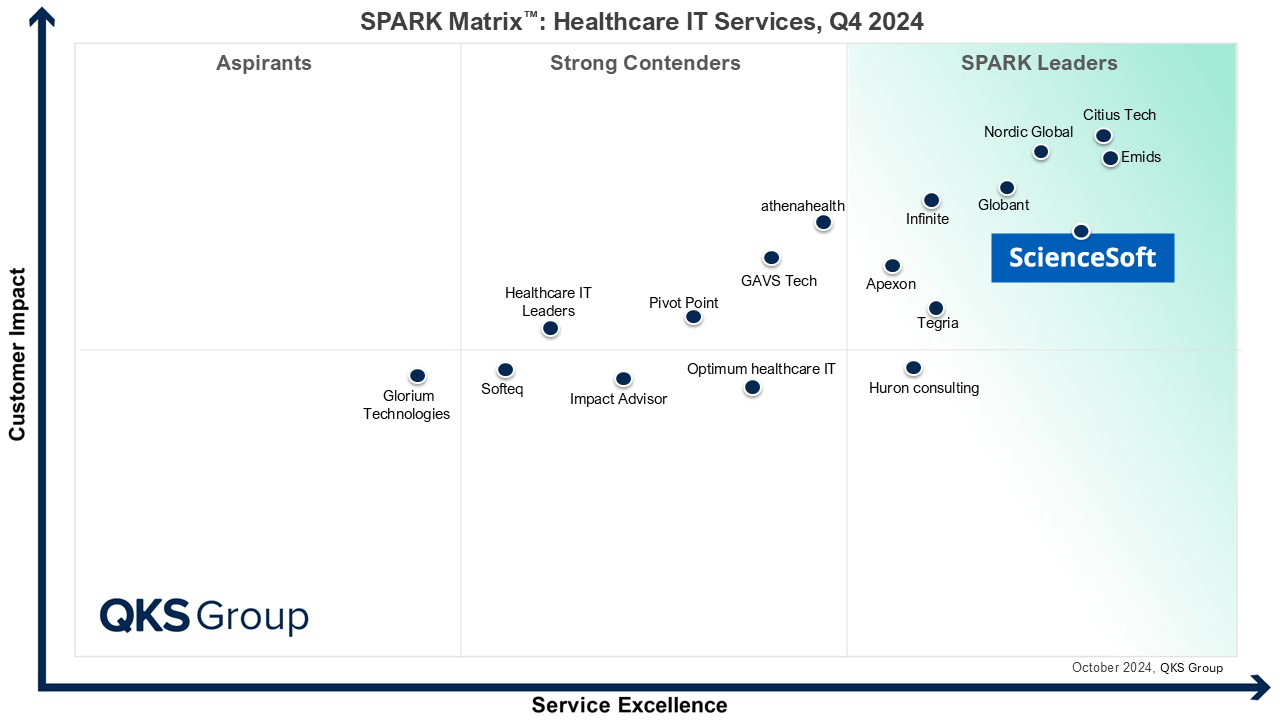
Featured among Healthcare IT Services Leaders in the 2022 and 2024 SPARK Matrix

Recognized for Healthcare Technology Leadership by Frost & Sullivan in 2023 and 2025

Named among America’s Fastest-Growing Companies by Financial Times, 5 years in a row
Four-time finalist across HTN Awards programs
Named among Becker’s Telehealth Companies to Know in 2026

Named Leading Healthcare Software Provider 2026 at GHP’s Healthcare & Pharmaceutical Awards
HIMSS Gold member advancing digital healthcare

ISO 13485-certified quality management system

ISO 27001-certified security management system
Let Us Meet You Where You Are

Hospital app development
Since 2005 in healthcare IT, we are ready to cover the entire process of hospital app implementation: from design and development to compliance testing and launch.
Hospital app support and evolution
Leveraging 23 years in IT security and 18 years in ITSM, we can establish comprehensive IT support, modernize legacy hospital apps with AI/ML, big data, and more, and ensure compliance.
We Let Our Clients Speak for Us


bioAffinity Technologies hired ScienceSoft to help in the development of its automated data analysis software for detection of lung cancer using flow cytometry.
Our project required a large amount of industry specific methodology and algorithms to be implemented into our new software connected to EHR/LIS systems, which the team handled well. They are reliable, thorough, smart, available, extremely good communicators and very friendly.



During our cooperation, ScienceSoft proved to have vast expertise in the Healthcare and Life Science industries related to the development of desktop software connected to laboratory equipment, a mobile application, and a data analytics platform.
They bring top-quality talents and deep knowledge of IT technologies and approaches in accordance with ISO 13485 and IEC 62304 standards.


We engaged ScienceSoft to build an Android app that complements our web-based platform for our patients.
They advised and successfully lead the way from end to end through the technical challenges and considerations with development of the app. We have also engaged them to introduce a few enhancements to the app and would certainly consider ScienceSoft as a technology partner in further software development initiatives.


To develop a mobile application that would enhance a line of Bluetooth-enabled devices for newborn and baby care, we opened an app development tender.
ScienceSoft's proof-of-concept was convincing enough for us to further the cooperation. During the project flow, we were very pleased by the work of ScienceSoft's business analysts and developers, who demonstrated a high level of skills and competence.
Six Steps to a Perfect Hospital App: Let’s Take Them Together
1
Planning stage
ScienceSoft’s business analysts elicit and analyze your hospital app requirements, plan and prioritize its features, define the project scope, delivery schedule, and a risk mitigation plan. At this stage, a solution architect designs hospital app architecture, and a regulatory consultant plans the compliance strategy.
2
Design stage
UX experts map out user journeys to make them more intuitive, and the UI team designs sleek interface elements to make the hospital app attractive for the target users.
3
Development stage
ScienceSoft’s experienced developers split the project into 2–4 week iterations and deliver a functional MVP with a set of priority features. Based on the user feedback and the pre-agreed scope of functionality to add, the team proceeds with frequent releases of new features until the MVP turns into a full-fledged app. At this stage, the app is also integrated with other hospital IT systems directly or via APIs.
4
Testing stage
In parallel with the hospital app development, our QA team conducts functional, integration, penetration, performance testing, as well as software compliance and vulnerability assessment.
5
Launch, support, and maintenance
After releasing the hospital app, ScienceSoft healthcare IT support team manages the performance of the app, proactively detects and fixes defects. If required, we also conduct regular security checks and updates, manage user access, and introduce minor functional adjustments.
6
Healthcare software evolution
When you decide that the hospital app doesn’t cover all the business needs anymore, ScienceSoft is here to help you introduce new features, upgrade old capabilities, integrate the app with the new elements of your IT ecosystem, etc.

How to protect your hospital app against security and compliance risks?
Improper security measures for a hospital app may jeopardize patient information and lead to HIPAA/GDPR penalties for healthcare providers and involved parties. To avoid it from the very start, we recommend choosing an IT vendor with practical experience in HIPAA, HITECH, GDPR, and other applicable data security regulations.
At ScienceSoft, we have 22+ years of experience in information security and ensure compliance by employing data encryption, data anonymization, data access control measures, and more. After the launch of your hospital app, we can perform regular vulnerability assessments, penetration testing, and establish continuous system monitoring.
Technologies We Use to Build Reliable Hospital Apps
Clouds
- Amazon Web Services
- Microsoft Azure
- Google Cloud Platform
- DigitalOcean
- Rackspace Technology
Front-end programming languages
Languages
- HTML5
- CSS
- JavaScript
JavaScript frameworks
- Angular JS
- React JS
- MeteorJS
- Vue.js
- Next.js
- Ember.js
Mobile
- iOS
- Android
- Xamarin
- Apache Cordova
- Progressive Web Apps
- React Native
- Flutter
- Ionic
Low-code development
- Microsoft Power Apps
- Microsoft Power Automate
- App Engine Studio (ServiceNow)
- Bubble.io
Databases / data storages
SQL
- Microsoft SQL Server
- Microsoft Fabric
- MySQL
- Azure SQL Database
- Oracle
- PostgreSQL
NoSQL
- Apache Cassandra
- Apache Hive
- Apache HBase
- Apache NiFi
- MongoDB
- Microsoft Fabric
Cloud databases, warehouses, and storage
AWS
- Amazon S3
- Amazon Redshift
- Amazon DynamoDB
- Amazon DocumentDB
- Amazon RDS
- Amazon ElastiCache
Azure
- Azure Data Lake
- Azure Blob Storage
- Azure Cosmos DB
- Azure SQL Database
- Azure Synapse Analytics
- Kinect DK
- Azure RTOS
Google Cloud Platform
- Google Cloud SQL
- Google Cloud Datastore
Other
- Microsoft Fabric
Platforms
- Microsoft Dynamics 365
- Salesforce
- Magento
- SharePoint
- ServiceNow
- SAP SE
DevOps
Containerization
- Docker
- Kubernetes
- Red Hat OpenShift
- Apache Mesos
Automation
- Ansible
- Puppet
- Chef
- Saltstack
- HashiCorp Terraform
- HashiCorp Packer
CI/CD tools
- AWS Developer Tools
- Azure DevOps
- Google Developer Tools
- GitLab CI/CD
- Jenkins
- TeamCity
Monitoring
- Zabbix
- Nagios
- Elasticsearch
- Prometheus
- Grafana
- Datadog
Ticketing systems
- ServiceNow
- Jira
- Redmine
- OTRS
- Zendesk
- Freshdesk
Remote collaboration
Connection
- VPN
- RDP
- TeamViewer
Communication
- Microsoft Teams
- Zoom
- GoToMeeting
Information security
- QRadar
- Cloudflare
- Siege
- BurpSuite
- Nessus Professional
- Aircrack-ng
- Acunetix
- Rapid7 Metasploit
- Nmap
- DIRB
- Wireshark
- ZMap
- Masscan
Sought-After Functionality for Hospital Apps
With an experienced team behind 150+ successful healthcare projects, we are ready to implement functionality of any complexity, including the following promising features.
Real-time communication
Essential for remote patient care, messaging and videoconferencing functionality enables medical staff to provide online consultations and monitor the treatment process.
SaMD functionality
With advanced software as a medical device functionality in your hospital app, you can provide state-of-the-art patient care. ScienceSoft is ready to introduce SaMD features that automate and improve diagnostics, treatment delivery, or disease management.
Integrations with IT systems
To achieve data consistency throughout the organization, the hospital app should be integrated with other relevant systems. Among the must-haves are EHR, HIS, practice management software, and your patient portal.
Don’t Miss Out on Trending Technologies for Hospital Apps






Practical examples of trending technologies used for hospital apps
ScienceSoft’s experts share the most promising cases of advanced technologies’ implementation in the hospital apps:
- Automated hospital asset tracking with RFID-based IoMT.
- Planning of complicated surgeries with VR models.
- VR-enabled doctor training.
- AI-powered chatbots for initial assessment of patient symptoms.
- AI-powered chatbots for clinician-approved discharge instructions, patient education, and follow-up guidance
- Healthcare image analysis for cancer diagnostics.
Hospital App Development Costs
The cost of hospital app development may vary from $70,000 to $2,000,000+. The primary cost factors include:
- Number and complexity of features.
- Non-functional requirements (e.g., security, usability, performance).
- Complexity of the architecture and the technologies selected.
- Platforms (web, mobile, desktop).
- Development approach (e.g., native vs. cross-platform for mobile).
- Number of user roles and users.
- Integrations with other medical software and devices.
- Compliance requirements (HIPAA, GDPR, etc.).
- Sourcing model (in-house vs. outsourced).
The cards below show the cost ranges for hospital apps typically requested by our clients.

$100,000–$250,000
For a patient management app that supports appointment scheduling and basic telehealth capabilities.

$150,000–$250,000
For a hospital management app that monitors staff, patients, and inventory, with billing and analytics capabilities.

$300,000–$400,000
For a telemedicine app integrated with medical devices to monitor patients’ vitals in real-time.


$800,000–$3,000,000
For a large-scale virtual hospital that enables real-time patient monitoring and clinical decision support.
Select a Pricing Approach for Your Hospital App Project
Fixed price
Best for: The projects with a clear scope that will not change later. Works best for hospital apps developed according to the Waterfall model.
Essence: The client receives a fixed quote for the fixed project scope.
Payment schedule: The payments are aligned with the pre-agreed project milestones.
Time and Materials
Best for: The hospital apps with a project scope that is likely to change or may require adjustments based on the user feedback.
Essence: The client pays for the actual time spent on the project, based on the hourly rate of the outsourced specialists.
Payment schedule: Monthly payments with reports on completed work.
Time and Materials with a cap
Best for: The projects with a scope that may require changes but with a limited development budget.
Essence: The client pays for the actual time efforts, but there is a fixed maximum total charge.
Payment schedule: Monthly payments with reports on completed work.
Get a Cost Estimate for Your Hospital App
Please answer a few questions about your software development needs. This will help our team provide a tailored service offering and a cost estimate much more quickly.

How ScienceSoft Tackles Hospital App Development
Insights From ScienceSoft's Healthcare IT Experts

Kate Lukina, MD
Healthcare IT & AI Consultant, ScienceSoft
Trend watch
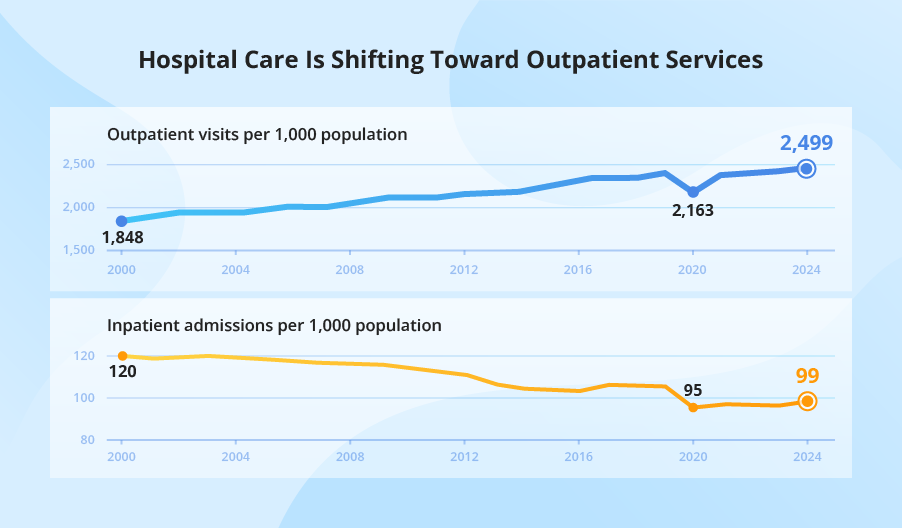
US Hospital Statistics 2026: Outpatient Care Expands

Hadeel Abu Baker
Senior Healthcare IT & AI Consultant, ScienceSoft
Trend watch
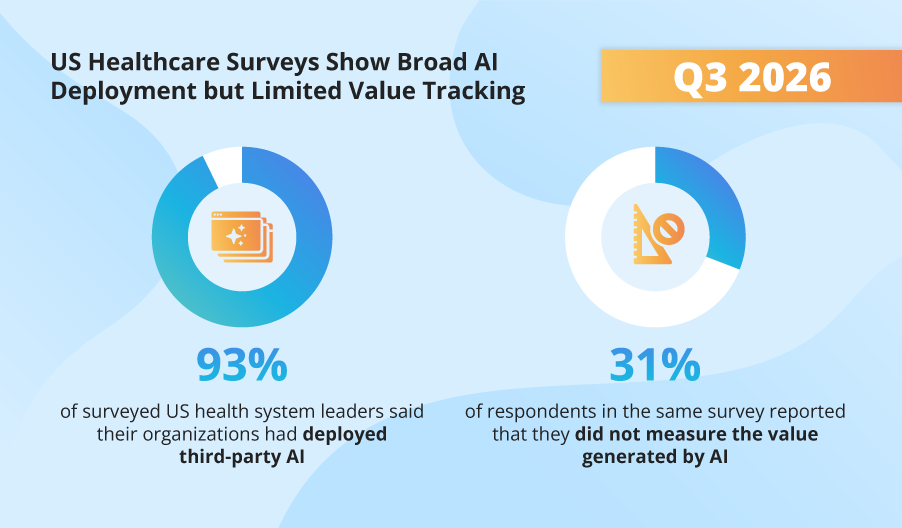
Q3 2026 Healthcare AI Trends by ScienceSoft | Oct 2026
Kate Lukina, MD
Healthcare IT & AI Consultant, ScienceSoft
Research
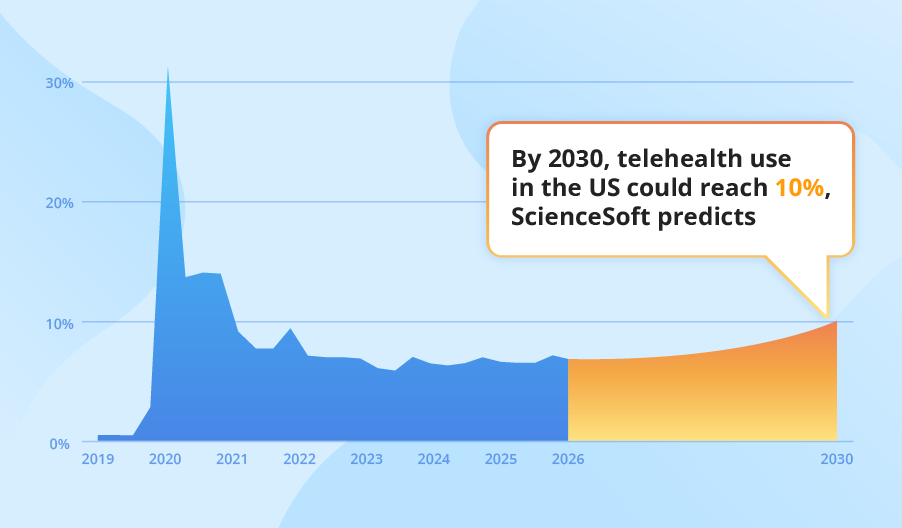
Telehealth to Make Up 10% of US Medical Visits by 2030, ScienceSoft Predicts
