 ScienceSoft Global


Artificial Intelligence for Clinical Workflow Automation
Use Cases, Architecture, Costs
With healthcare software engineering experience since 2005, ScienceSoft is an AI transformation company that helps providers implement artificial intelligence for clinical workflow automation. We integrate AI with EHRs and other clinical systems to reduce manual documentation, task coordination, and follow-up work while keeping qualified staff in control of clinical decisions.
Contributors

Senior Solution Architect, Healthcare, ScienceSoft

Head of AI, Principal Architect, ScienceSoft

Senior Healthcare IT & AI Consultant, ScienceSoft
AI for Clinical Workflow Automation: Essence
AI-powered clinical workflow automation is a technology-driven approach to managing clinical processes in which AI interprets patient information and supports the coordination of subsequent workflow steps. Unlike conventional rule-based automation, it can account for information in clinical notes, documents, and other unstructured sources, allowing healthcare providers to reduce manual work in processes that cannot be fully handled by predefined rules.
To automate clinical workflows reliably, you usually need to combine several AI and non-AI technologies:
- Generative AI (LLMs) and clinical NLP interpret clinical notes and other unstructured information, extract relevant details, and prepare summaries or documentation. Retrieval-augmented generation (RAG) can help ground AI-generated content in patient records and approved clinical sources.
- Traditional machine learning (ML) models, where needed, can analyze historical data to predict delays or identify cases that may need additional attention. For example, they can help prioritize follow-up tasks at risk of becoming overdue.
- Workflow automation and deterministic rules coordinate process steps across hospital systems and execute tasks that don't require AI interpretation. Workflow engines respond to events, such as new orders or test results, initiate the next steps, and track their completion. Predefined rules handle exact checks, such as verifying mandatory fields, and determine how tasks should be routed.
How Healthcare Providers Usually Implement AI Automation
-

Entry level: One focused clinical workflow
A hospital may start with one repetitive, relatively contained workflow, such as pre-visit chart summarization, AI-assisted documentation, or discharge summary drafting. AI retrieves relevant information from existing clinical systems and prepares a summary or draft directly in the clinician's usual workspace. Staff reviews the output before it becomes part of the medical record or triggers another action. This approach limits implementation complexity and provides clear baseline metrics for measuring whether AI actually reduces work.
-
Mid-scale: Connected automation within a department or service line
A cardiology department may automate several connected workflows, such as pre-visit preparation, test result follow-up, and discharge coordination. AI can prepare chart summaries before appointments, organize test results for clinician review, and draft discharge instructions. A shared workflow engine coordinates these processes across the EHR, laboratory, and scheduling systems. It routes tasks to the responsible staff, tracks their completion, and alerts the care coordination team if required follow-up appointments remain unscheduled past hospital-defined deadlines. This approach lets the department reuse AI services, integrations, and automation logic across multiple workflows rather than implementing each separately.
-
Enterprise level: Shared clinical workflow orchestration
A large hospital or health system may implement a shared automation layer across multiple departments and facilities. For example, AI can prepare pre-visit summaries across outpatient clinics, help organize lab and imaging results for clinician review, and draft discharge handoffs. A shared workflow engine can coordinate follow-up tasks across departments, route work to responsible staff, and track completion and delays. Instead of building separate solutions for each department, the health system can reuse AI services, integrations, and automation rules while adapting workflows to local needs. Centralized monitoring also helps identify bottlenecks and track automation performance across facilities.


Clinical Workflow Metrics AI Can Improve
-

Staff time per workflow
Fraser Health reported a 56% reduction in discharge summary preparation time after implementing AI-assisted discharge summary generation.
-
Time from clinical event to required action
A JAMA Network Open study found that an NLP-powered patient message routing tool reduced median time to first clinician read of high-acuity messages from 22 to 5 hours.
-
Manual chart review time
A JAMIA Open study found that AI-generated clinical summaries reduced chart review time by 49 seconds per visit among clinicians with above-average baseline review times.
-
Clinical documentation time
A 2026 study found 21% less note-writing time per appointment among frequent users of an ambient AI scribe.

Key Applications of AI in Clinical Workflows
-
 Virtual front door & triage
-
Pre-visit chart review & clinical documentation
-
Diagnostic workflows
-
Medication review
-
Results review & follow-up
-
Clinical handoffs & care coordination
-
Clinical inbox & worklist automation
-
Discharge & patient instructions






Reference Architecture for AI-Powered Clinical Workflow Automation
Below, you will find a reference architecture for AI-powered clinical workflow automation developed by ScienceSoft’s solution architects. It illustrates how AI can support clinical workflows while keeping human review and approval at key decision points.
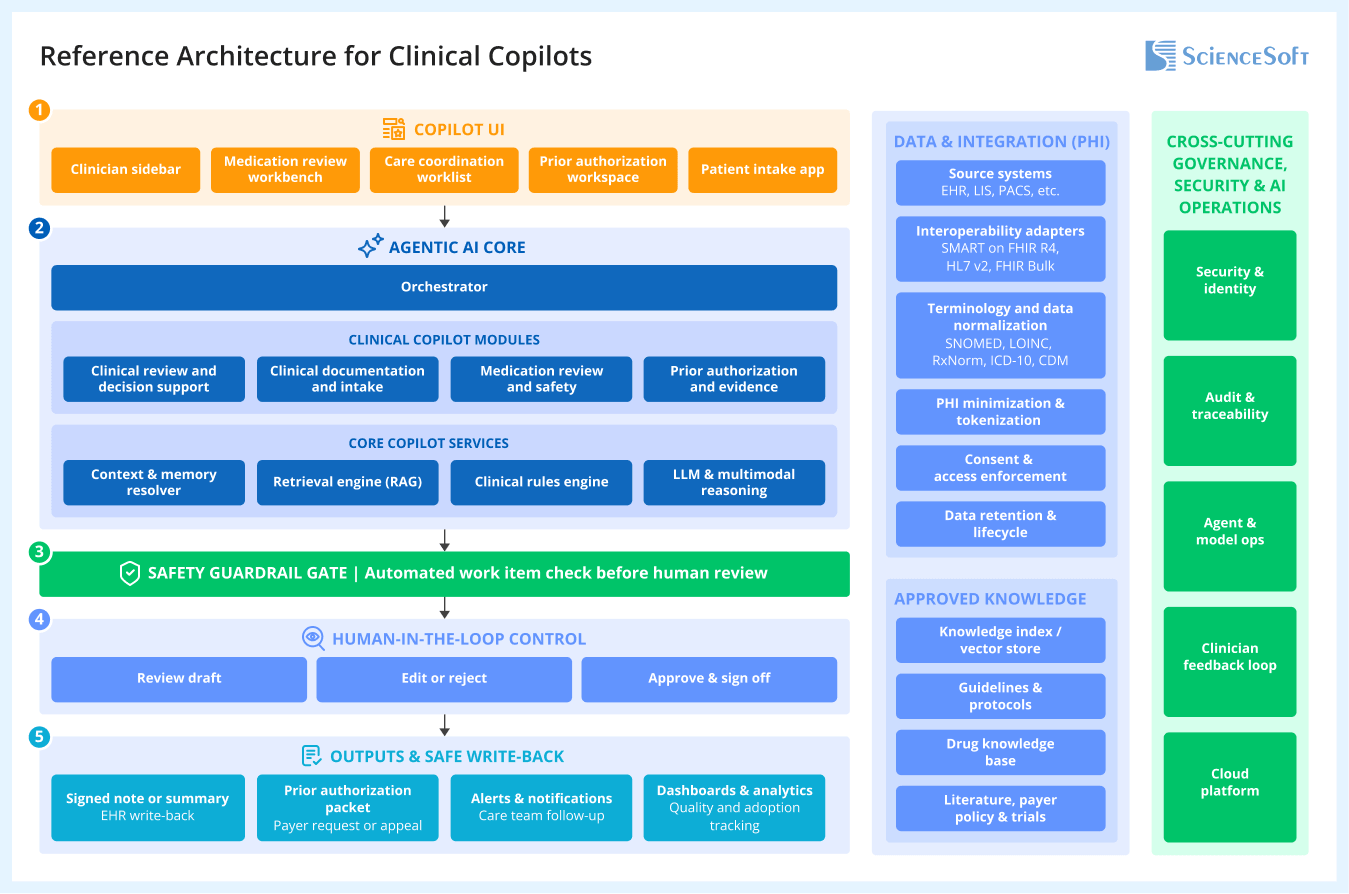
The architecture uses a shared AI layer connected to the EHR and other clinical systems. The solution retrieves relevant patient data and approved knowledge, applies AI models and deterministic rules to prepare summaries, documentation, alerts, or other workflow outputs, and screens them with guardrails before presenting them to clinicians for review.
Because many AI-generated clinical outputs require human review and approval before they affect the patient record or care decisions, these solutions often include clinical copilots as interfaces. After clinician approval, the system can securely write the result back to the EHR or trigger an approved workflow action.
A common mistake is adding an AI app as another window alongside clinicians’ regular software. Even a good AI-generated chart draft saves little time if staff must switch applications, re-find the right patient context, and manually transfer the result into the EHR. Where possible, let AI output appear directly in the clinician's existing draft area, inbox, or care management workflow.
From day one, also measure what clinicians do with the output. Track how often they edit, rewrite, reject, or override it. If the same corrections happen repeatedly, there may be an issue with source retrieval or AI behavior. Ultimately, if staff still spend nearly as much time correcting AI output as they did charting manually, the workflow has changed the type of work they do rather than automated it.
Technologies We Use to Implement AI-Powered Clinical Workflow Automation
AI implementation and model development
Platforms
- Azure OpenAI
- Amazon Bedrock
- Google Vertex AI
General-purpose AI models
- OpenAI GPT
- Anthropic Claude
- Google Gemini
- Meta Llama
- Mistral
- Phi
- Qwen
Healthcare-specific AI models
- MedGemma
- JSL-MedLlama
- MediPhi
- BioClinicalBERT
- Google MedASR
Clinical NLP
- Amazon Comprehend Medical
- Azure Text Analytics for Health
- John Snow Labs Spark NLP for Healthcare
- medspaCy
- scispaCy
Document processing
- Azure AI Document Intelligence
- Amazon Textract
- Google Document AI
RAG, search, and grounding
- LlamaIndex
- LangChain
- Azure AI Search
- Amazon OpenSearch
- Pgvector
- Qdrant
- Weaviate
- Neo4j
AI agents and orchestration
- LangGraph
- OpenAI Agents SDK
- Claude Agent SDK
- Google Agent Development Kit (ADK)
- Microsoft Agent Framework
AI guardrails and content safety
- NVIDIA NeMo Guardrails
- Microsoft Presidio
- Azure AI Content Safety
Predictive modeling and traditional ML
- Azure Machine Learning
- Amazon SageMaker AI
- TensorFlow
- PyTorch
- Scikit Learn
- XGBoost
- LightGBM
MLOps and AI observability
- Databricks MLflow
- Langfuse
- Evidently AI
Software engineering, integration, and deployment
Business rules and workflow automation
- Camunda
- Temporal
- Drools
- DMN decision tables
- Azure Durable Functions
- AWS Step Functions
Cloud and healthcare data platforms
- Microsoft Azure
- Amazon Web Services
- Google Cloud Platform
- Azure Health Data Services
- Amazon HealthLake
Databases and storage
- PostgreSQL
- Microsoft SQL Server
- Azure SQL Database
- MongoDB
- Azure Blob Storage
- Amazon S3
Messaging and event streaming
- Apache Kafka
- Azure Event Hubs
- Amazon EventBridge
Application and integration development
- Microsoft .NET
- Java
- Python
- C++
- R
- Node.js
- FastAPI
Containers, infrastructure, and CI/CD
- Docker
- Kubernetes
- HashiCorp Terraform
- GitHub Actions
Identity, security, and monitoring
- Microsoft Entra ID
- Okta
- HashiCorp Vault
- Azure Key Vault
- AWS KMS
- OpenTelemetry
- Prometheus
- Grafana
Key Challenges of Implementing AI-Powered Clinical Workflow Automation
Challenge #1: AI may generate incorrect, incomplete, or unsupported clinical content.
Solution
ScienceSoft targets the causes of AI errors at several stages of the AI workflow, from retrieving patient data to generating and validating AI outputs. We apply a range of safeguards, including grounding AI outputs in reliable clinical sources, checking for missing or conflicting information, and using deterministic rules to verify details such as medication data, dates, and required fields. If an AI output fails validation, the system flags it for qualified staff review or blocks its use. These safeguards help reduce AI errors.
Challenge #2: AI may overstep its boundaries and attempt to make clinical judgment.
Solution
ScienceSoft maps the target clinical workflow step by step and defines which activities AI may perform and which require qualified staff, similarly to how you would plan rules and permissions for a new employee. For example, when automating discharge coordination, AI can retrieve relevant patient information, draft discharge instructions, and prepare follow-up tasks. However, decisions about discharge readiness, medication changes, and treatment plans remain with qualified clinicians.
ScienceSoft enforces these boundaries through predefined workflow rules and access restrictions that limit which actions AI can initiate. We also implement approval gates and escalation rules that pause the workflow and involve a qualified clinician when a step requires clinical judgment or falls outside the approved scope.
Challenge #3: AI may understand the task but fail to execute the workflow correctly across hospital systems, causing errors in the EHR or losing data.
Solution
ScienceSoft separates AI reasoning from transaction execution. The language model does not receive unrestricted access to the EHR or other hospital systems. Instead, approved actions are performed through controlled back-end tools for specific operations, such as retrieving information, creating a task, or updating workflow status. Each tool has defined permissions, validation, and error handling. The workflow engine checks whether each action was completed successfully before proceeding to the next step. If an integration is unavailable, required information cannot be retrieved, or an update fails, the workflow can retry, use an approved fallback, or route the case to staff rather than assuming that the action was completed.
Challenge #4: AI-powered clinical workflows may expose PHI to more systems and vendors than hospitals expect
Solution
ScienceSoft starts by mapping where PHI will be processed, stored, and transferred across the EHR, AI services, and supporting systems. We build security controls into the solution architecture from the outset, including least-privilege access, encryption of data at rest and in transit, and logging of PHI access. For third-party AI and cloud services, we also verify applicable contractual and technical conditions, including BAA coverage where required, processing location, data retention policies, and whether customer data can be used for model training.
Challenge #5: Hospitals may find it difficult to detect, investigate, and fix AI errors at scale.
Solution
To help hospitals detect AI errors at scale, we implement automated checks that flag missing or conflicting information, failed system actions, and other predefined issues. We also track clinician corrections, overrides, and escalations to identify recurring problems and changes in AI performance. Periodic reviews of representative AI outputs by qualified staff help identify errors that automated checks may miss.
To make errors easier to investigate, ScienceSoft can establish a unified record of each AI-assisted workflow, including the source information used, AI-generated outputs, validation results, staff corrections and approvals, and system actions. These records help trace errors back to their causes, whether in source data, information retrieval, AI processing, validation rules, or system integration. Based on the findings, we can correct the affected components and test the changes before deployment.
Costs of Implementing AI-Powered Clinical Workflow Automation
The cost of implementing AI-powered clinical workflow automation may range from $100,000 to $1,500,000+. These estimates cover solution design and implementation. Third-party software licenses, AI model/API usage, cloud infrastructure, and ongoing support are calculated separately.
- At the lower end, a hospital may implement one focused AI-assisted workflow in one department, such as pre-visit chart summarization or documentation drafting with EHR integration.
- A mid-scale implementation may connect several related clinical workflows and systems and introduce shared orchestration, deterministic validation, and monitoring.
- At the higher end, a multi-site health system may implement an enterprise clinical workflow automation layer spanning multiple departments, facilities, and clinical systems, with centralized governance, high availability, and complex integrations. Projects that require proprietary model development or substantial model adaptation, specialized infrastructure, or functionality subject to additional regulatory requirements may further increase costs.
Key AI implementation cost drivers
- The number and complexity of clinical workflows covered, including the departments, facilities, and sites involved.
- The complexity of workflow automation, including staff review and approval steps, exception handling, and fallback paths.
- The number and complexity of integrations.
- The quality, structure, and accessibility of clinical data required for AI processing.
- The number and complexity of AI capabilities, including generative AI, clinical NLP, and predictive models.
- AI validation, evaluation, and monitoring requirements.
- Workflow volumes and performance requirements.
- Security, compliance, and governance requirements.
Why Choose ScienceSoft for Clinical Workflow Automation
- In healthcare IT since 2005, with 150+ healthcare IT projects.
- In AI since 1989, with experience selecting, adapting, and integrating AI models for healthcare-specific data and workflows.
- 750+ experts, including AI specialists, healthcare IT consultants, MD consultants, solution architects, software developers, integration specialists, cybersecurity experts, and QA engineers.
- An Architecture & Solutions Center of Excellence that helps design secure, scalable AI automation solutions with reliable EHR integrations, protected patient data, and controlled AI actions.
- An in-house PMO to keep complex projects on track despite time and budget constraints or changing expectations.
- Healthcare interoperability expertise, including proficiency in HL7 v2/v3 and FHIR.
- Experience supporting compliance with HIPAA/HITECH, GDPR, Saudi PDPL, and other privacy requirements.
- Security and quality management practices backed by ISO 27001 and ISO 9001 certifications.
Certifications, partnerships and awards
-

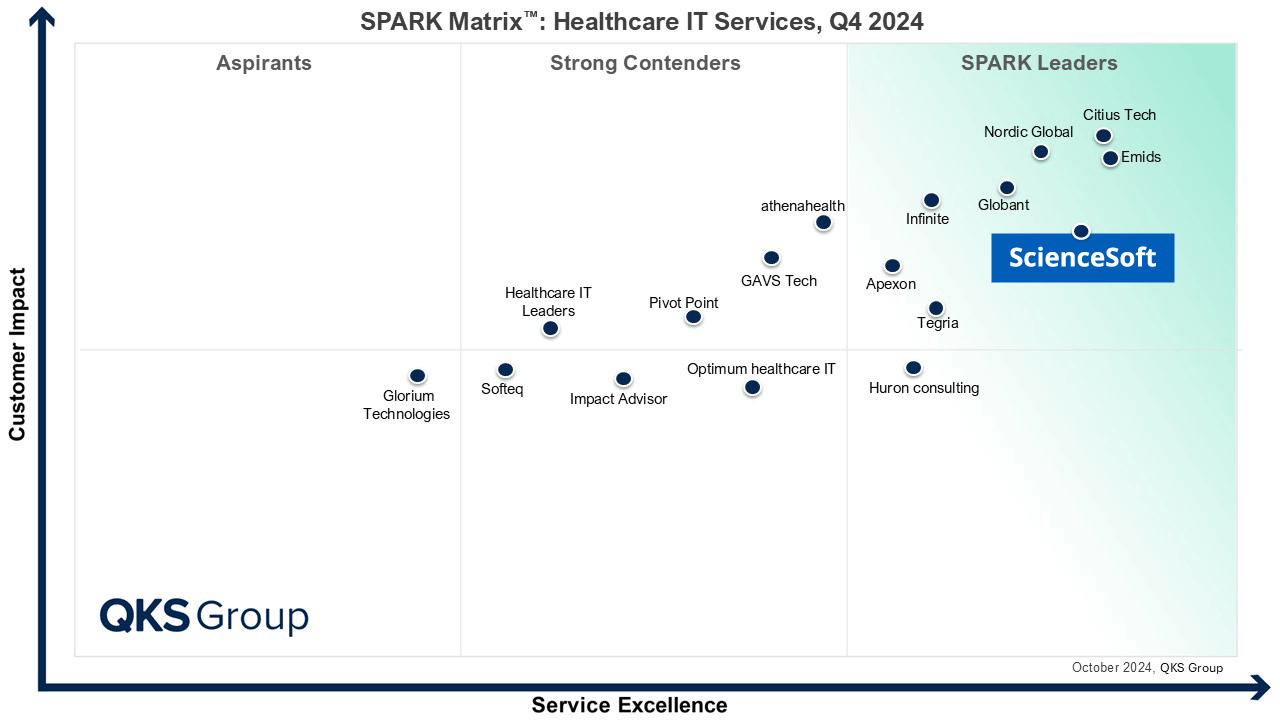
Featured among Healthcare IT Services Leaders in the 2022 and 2024 SPARK Matrix
-

Named among America’s Fastest-Growing Companies by Financial Times, 5 years in a row
-

Claude Certified Services Partner


-

Microsoft Solutions Partner for Data & AI
-

HTN Now Awards 2025/26 finalist in the Best AI Scribe Solution category
-

Recognized for Healthcare Technology Leadership by Frost & Sullivan in 2023 and 2025
-

HIMSS Gold member advancing digital healthcare
-

ISO 13485-certified quality management system
-

ISO 27001-certified security management system




What Our Clients Say


They are reliable, thorough, smart, available, extremely good communicators and very friendly. We would recommend hiring ScienceSoft to anyone looking for a highly productive and solution-driven team.



Working with ScienceSoft was a pleasure from A to Z. We are grateful for their can-do attitude, responsiveness, and straightforward communication.

Todd Nilson
MD

We are thankful for the meticulous and value-driven approach of ScienceSoft’s team. ScienceSoft proved to be a reliable vendor with a solid healthcare background, and we recommend them to everyone looking for a telehealth software development partner.
