ScienceSoft Global







ScienceSoft helps PHM leaders prioritize IT investments around existing gaps in population analytics, care team workflows, and quality reporting. Our consultants and architects can turn your priorities into a viable solution scope, architecture options, delivery plan, and preliminary estimates.
Population Health Management Software (PHM) Development Services
ScienceSoft develops custom PHM software for ACOs, provider organizations, and health plans to help them identify population needs and coordinate care. Our principal architects design it to fit existing systems and let teams update care program rules as value-based requirements change.

Population health management software development services help provider organizations, health plans, and PHM software companies build tools that automate population stratification, coordinate interventions, and measure program performance.
When off-the-shelf PHM solutions or the existing EHRs cannot support an organization's population health programs, custom development typically takes the following forms:
- Adding focused modules to existing PHM software for missing functionality, e.g., for patient attribution and payer roster reconciliation across multiple value-based contracts.
- Setting up a network-wide care management workspace for care teams across participating organizations, with a shared workflow for assigning interventions and tracking outreach, referrals, and follow-up to completion.
- Building an integrated PHM solution to connect population analysis with care workflows and reporting across existing systems while keeping program rules configurable as contracts change.
Why Choose ScienceSoft for Your PHM Software Project
- Since 2005 in healthcare IT, with over 150 projects for providers, healthtech companies, and health payers.
- Since 1989 in data analytics and AI. Our healthcare services include predictive analytics, workflow automation, and AI-supported recommendations for care teams.
- 750+ IT specialists, including healthcare business analysts, data and AI engineers, and regulatory consultants. Over 50% are senior-level professionals.
- Proficiency in HL7 v2/v3 messaging, FHIR APIs, X12 payer transactions, and USCDI-aligned clinical data mapping.
- Expertise in medical terminology and coding standards, including SNOMED CT, LOINC, RxNorm, ICD-10-CM, and CPT.
- Architecture and Solutions CoE with over 30 senior architects to design PHM systems with configurable program and contract rules, limiting rework when requirements change.
- Hands-on experience with HIPAA, HITECH, and the 21st Century Cures Act requirements.
Certifications and awards
-

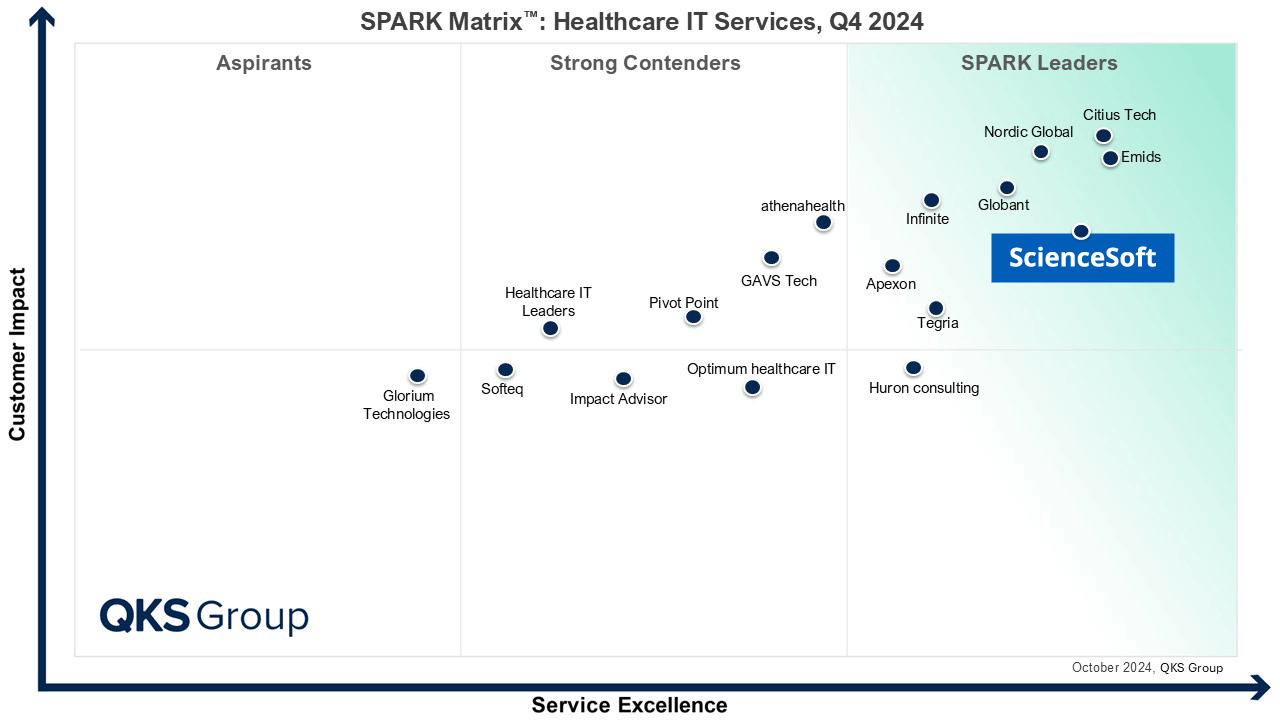
Featured among Healthcare IT Services Leaders in the 2022 and 2024 SPARK Matrix
-

Recognized for Healthcare Technology Leadership by Frost & Sullivan in 2023 and 2025
-

Named among America’s Fastest-Growing Companies by Financial Times, 5 years in a row
-

Four-time finalist across HTN Awards programs
-

Named among Becker’s Telehealth Companies to Know in 2026
-

Named Leading Healthcare Software Provider 2026 at GHP’s Healthcare & Pharmaceutical Awards
-

HIMSS Gold member advancing digital healthcare
-

ISO 13485-certified quality management system
-

ISO 27001-certified security management system
Capabilities We Can Build Into a Population Health Management Solution
ScienceSoft can develop the capabilities below as part of a standalone population health management solution or as modules that integrate with existing EHR, claims, and analytics systems. We tailor the scope to your populations, care programs, and workflows.
Defining populations and programs
-

Population registries and attribution
Roster import and patient matching tools can reconcile ACO attribution or payer enrollment files with EHR records, flag uncertain matches for analysts, and maintain contract-specific population lists.
-
Cohort analysis
A cohort builder can filter diagnoses, claims, and social needs assessments into reusable patient lists for programs or outreach. An AI assistant could turn a query like “diabetes patients with recent ED visits” into editable data filters.
-
Care program configuration
Through an admin console, program managers can define eligibility, enrollment steps, assessment forms, and care pathways for programs such as chronic disease management. Configurable rules can trigger follow-up tasks by condition, site, or contract.
Identifying risks and care gaps
-
Care gap identification and tracking
A rules engine can check EHR, claims, and immunization records against screening or follow-up criteria, flag likely gaps, and update their status when new evidence arrives. Staff can verify exceptions and missing records.
-
Risk stratification
A scoring engine can group patients by risk based on diagnoses and prior hospital or ED visits. Predictive AI models could estimate 90-day hospitalization risk so care teams can prioritize outreach.
Care management and coordination
-
Patient review
A longitudinal view can bring together available EHR, claims, and care program records. AI copilots could draft source-linked briefings on recent admissions, medication changes, and pending follow-ups for care managers to verify.
-
Care planning
Care managers can record clinical and social needs in assessments, then use a plan editor to set goals, interventions, owners, and follow-ups. AI could draft plan entries from those assessments for review.
-
A rules engine or AI orchestrator can turn care gaps, care plans, and patient events into follow-up tasks. Care teams can then use a shared work queue to assign responsibilities, monitor progress, and escalate unresolved cases.
-
To support patients moving from hospital to outpatient or home care, dedicated workflows can help care teams review discharge instructions, reconcile medications, schedule follow-up visits, and coordinate handoffs.
-
Clinical and social service referrals
A service directory can help coordinators find clinical or community partners and send referrals. A tracker can capture acceptance and service status from partner feeds or manual staff updates.
Patient engagement
-
Campaign planning
A campaign builder can help managers select cohorts needing screening, vaccination, or education; schedule approved messages by channel; log replies and opt-outs; and queue patients who need personal follow-up.
-
Automated patient outreach
Outreach managers can set up automated voice or text interactions for appointment reminders, care plan check-ins, and post-discharge follow-ups. AI agents could handle two-way patient conversations (voice or text), scheduling requests, and escalation to care teams.
-
Patient self-management support
A portal or app can show care tasks, reminders, and educational resources and collect symptom or progress updates. An AI chatbot for patients could explain approved care plan instructions and refer concerns to staff.
Quality reporting and program performance
-
Quality measurement and reporting
Automated calculations can help quality teams track performance against ACO, payer, and provider quality requirements using EHR and claims data. Staff can verify supporting evidence, review exceptions, and prepare reports for submission.
-
Program and financial performance analysis
Dashboards can combine care program activity with clinical outcomes, hospital and ED utilization, and costs, helping leaders assess program effectiveness and performance against value-based contract targets.
How Custom PHM Software Can Support Multiple Care Programs and Value-Based Contracts
Provider networks and health systems often manage several PHM programs and value-based contracts. They regularly add new ones or update existing ones as attribution methods, quality measures, reporting rules, and program requirements change. When these rules are built into the software, even routine updates may require developers, delaying their adoption.
The architecture below illustrates how custom PHM software can address this challenge by letting organizations change program and contract settings without modifying the functionality they already use for population analysis, care coordination, and reporting. This is achieved by separating variable program and contract logic from shared PHM processing, allowing the same software to support different program and contract combinations through configuration.
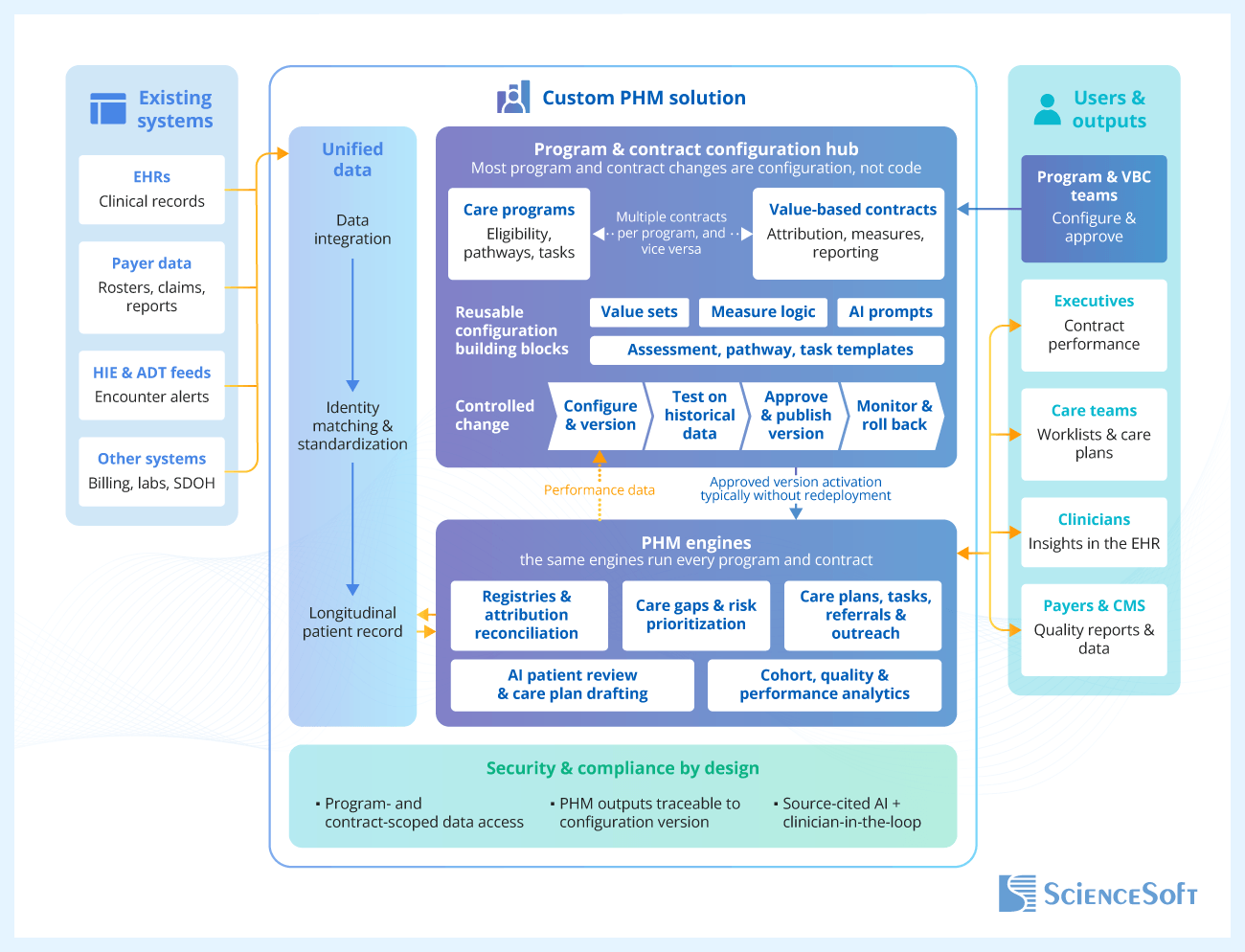
In this design, a program and contract configuration hub provides one place to manage the rules for different care programs and contracts. For example, a diabetes management program may serve patients covered by several payer contracts. Care teams can follow the same care process, while the software applies payer-relevant quality measures, reporting rules, and other contract requirements to each patient population.
When requirements change, authorized staff can update the relevant settings and test how the changes would affect existing data before they take effect. Previous settings remain available for historical reporting, and teams can restore an earlier version if a change causes problems.
This approach helps organizations introduce new programs, accommodate different payer requirements, and make routine updates without repeatedly modifying the underlying software. Updates to supported settings can typically be made without code changes or software redeployment, although new functionality or data integrations may still require development.
PHM Software Development Services ScienceSoft Offers
PHM technology consulting and architecture design
PHM software development
ScienceSoft develops full-scale population health management software solutions and builds focused modules or shared care workspaces for existing tools. We make PHM workflow requirements testable and validate implementation against realistic population data and exception scenarios to reduce late-stage rework.
PHM software integration and data governance
We integrate PHM software with clinical and payer systems and build reusable APIs and interfaces for onboarding practices, partners, or software customers. We then verify that the system consistently interprets terminology and data formats. Our solutions maintain a history of field mapping changes so provider teams can determine whether unexpected shifts in population counts or quality reports are related to an interface update.
PHM software modernization and migration
ScienceSoft modernizes PHM software when aging code, databases, or infrastructure make releases risky or slow population data processing. We roll out upgrades and migrations in stages and check PHM data and report integrity before each release. When more capacity is needed, we test performance under realistic loads.
AI transformation for PHM workflows
ScienceSoft implements AI where it can boost PHM workflow efficiency, adding clear boundaries for automated actions and human review rules to minimize AI-related risks. Before a broader rollout, we can evaluate AI accuracy, exception handling, and the impact on staff workload through a focused pilot.
PHM software support and maintenance
ScienceSoft can support live PHM applications and data pipelines, resolve production incidents, and roll out necessary updates. We monitor software health and population data integrity, prioritize incidents by impact on care workflows and reporting deadlines, and trace root causes to reduce repeat failures.
How We Handle Common Challenges in PHM Software Projects
-
Challenge #1. Unreliable population data despite functioning integrations
Provider networks and health systems combine EHR and payer data to identify care gaps and report quality results. Yet successful data transfers do not guarantee accurate population records. The same patient may be counted twice, or a completed screening may appear overdue because its code was mapped incorrectly. These errors can distort care gap lists and quality measures, and staff may need to verify source records before they can trust the results.
Solution
-
Challenge #2. Gaps between identified patient needs and care team actions
Provider networks and health systems typically use PHM software to identify care gaps and other follow-up patient needs, while local care teams often work in EHRs or care management systems. If PHM software cannot create assigned work in those systems and receive completion updates, staff must pass tasks between teams and check their status manually. Across multiple practices, this can cause duplicate or delayed follow-up and leave program managers unsure which interventions remain open.
Solution

What Our Healthcare Customers Say



I am particularly impressed by the cooperative nature of ScienceSoft’s team. Our project required coordination with multiple companies and individuals. ScienceSoft worked well with everyone.



Thanks to this collaboration, we were able to launch a practical, secure, and easy-to-use mobile app that can support older adults on their healthy aging journey.


ScienceSoft successfully migrated us to a modern, modular <…> platform featuring virtual consultations, care coordination, and seamless data exchange with partner systems, including robust EHR integrations.


Working with ScienceSoft was a pleasure from A to Z. We are grateful for their can-do attitude, responsiveness, and straightforward communication.

We found ScienceSoft to be dependable and forward-thinking, and we would confidently recommend them for high-responsibility projects.


We were pleased to see that ScienceSoft approached our ecosystem with a good understanding of healthcare operations and the HIPAA Security Rule.
Let’s Continue With PHM Planning Together
Share the current stage and priorities, and we will arrange a free, non-binding collaborative session with the appropriate specialists. We can work through your data integration needs, cross-system workflow specifics, and compliance requirements to define a practical project scope and architecture options.