ScienceSoft Global



AI for RCM Automation
Architecture, Costs, Implementation Areas
ScienceSoft, an AI transformation and software development company, helps hospitals and health systems use AI to automate RCM workflows and reduce manual work across claims, denials, and payer follow-up. Since 1989 in AI services and since 2005 in healthcare IT, we cover projects from data preparation and system integration to testing and support.

Contributors

Senior Solution Architect, Healthcare, ScienceSoft

Senior Healthcare IT & AI Consultant, ScienceSoft
AI-Powered RCM Automation in Healthcare
AI-powered revenue cycle management automation applies AI to selected RCM tasks, from predicting denial or payment risk to interpreting clinical information and preparing staff actions. Depending on the use case, it may take the form of a predictive engine, an RCM assistant, a focused AI module, or an agentic AI layer connected to existing RCM systems.
What powers each solution depends on the RCM task:
- Predictive machine learning estimates denial, underpayment, and recovery risk and helps prioritize accounts.
- Natural language processing and generative AI work with clinical and payer text, for example, to extract supporting information, summarize a case, or prepare an appeal draft.
- Agentic AI coordinates multi-step workflows across connected systems, such as collecting authorization evidence, checking requirements, and escalating exceptions to staff.
Rules engines and portal automation can complement these AI capabilities where the work follows explicit payer requirements or repetitive system steps.
How AI Changes the Traditional RCM Process
Traditional RCM workflows depend heavily on manual review and fixed rules. When patient, clinical, or payer data is incomplete or inconsistent, issues may remain unnoticed until a claim is delayed or denied. Staff then spend time tracing the cause across disconnected systems, correcting records, and reworking the claim.
An AI-enabled workflow can facilitate the most labor-intensive parts of this process:
- Extract relevant information from clinical notes, payer responses, remittance files, and supporting documents.
- Flag likely eligibility, authorization, documentation, and coding issues before submission.
- Predict denial risk and direct staff to the most urgent accounts.
- Automate routine checks of claim, authorization, and payment status.
- Classify denial reasons and identify recurring sources of revenue loss.
- Prepare appeal drafts using relevant clinical evidence and payer policy references.
To do this, AI does not need to take control of coding, billing, or payer disputes. RCM staff can continue to validate claim changes, approve appeals, and resolve complex cases, while AI handles data collection, preliminary analysis, and routine follow-up.
AI For RCM Automation Market
AI adoption in RCM is growing, but most providers are still using it for selected workflows rather than across the entire revenue cycle. Of 191 provider executives surveyed in late 2025, 39.4% had implemented point solutions, while only 1.8% had integrated AI or automation across their revenue cycle. At the same time, 69% ranked RCM technology among their highest investment priorities for the following 12 months.
Billing is already becoming a prominent AI use case in hospitals. Among non-federal acute care hospitals using predictive AI, 61% used it to simplify or automate billing procedures, making billing one of the fastest-growing predictive AI applications.
RCM Metrics AI Can Improve
-

Denial rate
Fewer preventable denials caused by eligibility, authorization, documentation, coding, and claim data issues.
-
First-pass claim acceptance
More claims accepted without correction or resubmission.
-
Days in accounts receivable
Faster movement of accounts through payer follow-up, denial resolution, and payment.
-
Cost to collect
Less staff effort spent on status checks, case research, rework, and routine follow-up.
-
Net collection rate
More contractually owed revenue captured through better charge, underpayment, and recovery controls.
-
RCM productivity
More accounts handled per full-time equivalent employee and a greater share of routine work completed without manual intervention.


AI Use Cases in RCM Automation
Patient access and financial clearance
-

Coverage and registration checks
AI can reconcile registration data with coverage information from payer responses and other available sources. It can flag inactive coverage, incorrect subscriber details, or insurance missing from the account so staff review only the discrepancies.
-
Rules can check the scheduled procedure against payer requirements and alert staff if prior authorization is needed. NLP can extract diagnoses, prior treatment details, and supporting chart evidence, while GenAI can help assemble a draft request for review.
-
Patient cost estimation
AI can extract and normalize coverage and benefit details from payer data and documents. A deterministic rules engine then applies contract terms, expected charges, deductibles, copays, and coinsurance to calculate patient responsibility. Validation rules flag incomplete or conflicting inputs.


Documentation, coding, and claim preparation
-
Documentation completeness support
When a note does not provide enough detail for the intended code, NLP and coding rules can identify missing or inconsistent information and show the relevant chart evidence. For example, they may flag that a diagnosis lacks the specificity required by the payer.
-
Automated coding for suitable encounters
For predictable, high-volume cases, such as selected radiology or pathology encounters, specialized NLP and ML coding models can assign codes and send only uncertain or unusual cases to coders.
-
Charge capture
NLP and rules engines can compare documented services, orders, medications, and supplies with recorded charges to identify potentially missed billable items. Staff can then review the supporting documentation before adding a charge.
-
Claim and supporting document preparation
NLP and rules engines can assemble the information required for claim submission, including authorization details, reference data, and supporting documentation. Completeness checks can flag missing or inconsistent information before the claim is submitted.


Claims and denial management
-
Claim status and payer response processing
AI can interpret claim status responses, payer letters, remittance data, and portal messages. It can extract deadlines and required actions, reconcile conflicting updates, and route the account to the appropriate queue.
-
Appeal preparation
Generative AI with retrieval-augmented generation can retrieve relevant clinical evidence and the payer policy that applied to the case. It can then assemble the supporting information and prepare a source-backed appeal draft for staff review.
-
Denial classification and root-cause analysis
AI can classify denials and identify recurring patterns by payer, facility, service line, cause, or workflow stage. This helps teams trace repeated denials back to registration, authorization, documentation, coding, or billing issues.


Payment and accounts receivable optimization
-
Underpayment detection
AI can extract and normalize reimbursement terms from contracts, amendments, and payer documents. Deterministic contract rules then compare the expected reimbursement with the payment received and flag suspected underpayments for review.
-
Accounts receivable prioritization
Predictive models can rank outstanding accounts for follow-up based on balance, account age, payer behavior, claim status, approaching deadlines, and historical recovery outcomes. This helps staff focus first on accounts where timely action is most likely to improve collections.


Reference Architecture for Enterprise RCM Automation
Below is a reference architecture for a hospital or health system automating several RCM workflows across its existing systems. The EHR, patient accounting software, coding tools, and other core systems remain authoritative. Rules engines handle auditable checks and calculations, AI supports extraction, prediction, and drafting, and qualified staff retain high-impact decisions.
Because this example covers cross-system workflows that may involve payer responses, deadlines, retries, and human handoffs, it includes agentic orchestration to coordinate the work. Agentic AI is not required for every RCM automation project. A focused use case may rely on task-specific AI services and conventional workflow orchestration instead.
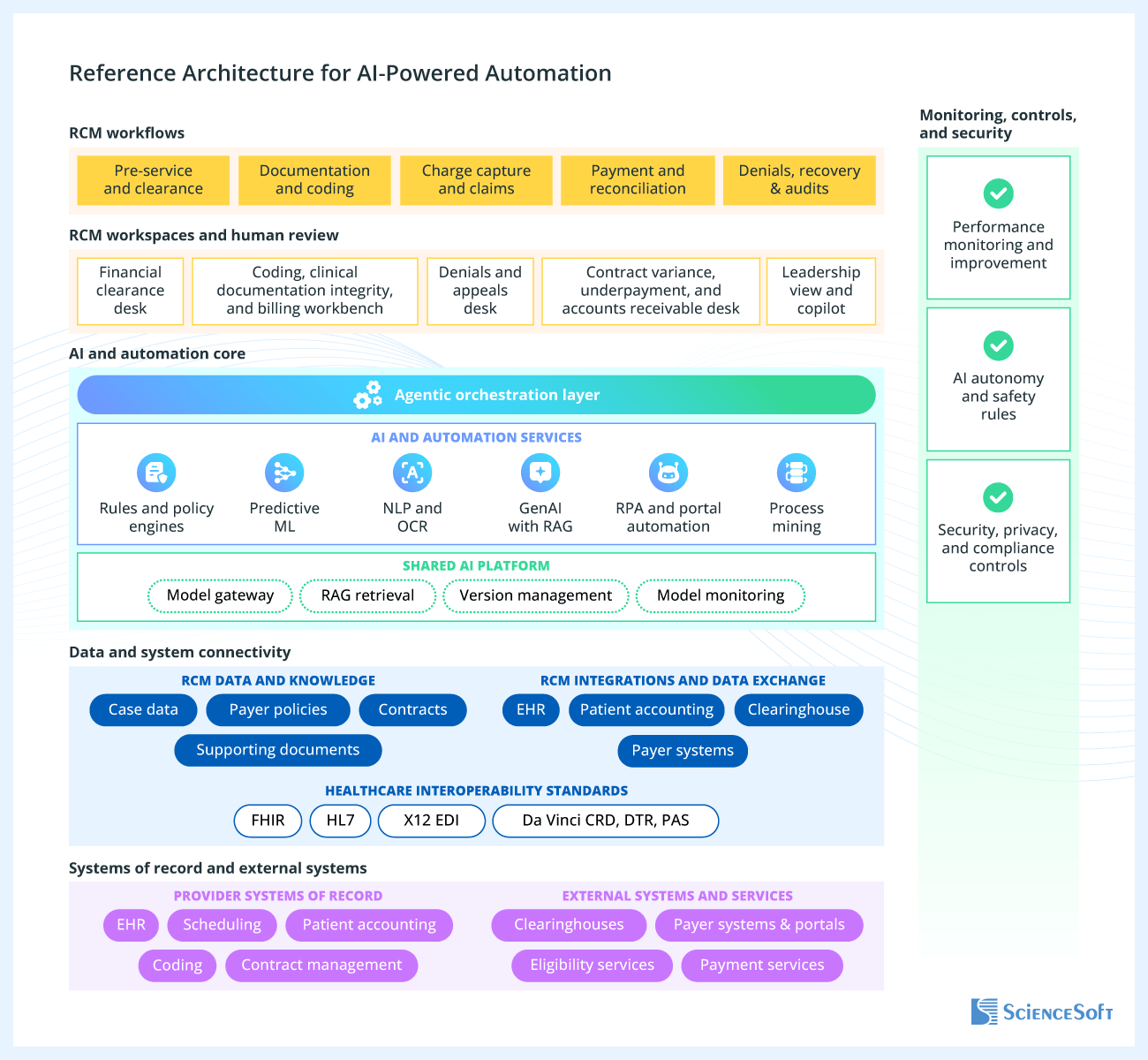
The data and system connectivity layer gives each RCM case a consistent view across hospital and payer sources. RCM integrations exchange data with EHR, patient accounting, clearinghouse, and payer systems through APIs and standards such as FHIR, HL7, and X12 EDI. RCM data and knowledge combines structured case data with searchable indexes of payer policies, contracts, and supporting documents. Identity resolution and case matching connect records that belong to the same patient, account, claim, payment, or denial. When rules or AI need payer guidance, the retrieval pipeline selects the policy or contract version that was effective on the date of service.
The AI and automation core separates tasks that need exact, auditable logic from those that benefit from probabilistic AI. Rules and policy engines handle deterministic decisions such as claim edits, authorization requirements, and contract calculations. Where the case depends on information buried in clinical notes, payer letters, or scanned documents, document processing and natural language processing (NLP) extract the required facts and attach confidence scores.
Those structured facts can then feed task-specific AI. Predictive ML models estimate outcomes such as denial or recovery likelihood to support case prioritization, while generative AI with retrieval-augmented generation (RAG) retrieves approved source material and uses it to prepare evidence-backed summaries, requests, or appeal drafts. Where an RCM step must be completed through a payer website rather than an API or standard transaction, robotic process automation (RPA) can carry out the portal interaction.
The agentic orchestration layer coordinates AI and automation services and calls them as needed for each task instead of relying on one model to handle the workflow end to end. It keeps track of each case as it moves through an authorization, claim, or appeal process. Predefined autonomy rules specify which steps can run automatically, which require staff approval, and which conditions trigger a handoff. The shared AI platform provides common services such as controlled model access, retrieval of approved sources for RAG, version management, and model monitoring.
The RCM workspaces and human review layer give staff access to both automated and review-required cases. Routine checks and evidence collection can run automatically where hospital policy permits, while coding decisions, medical necessity reviews, and appeal submissions remain with qualified staff. Reviewers can also inspect sampled or completed automated cases, see the evidence and actions behind them, and override or correct results when needed. Low-confidence or contradictory cases are routed to staff with the relevant evidence already assembled.
Monitoring, governance, and security controls apply across the architecture. Every automated step, model call, rule version, and human override is logged so the hospital can trace how a case was handled and compare system confidence with actual outcomes. When performance deteriorates, the affected workflow can be routed back to human review, and the relevant rules, prompts, or model versions can be revised.
Staff corrections and payer outcomes feed back into the system. Teams use this feedback to refine rules, models, and upstream RCM checks so recurring problems are prevented rather than repeatedly reworked.
Plan for correction, not rollback
Many clinical and billing systems do not let users simply undo a posted update. We record every automated change with its source, time, and action history. If AI makes an incorrect update, the system follows the normal correction path, such as submitting a replacement claim or adding a corrective entry, instead of trying to erase the original action. This keeps the audit trail intact and lets staff recover from errors without stopping the wider RCM workflow.
Technologies Used in AI-Powered RCM Automation
Generative AI
Models
- Large Language Models (LLMs)
- Small Language Models (SLMs)
- Multimodal models
- Computer vision models
- Image generation models
- ASR speech models
- TTS speech models
- Speech-to-Speech Models
- Audio models
- Real-time
Model adaptation and efficiency
- Training from scratch
- Data design
- Data labelling/annotation
- Fine-tuning
- Instruction tuning
- LoRA adapters
AI platforms and services
- Azure OpenAI Service
- Microsoft Foundry
- Amazon Bedrock
- Google Vertex AI
- Google AI Studio
- Hugging Face Inference
- Oracle Cloud
- G42/Core42
- NVIDIA AI Enterprise
Agents and orchestration
- RAG
- Graph RAG
- Agentic workflows
- OpenAI Agents SDK
- OpenAI Agents (platform/guides)
- AWS Agents
- Claude Agent SDK
- Google Agent Development Kit (ADK)
- Microsoft 365 Agents SDK (Copilot Studio)
- OpenClaw
- LangChain
- LangGraph
- smolagents
- LiveKit
- Dify
- n8n
- Faiss
- ChromaDB
- Qdrant
- Weaviate
- OpenSearch
- Pgvector
- Amazon Neptune
- Graph RAG Toolkit
- Neo4j
Healthcare-specific language models
- MedGemma
- MedLM
- BioMedLM
Traditional ML
Platforms and services
- Azure Cognitive Services
- Azure Machine Learning
- Microsoft Bot Framework
- Amazon SageMaker AI
- Amazon Transcribe
- Amazon Lex
- Amazon Polly
- Google Cloud AI Platform
- Google Vertex AI
Frameworks and libraries
- Apache Mahout
- Apache MXNet
- Caffe
- TensorFlow
- Keras
- Torch
- OpenCV
- Apache Spark MLlib
- Theano
- Scikit Learn
- Gensim
- SpaCy
Challenges of Using AI for RCM: Practical Answers
Could AI make the wrong RCM decision?
Yes. The main solution is to limit what AI can decide in the first place and let it escalate uncertain cases to humans instead of guessing.
Some RCM steps have an objective answer that can be checked against explicit rules, such as whether required data is present or whether an authorization rule applies. A deterministic rules engine (non-AI) can handle those checks more reliably than a model. For tasks that involve legal and financial consequences, AI should always request approval from qualified staff. That includes coding, medical necessity, and appeal decisions.
For lower-risk tasks, such as data extraction, classification, or prioritization, AI can use calibrated confidence thresholds to decide whether to proceed or send the case for review. It should also keep every recommendation traceable to the chart, payer policy, contract, and rule version that produced it, so mistakes can be investigated instead of disappearing into the workflow.
Lastly, you will need ongoing monitoring to check whether confidence scores still match real outcomes (e.g., edits, rejections, denials). If AI accuracy drops, the solution can raise the confidence threshold, send more cases to human review, or temporarily turn off automation for that task until the model is recalibrated or corrected.
Will this become another RCM tool staff have to work around?
We design against this by embedding AI interfaces and automation into the systems and queues staff already use. We can build an AI layer on top of EHR, patient accounting, coding, clearinghouse, and payer systems so it can pull together case information, track progress, and surface the next action in the existing workflow. Staff spend less time switching between systems, copying data, and reconstructing case history, while approved updates can flow back to the relevant system automatically.
How will AI know which payer policy to apply to the case?
Instead of letting AI automatically use the latest policy, we keep policy and contract versions with their effective dates and retrieve the one that applied to the patient’s plan and date of service. If the available rules or case evidence conflict, the system sends the case to staff for review rather than choosing a source on its own.
What if a claim or a request disappears between systems?
We build transaction tracking that matches each outbound claim or request with the expected clearinghouse or payer acknowledgment. If an acknowledgment does not arrive, predefined retry and aging rules trigger follow-up. Unresolved transactions move to a visible exception queue before filing or authorization deadlines are missed.
Payer communications can be inconsistent or misleading. How do we stop AI from taking them at face value?
We treat payer portal messages, emails, faxes, and other external content as untrusted input. AI checks them against the patient’s plan, the policy version that applied on the date of service, contract terms, and the provider’s own case data. If the sources conflict, the system flags the discrepancy and sends the case to staff with the relevant evidence instead of updating the account or continuing the disputed action automatically. External content is also sanitized and labeled so embedded instructions cannot trigger updates or submissions in connected RCM systems.
How do we control PHI sent to external AI model providers?
We first check each provider’s terms for BAA coverage, data retention, model training, processing location, and deletion. A controlled AI gateway can then apply different rules by provider and data type: route requests only to approved models, mask or remove PHI when it is not needed, and block requests that violate the approved policy. For workloads that require identifiable PHI, we can use a HIPAA-eligible service under a BAA or choose a private deployment where appropriate.
The Cost of Implementing AI for RCM Automation

Implementation costs for AI automation in RCM start at $150,000–$300,000 for a narrowly scoped, proof-of-value RCM workflow using existing software platforms and limited integrations. A production-grade workflow or a small group of related workflows may require $300,000–$700,000+ to implement. Multi-workflow or multi-facility programs generally require phased implementation and may start around $700,000 and extend beyond $1 million, depending on the existing RCM environment and rollout scope.
Need a custom estimate for your case?
These ranges are illustrative and cover implementation work only. They do not include ongoing cloud and AI usage, third-party software subscriptions, transaction and clearinghouse fees, and long-term maintenance costs.
Key cost drivers include:
-
Workflow scope and rollout scale: the number of RCM workflows, facilities, and user groups involved.
-
RCM integrations: the number and complexity of EHR, patient accounting, clearinghouse, payer, and portal connections.
-
Degree of AI autonomy: the more decisions and actions the solution can perform without staff approval, the more effort is needed for validation, controls, exception handling, and monitoring.
-
Data readiness: the effort required to map, normalize, and match clinical, financial, payer, and document data.
-
Production readiness: the effort required to implement security and access controls, audit logging, version management, recovery mechanisms, and production-grade deployment environments.
Why Choose ScienceSoft for AI-Powered RCM Automation
- Since 1989 in AI development and since 2005 in healthcare software engineering.
- 150+ healthcare IT projects completed for providers, healthtech companies, and life sciences organizations.
- 750+ IT specialists on board, including AI and data science experts, integration specialists, cybersecurity experts, business analysts, and UX and UI designers.
- 30+ senior architects in our Architecture and Solutions Center of Excellence to support the design and review of complex AI solutions, including integration, data, security, and cloud architecture.
- Healthcare compliance expertise: privacy and data protection laws such as HIPAA/HITECH, GDPR, and Saudi PDPL; US interoperability and patient financial requirements, including the 21st Century Cures Act and No Surprises Act.
- RCM interoperability and coding expertise: healthcare data exchange and transaction standards such as FHIR, HL7 v2, and ASC X12N; CAQH CORE operating rules; coding and remittance standards including CPT, HCPCS, ICD-10-CM/PCS, and CARC/RARC.
Certifications, partnerships and awards
-

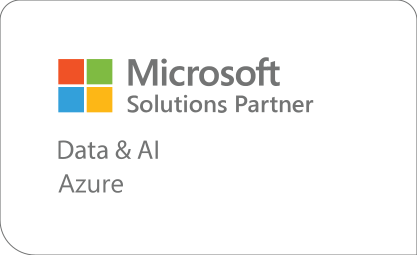
Featured among Healthcare IT Services Leaders in the 2022 and 2024 SPARK Matrix
-

Named among America’s Fastest-Growing Companies by Financial Times, 5 years in a row
-

Claude Certified Services Partner


-

Microsoft Solutions Partner for Data & AI
-

HTN Now Awards 2025/26 finalist in the Best AI Scribe Solution category
-

Recognized for Healthcare Technology Leadership by Frost & Sullivan in 2023 and 2025
-

HIMSS Gold member advancing digital healthcare
-

ISO 13485-certified quality management system
-

ISO 27001-certified security management system



Our Healthcare Clients Say

They collaborated with our medical professionals with great professionalism and care <…>. We found ScienceSoft to be dependable and forward-thinking, and we would confidently recommend them for high-responsibility projects.


Todd Nilson
MD

We are thankful for the meticulous and value-driven approach of ScienceSoft’s team. ScienceSoft’s project manager, business analyst, QA and software engineers were always friendly and ready to answer our questions or solve any ad-hoc issues.

ScienceSoft has been a competent partner for medical software development. We would recommend them as a trustworthy vendor. They are reliable, thorough, smart, available, extremely good communicators and very friendly.


Working with ScienceSoft was nothing but a learning experience <…>. They’re very responsive and very knowledgeable. I recommend ScienceSoft for any needs and will work with the company again if needed in the future!