 ScienceSoft Global



Senior Living Care Platforms
Capabilities, Integrations, Development Costs
In healthcare IT since 2005, ScienceSoft delivers senior living care platforms that bring resident data and workflows together across sales, care, staffing, and billing. Our centralized solutions remove duplicate entries, speed up staff work, and keep care, pricing, and compliance audit-ready across communities.
Contributors

Head of AI, Principal Architect, ScienceSoft

Senior Healthcare IT & AI Consultant, ScienceSoft
Senior Living Care Platforms: Overview
Senior living care platforms unify sales and pricing operations with care delivery and workforce planning in centralized, integration-ready environments for senior living operators. These software solutions complement existing operational and financial systems and provide a 360-degree view for care, sales, billing, and staffing workflows. Mature platform implementations typically include community and portfolio analytics, AI support for occupancy and workforce planning, and resident engagement tools built on the consolidated resident record.
ScienceSoft can engineer either an all-round senior living care platform or its specific modules (e.g., sales, workforce, analytics), depending on the provider’s needs:
- Assisted living and memory care operators often need to cover occupancy, pricing, and resident experience oversight.
- Small- to mid-sized nursing home chains with senior living operations usually need portfolio-wide visibility into occupancy, labor costs, and service mix that their EHR stack does not provide.
- Life Plan communities often want to align resident journeys, contracts, and margins across multiple care levels.
Implementation time: 4–9 months for focused sales, workforce, or analytics modules and 12–20+ months for full multi-module platforms across a property portfolio.
Development costs: from $300,000 for a targeted module to $2,000,000+ for a multi-site platform with deep ERP, CRM, HR, property, and EHR integrations plus AI-enabled analytics. Use our free calculator to get a cost estimate tailored to your project needs.
Capability Map for a Senior Living Care Platform
Below, ScienceSoft’s consultants present a feature map for senior living care platforms that reflects the capabilities most often requested by our clients among assisted living or memory care providers, skilled nursing facilities (SNFs), and Life Plan operators. In practice, operators select and phase only the modules that support their operating model, existing systems, and budget priorities.
Care delivery and unit operations

Service and care delivery
- A service plan builder stores resident profile data and turns intake findings, ADL needs, and service selections into care-level plans tied to pricing.
- A unified task board turns service plans into tasks for nursing, aides, dining, and housekeeping and sends role-specific lists to workstations and mobile devices.
- A medication administration workspace shows scheduled administrations from connected pharmacy or EHR systems and flags missing, late, or conflicting entries for review.
- A wellness and incident log provides guided forms for capturing falls, behaviors, mood checks, and injuries, and links each record to follow-up tasks and resident timelines.
Value-adding features:
- A dependency scoring engine converts documented support needs and behaviors into configurable scores, feeding staffing planners and care-level pricing tiers.
- A service plan review workspace aggregates plan versions, incidents, and trend signals, and schedules reassessments and care conferences with decision tracking.

Unit management and billing operations
- A rate and service configurator stores community-specific base rents, care packages, optional services, and promotions, and automatically calculates resident pricing based on configured rules.
- A unit inventory board reads data from admission workflows and displays units as vacant, reserved, occupied, or in maintenance, with level-of-care and rate labels.
- A contract packet generator assembles contracts and consent forms from templates, fills out resident and unit data automatically, and routes e-signatures to authorized signers and guarantors.
- A move-in and move-out orchestration engine creates checklists for maintenance, housekeeping, nursing, dining, and finance and tracks status and dates per resident and unit.
Value-adding features:
- A resident billing engine assembles recurring rent, care plans, one-time fees, and credits into itemized statements and exports charges to finance and payment systems.
- Revenue protection controls apply rules for dates, discounts, and deposits and flag exceptions when charges differ from unit status, service plans, or approved pricing.
- A Life Plan contract rules engine (only for Life Plan communities or CCRC portfolios) supports entrance fees, recurring charges, and care-level price adjustments, and keeps an audit-ready history of contract changes.
Workforce planning and executive analytics

Multi-site workforce planning
- A multi-site schedule board organizes shifts across communities and departments, applies staffing ratio rules per unit type, and updates assignments when managers change coverage plans.
- A coverage view reads census and care-level data from the platform and shows target and assigned staff by role for each shift and unit.
- A credential and training tracker stores license, certification, and in-service records for each employee and blocks scheduling into restricted roles when requirements expire.
- Time and attendance capture lets staff clock in and out on the web, kiosk, or mobile devices, and exports approved hours to payroll systems.
Value-adding features:
- A self-service shift scheduler lets employees request time off, swap or pick up open shifts within configured rules, and pushes approved changes into the schedule.
- An agency and contractor management tool identifies external staff in scheduled shifts, applies unit caps, routes high-rate shifts for approval, and summarizes agency hours and costs.

Multi-site performance and executive analytics
- Portfolio performance dashboards use data from CRM and census systems and show occupancy, unit mix, and recent move-ins and move-outs by community.
- A revenue and margin analytics tool calculates revenue per occupied unit, discount levels, service use against rate plans, and highlights communities with low profitability.
- Resident experience views combine incidents, retention, surveys, and activity participation data to present service quality trends by building, care level, and time period.
- An operational compliance and audit tracking center monitors state-specific regulatory documentation and inspection dates, policy acknowledgements, and contract review dates, and records approvals for pricing and discount changes.
- SNF reporting dashboards (only for SNFs) consume MDS, PDPM, and claim status feeds from EHR and revenue systems for portfolio visibility.
Value-adding features:
- A risk prediction tool generates occupancy, margin, and staffing risk scores from historical patterns and displays high-risk communities and future periods on executive dashboards.
- A governed metrics catalog keeps KPI definitions consistent, tracks data lineage, and supports scheduled exports to data warehouses and business intelligence tools.
Sales, marketing, and family engagement

Resident acquisition and sales pipeline
- A lead intake workspace automatically collects inquiries from website forms, call centers, referral partners, and marketing campaigns, and creates a single prospect profile with a timeline of every contact.
- A sales board tracks each prospect from inquiry through tour, deposit, and decision and shows the stage, assigned owner, and next actions in one shared view.
- A lead-to-resident conversion tool turns prospect data into a resident record and sends services, contacts, and notes to the admission, billing, and care systems.
Value-adding features:
- A care level and quote engine uses intake answers to calculate the care level and starting rate and stores a proposal directly in the prospect record.
- A lead scoring and ranking model evaluates engagement, urgency, and financial fit and highlights the prospects that need immediate contact on prioritized worklists across all communities.
- Competitive and lost-lead analysis tools capture the chosen competitor, quoted rates, and stated reasons for loss and present structured summaries for each market and community.

Resident, family, and community engagement
- A resident and family portal shows balances, upcoming events, key notices, and select wellness updates for each resident in a secure web or mobile view.
- A secure messaging workspace organizes conversations by resident, assigns staff owners, and triggers email or mobile alerts when families send new questions or updates.
- An activity calendar manager allows teams to schedule programs, flag family-visible events, and publish calendars that update automatically inside the portal and on community screens.
- A service request form collects maintenance, housekeeping, dining, and transport needs from residents and families and turns them into structured work items for the platform’s task board and connected maintenance systems.
- An amenity booking calendar lets residents reserve shared spaces and services, and posts optional fees to billing.
Value-adding features:
- Configurable content visibility controls apply consent and role rules to health, billing, and activity details in the portal by resident and contact type.
- An engagement and satisfaction tracker combines attendance records, portal logins, and survey answers into resident and community scores.
Common AI Use Cases for Senior Living Platforms
ScienceSoft helps senior living and Life Plan operators implement secure, transparent AI modules that reduce documentation burden, sharpen occupancy and pricing decisions, optimize staffing, and enhance resident and family experience across communities.
The use cases below describe common options that we can deliver as separate modules, so providers can start with one priority area and expand later.

An LLM-based assistant can capture shift notes and incident details in voice or text, and draft structured records and care plan updates for staff review. It can also answer staff questions about operator policies and required documentation for incidents and services.
Reported benefits: up to 61% less time spent on notes after working hours and a 17% increase in same-day note completion with AI documentation support.

AI digital concierge for residents and families
AI-powered assistants on the website, resident portal, and messaging channels can answer tour and service questions, and nudge prospects to book visits. After move-in, the same assistant can answer family FAQs, help submit service requests, support amenity bookings, and offer voice help for residents who do not use smartphones.
Expected benefits: fewer routine calls, quicker request submission, and higher tour bookings.

AI-assisted sales conversion and occupancy forecasting
AI-assisted occupancy tools can analyze historical leads, prospect digital behavior, payer mix, and local demand to score prospects, recommend outreach steps, and suggest price and discount ranges. The same models can forecast move-ins and move-outs across communities to highlight buildings that need sales or pricing action.
Expected benefits: higher conversion from existing leads and fewer missed follow-ups.

AI-powered workforce optimization and staffing
AI workforce optimization tools can use existing HR and census data to forecast care intensity across communities and assemble budget-aligned schedules that match qualifications and staff preferences. They can also flag emerging overtime and agency reliance and support automated candidate screening and nurturing workflows.
Reported benefits: ~77% shorter schedule-build time with predictive scheduling in hospital workforce pilots.
When ScienceSoft implements AI, we focus on controls that address the operational and legal risks providers face in daily practice. These usually include clear ownership of AI-driven steps, the ability for staff to review or override AI output where impact is high, and a clear rationale that leaders can communicate to families, auditors, and regulators.
Because AI expands how resident data is accessed, processed, and logged, we recommend HIPAA-aligned security and privacy practices even when a senior living provider isn’t formally subject to HIPAA. The goal is to reduce AI-related exposure risk by controlling who can access data, what gets sent to AI services, what gets stored in logs, and maintaining an audit trail of AI-assisted actions. Many of these safeguards are already built into enterprise cloud platforms (encryption, access control, audit logs), helping operators adopt AI without funding a separate security foundation.
Essential Integrations for a Senior Living Care Platform
In senior living care platforms, robust integrations with CRM, referral, pharmacy, billing, HR, and property systems often determine whether operators can grow occupancy, protect margins, and keep families informed without drowning staff in re-entry and reconciliation work. Moreover, senior living operators cite data integration as a top barrier to technology adoption, with fragmented tech stacks preventing reliable, portfolio-wide KPIs.
ScienceSoft prevents this by defining what must stay consistent across systems, like resident identity, care-level changes, billable events, and staffing demand, so that pricing, payroll, and dashboards never drift apart. When vendor tools cannot exchange data cleanly, our architects add a governed integration layer that stabilizes mappings, monitors data quality, and reduces the cost of each new system connection.
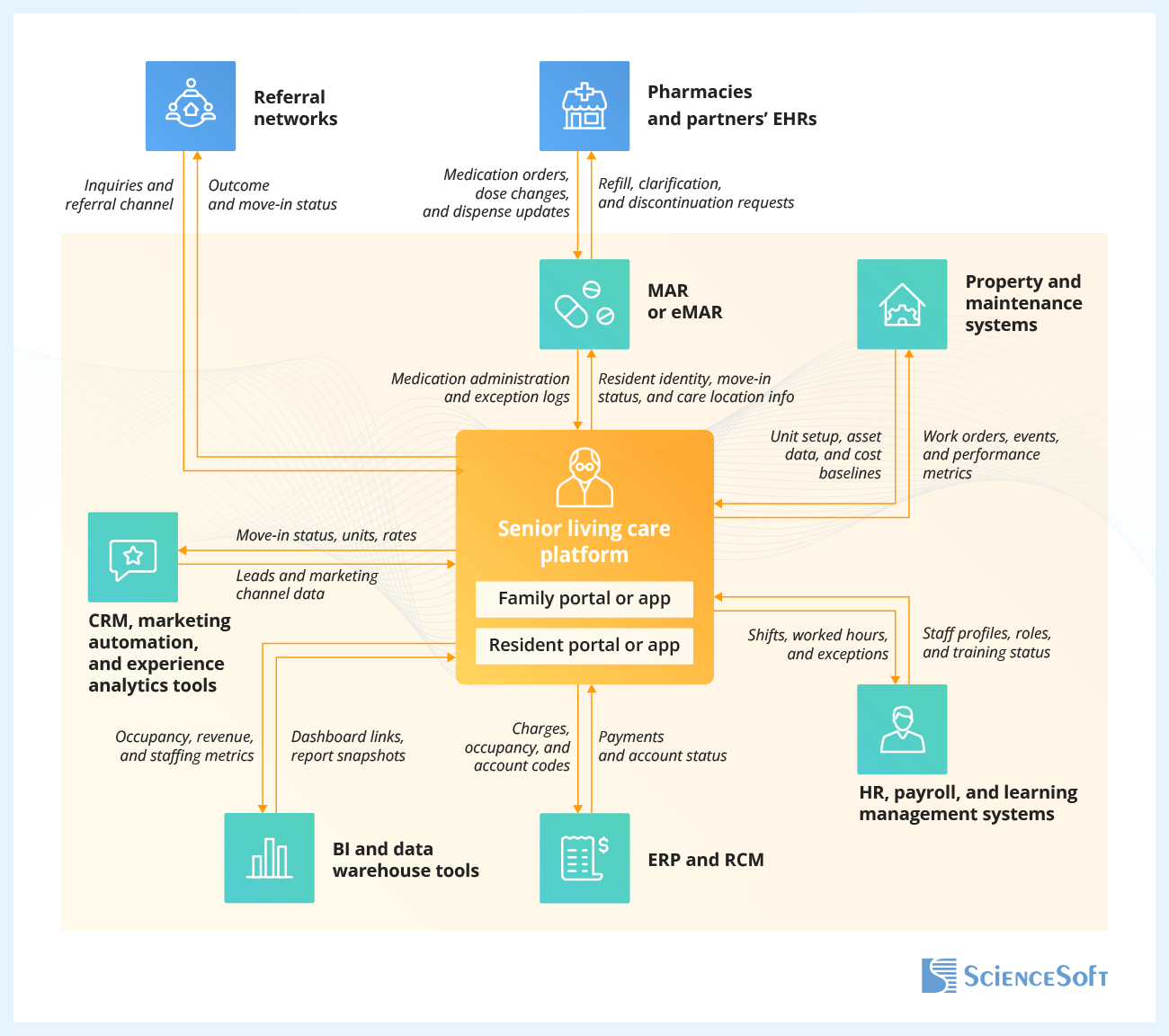
- CRM, marketing automation, survey, and reputation tools — to connect campaign, message, and survey activity to move-in outcomes and revenue per resident, so teams fund channels that drive profitable, longer stays.
- Referral networks (online lead and placement portals, referral management systems) — to drop new agency and online placement leads straight into sales worklists with clear partner attribution; to return real outcomes and move-in results, so operators can focus effort and budget on high-converting referrers and markets.
- ERP and RCM software — to post occupancy and service charges to the general ledger; to ensure resident portals reflect real-time, reconciled balances and payment status straight from the ERP or RCM system; to give finance auditable revenue and margin figures by community and level of care.
- Pharmacy systems and partners’ EHRs (via provider’s MAR or eMAR tool) — to keep medication lists and administration records current in the platform and to surface recent hospital stays or major diagnoses directly inside service planning, incident reviews, and risk dashboards without retyping from external charts.
- HR, payroll, and learning management systems — to drive staffing plans from current employee roles, availability, and credentials; to return worked hours, overtime, and missed shifts for precise payroll runs, labor cost analytics, and documented training compliance.
- Property management and maintenance systems — to turn service requests, move-in and move-out checklists into work orders with clear ownership; to sync unit status and asset data for unit readiness planning.
- BI tools — to build portfolio dashboards and board reports from occupancy, revenue, and staffing data.
Other frequently requested integrations include:
- Single sign-on with multi-factor authentication, eSignature tools, and payment gateways that support autopay and lockbox posting.
- SMS and voice platforms, nurse call systems, and monitoring tools, so alerts turn into assigned tasks, cut manual follow-ups, and keep operations dashboards aligned with real-time events.
Development Tips for Senior Living Care Projects
ScienceSoft’s recommendations below focus on structural choices that often stay invisible during early design. However, these choices directly inform long-term data consistency, which will affect the speed of data exchange, accuracy of billing, and efficiency of frontline staff.

Location-level workflow rules for multi-site operations
Multi-site providers often discover only during rollout that one workflow must behave differently across locations or states. The quickest solution is to add hard-coded exceptions to the forms and approval logic for each location. But after a few software updates like this, these exceptions pile up, and rule changes can trigger regression bugs, data mismatches, and inconsistent audit trails across communities.
ScienceSoft recommends a centralized rules engine with versioned configurations per location and state that drive validations, task routing, and required documentation. This keeps the core codebase stable, speeds policy and workflow updates, and reduces audit friction and security risk.
Care-level changes engineered as billable events
In many platforms, care reassessments update clinical records but leave pricing and billing logic untouched until the next cycle. The gap later manifests as missed charges, retroactive adjustments, and family disputes that staff must resolve manually.
ScienceSoft recommends modeling care-level changes as dated financial events that trigger pricing recalculation and proration, with audit logs automatically recorded. This keeps clinical, billing, and revenue views aligned and protects margin as resident needs evolve.
Resident identity continuity across the full lifecycle
In many senior living IT stacks, the CRM, care, billing, and portal tools store separate records for the same person across the prospect, resident, and discharge stages. As a result, staff lose context, families see gaps, and analytics miss long-term patterns.
ScienceSoft recommends maintaining a single persistent identity for every person (whether it’s a resident, family member, or guarantor) from the first inquiry through discharge, with controlled merges and auditable transitions. This preserves context, supports accurate reporting, and improves coordination across sales, care, and finance teams.
How Much It Costs to Develop a Senior Living Care Platform
The cost of a senior living care platform typically ranges from $300,000 for focused sales or analytics modules to more than $2,000,000 for a full multi-site enterprise platform. Budgets depend on the number of communities in scope, the mix of CRM, operations, workforce, and engagement modules, and the complexity of required integrations and analytics.
The scenarios below outline common scope combinations and cost ranges for senior living and Life Plan networks that prioritize occupancy, margin, and resident experience improvements across communities.
Cost ranges cover design, development, testing, and core integrations. Hosting, support, third-party licenses, and data migration are scoped separately.

Sales and occupancy module
For senior living and Life Plan operators seeking tighter occupancy, pricing discipline, and sales pipeline visibility across communities.
Typical functionality
A configurable sales and occupancy layer that integrates with an existing CRM can centralize lead intake, pipeline views, and unit and rate data across communities. It may integrate with website forms, referral portals, current senior living systems, and BI tools.
We can also build, as an extension or a stand-alone option, a care-level and quote engine, lead prioritization, occupancy forecasting, and revenue impact analytics, including AI tools.
Cost: $300,000–$800,000+

Analytics and governance module
For assisted living and memory care operators focused on board-grade KPIs, investor reporting, and governed portfolio data.
Typical functionality
A governed reporting layer can unify CRM, billing, HR, and property data across communities. It may establish shared KPI definitions, audit-ready lineage, and dashboards that match the operator’s governance model and financial reporting rules.
We can also build predictive risk models for occupancy, margin, and staffing. Other useful features are curated analytics marts, a metric catalog for board and lender reporting, and AI tools for drafting narrative summaries, explaining KPI variance drivers, and proposing follow-up checks from the governed dataset.
Cost: $400,000–$900,000+

Operations and workforce optimization module
For senior living and SNF operators seeking integrated staffing, scheduling, and labor analytics across communities and corporate finance.
Typical functionality
A workforce operations module can standardize multi-site schedules, staffing ratio rules, and time capture in one workflow. It may connect to HR and payroll platforms, and it can pass approved hours and exceptions into billing and finance. Role-based views can track labor KPIs, overtime, and budget variance by community.
Some operators request such enhancements as labor and occupancy data marts, staffing optimization models, ERP and property integrations, and AI support for draft schedules, compliance reporting, and executive workforce summaries.
Cost: $450,000–$900,000+

Full-scale senior living care platform build
For multi-site senior living and Life Plan networks seeking to consolidate CRM, operations, and engagement into a single, configurable enterprise platform.
Typical functionality
A full build can combine resident acquisition, care and service planning, unit and billing operations, and resident or family digital touchpoints across communities. Core integrations may connect ERP and revenue systems, CRM or marketing tools, HR systems, and property or maintenance solutions to support unified occupancy and margin analytics.
If needed, we can also add enterprise governance workspaces, cross-portfolio workflow orchestration, and deeper analytics for occupancy, margin, and resident experience. The scope may also include enterprise EHR connectivity, corporate BI feeds, partner portals, and AI modules for documentation, analytics, and leadership decision support.
Cost: $1,200,000–$2,000,000+
For a senior living platform, not every module must be built with heavy custom code. ScienceSoft often uses low-code tools like Microsoft Power Apps for staff-facing workspaces and dashboards (e.g., move-in checklists, shift marketplaces, or executive occupancy views) on top of the core data layer. This approach usually shortens delivery time and lowers the cost of these modules by roughly a third, while reliability and compliance stay intact since we can still build complex integrations and core business rules in custom code.
However, low-code is not a good fit for resident and family portals, intricate CCRC contract logic, or high-volume AI workloads. They still demand custom engineering for smooth performance, UI branding, and compliance. In this case, we can propose a hybrid architecture: low-code accelerates internal workflows, while strategic platform capabilities stay fully custom.
Why Choose ScienceSoft for Implementing Your Senior Living Care Platform
- Since 2005 in healthcare software engineering and IT consulting.
- 150+ successful projects in the domain, including patient engagement, care management, data integration, and analytics solutions.
- Since 1989 in data analytics and AI.
- Architecture and Solutions CoE with 9 principal architects to design integration-first platforms with resilience patterns, and role-based workflows for multi-system senior living environments.
- Interoperability expertise, including HL7 v2 and FHIR for clinical exchange, NCPDP for pharmacy connectivity, and X12 for billing and eligibility workflows.
- Clinical terminology and coding expertise for SNOMED CT, LOINC, ICD-10, CPT, and more.
Certifications and awards
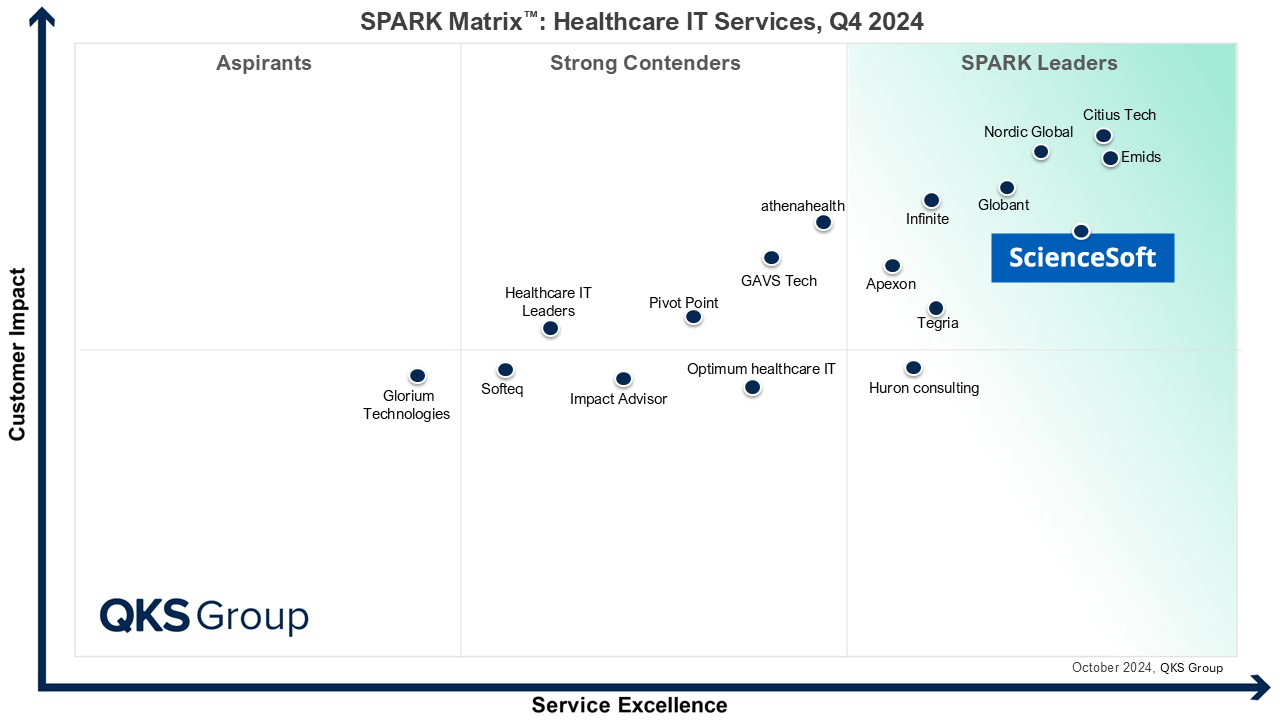
Featured among Healthcare IT Services Leaders in the 2022 and 2024 SPARK Matrix
Recognized for Healthcare Technology Leadership by Frost & Sullivan in 2023 and 2025

Named among America’s Fastest-Growing Companies by Financial Times, 5 years in a row
Four-time finalist across HTN Awards programs
Named among Becker’s Telehealth Companies to Know in 2026

Named Leading Healthcare Software Provider 2026 at GHP’s Healthcare & Pharmaceutical Awards

HIMSS Gold member advancing digital healthcare
ISO 13485-certified quality management system
ISO 27001-certified security management system
What Our Healthcare Clients Say

Todd Nilson
MD

We worked with ScienceSoft on the refactoring and modernization of our telehealth web portal and a cross-platform patient application. We were impressed by their code analysis proficiency and in-depth knowledge of telemedicine specifics. ScienceSoft proved to be a reliable vendor with a solid healthcare background.


Our clients in healthcare rely on Qventive for the support and administration of essential software solutions such as EHR and practice management systems. <…> When we were faced with a large influx of support requests, having ScienceSoft step in for 24/7 help desk was a lifesaver. We appreciate their proactive communication and commitment to quality. Highly recommend them!

Our project required a large amount of industry-specific methodology and algorithms to be implemented into our new software connected to EHR/LIS systems, which the team handled well. In addition to the solid technical expertise shown by ScienceSoft, its developers demonstrated a profound understanding of laboratory software specifics and integrations. They are reliable, thorough, smart, available, extremely good communicators and very friendly.

I honestly can’t say enough about how impressed I am with ScienceSoft. It’s not often that you find a team that moves this fast without sacrificing quality. I’m genuinely grateful to ScienceSoft for their hard work and would absolutely recommend them to anyone looking for top-notch results in health tech.
