 ScienceSoft Global



How Much Will Your Healthcare IT Project Cost?
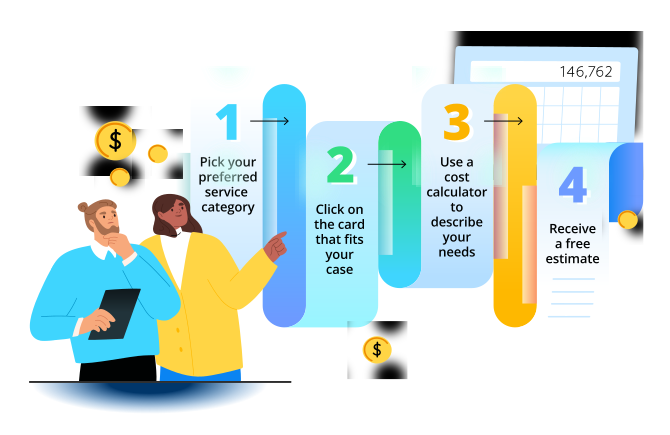
We’ve built over 200 cost calculators to help you estimate project expenses. Simply type a few words into the search bar to see the most relevant calculators — or browse the categories below to find the one that fits your project.
Cost Calculators by Solution Type
Click on the card to reach the cost calculator for your required solution type.






























Specialized Technology Solutions
Consider leveraging advanced technologies to enhance the precision, efficiency, and safety of healthcare delivery and operations.




Explore Our Sample Estimates
Software development cost ranges
- $60,000–$100,000: A simple patient or staff mobile app that focuses on one aspect, such as medication intake tracking or clinical documentation management, and features only basic functionality (e.g., health data tracking, push notifications, in-app messaging).
- $150,000–$250,000: An EHR-integrated patient or staff app that covers several operational aspects (e.g., from appointment management to daily care) and has moderately complex features, such as prescription refill requests, health analytics, and reporting.
- $150,000–$250,000: An EHR-integrated telehealth app with a basic feature set (audio and video calls, text messages, and manual tracking of symptoms, medication intake, etc.).
- $200,000–$400,000+: A custom remote patient monitoring solution or medical device software.
- $500,000–$800,000: A chronic disease management solution with condition-specific functionality, EHR/EMR integration, and comprehensive patient data analytics, including AI-powered recommendations.
- $120,000–$2,000,000+: A custom EHR/EMR solution, depending on its complexity and scale.
Data analytics and AI service costs
- $30,000–$200,000: A separate AI-powered automation module (e.g., for forecasting hospital capacity, optimizing staff scheduling and inventory management, or detecting insurance fraud).
- $100,000–$250,000: A basic healthcare data analytics solution that integrates with 1–3 key data sources (e.g., EHR, CRM), calculates essential operational and financial KPIs, and identifies trends and dependencies in health and operational data.
- $250,000–$500,000: A moderately complex analytics solution that integrates with multiple internal data sources, enables real-time data processing, and provides both rule-based and AI-driven analytics.
- $500,000–$1,250,000: An advanced solution that integrates with an unlimited number of internal and external data sources, including patient apps and IoT devices; handles multiple same-type sources (e.g., two CRMs of different divisions); enables real-time analytics, including big data processing; offers AI-powered predictions and recommendations.
Managed IT support prices
- $14–$40 per ticket: L1-L2 IT support for healthcare organizations.
- $5,000–$15,000+ per month: Maintenance and L3 support of a mature hospital app with a low volume of change requests.
- $30,000–$50,000+ per month: Maintenance and L3 support of an actively evolving patient-facing app with a high volume of change requests.
Security and compliance cost estimates
- $10,000: One-time penetration testing of a patient-facing app.
- $10,000–$20,000: IT infrastructure security testing for a midsized healthcare organization.
- $10,000–$25,000: Compliance pre-audit (HIPAA, GDPR, PCI DSS, etc.).
- $15,000–$25,000: Security code review for healthcare software (to confirm data protection).
QA and testing costs
- $5,000: One-time performance testing of a mobile healthcare app.
- $8,000–$16,000: QA code review for healthcare software (to determine and fix the root causes of software defects).
- $20,000 per month: Continuous managed testing for a healthcare organization having 3–5 constantly evolving apps.
- $24,000–$72,000: Audit of QA processes in healthcare software development and recommendations for their improvement.
For a more precise cost estimate, please use our online cost calculators.
Why Healthcare Organizations Choose ScienceSoft
- Since 1989 in custom software development and since 2005 in healthcare IT.
- Over 150 successful medical IT projects.
- Team of 750+ talents, including certified healthcare software architects, developers, QA engineers, and project managers with 9–20 years of experience in the domain. 50% of our developers are senior-level specialists.
- Regulatory compliance consultants proficient in HIPAA, HITECH, GDPR, NCPDP, FDA, ONC, MDR, IVDR, SAMHSA, MACRA, MIPS, CEHRT, and SAFER.
- ISO 13485, ISO 27001, and ISO 9001 certifications proving our focus on medical software quality and data security.
- Proficiency in healthcare standards and clinical terminologies such as HL7, FHIR, ICD-10, CPT, LOINC, SNOMED CT, XDS/XDS-I, DICOM, Blue Button+, CDA, and CCD.
Certifications and awards
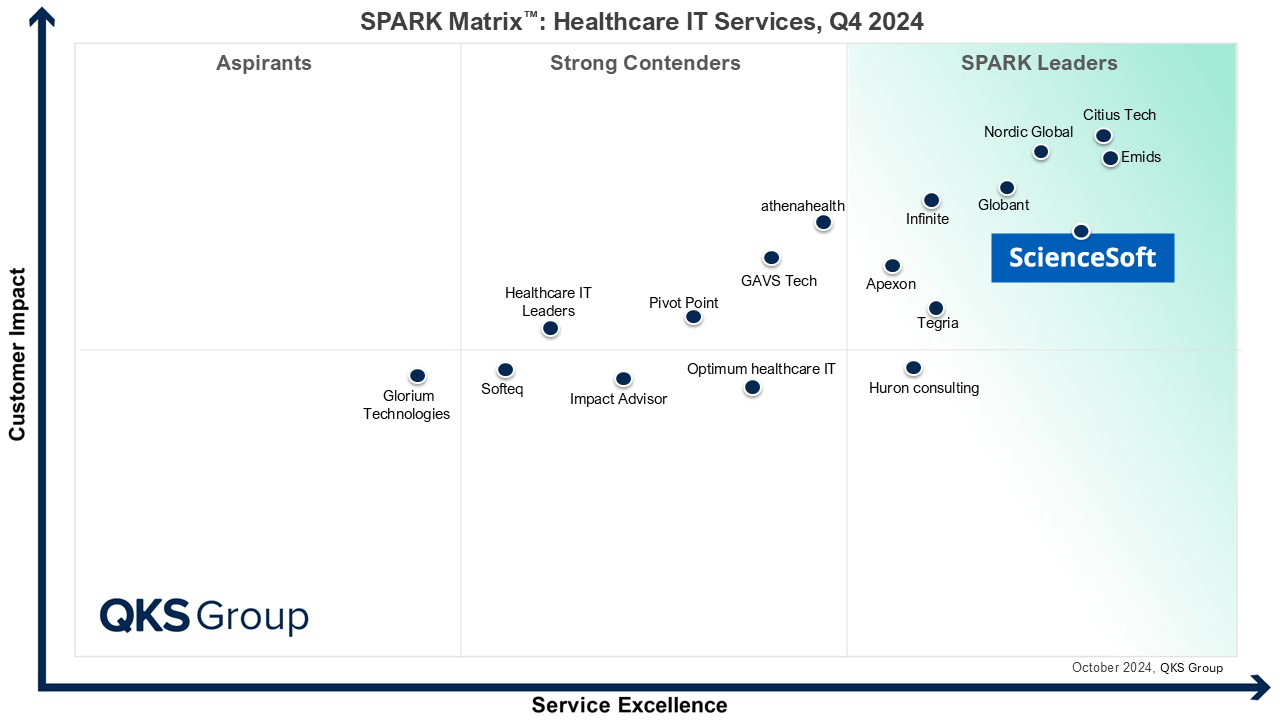
Featured among Healthcare IT Services Leaders in the 2022 and 2024 SPARK Matrix

Recognized for Healthcare Technology Leadership by Frost & Sullivan in 2023 and 2025

Named among America’s Fastest-Growing Companies by Financial Times, 5 years in a row

Four-time finalist across HTN Awards programs
Named among Becker’s Telehealth Companies to Know in 2026
Named Leading Healthcare Software Provider 2026 at GHP’s Healthcare & Pharmaceutical Awards
HIMSS Gold member advancing digital healthcare

ISO 13485-certified quality management system
ISO 27001-certified security management system
Our Clients Share Their Experience with ScienceSoft

In addition to the solid technical expertise shown by ScienceSoft, its developers demonstrated a profound understanding of laboratory software specifics and integrations.



Patrick Pakan
Founder and CEO

I’ve had six orthopedic surgeries since playing college football and tried every major digital exercise therapy platform on the market. None of them offer the comprehensive and personalized care they claim. Thanks to ScienceSoft’s practical healthcare IT expertise, we created a musculoskeletal therapy platform that can be fully customized and reflect the needs of each program member.


Working with ScienceSoft was a pleasure from A to Z. We are grateful for their can-do attitude, responsiveness, and straightforward communication. RIVANNA already witnessed tangible benefits of our cooperation. We have more projects to come and are looking forward to working with ScienceSoft again.











How We Optimize Costs
Below are some of the proven practices we apply to maximize long-term value and optimize total cost of ownership.
Continuously optimizing infrastructure and cloud spending
ScienceSoft applies cloud rightsizing, workload and storage optimization, FinOps, and continuous utilization monitoring to eliminate unnecessary infrastructure spending. Our cloud architects regularly reduce cloud infrastructure costs by 20–70% without compromising performance and availability.
Using healthcare standards to reduce integration costs
ScienceSoft uses HL7, FHIR, DICOM, X12, and proven integration patterns whenever feasible. Standards-based interoperability reduces custom development, simplifies system upgrades, and lowers integration and maintenance costs.
Modernizing legacy systems incrementally
We prioritize modernization based on business value, technical risk, and ROI rather than replacing viable systems unnecessarily. This helps reduce technical debt and operating costs while avoiding the expense and risk of large-scale replacement.
Designing for compliance from the start
ScienceSoft incorporates healthcare security, privacy, audit, and data governance requirements into solution design from the outset. This helps prevent costly redesigns, compliance gaps, and deployment delays.
Optimizing healthcare workflows before automating them
Before introducing new software or integrations, we identify redundant steps, manual work, and inefficient clinical and administrative workflows. This helps reduce implementation scope and integration complexity while improving adoption.
Automating software delivery and IT operations
ScienceSoft uses CI/CD, Infrastructure as Code, automated testing, security and quality checks, and automated environment management to reduce manual effort and accelerate releases. Depending on the project, test and deployment automation can cut release preparation effort by 50–80%.
