 ScienceSoft Global



ScienceSoft helps healthcare providers and health tech companies define the scope of new nursing software or plan the evolution of an existing system. We can analyze your current needs and operational constraints and suggest suitable architecture options, integration approaches, and a risk-controlled implementation roadmap.
Software Development for Nursing
ScienceSoft develops, integrates, evolves, and maintains nursing software for healthcare providers and product companies. We help providers reduce manual nursing workload and make care coordination more efficient. We also build and upgrade nursing software products that can adapt to different customer workflows, integrate with diverse healthcare IT environments, and scale across organizations and care settings.
Contributors

Kate Lukina, MD
Healthcare IT & AI Consultant, ScienceSoft

Alex Cheushev
Senior Solution Architect, Healthcare, ScienceSoft
Nursing software development services help healthcare providers and health tech companies create or evolve software for nursing workflows. Providers can add custom capabilities, integrations, and improvements around systems already in use, while health tech companies can build and scale nursing-focused products for different customers and care settings.
Nursing Software Projects ScienceSoft Delivers

Nursing applications and platforms
We can develop custom nursing software for a provider or build a scalable commercial product for a health tech company.

Focused modules and extensions
We can add a new nursing workflow to an existing clinical or administrative system without replacing it.

Legacy software modernization
We can modernize the problem areas of an old application and preserve parts that remain fit for purpose.

Software integrations
We can build integrations between nursing software and other systems to automate data exchange that otherwise depends on manual entry or transfer.

AI-enabled nursing solutions
We can embed governed AI into nursing systems where it removes workflow steps or speeds up data-heavy work.
Why Choose ScienceSoft for Nursing Software Development
- Since 2005 in healthcare IT, with 150+ successful projects.
- 750+ IT professionals; over 50% of ScienceSoft’s talent pool are senior-level experts.
- 30+ architects to design nursing software that remains secure, scalable, and maintainable.
- In-house Project Management Office to keep delivery aligned with budget, timelines, quality standards, and changing priorities.
- Healthcare IT consultants with MD degrees and HIMSS-aligned expertise.
- Hands-on experience with healthcare security and compliance requirements, including HIPAA, HITECH, GDPR, and the 21st Century Cures Act, as well as medical device regulations when nursing workflows involve regulated device functionality.
- Healthcare interoperability expertise across HL7 v2/v3, FHIR, USCDI, C-CDA, and XDS/XDS-I, with clinical terminology mapping for SNOMED CT, LOINC, RxNorm, ICD-10, CPT, and more.
Certifications and awards
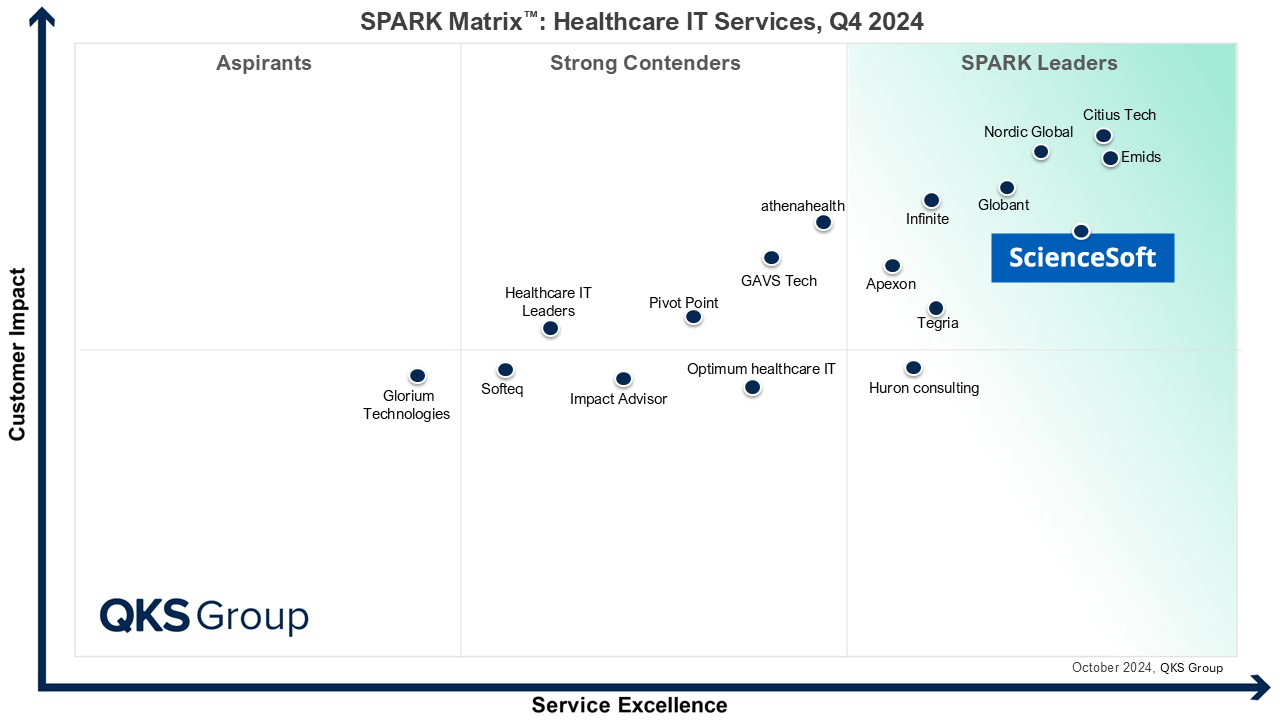
Featured among Healthcare IT Services Leaders in the 2022 and 2024 SPARK Matrix
Recognized for Healthcare Technology Leadership by Frost & Sullivan in 2023 and 2025

Named among America’s Fastest-Growing Companies by Financial Times, 5 years in a row
Four-time finalist across HTN Awards programs
Named among Becker’s Telehealth Companies to Know in 2026

Named Leading Healthcare Software Provider 2026 at GHP’s Healthcare & Pharmaceutical Awards
HIMSS Gold member advancing digital healthcare
ISO 13485-certified quality management system
ISO 27001-certified security management system
Nursing Software We Develop
ScienceSoft develops full-scale nursing software as well as focused modules and extensions for existing healthcare environments. The scope can be tailored to the client’s current setup, workflow gaps, and plans for future expansion.

Care management tools for nurses
A shared workspace for care plans, nursing documentation, medication management, and current patient status.

Nursing task management tools
Shared task queues, priorities, reminders, handoffs, and completion tracking across shifts.

Nurse staffing and scheduling systems
Covering shift planning, availability, open shifts, swaps, overtime, and float-pool coordination.

Nurse-to-patient assignment tools
For balancing patient assignments by acuity, workload, nurse qualifications, and continuity of care.

Nurse call and communication systems
Patient calls, device alerts, secure messaging, mobile notifications, routing, and escalation in one communication workflow.

Nurse rounding apps
Including mobile apps for phones and tablets to document rounds, capture follow-up tasks, and track completion.

Skilled nursing facility software
For long-term care providers that need SNF-specific clinical, medication, staffing, and compliance workflows.

To support remote nursing consultations, follow-up care, and inpatient virtual nursing.
How AI Can Improve Nursing Workflows
ScienceSoft redesigns nursing workflows with AI where it can measurably reduce manual effort, shorten task completion times, or lower operating costs. We can introduce AI into software nurses already use or embed it into new applications and products, with human review and approvals built into workflows that require clinical judgment.
When AI works with clinical records, a plausible-looking output is not enough: important details can be omitted, outdated, or taken out of context. Depending on the use case, we ground AI in approved data sources, add deterministic checks for information that can be verified automatically, surface conflicts and unsupported claims, and require nurse review before high-impact outputs are recorded or shared. See our architecture for reducing healthcare AI hallucinations.
Clinical documentation
AI for patient records can turn dictation into draft nursing notes, prefill structured fields, summarize recent chart changes, and highlight conflicting or outdated information that needs review before documentation is finalized.
Care coordination and handoffs
Agentic AI can turn incoming clinical information into follow-up tasks, route them to the appropriate work queues, track their status, and escalate missed actions or exceptions for staff review. It can also support medication reconciliation by comparing medication records and bringing discrepancies to the nurse’s attention.

Nursing operations and patient flow
AI-powered healthcare command centers can analyze patient flow, bed availability, staffing, and workload data to flag emerging capacity problems, forecast demand, and direct operational tasks or escalations to the responsible teams.
Device alerts and monitoring
AI for connected medical devices can analyze device data to detect clinically relevant patterns, add context to alerts, prioritize notifications, and reduce low-value alarm noise before it reaches nursing staff.
Patient instructions and discharge
Dedicated GenAI tools can prepare discharge instructions, patient education materials, and follow-up guidance from approved clinical information, adapting the content to the patient’s situation while keeping the result available for nurse review before it is shared.
Need a Tailored Cost Estimate for Your Nursing Software Project?
Describe your current setup and expectations, and ScienceSoft’s consultants will get back to you with a custom quote for your case.
Services We Offer
Technology consulting and software architecture design
Nursing software development
We engineer custom nursing software and healthtech products from focused apps to full-scale care management platforms. ScienceSoft can cover the full delivery cycle, including requirements engineering, UX/UI design, development, integration, testing, deployment, and rollout. For complex solutions, we can start with a limited workflow or pilot.
AI transformation for nursing workflows
We identify where AI can measurably speed up or simplify operations and embed it into the apps and workflows that nurses already use. We then define patient data controls, human review and approval points, and output validation for each AI-enabled workflow, as well as set up ongoing monitoring to detect recurring errors or performance changes after launch.
Healthcare software integration
We can connect nursing applications with EHRs, staffing and assignment tools, medical devices, communication platforms, and other relevant hospital systems. Our architects design data flows that help nurses avoid duplicate entry and receive tasks, calls, or alerts with the full context needed to act on them.
Nursing software modernization
ScienceSoft modernizes legacy nursing applications that are difficult to maintain, integrate, or use in current clinical workflows. Depending on the identified issues, we can redesign key workflows, replace outdated components, improve interoperability and performance, or gradually re-platform the software without disrupting critical nursing operations.
Nursing software evolution and support
ScienceSoft can evolve nursing software as workflows, staffing models, connected systems, and user needs change, adding new capabilities and refining existing ones based on production feedback. We can also provide ongoing maintenance, performance and integration monitoring, defect resolution, and security and compatibility updates.
How to Avoid Common Pitfalls When Building Nursing Software

New software adds extra steps instead of reducing nursing workload
A new task management or documentation tool may require nurses to switch between systems, enter information that already exists elsewhere, or document the same activity twice. Even useful functionality may see poor adoption if it adds work to an already busy workflow.
Solution
AI-generated notes, handoffs, or patient instructions may look plausible while missing important clinical details
AI can produce clear, well-structured text and still omit a follow-up action, use outdated information, or change the meaning of a clinical statement. This is especially risky when the output is used for a handoff, added to the patient record, or shared with the patient: the next person may reasonably assume that a polished summary is complete.
Solution
Automated routing and assignments stop reflecting what is actually happening during a shift
Schedules and initial patient assignments can change throughout a shift as nurses cover for colleagues, patients move between units, or workloads are redistributed. If nursing software relies on outdated assignment data, calls, tasks, or alerts may reach the wrong person or require manual rerouting.
Solution
Planning to Build or Evolve Nursing Software?
Work with our healthcare consultants and solution architects to refine the scope, choose a suitable implementation approach, and estimate the required investment. We can support both provider-side software initiatives and nursing-focused products for the healthcare market.

How We Handle Real-World Clinical Complexity in Nursing Software Solutions
Example scenario: adding a clinical communication system to an existing hospital environment
In this scenario, the hospital already has nurse call hardware, bedside devices, an EHR, and staffing software, but alerts and the patient and staff context needed to act on them remain split across systems. The blue layer is a custom-built clinical communication and alarm management platform that solves that problem. It doesn’t replace those systems, but brings their events and context together so calls and alerts can be filtered and routed accurately.
We show this scenario because it brings several common architecture challenges into one view. You often need to add new functionality without replacing working systems, pull data from several sources, synchronize records or alerts, and keep life-saving workflows running even if a connected system goes down temporarily. For healthcare software companies, the same type of challenge arises when their product has to work within providers’ existing clinical environments.
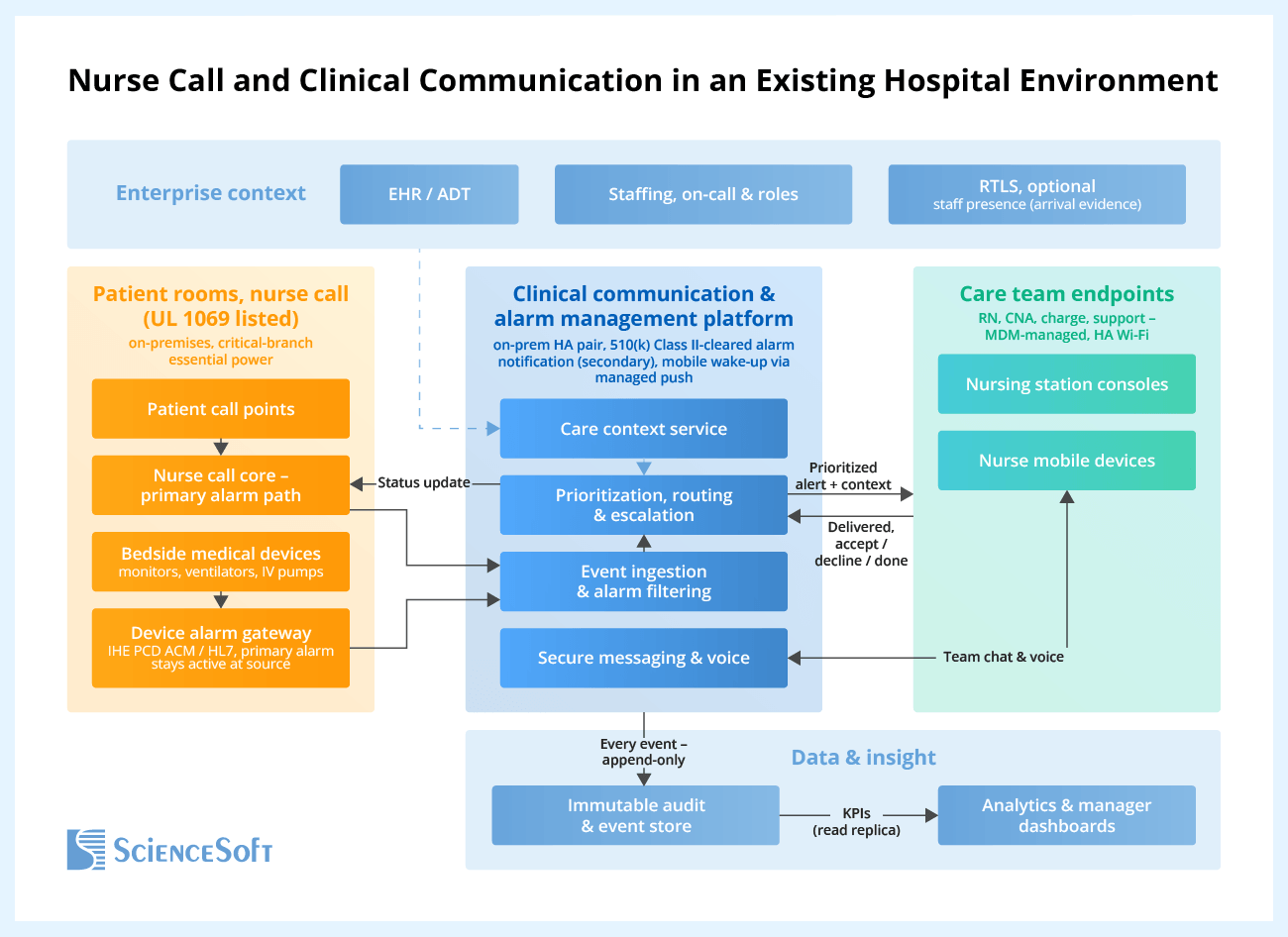
In the proposed architecture, a custom clinical communication platform ingests events like patient calls or bedside-device alerts and converts them into a consistent format. Then, it retrieves the context needed to route them to the right care team, such as the patient’s location and current nurse assignments. The platform sends the alert to the responsible nurse’s workstation or mobile device and tracks whether it was delivered and acknowledged. If nobody responds within the required time, it follows the hospital’s escalation rules to an approved fallback. To reduce alert fatigue from duplicate or low-value notifications, the platform can filter them using clinically approved rules.
Importantly, this custom platform does not become the hospital’s only alarm path. If the platform or the mobile delivery network becomes unavailable, local nurse call and bedside alarms will still function through their original systems. The hospital only temporarily loses access to mobile routing, extra patient context, and auto-escalation. And if the EHR or staffing software goes offline, the platform can continue routing alerts using the latest assignment data it holds in temporary storage (cache) for that very purpose.
The platform also records alert activity as it happens. Still, management dashboards and historical reports use a separate copy of these records instead of querying the data used for live alert delivery. This is done so that reporting or analytics cannot slow down an active alert.
Technologies We Use to Build Software for Nurses
Front-end programming languages
Languages
- HTML5
- CSS
- JavaScript
JavaScript frameworks
- Angular JS
- React JS
- MeteorJS
- Vue.js
- Next.js
- Ember.js
Mobile
- iOS
- Android
- Xamarin
- Apache Cordova
- Progressive Web Apps
- React Native
- Flutter
- Ionic
Low-code development
- Microsoft Power Apps
- Microsoft Power Automate
- App Engine Studio (ServiceNow)
- Bubble.io
Clouds
- Amazon Web Services
- Microsoft Azure
- Google Cloud Platform
- DigitalOcean
- Rackspace Technology
Platforms
- Microsoft Dynamics 365
- Salesforce
- Magento
- SharePoint
- ServiceNow
- SAP SE
DevOps
Containerization
- Docker
- Kubernetes
- Red Hat OpenShift
- Apache Mesos
Automation
- Ansible
- Puppet
- Chef
- Saltstack
- HashiCorp Terraform
- HashiCorp Packer
CI/CD tools
- AWS Developer Tools
- Azure DevOps
- Google Developer Tools
- GitLab CI/CD
- Jenkins
- TeamCity
Monitoring
- Zabbix
- Nagios
- Elasticsearch
- Prometheus
- Grafana
- Datadog
Databases / data storages
SQL
- Microsoft SQL Server
- Microsoft Fabric
- MySQL
- Azure SQL Database
- Oracle
- PostgreSQL
NoSQL
- Apache Cassandra
- Apache Hive
- Apache HBase
- Apache NiFi
- MongoDB
- Microsoft Fabric
Cloud databases, warehouses, and storage
AWS
- Amazon S3
- Amazon Redshift
- Amazon DynamoDB
- Amazon DocumentDB
- Amazon RDS
- Amazon ElastiCache
Azure
- Azure Data Lake
- Azure Blob Storage
- Azure Cosmos DB
- Azure SQL Database
- Azure Synapse Analytics
- Kinect DK
- Azure RTOS
Google Cloud Platform
- Google Cloud SQL
- Google Cloud Datastore
Other
- Microsoft Fabric
Generative AI
Models
- Large Language Models (LLMs)
- Small Language Models (SLMs)
- Multimodal models
- Computer vision models
- Image generation models
- ASR speech models
- TTS speech models
- Speech-to-Speech Models
- Audio models
- Real-time
Model adaptation and efficiency
- Training from scratch
- Data design
- Data labelling/annotation
- Fine-tuning
- Instruction tuning
- LoRA adapters
AI platforms and services
- Azure OpenAI Service
- Microsoft Foundry
- Amazon Bedrock
- Google Vertex AI
- Google AI Studio
- Hugging Face Inference
- Oracle Cloud
- G42/Core42
- NVIDIA AI Enterprise
Agents and orchestration
- RAG
- Graph RAG
- Agentic workflows
- OpenAI Agents SDK
- OpenAI Agents (platform/guides)
- AWS Agents
- Claude Agent SDK
- Google Agent Development Kit (ADK)
- Microsoft 365 Agents SDK (Copilot Studio)
- OpenClaw
- LangChain
- LangGraph
- smolagents
- LiveKit
- Dify
- n8n
- Faiss
- ChromaDB
- Qdrant
- Weaviate
- OpenSearch
- Pgvector
- Amazon Neptune
- Graph RAG Toolkit
- Neo4j
Healthcare-specific language models
- MedGemma
- MedLM
- BioMedLM
Traditional ML
Platforms and services
- Azure Cognitive Services
- Azure Machine Learning
- Microsoft Bot Framework
- Amazon SageMaker AI
- Amazon Transcribe
- Amazon Lex
- Amazon Polly
- Google Cloud AI Platform
- Google Vertex AI
Frameworks and libraries
- Apache Mahout
- Apache MXNet
- Caffe
- TensorFlow
- Keras
- Torch
- OpenCV
- Apache Spark MLlib
- Theano
- Scikit Learn
- Gensim
- SpaCy
Our Clients Say


In just four months from project kickoff, they successfully migrated us to a modern, modular Microsoft-based telehealth platform featuring virtual consultations, care coordination, and seamless data exchange with partner systems, including robust EHR integrations.



We were pleased to see that ScienceSoft approached our ecosystem with a good understanding of healthcare operations and the HIPAA Security Rule.

I am particularly impressed by the cooperative nature of ScienceSoft's team. They are reliable, thorough, smart, available, extremely good communicators and very friendly. We would recommend hiring ScienceSoft to anyone looking for a highly productive and solution-driven team.

We found ScienceSoft to be dependable and forward-thinking, and we would confidently recommend them for high-responsibility projects.

Todd Nilson
MD

ScienceSoft proved to be a reliable vendor with a solid healthcare background, and we recommend them to everyone looking for a telehealth software development partner.
