ScienceSoft Global



SCM Software Development Services for Providers
In healthcare IT since 2005, ScienceSoft delivers supply chain management solutions that connect sourcing, purchasing, inventory, and utilization workflows across hospitals and ambulatory networks. Our principal architects engineer compliance- and risk-aware software ecosystems that strike the right balance between performance, longevity, and cost.
Contributors

Compliance Officer, Healthcare and Finance IT & AI Compliance Consultant, ScienceSoft

Head of AI, Principal Architect, ScienceSoft
Healthcare supply chain software development services help hospitals and health systems when out-of-the-box SCM tools can’t match their real workflows, governance, and multi-system environments. Through custom development, providers get flexible options for custom software extensions, integrations, and purpose-built applications that fit their current supply chain ecosystem.
Providers typically take one or several of these custom software implementation paths:
- Build a focused custom module to remove the biggest bottleneck first (e.g., approvals, invoice exceptions, recalls, contract compliance), without changing core systems.
- Add a workflow hub that standardizes how work gets done across sites while existing ERP, MMIS, and EHR platforms remain systems of record.
- Develop integrations and a shared data foundation so item, vendor, pricing, and status updates stay consistent across procurement, inventory, AP, and clinical consumption workflows.
- Launch targeted point-of-use capture (often perioperative or other high-cost areas) to improve utilization visibility and reduce leakage, then expand after a successful pilot.
- Build a large-scale custom SCM solution when consolidation, post-merger complexity, or highly specialized operations make other approaches too slow or too limiting to sustain.
Why Providers Trust ScienceSoft With SCM Software
-
Since 2005 in healthcare software engineering and IT consulting.
- Since 2012 in supply chain software development.
- Since 1989 in data analytics and AI.
- 150+ successful healthcare IT projects.
- Architecture and Solutions CoE with 9 principal architects designing SCM solutions for interoperability with clinical and administrative systems.
- Experience with high-demand technology for the healthcare supply chain, including medical IoT, RFID, and blockchain.
- In-house HIMSS-certified consultants who understand provider operations, supply chain realities, and clinical workflows.
- HIPAA-aligned engineering practices, including access control, audit trails, encryption, secure SDLC, and BAA-ready delivery when SCM solutions touch ePHI or patient-linked utilization data.
Certifications and awards
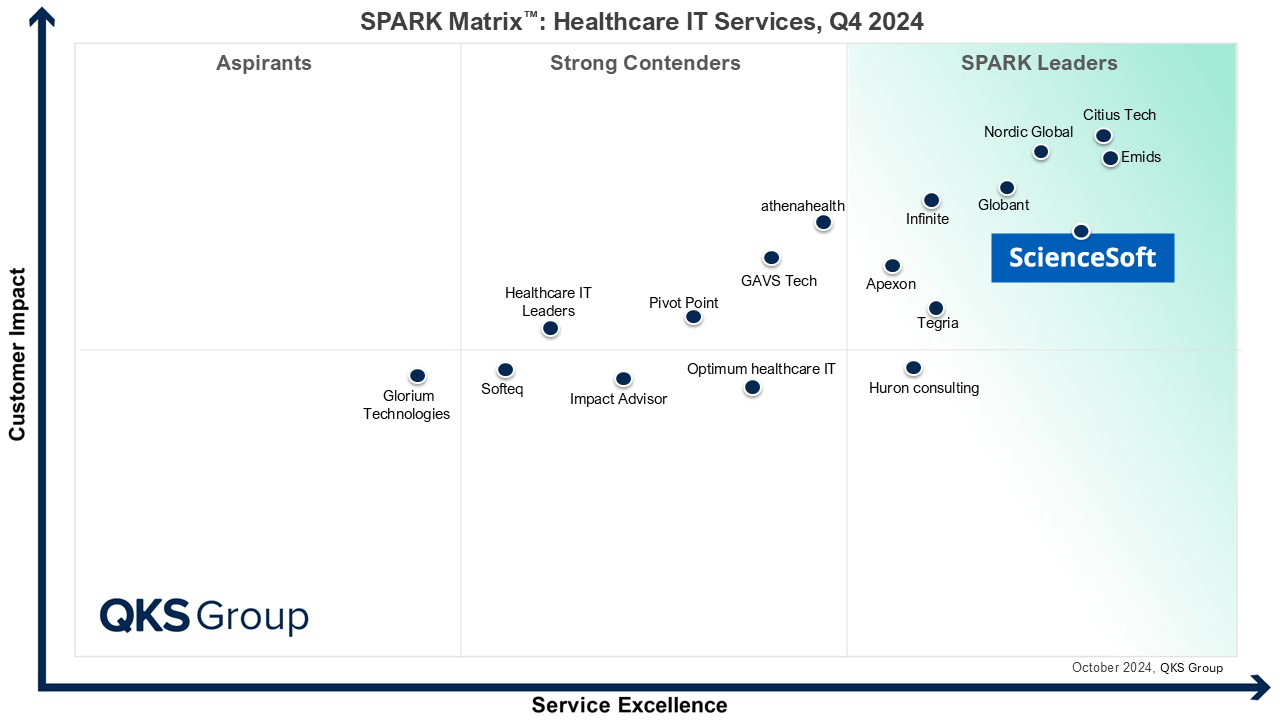
Featured among Healthcare IT Services Leaders in the 2022 and 2024 SPARK Matrix
Recognized for Healthcare Technology Leadership by Frost & Sullivan in 2023 and 2025

Named among America’s Fastest-Growing Companies by Financial Times, 5 years in a row

Four-time finalist across HTN Awards programs

Named among Becker’s Telehealth Companies to Know in 2026

Named Leading Healthcare Software Provider 2026 at GHP’s Healthcare & Pharmaceutical Awards

HIMSS Gold member advancing digital healthcare

ISO 13485-certified quality management system

ISO 27001-certified security management system
Key Functionality of Supply Chain Management Software in Healthcare
Below is a practical set of capabilities that healthcare organizations often request when implementing an SCM solution. We shape each implementation around the existing SCM process, insurer requirements, and integration landscape, so the final workflow steps and modules may vary by organization.

Purchasing workflows
Procurement teams can standardize how departments request supplies and how approvers review them. The solution can include guided buying (catalogs and preferred items), policy and budget checks, configurable approval chains, and contract-aware item selection. Buyers can track substitutions, backorders, and urgent requests in a single workflow rather than email threads, so facilities maintain control without slowing clinical operations.

Supplier collaboration
Supply chain and contracting teams can centralize supplier interactions around orders, terms, and exceptions through a dedicated portal. It can support supplier onboarding, contract document management, PO acknowledgements, shipment milestones, and structured conversations tied to a specific PO or discrepancy. Teams can keep changes and commitments traceable across facilities, reducing “who said what” disputes and shortening resolution cycles.

Receiving and exception management
Receiving, AP, and materials teams can manage discrepancies using consistent rules rather than ad hoc fixes. A custom solution can support barcode-assisted receiving, partial receipts, substitution logging, required-document checks, and tolerance-based matching. A single exception queue can assign owners, set due dates, and capture outcomes, preventing invoice delays and payment holds from cascading into supply shortages and supplier friction.

Materials management teams can maintain dependable stock visibility across storerooms, carts, and satellite locations. This module can cover par levels, replenishment tasks, transfers, cycle counting, expiry controls, and consignment handling. Staff can follow clear task lists by location and priority, which helps avoid stockouts, “panic ordering,” and waste.

Perioperative and other clinical teams can capture consumption through low-friction workflows that align with case pace. A customized tool can support GS1/UDI barcode scanning and RFID, case pick and return, preference-card alignment, and automatic capture of lot, serial, and expiry data for high-risk items. Supply chain teams can trace items fast during recalls, while staff can route unreadable labels and missing identifiers into a defined correction loop.

Recall, shortage, and risk actions
Supply chain, pharmacy, and OR leaders can run targeted actions during recalls, shortages, and safety events. The automated workflow can identify impacted items and locations, generate hold or quarantine tasks, track acknowledgements, and document disposition. Teams can coordinate substitutions and backorders, communicate guidance to affected departments, and preserve a defensible audit trail without relying on manual spreadsheets under time pressure.

Executives, supply chain leaders, and finance teams can monitor supply chain performance and track cost variance, contract compliance, stockouts, expiry waste, lead-time volatility, and exception drivers. Teams can drill down by facility, service line, supplier, and category to prioritize fixes, then track whether workflow and data changes actually move KPIs over time.

Item and vendor master data governance
A single master data governance layer can enforce required attributes (UoM, packaging hierarchy, identifiers), manage deduplication, and control who can create or change records, preventing inconsistent data from breaking automation. Teams can map local item codes to normalized identifiers, maintain consistent pricing and vendor attributes, and keep a full change history that supports audits and multi-site standardization.
We typically build SCM software workflows with built-in jurisdictional security, auditability, and retention controls: this may include SSO/RBAC, encryption, immutable logs, evidence-ready reporting, and more. If pharmacy is in scope, we can also support DSCSA/UDI traceability, controlled-substance and hazardous-drug workflows (USP <800>), and 340B audit preparation.
AI Capabilities That Boost Supply Chain Management Workflows

Copilot for supply requests and ordering
A workflow copilot can help buyers create a supply request by finding the right item, unit, and pack size, suggesting required fields, and warning when the request deviates from approved items or terms. It can also answer status questions using the current request or order context.

AI for contracts and catalogs
A natural language processing (NLP) model can extract key fields from supplier contracts and catalog files into a structured draft (effective dates, renewal terms, price schedules, pack sizes, replacements). Teams can review the draft and apply changes to contract and catalog records. Role-based approval and version history prevent unreviewed pricing or pack-size changes from affecting orders and invoices.

Copilot for procure-to-pay exception handling
A copilot can summarize mismatches between purchase orders, receipts, and invoices, suggest an exception category, and draft resolution notes for accounts payable, receiving, and buyers to review. It can also prepare supplier follow-up messages with the relevant order details pulled into the draft.
AI safeguards for the healthcare supply chain
I understand that many hospital leaders are cautious about letting AI into their IT environment, mainly because of privacy, security, and governance risks. Let me be clear: when we say AI, we don’t mean an independent robot that will place orders or approve purchases without your control. In our healthcare solutions, AI’s role is carefully contained: it can draft an exception note, summarize what changed, or flag anomalies, but human staff still approve every action. We set explicit guardrails before rollout: who can access which data, which prompts and outputs must be stored and where, and what gets audited. Access stays role-based, all actions are logged, and if a workflow includes patient or case context, we apply the same HIPAA/HITECH controls used for other systems handling ePHI.
Reference Architecture for a Hospital Supply Chain Management Solution
Below, ScienceSoft’s solution architects present a high-level architecture of a modular, cloud-native SCM platform that sits above a hospital’s existing ERP or MMIS, EHR, and supplier channels for electronic ordering. With this setup, the hospital keeps its core systems as systems of record; the SCM platform adds a unified operational layer that standardizes how supply chain teams work across sites and locations. One of the architects’ priorities was a modular design that supports ongoing updates and future platform changes without rebuilding the solution.
The reference architecture is shown on Amazon Web Services, but the same modular approach can be implemented on other cloud platforms and, where required, in on-prem environments.
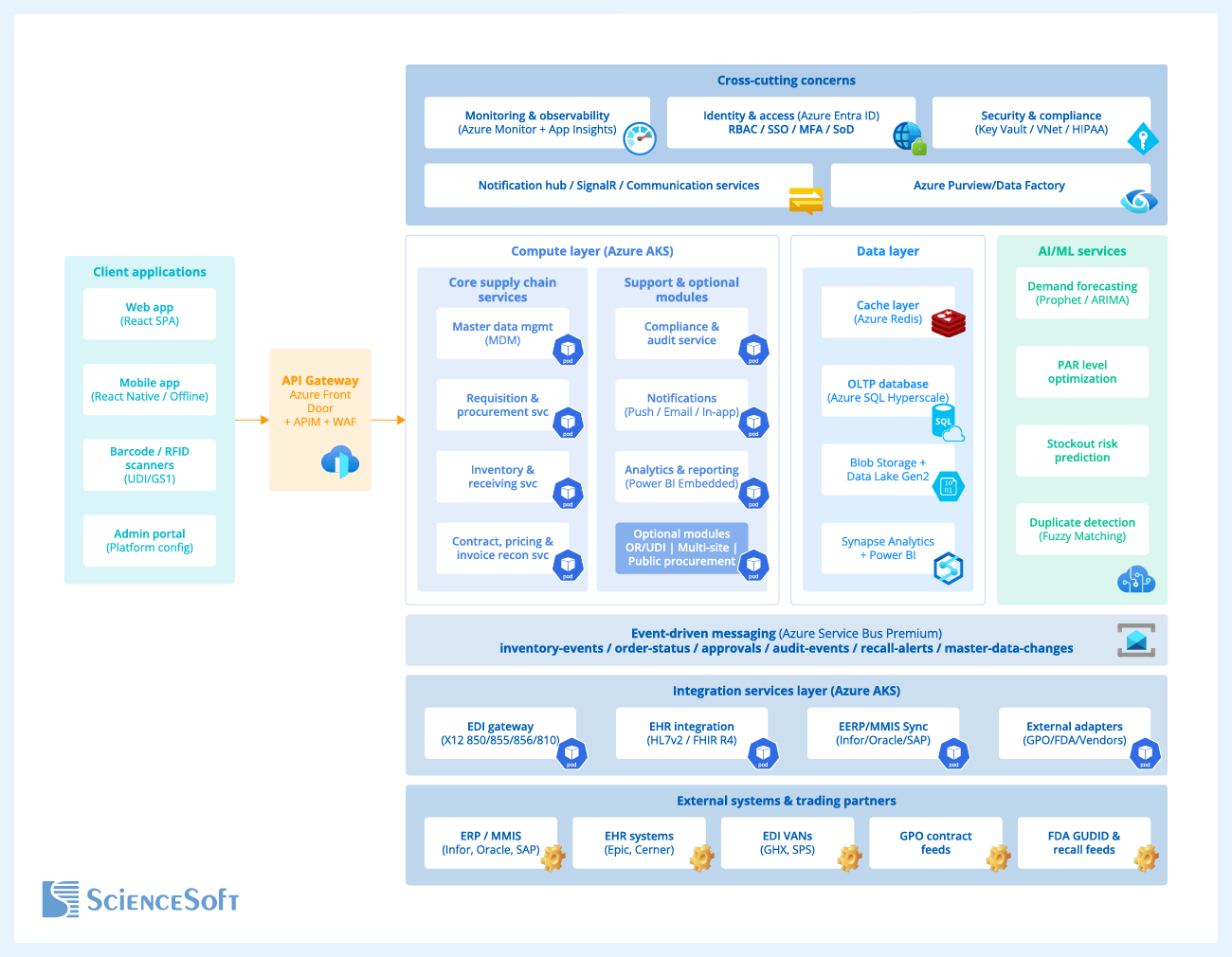
The shared compute layer is the core of the SCM solution, covering master data governance, procure-to-pay workflows, inventory tracking and movements, invoice checks, and consolidated reporting. Users can access the platform through a role-based web application for procurement and finance workflows and a mobile app for hands-on tasks like receiving, counts, deliveries, and point-of-use capture. The mobile app can also support offline use in areas with unreliable connectivity.
The integration layer connects the SCM platform to ERP/MMIS, EHR, EDI, and external adapters to gather data from all key supply chain sources. The platform uses an internal message bus so modules can notify each other when something changes (e.g., an order approval or an inventory update).
The data layer is separated to prevent a common hospital failure mode: screens slow down during peak receiving and counting, because the same storage is trying to serve real-time operations, dashboards, and document-heavy history at once. The OLTP database is where supply chain and AP staff do the live work: create purchase orders, post receipts, record inventory counts, etc. A separate cache layer keeps the most-used values (item ID, permissions, contract pricing) instantly available so scanning and posting don’t stall under peak load. Blob Storage and Data Lake Gen2 store contracts, invoices, recall notices, and audit evidence because these files require versioning and long-term retention without bloating operational storage. The same data lake also holds structured historical exports used for reporting. Synapse Analytics and Power BI run dashboards on those curated datasets, so large queries and scheduled refreshes don’t compete with day-to-day work.
Optional modules can be added when specific workflows are in scope, such as perioperative supply chain, multi-site operations, or public procurement controls. AI and machine learning capabilities are also optional and are typically used for demand forecasting, recommended inventory level updates, early stockout risk flags, and duplicate detection in item data. These outputs are delivered as decision support with review and audit history rather than automated purchasing actions.
The cross-cutting layer supports governance and operational reliability across all workflows, from supply requests and approvals to receiving, inventory counts, and invoice review. It enforces consistent access rules and segregation of duties, keeps actions traceable for audits, and supports hospital security and privacy requirements when supply records connect to clinical or financial systems. It also provides monitoring, alerts, and notification channels to prevent silent failures in interfaces and to ensure that critical tasks (e.g., approvals, shortages, expirations, delivery exceptions) reach the right roles on time.
Services to Strengthen Your Supply Chain IT Ecosystem

Healthcare supply chain software consulting
ScienceSoft’s architects and consultants assess your current SCM setup and its challenges, then propose feasible improvements that fit your existing workflows, tools, budget, and compliance constraints. You get an actionable set of priorities and a phased roadmap that reduces operational disruption, closes the biggest workflow gaps, and builds in the governance and risk controls providers expect.

Custom software development and evolution
We design, build, and evolve healthcare SCM software that fits your operating model and existing infrastructure. Depending on what you need, we can extend current ERP/MMIS-centered workflows or deliver a dedicated SCM solution, with integrations and data governance that keep multi-site operations consistent as you scale.

Integration and data governance
We design and implement integrations between your SCM tools so key events and statuses flow consistently across facilities. Our engineers can also set up master data governance for items, suppliers, and locations, including code and identifier mapping, unit-of-measure alignment, and a controlled process for updating records.

Modernization and optimization of SCM systems
We modernize and extend existing supply chain platforms by improving usability, stabilizing integrations, adding reporting, and introducing new workflows without disrupting daily operations. This may include migrating selected legacy or on-prem components in stages, adding health checks and alerts for critical integrations, and rolling out new capabilities site by site to limit operational risk.

Low-code development for cost-effective feature delivery
We can use low-code tools, such as Power Apps, to deliver focused SCM functionality and small automation modules: request and approval forms, exception queues, mobile task lists for counts and restocks, lightweight dashboards, and admin tools. These modules can sit on top of the existing ERP and can be updated with less engineering effort, supporting lower cost and easier maintenance.
Validate your SCM plan before you commit
Ask questions, test assumptions, and compare implementation options without locking into a proposal process.
Healthcare SCM Challenges We Solve

Challenge 1. A multi-system environment prevents end-to-end supply chain workflows
Hospitals and health systems often run supply chain processes across an ERP or MMS, the EHR, and supplier channels. As a result, item definitions and transaction statuses don’t match across systems, and staff manually reconcile orders, receipts, and invoices.
Solution
Challenge 2. Inconsistent capture of device identifiers at the point of use limits traceability and drives supply chain leakage
Many provider workflows still record implant and regulated item usage without reliable identifiers (UDI, lot and serial, expiry), relying on manual entry or generic item codes. This lowers recall precision, complicates consignment reconciliation, weakens expiration control and inventory accuracy.
Solution
Challenge 3. Item master data issues lead to errors in purchasing, inventory, and billing-linked workflows
Item masters often include duplicates, inconsistent units of measure or packaging hierarchies, or missing attributes. This results in ordering and receiving errors, repeated invoice exceptions, and unreliable reporting.
Solution
Challenge 4. Provider procure-to-pay depends on linking supplier documents (purchase orders, acknowledgements, ship notices, invoices, credits) to the same order record
When links are missing or inconsistent, AP and receiving teams reconcile partial shipments, substitutions, and price or quantity variances outside the system, which slows processing and weakens audit trails.
Solution
Challenge 5. DSCSA workflows break when traceability data is incomplete or not linked to receiving and dispensing records
Even when DSCSA processes are in place, day-to-day work often breaks down due to missing or mismatched transaction data (product identifiers, transaction history, shipment identifiers) and gaps between wholesaler documents, receiving records, and pharmacy inventory movements.
Solution
ScienceSoft’s Clients Say


They collaborated with our medical professionals with great professionalism and care <…>. We found ScienceSoft to be dependable and forward-thinking, and we would confidently recommend them for high-responsibility projects.



ScienceSoft has been a competent partner for medical software development. We would recommend them as a trustworthy vendor. They are reliable, thorough, smart, available, extremely good communicators and very friendly.



ScienceSoft’s team is thoughtful, proactive, and well-rounded in healthcare specifics.


Working with ScienceSoft was nothing but a learning experience <…>. They’re very responsive and very knowledgeable. I recommend ScienceSoft for any needs and will work with the company again if needed in the future!