 ScienceSoft Global



Artificial Intelligence for Medical Diagnosis
Use Cases, Features, Challenges, and Costs
An ISO 13485-certified company with three decades of AI development experience, ScienceSoft engineers medical diagnosis software that accurately and timely identifies diseases and helps reduce the risk of medical errors.
AI for Medical Diagnosis in Brief
AI applications for medical diagnosis may combine traditional machine learning (ML) and deep learning, computer vision, natural language processing, and generative AI. The core diagnostic engine typically relies on validated ML models that detect patterns in health records, medical images, vitals, lab results, and other clinical data. GenAI components can support the surrounding workflow by extracting relevant patient context from documents, summarizing clinical history, drafting diagnostic reports, and explaining AI findings for clinician review. ScienceSoft builds AI systems for medical diagnosis that help clinicians make faster, more accurate diagnostic decisions.
What Are Market Trends?
In 2025, the global market of artificial intelligence in medical diagnosis was estimated at $2.0 billion. By 2033, it is expected to reach $9.7 billion, growing at a CAGR of 21.7%. The main force driving the market growth is healthcare organizations’ need to improve diagnostic speed, accuracy, and workflow efficiency amid rising clinical workloads. Providers are increasingly looking for AI solutions that support the full diagnostic workflow, from data analysis and case prioritization to documentation, result communication, and integration with clinical systems.
How AI for Medical Diagnosis Works
Architecture
Many healthcare providers now seek to optimize not only abnormality detection but the broader diagnostic workflow: case routing, clinical context gathering, and report preparation. Traditional ML and computer vision models are well-suited to narrow tasks like image analysis and risk scoring, but many workflow bottlenecks are text- and context-heavy: comparing prior reports, structuring findings, and explaining which source or model output supports each draft statement. This is where GenAI becomes useful — not as an autonomous diagnostician, but as a controlled assistant around validated diagnostic models.
To keep responsibilities, validation boundaries, risk controls, and regulatory considerations clear, ScienceSoft proposes a two-layer architecture:
- A diagnostic AI engine that analyzes clinical data to flag suspected abnormalities, segment suspicious areas, calculate confidence/risk scores, and prioritize cases.
- A GenAI assistant layer that extracts relevant clinical context, retrieves approved medical knowledge, summarizes findings, and drafts structured reports for clinician review.
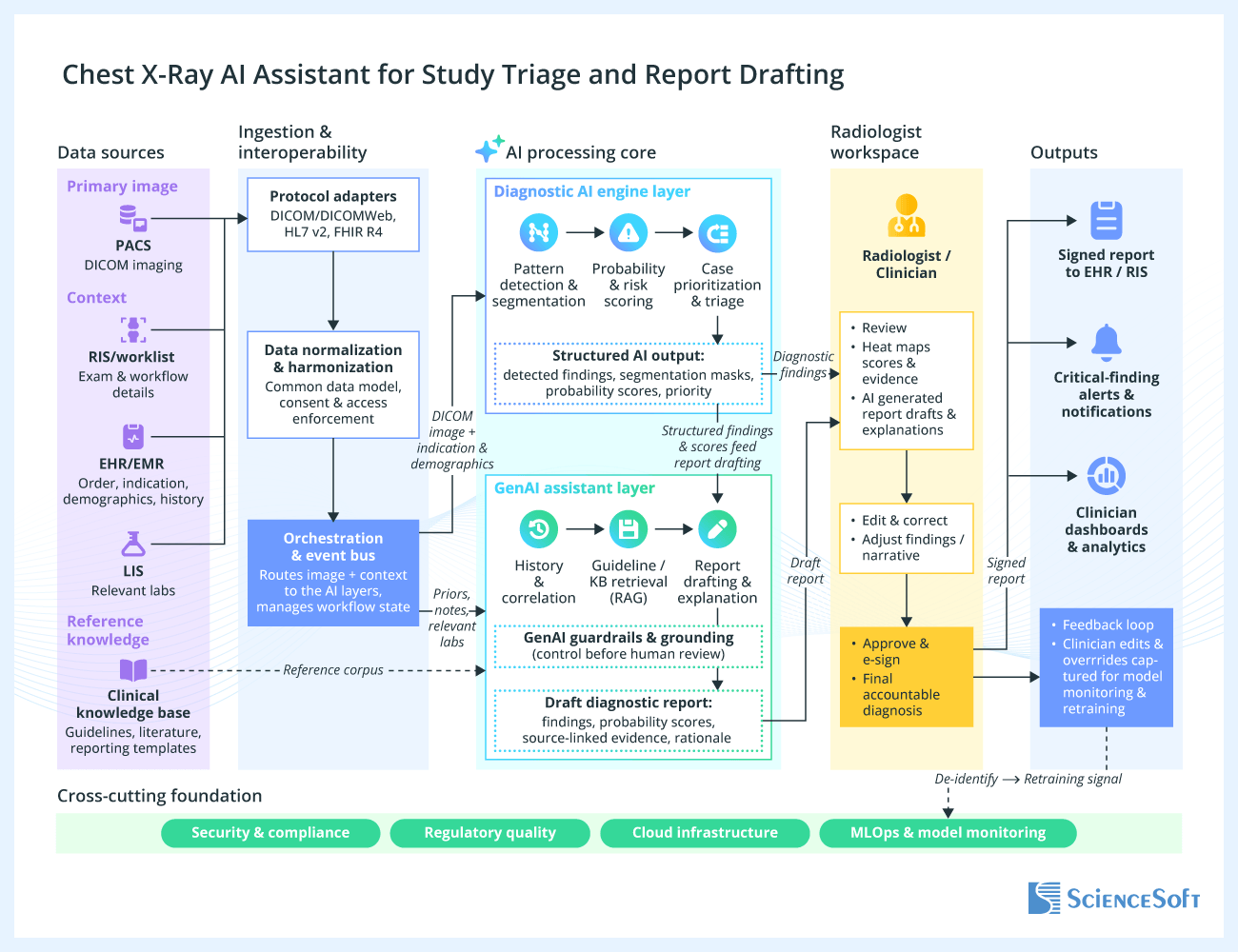
Below, ScienceSoft’s solution architects present a sample architecture of a radiologist-facing chest X-ray AI assistant for study triage and report drafting.
Check in-depth architecture description
The system receives a DICOM chest X-ray from PACS, exam order and worklist data from the RIS, patient context from the EHR, and approved reference knowledge, such as clinical guidelines and report templates. Selected lab results from the LIS can be added as optional context when clinically relevant and within the solution’s intended use. Patient data enters the ingestion layer, where protocol adapters process DICOM, HL7, and FHIR data, normalize it, check access rights, and route it to the right AI components. Patient identity is preserved throughout the clinical workflow so that the final report can be returned to the correct patient record.
The diagnostic AI engine analyzes the X-ray using computer vision models. It detects and segments suspicious areas, calculates probability and risk scores, and prioritizes urgent cases for faster review. The engine produces AI-generated structured outputs for radiologist review, including marked image areas, suspected findings, measurements, confidence scores, and triage flags.
The GenAI assistant layer uses the diagnostic AI outputs together with available patient context, approved report templates, and institution-approved reference sources. Its role is assistive: it can summarize relevant history, organize suspected findings, and draft report text based on marked image areas, model scores, prior reports, and retrieved clinical knowledge. The draft is constrained by structured templates, source-linking rules, RAG over approved sources, confidence thresholds, and automated consistency checks to help reduce the risk of unsupported statements. The output remains a draft for radiologist review, editing, and approval; the final signed report is the radiologist’s clinical and legal output.
The radiologist remains in control of the final diagnosis. They review the heat maps, scores, linked evidence, and draft report, then edit, approve, and e-sign the final version. No AI-generated output is sent to the patient record without human sign-off.
After approval, the signed report is returned to the EHR/RIS, critical findings trigger alerts, and operational data is sent to dashboards. Radiologist edits and overrides can be de-identified and used for MLOps, model monitoring, drift detection, and future retraining. This feedback is valuable because it shows how AI-generated findings and draft report text perform in real clinical workflows and helps identify patterns of missed findings, false positives, low-confidence outputs, or recurring wording corrections.
The architecture is designed to support secure and compliant AI diagnostics workflows. It includes security and privacy controls, such as role-based access, encryption, PHI protection, access logging, and audit trails. The solution is developed with regulatory quality in mind, following ISO 13485 and IEC 62304 principles and considering FDA/MDR requirements for software as a medical device where applicable. It also supports MLOps and model monitoring to track AI performance, detect drift, and manage controlled updates after release. Depending on the provider’s requirements, the solution can be deployed in a cloud, private cloud, hybrid, or on-premises environment.
Hide
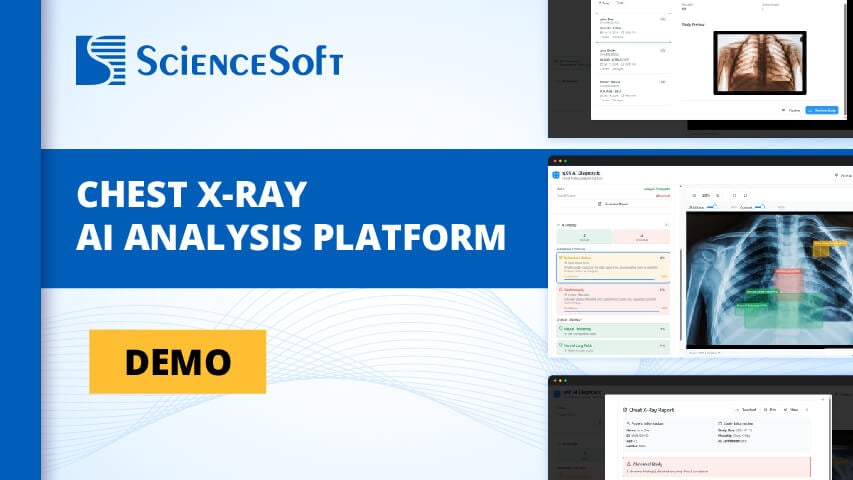
Clinician Workflow Demo for Chest X-Ray AI
Follow a clinician as our chest X-ray AI platform pulls a study from PACS and flags suspected findings on the image within seconds. The UI illustrates the way to present results, with probability scores, heat maps, and one-click reporting. The showcased solution targets over 90% diagnostic accuracy and about 30% faster reads.
Where this architecture can apply
The chest X-ray architecture above shows one implementation of the same principle: validated ML/CV models handle bounded diagnostic tasks, while GenAI supports context retrieval, summarization, and clinician-reviewed documentation. The same separation can be adapted to other diagnostic workflows and data types.

AI algorithms can interpret CT, MRI, ultrasound, PET, SPECT, X-ray, and other medical images. Using computer vision, image segmentation, quantification, and deep learning, the software can detect abnormal areas that may require a radiologist’s or physician’s attention. GenAI can further help summarize findings and draft clinician-reviewed diagnostic reports.

When patients have multiple conditions, it may be hard to differentiate symptoms and identify the most probable diagnosis. Traditional ML models can analyze structured EHR data to detect patterns, while LLMs can extract relevant details from clinical notes, discharge summaries, referrals, and prior diagnostic reports to support physicians’ decision-making.

ML algorithms can identify correlations among abnormal lab test parameters, detect patterns that may indicate specific diseases, and present diagnostic hypotheses for physician review. GenAI can help summarize abnormal findings and suggest clinically relevant next steps from approved protocols or guidelines. ScienceSoft specializes in AI for diagnostics and predictive analytics based on lab tests, helping clinicians diagnose faster and more accurately.

Vitals
AI can analyze large volumes of vitals collected via connected medical devices, such as continuous glucose monitors, ECG monitors, pulse oximeters, and blood pressure monitors. Time-series ML models can detect trends, abnormalities, and early signs of patient deterioration, while GenAI can summarize key changes, explain alerts, and support clinician-reviewed reporting.

ML and deep learning models can analyze digitized histology and cytology slides to detect suspicious cells, classify tissue abnormalities, quantify biomarkers, and prioritize high-risk cases for pathologist review. GenAI can assist with summarizing findings and preparing structured pathology report drafts.

Vocal biomarkers
Typically used for screening and early risk detection, AI can analyze speech patterns, tone, pitch, pauses, and other vocal features to identify subtle changes that may be associated with emotional, cognitive, respiratory, or neurological conditions. Clinically validated solutions can support further diagnostic assessment.
Note: An AI-powered solution can process several data types to identify complex disease patterns and support more informed diagnostic decisions. For example, continuous Holter monitoring data can complement ECG scans to help detect heart conditions.
Functional components of a diagnostic AI solution
Based on the architecture and use cases above, ScienceSoft’s healthcare IT consultants can help assemble a diagnostic AI tool from modular capabilities: clinical data ingestion, diagnostic model outputs, GenAI-assisted reporting, human review, alerting, and compliance controls. The final feature set will depend on the target diagnostic workflow, data types, intended users, and regulatory pathway.

Clinical data ingestion and normalization
The AI diagnostics solution collects data from relevant diagnostic sources, such as PACS, EHR, LIS, RIS, connected devices, referrals, physician notes, and prior radiology or pathology reports. OCR may help process scanned documents, while NLP and LLM-based components can extract and structure relevant clinical context from textual records.

Diagnostic patterns detection
Diagnostic ML and deep learning models analyze selected data types, such as medical images, lab parameters, vitals, ECG signals, or digital pathology slides, to flag suspected abnormalities, identify clinically relevant patterns, calculate confidence scores, and prioritize cases for clinician review.

Diagnostic report drafting
The AI diagnostics solution prepares reports based on ML model outputs, highlighted findings, measurements, abnormal lab values, prior reports, and approved templates. GenAI can assist with drafting structured report text and source-grounded explanations, while physicians remain responsible for editing and approving the final output.

Patient risk analysis
AI can calculate risk scores or predict potential deterioration based on relevant factors, such as abnormal findings, patient age, comorbidities, vital signs trends, and historical data. Risk outputs should contain explanations so that clinicians can understand which factors influenced the score.

Clinical alerts and case prioritization
Healthcare specialists can receive alerts when the system detects suspected urgent findings, high-risk scores, or signs of possible deterioration. Alerts can include summarized clinical context, relevant source data, and suggested next steps retrieved from approved protocols for clinician review.

Security, compliance, and auditability features
Role-based access, encryption in transit and at rest, MFA, audit trails, PHI de-identification, secure storage, and access logging help protect sensitive patient data under HIPAA, GDPR, and similar privacy laws. For regulated diagnostic software, these controls should be complemented by risk management, clinical/performance validation, software lifecycle documentation, QMS processes, and post-market monitoring.
Our Clients Say


bioAffinity Technologies hired ScienceSoft to help in the development of its automated data analysis software for detection of lung cancer using flow cytometry. In addition to the solid technical expertise shown by ScienceSoft, its developers demonstrated a profound understanding of laboratory software specifics and integrations. I am particularly impressed by the cooperative nature of ScienceSoft’s team. Our project required coordination with multiple companies and individuals. ScienceSoft worked well with everyone. They are reliable, thorough, smart, available, extremely good communicators and very friendly.


King Saud University approached ScienceSoft to explore the possibility of developing a mobile solution for the early identification of a specific medical condition. From day one, ScienceSoft’s team approached the project with initiative and seriousness. After we shared our interest from the medical perspective, ScienceSoft suggested we explore it through a Proof of Concept – and took full ownership of its development. They collaborated with our medical professionals with great professionalism and care, respecting the research environment and its unique challenges.


ScienceSoft delivered a fully customized AI medical chatbot PoC in just two weeks. The attention to detail in the chatbot design, and especially the pitch deck, was amazing — with this kit on hand, we are ready to go into investor discussions confidently. I’m genuinely grateful to ScienceSoft for their hard work and would absolutely recommend them to anyone looking for top-notch results in health tech.
Technology Behind Smart Diagnostics
Cloud data storage and databases
AWS
- Amazon Web Services
- Amazon RDS
- Amazon S3
- Amazon Redshift
- Amazon DocumentDB
- Amazon DynamoDB
- Amazon ElastiCache
Azure
- Microsoft Azure
- Azure SQL Database
- Azure Data Lake
- Azure Blob Storage
- Azure Cosmos DB
Google Cloud Platform
- Google Cloud Platform
- Cloud SQL
- Google Cloud Datastore
Other
- DigitalOcean
- Rackspace Technology
Machine learning platforms and services
AWS
- Amazon Machine Learning
- Amazon SageMaker AI
- Amazon Transcribe
- Amazon Polly
- Amazon Comprehend Medical
Azure
- Azure Machine Learning
- Azure Cognitive Services
Google Cloud Platform
- Google Cloud AI Platform
- Google ML Kit
Machine learning frameworks and libraries
Frameworks
- Apache Mahout
- Apache MXNet
- Caffe
- TensorFlow
- Keras
- Torch
- OpenCV
Libraries
- Apache Spark MLlib
- Theano
- Scikit Learn
- Gensim
- SpaCy
Generative AI, RAG, and LLMOp
Cloud GenAI platforms
- Azure OpenAI Service
- Amazon Bedrock
- Google Vertex AI
Models
- OpenAI
- Anthropic Claude
- Google Gemini
- MedGemma
- Meta Llama
- Mistral
- Microsoft Phi-3
- Qwen
- Med42
Speech-to-text and medical dictation
- Google MedASR
Clinical NLP and medical data extraction
- Amazon Comprehend Medical
- Azure Text Analytics for Health
- John Snow Labs Spark NLP for Healthcare
RAG and vector search
- Pinecone
- Weaviate
- Qdrant
- Zilliz (Milvus)
- ChromaDB
- Pgvector
- Azure AI Search
- OpenSearch
- Elasticsearch
Orchestration
- LangChain
- LangGraph
- LlamaIndex
- Microsoft Agent Framework
Guardrails and PHI handling
- Guardrails AI
- NVIDIA NeMo Guardrails
- Amazon Bedrock Guardrails
- Azure AI Content Safety
- Microsoft Presidio
Evaluation and LLMOps
- RAGAS
- DeepEval
- TruLens
- LangSmith
- Arize Phoenix
- Promptfoo
- Langfuse
- Databricks MLflow
- Weights & Biases
Data analytics
AWS
- AWS IoT Analytics
- Amazon Redshift
- Amazon DynamoDB
Azure
- Azure Stream Analytics
- Azure Synapse Analytics
- Azure Cosmos DB
Others
- Apache Cassandra
- Apache HBase
- Apache Hadoop
- Apache Spark
Front-end development
Languages
- HTML5
- CSS
- JavaScript
JavaScript frameworks
- Angular JS
- React JS
- Backbone.js
- MeteorJS
- Knockout.js
- Vue.js
- Ember.js
Mobile development
- iOS
- Android
- Xamarin
- Apache Cordova
- Progressive Web Apps
- React Native
- Flutter
- Ionic
How to Navigate the Challenges of AI-Powered Diagnostics
Challenge 1: The ML model may return inaccurate, biased, or clinically unsafe diagnostic outputs.
Solution: During the discovery, ScienceSoft defines the solution’s intended use, target users, supported data types, and safety-critical failure scenarios. This helps determine what the model is allowed to do, what it should not do, and which risks must be controlled before development starts.
To reduce accuracy and bias risks, we assess the quality and representativeness of training and validation data, including patient groups, clinical cases, imaging protocols, device types, and edge cases relevant to the intended use. If the data is incomplete, outdated, poorly labeled, or not representative enough, we help decide whether to improve labeling, expand the dataset, narrow the intended use, add low-confidence flags, or introduce extra human review steps.
ScienceSoft validates diagnostic ML models using clinically meaningful metrics, such as sensitivity, specificity, false-positive and false-negative rates, AUC, confidence calibration, and performance across population subgroups. We also help tune decision thresholds with workflow impact in mind: for example, increasing sensitivity may help detect more high-risk cases, but it may also increase false positives and clinician workload. The goal is to design AI outputs that support physicians’ decisions while keeping final clinical judgment with qualified medical professionals.
Challenge 2: The ML model may lose performance after release, while updates must remain controlled and compliant.
Solution: ScienceSoft can implement MLOps and post-release monitoring controls that help detect model drift and performance degradation early. We define a validated baseline for the model’s intended use, supported data types, clinical scenarios, device/site coverage, and target metrics, such as sensitivity, specificity, false-positive and false-negative rates, AUC, confidence calibration, and subgroup performance.
After release, the system can monitor incoming data, model outputs, and clinical feedback. For example, it can track changes in DICOM metadata, scanner types, acquisition protocols, image quality, patient population, confidence score distribution, triage rates, low-confidence outputs, radiologist overrides, and confirmed false-positive or false-negative cases. If monitored values move beyond predefined thresholds, the product team receives an alert for investigation.
Retraining is not the only response to model drift. Depending on the root cause, the safer action may be to correct preprocessing or integration errors, recalibrate decision thresholds, adjust site-specific configuration, improve data quality checks, update user instructions, limit the model’s intended use, roll back a faulty release, or retrain the model under a controlled change process. For regulated AI diagnostics software, significant changes should be assessed for their impact on safety, performance, validation evidence, and regulatory documentation before release.
Challenge 3: Changes to AI diagnostics software may trigger revalidation and regulatory approval risks.
Solution: ScienceSoft plans change management procedures early in the project to help healthcare organizations update AI diagnostics software without compromising patient safety or compliance. We define which software, data, model, and workflow changes require revalidation, documentation updates, or regulatory assessment. For FDA-regulated solutions, we can help prepare a predetermined change control plan to define how future changes will be assessed, validated, documented, and implemented by authorized development and quality management teams. For EU-facing projects, we account for MDR/IVDR requirements and the EU AI Act, which may apply to medical device software that includes high-risk AI functionality.
Challenge 4: AI diagnostics software may expose sensitive clinical data across multiple systems, vendors, and AI tools.
Solution: ScienceSoft starts by mapping where patient data, images, prompts, model outputs, embeddings, logs, and monitoring data may flow across the product architecture. This is especially important when the solution uses third-party GenAI models, cloud AI services, vector databases, monitoring tools, or support environments, because PHI can appear not only in the EHR or PACS integration but also in prompts, retrieved context, generated report drafts, audit logs, backups, and troubleshooting workflows.
After mapping the data flows, we help choose the right processing model: a HIPAA-eligible cloud service under a BAA, a private cloud deployment, an on-premises setup, de-identified processing, or a hybrid approach. We also help configure least-privilege access, encryption, tenant isolation, key management, PHI redaction or de-identification where appropriate, audit trails, secure API integrations, and controls for AI-related logs and embeddings. For third-party AI and GenAI services, we help verify vendor-side terms and responsibilities, including BAA coverage, data retention rules, processing location, no-training commitments, deletion policies, and the split of responsibilities between the product company, ScienceSoft, the cloud provider, and the AI service provider.
Featured Expert Talk

Reducing AI Risks in Clinical Diagnosis
AI-generated insights can influence important diagnostic decisions, making accuracy and reliability essential. In this presentation at WHX Miami 2026, Marina Chernik, Senior Healthcare IT & AI Consultant at ScienceSoft, explores practical ways to prevent unsupported AI output and strengthen the safety of AI-assisted clinical decision-making.
Costs of Developing AI-Powered Software for Medical Diagnosis

Based on ScienceSoft’s experience, the cost of developing AI-powered software for medical diagnosis typically ranges from $200,000 to $1,000,000+, depending on the diagnostic scope, AI model complexity, integrations, user roles, GenAI-assisted functionality, validation requirements, and regulatory documentation needs. This estimate covers ScienceSoft’s software development work only. It does not include third-party infrastructure or cloud costs, AI model/API licensing fees, data acquisition, clinical data annotation by medical experts, independent clinical validation studies, regulatory submission fees, certification costs, or post-release maintenance and monitoring unless these activities are scoped separately.
Want to get a tailored cost estimate for AI-powered diagnosis software?
A focused MVP or product module for one narrow diagnostic use case, such as chest X-ray triage for one suspected condition, may cost $200,000–$350,000. A production-grade product built around an existing ML model, with a clinician UI, PACS/RIS/EHR/LIS integrations, reporting workflow, audit trails, MLOps, and monitoring, may cost $350,000–$700,000. If ScienceSoft also needs to develop or substantially adapt a custom ML model and build the diagnostic software around it, the cost may reach $500,000–$1,000,000+.
For companies that already have an ML-based diagnostic product, GenAI functionality can be scoped separately. A focused GenAI feature, such as source-grounded explanation of AI findings or draft report text, may start from $80,000–$150,000. A broader GenAI layer for clinical data extraction, RAG over approved knowledge sources, structured report drafting, guardrails, evaluation, and LLMOps may cost $250,000–$600,000+.
Cost factors to consider
- The type of diagnostics and the complexity of ML algorithms.
- Costs of compiling or buying relevant data sets to create an ML model.
- The complexity of the data required for medical diagnostics: volume, type (structured or unstructured), number of data sources, etc.
- The need for GenAI-enabled features, such as clinical data extraction, findings summarization, source-grounded explanations, and diagnostic report drafting.
- The need for RAG setup or integration with approved medical knowledge sources to keep AI-generated outputs grounded and traceable.
- The scope of AI validation, including testing for accuracy, sensitivity, specificity, bias, robustness, explainability, and clinical safety.
- The number and complexity of software integrations (with one or several EHRs, medical imaging software, etc.).
- Security requirements and compliance-associated costs (e.g., for FDA/MDR submission, HIPAA/GDPR pre-audit).
- Deployment type (AI outputs are delivered in batches or in near real time).
- Infrastructure costs, including cloud storage, security tools, etc.
Tap Into Our Decades-Long Healthcare and AI Experience
An ISO 13485-certified company, ScienceSoft knows all the ins and outs of delivering efficient, secure, and compliant AI-powered software for diagnostics. You set goals, we drive the project to fulfill them in spite of time and budget constraints, as well as changing requirements.

Consulting on AI for medical diagnostics
Our healthcare IT consultants with 5–20 years of experience will plan your AI-powered software for diagnostics and help mitigate software safety, security, and compliance risks.

Implementation of AI for medical diagnostics
From shaping the idea to training ML models, developing a secure app, and submitting it for FDA or CE certification — ScienceSoft can do it all.

About ScienceSoft
ScienceSoft is an international AI transformation and software development company that has worked with AI and ML since its inception in 1989. In healthcare IT since 2005, ScienceSoft is experienced in delivering advanced medical software for diagnostics according to ISO 13485, ISO 27001, and ISO 9001 standards.
