ScienceSoft Global



AI-Assisted Medication Reconciliation and Drug Interaction Review
ScienceSoft, an AI transformation and software development company in healthcare IT since 2005, helps hospitals, health systems, and pharmacies reduce the manual burden and safety risks of medication reconciliation. Our clients receive interoperable, compliance-aware AI tools that connect EHRs, clinical documents, and medication data sources into one governed review process.
Contributor

Head of AI, Principal Architect, ScienceSoft

Senior Healthcare IT & AI Consultant, ScienceSoft
AI-Assisted Medication Review in Brief
When used in medication reconciliation, AI can help healthcare organizations establish a more complete medication history at transitions of care, reduce manual record comparisons, spot likely discrepancies, and surface clinically meaningful interaction risks for review before they occur.
Custom AI solutions for medication reconciliation can fit into existing EHR workflows and connect fragmented data sources into a structured record, avoiding the data consistency and connectivity issues that often affect the accuracy of off-the-shelf AI suites.
Why Healthcare Providers Are Turning to AI-Assisted Medication Review
Demand for AI-assisted medication review is driven by a persistent medication-harm problem, heavy pharmacist and clinician workload, and the difficulty of maintaining an accurate medication list across care settings. The World Health Organization estimates that medication-related harm costs about $42 billion globally each year, showing the scale of the safety challenge healthcare providers are trying to address. At the same time, clinicians and pharmacists are increasingly open to using AI as a practical support tool: in a 2025 hospital-pharmacist survey, about three in four respondents were willing to use AI to identify drug-related problems, medication errors, and treatment options. For many healthcare organizations, the push for AI adoption comes from the need to reduce reconciliation effort, improve medication-list accuracy, and make medication safety review more focused on high-risk issues, without adding extra steps for clinicians.
How AI Changes the Traditional Medication Review Process
Traditionally, medication review relies on manual collection, comparison, and interpretation of medication data. Teams pull information from charts, pharmacy records, referrals, and patient-reported histories, then try to reconcile differences and check for interaction risks. This often leads to repetitive data entry, slow review cycles, and missed context when medication details are incomplete or spread across disconnected systems. Even when electronic tools are available, they often present medication lists rather than a review-ready picture.
An AI-assisted workflow improves the most labor-intensive parts of that process. An AI-powered system can:
- Extract medication details from referral notes, discharge summaries, and other unstructured documents.
- Match records across sources when medication names, instructions, or formats differ.
- Highlight likely omissions, duplicates, unintended changes, and other discrepancies.
- Prioritize flagged discrepancies by likely clinical importance and route higher-risk cases for review where clinical staff make the final decisions on what should stay, change, or be removed.
- Support interaction and therapy-risk screening using patient-specific context.
The goal of AI in medication review is not autonomous clinical decision-making but a more structured review process. Pharmacists and clinicians retain decision control while AI helps prepare a clearer medication picture and surfaces the issues most likely to require attention.
What AI Can Do in Medication Review

Medication data unification
Medication evidence often comes from multiple systems, records, and documents at once, including EHR medication lists, pharmacy records, payer data, referral documents, discharge summaries, and patient-reported histories. AI can ingest these inputs, standardize medication names and details (e.g., dosage, route, instructions), match related records across sources while preserving source history, and prepare one consolidated medication view. Pharmacists or clinicians then confirm uncertain entries and use a cleaner data foundation for the next steps.

Medication reconciliation support
Once the medication data is unified, the AI engine compares lists across sources and care stages, such as pre-admission, inpatient, discharge, pharmacy, and patient-reported records. It highlights likely discrepancies, omissions, duplicates, and possible unintended changes to help pharmacists or clinicians establish the most accurate medication history and the current medication list. The system can prioritize issues and route them for review, but clinical staff make the final decisions on what should stay, change, or be removed.

Drug interaction and therapy risk screening
After the medication list is confirmed, the solution uses medication knowledge, clinical rules, and patient context to check for safety concerns. It can identify potential drug interactions, duplicate therapies, allergy conflicts, and dose or frequency issues, while accounting for patient context, such as diagnoses, age, and relevant laboratory results. The highest-priority findings are then presented to pharmacists or clinicians with supporting evidence and clear severity cues for review.

Discharge medication communication support
After clinical staff review and confirm discharge medications, AI can help prepare patient-friendly instructions and structured summaries for the next care setting. It can show what changed and draft clear guidance on medication names, doses, timing, and change explanations. Clinical staff review and approve the final instructions before they are shared with patients or passed to the next care team.
See How AI Works in Medication Reconciliation
Below, ScienceSoft’s solution architects present a sample architecture of an agentic AI medication reconciliation solution that works with a provider’s existing clinical systems. In this cloud-agnostic setup, the organization keeps its core software (e.g., EHR, pharmacy) as systems of record. The AI solution adds an orchestration layer that gathers medication evidence, compares records across sources, and prepares reconciled findings for clinician review. ScienceSoft can develop AI-powered medication reconciliation software for hospitals.
One of our top priorities here is controlled automation. The system should automatically start reconciliation work when a new admission, transfer, or record update appears, so clinicians don’t have to trigger every review step manually, and the data is already there by the time they begin review.
Another priority is a clear separation of responsibilities between AI components. We keep each AI agent focused on a narrow task (gathering data, finding conflicts, or drafting recommendations), so that we can test, govern, and replace any of them as needed without disrupting the entire workflow. This also helps minimize the risk of AI overstepping its intended role, since each component is limited by design to a very specific set of allowed actions.
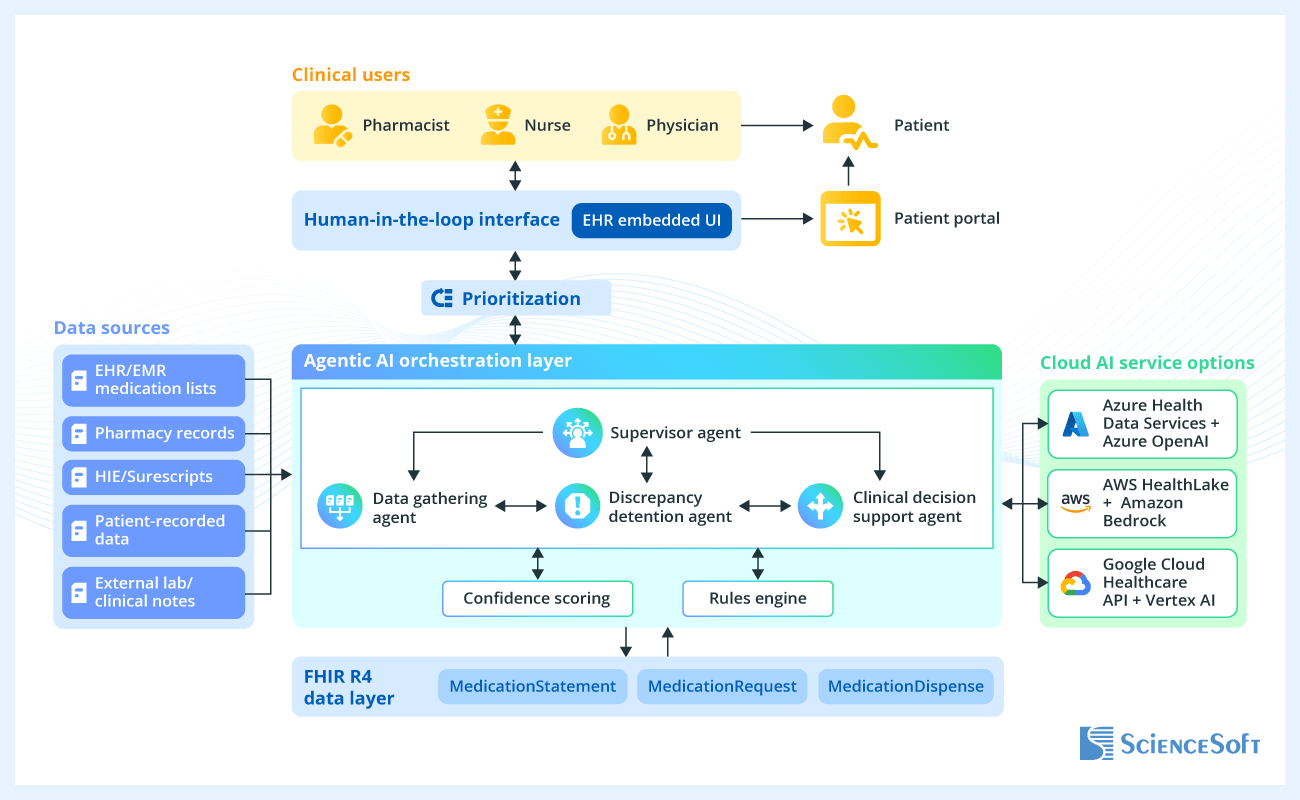
The workflow starts in the data sources layer. The solution gathers medication-related evidence from the EHR and other hospital systems where it finds medication histories, dispensing records, and other supporting clinical context.
The core of the architecture is the agentic AI orchestration layer. An AI orchestrator manages the workflow and calls three specialized agents:
- The data gathering agent collects medication history from all connected sources.
- The discrepancy detection agent compares medication lists and flags conflicts, missing entries, or inconsistencies.
- The clinical decision support agent then uses those findings to prepare a reconciled list with recommendations for review.
This agent-based setup supports the branching nature of medication reconciliation. For example, if the available evidence is incomplete, the workflow can return to data gathering before moving forward.
The AI Orchestration Layer gathers medication evidence from the connected source systems and helps map it into the FHIR R4 data layer. That normalized medication model then serves as the shared working structure for comparison, discrepancy detection, and draft recommendations throughout the reconciliation workflow.
Clinicians interact with the solution through the human-in-the-loop interface. Pharmacists, nurses, and physicians can review findings through the EHR-embedded UI, check AI recommendations or flagged medication history issues, and decide what to accept, correct, or escalate.
An agentic medication reconciliation workflow can be implemented using agent orchestration frameworks or SDKs such as LangGraph, Claude Agent SDK, or OpenAI Agents SDK. LangGraph is particularly suitable for this use case because reconciliation often involves multi-step, stateful logic: the process may need to loop back for more data, branch based on findings, and follow a consistent sequence instead of relying on a language model to decide the order of actions.
Check how a typical workflow runs in this architecture
- A transition-of-care event, such as admission, transfer, discharge, or a relevant medication record update, starts the reconciliation process automatically.
- The orchestrator launches the workflow.
- The data gathering agent pulls medication history from the connected sources.
- The workflow checks how recent, complete, and clinically reliable the collected medication evidence is.
- It also reviews admission notes and transferred records to capture medication details that may not appear in structured data.
- All medications are normalized to RxNorm, so records from different sources can be compared consistently.
- The discrepancy detection agent compares the collected medication list with active orders and flags missing medications, unexpected new orders, dose differences, route changes, and therapeutic substitutions.
- The workflow ranks each discrepancy by likely clinical importance.
- High-risk issues (e.g., high-severity interactions, dose conflicts, omissions of essential medications) can be sent to a pharmacist for immediate attention.
- The clinical decision support agent prepares a draft reconciliation recommendation for each flagged issue with supporting rationale.
- These draft recommendations appear in a pharmacist review queue in the EHR-embedded UI.
- A pharmacist reviews each recommendation and decides whether to approve, modify, reject, or escalate it. ScienceSoft can build a medication reconciliation agent that runs on MCP to identify drug interactions and support hospital pharmacy teams.
Hide
We usually advise our clients to build a solid medication data foundation before trying to make AI more advanced. In this workflow, the quality of the review findings depends directly on the quality of the medication data the system receives. If records come from different sources with inconsistent naming, missing instructions, or gaps between documented and dispensed medications, the solution will generate more noise, not better review support.
That is why the workflow starts with a data gathering agent that connects to the main medication evidence sources, extracts medication details from structured records and unstructured documents, maps the findings to a shared FHIR-based structure, and normalizes medications with standard vocabularies such as RxNorm and NDC. We validate the completeness and accuracy of medication data on a sample patient cohort before adding more advanced review-support features. In our experience, this approach helps reduce false discrepancies and gives users more confidence that the findings they see are worth acting on.
Technologies We Use to Build AI Solutions for Medication Consolidation
Generative AI
Models
- Large Language Models (LLMs)
- Small Language Models (SLMs)
- Multimodal models
- Computer vision models
- ASR speech models
- TTS speech models
- Speech-to-Speech Models
- Audio models
- Real-time
Model adaptation and efficiency
- Fine-tuning
- Instruction tuning
- LoRA adapters
- RAG
- Graph RAG
- Agentic workflows
AI platforms and services
- Azure OpenAI Service
- Amazon Bedrock
- Hugging Face Inference
- Oracle Cloud
Agents and Orchestration
- OpenAI Agents SDK
- OpenAI Agents (platform/guides)
- AWS Agents
- LangChain
- LangGraph
- smolagents
- LiveKit
- Dify
- n8n
- Faiss
- ChromaDB
- Qdrant
- Weaviate
- OpenSearch
- Pgvector
- Amazon Neptune
- Graph RAG Toolkit
- Neo4j
Traditional ML
Platforms and services
- Azure Cognitive Services
- Azure Machine Learning
- Microsoft Bot Framework
- Amazon SageMaker AI
- Amazon Transcribe
- Amazon Lex
- Amazon Polly
- Google Cloud AI Platform
Frameworks and libraries
- Apache Mahout
- Apache MXNet
- Caffe
- TensorFlow
- Keras
- Torch
- OpenCV
- Apache Spark MLlib
- Theano
- Scikit Learn
- Gensim
- SpaCy
Big data
- Apache Hadoop
- Apache Spark
- Apache Cassandra
- Apache Kafka
- Apache Hive
- Apache ZooKeeper
- Apache HBase
- Azure Cosmos DB
- Amazon Redshift
- Amazon DynamoDB
- MongoDB
Data visualization
- Power BI
- Microsoft Fabric
- Microsoft SQL Server
- Microsoft Excel
- Google Developers Charts
- Tableau
- Grafana
- Chartist.js
- FusionCharts
- DataWrapper
- Infogram
- ChartBlocks
- D3.js
- Oracle Business Intelligence
- MicroStrategy
- QlikView
- Sisense
- Kyubit Business Intelligence
Common Challenges in Implementing AI-Assisted Medication Review
Challenge #1: Too many low-value alerts can reduce trust in the solution
If the system treats every discrepancy or therapy risk equally, pharmacists and clinicians may experience alert fatigue and begin to ignore useful signals.
Solution
ScienceSoft recommends combining AI with deterministic rules, confidence scoring, and risk-based prioritization to rank discrepancies and therapy risks by clinical importance. High-risk discrepancies and therapy risks should appear first in the main review flow, while lower-priority items can be routed to a non-urgent review queue according to the provider’s established process. Low-confidence findings should be clearly marked, supported with source evidence, and either routed for additional verification or held back from immediate alerting until there is enough evidence to make them actionable. Explainable outputs with source evidence also help teams understand why a finding was flagged and validate it faster. We also recommend monitoring recommendation volumes and adjusting thresholds over time to ensure the solution does not overwhelm clinicians with low-value signals.
Challenge #2: Clinicians may hesitate to trust AI in medication review
Clinicians may be reluctant to rely on AI if they cannot clearly see why it flagged an issue, what data it used, or whether they remain responsible for the final decision. They may also worry about acting on a wrong suggestion, missing an important issue, or being held accountable if the system makes a mistake.
Solution
ScienceSoft recommends using the solution as a decision-support assistant, with pharmacists and clinicians always validating findings and making the final decisions. Recommendations should appear in a structured, reviewable format with supporting evidence and confidence cues.
During the pilot, a small group of clinical champions should be able to incorporate AI findings into their normal workflow, review supporting evidence, and mark each finding as accepted, rejected, or escalated. The implementation team can then use this feedback to adjust thresholds, reduce low-value signals, and improve the review experience before broader rollout.
Challenge #3: A full-scale AI rollout may feel too broad for the immediate need
Healthcare organizations may hesitate to launch a wide medication intelligence initiative when the immediate need is limited to one workflow. A broad rollout can affect too many clinical processes and systems at once, which makes the initiative harder to approve, fund, and operationalize.
Solution
ScienceSoft recommends starting with one focused use case, such as admission medication history cleanup, discharge review support, or document-based medication intake. To limit workflow disruption and speed up delivery, the solution can reuse existing EHR workflows through SMART on FHIR and integrate third-party medication knowledge services. At the same time, providers should design the data and integration foundation from the start so the solution can later expand to include additional medication review capabilities.
Challenge #4: Integration issues can interrupt medication review workflows
If the solution depends too heavily on one system connection, interface failures or EHR downtime can delay reconciliation work and reduce trust in the tool.
Solution
ScienceSoft recommends designing the solution so one failed connection does not stop the whole reconciliation process. The workflow should query each data source separately, save the medication records already collected, and show which source is still missing. For example, if the EHR data has already been retrieved, the case should remain available for review even when another medication data source is temporarily unavailable. The system should also retain the discrepancies already identified and the items already queued for pharmacist review, instead of repeating the whole reconciliation workflow after a temporary interface failure. We also suggest testing interface failures, recovery scenarios, and EHR write-back logic in the sandbox before production rollout.
Featured Expert Talk

Reliable AI for Medication Reconciliation and Review
Medication reconciliation and interaction review depend on accurate, patient-specific information. See Marina Chernik, Senior Healthcare IT & AI Consultant at ScienceSoft, explain how healthcare AI can be engineered to reduce unsupported outputs, strengthen verification, and provide clinicians with more reliable information for decision-making.
How Much Does It Cost to Implement an AI-Enabled Medication Review Solution?
For a midsize healthcare organization, implementing an AI-enabled medication review solution typically costs from $90,000+ for a narrowly scoped foundation or pilot to $600,000+ for an enterprise medication intelligence platform.
What influences the cost:
- The scope and complexity of required integrations, including the number of connected source systems, the supported exchange standards such as FHIR, HL7 v2, and NCPDP.
- The complexity of clinician review workflows (e.g., exceptions).
- The depth of medication safety logic and the amount of patient context considered.
- The amount of customization needed to fit the solution into existing clinical workflows.

$90,000+
For a focused medication reconciliation accelerator that extracts medications from selected documents, compares lists across sources, flags likely discrepancies, and routes uncertain cases for review. This assumes moderate integration complexity and reuse of third-party medication knowledge sources.

$180,000+
For a governed medication safety layer that reviews interactions, allergy conflicts, duplicate therapies, and dose or frequency issues, with patient-specific logic, alert prioritization, and explainable evidence for clinician decision-making.

From $350,000 to $600,000+
For an enterprise medication intelligence platform that unifies medication data, reconciliation, safety screening, task routing, analytics, monitoring, and governance across care settings.
What Makes ScienceSoft a Reliable Partner for Healthcare AI Initiatives
- Since 2005 in healthcare IT.
- Since 1989 in AI software development.
- 150+ completed projects for hospitals, outpatient clinics, post-acute care organizations, and other healthcare providers.
- 750+ IT specialists, including MD consultants, project managers, and regulatory experts, more than 50% of them are senior-level.
- Experience in building healthcare AI architectures with built-in privacy safeguards and controls against common language model risks.
- In-house PMO with 48 project managers to support controlled delivery, risk management, and accountability in complex projects.
- Experience in designing healthcare solutions to support HIPAA, GDPR, and other privacy and security requirements, as well as regulated workflows where FDA or MDR considerations apply.
- Hands-on experience with HL7, FHIR, RxNorm, SNOMED CT, and LOINC.
Certifications, partnerships and awards
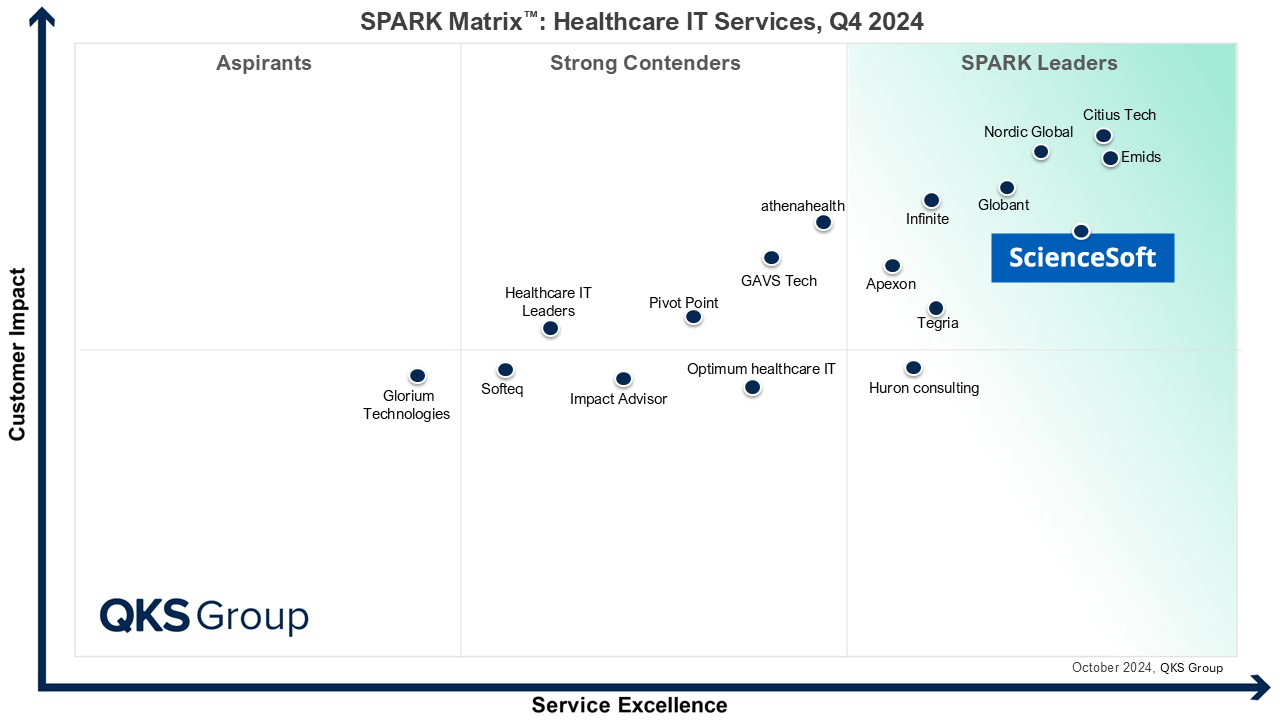
Featured among Healthcare IT Services Leaders in the 2022 and 2024 SPARK Matrix

Named among America’s Fastest-Growing Companies by Financial Times, 5 years in a row

Claude Certified Services Partner

Microsoft Solutions Partner for Data & AI
HTN Now Awards 2025/26 finalist in the Best AI Scribe Solution category

Recognized for Healthcare Technology Leadership by Frost & Sullivan in 2023 and 2025

HIMSS Gold member advancing digital healthcare

ISO 13485-certified quality management system

ISO 27001-certified security management system
Our Clients Say


They collaborated with our medical professionals with great professionalism and care <…>. We found ScienceSoft to be dependable and forward-thinking, and we would confidently recommend them for high-responsibility projects.



I’m genuinely grateful to ScienceSoft for their hard work and would absolutely recommend them to anyone looking for top-notch results in health tech.

ScienceSoft has been a competent partner for medical software development. We would recommend them as a trustworthy vendor. They are reliable, thorough, smart, available, extremely good communicators and very friendly.