ScienceSoft Global


















- Custom software development
- Web app development
- Mobile app development
- UI/UX design services
- Healthcare software testing
Software Development and IT Services for Hospitals and Health Systems
In healthcare IT since 2005, ScienceSoft provides software consulting, engineering, support, and evolution services to medical care providers. With ISO 13485, ISO 9001, and ISO 27001 certifications and proficiency in HIPAA, GDPR, FDA, Cures Act, and MDR requirements, ScienceSoft designs robust solutions tailored to the needs of patients, healthcare professionals, care coordinators, and other roles.

AI Transformation Opportunities for Hospitals and Health Systems
-

Reduce charting delays and documentation workload
Challenge. In emergency departments and inpatient units, clinicians must document patient encounters while managing admissions, transfers, and urgent care needs. Notes left unfinished after shifts add to clinicians' workloads and may delay access to complete clinical records for subsequent care.
Change. Ambient AI scribes can draft encounter notes from clinician-patient conversations for clinicians to review, reducing manual charting. A 2026 Stanford Health Care study of 8,740 emergency department encounters found that visits documented with an ambient AI scribe were associated with 28% less on shift documentation time and 16% less total EHR time per encounter. For inpatient care, AI can also draft discharge summaries from hospital records, subject to clinician review.
-
Streamline prior authorization requests
Challenge. Hospital staff spend considerable time reviewing patient records, gathering clinical evidence, and preparing prior authorization requests according to payer requirements. Manual processing adds to administrative workloads and can delay patients' access to prescribed treatments.
Change. AI-powered prior authorization tools can extract relevant information from EHRs, assemble supporting clinical evidence, and prepare requests for staff review. Northwestern Memorial Hospital deployed Latent Health's AI solution in its specialty pharmacy, reducing the average time spent preparing a request by 67%, from 17 minutes to 5 minutes and 20 seconds. The pharmacy also processed 22–25% more requests without adding staff.
-
Improve patient flow and hospital capacity
Challenge. Managing patient admissions, transfers, and discharges across multiple departments and facilities requires constant coordination. Limited visibility into bed availability, expected discharges, and incoming patients can lead to delayed admissions, emergency department boarding, and inefficient use of hospital capacity.
Change. AI-powered hospital command centers can predict patient admissions and discharges, identify potential capacity bottlenecks, and help staff coordinate bed assignments and transfers. Duke Health reported a 66% reduction in bed assignment times and enough additional capacity to accommodate 500 more patients annually after implementing an AI-powered command center.

In a large health system, AI can create the most value where teams must make time-sensitive decisions based on constantly changing information. But realizing that value takes more than simply adding AI to existing workflows. Its recommendations must fit how teams make decisions and coordinate their work, which may also require adjustments to the workflows themselves. When we evaluate AI opportunities for hospitals, we look at the entire decision-making process: how reliable the data is, who receives the recommendation, what action follows, and how the results will be measured. This helps us prioritize AI solutions that can deliver measurable improvements across facilities, rather than adding unnecessary complexity to already busy teams.
What Healthcare IT Work Has to Account For in Care Delivery
Care providers rarely make IT changes in isolation. A new system, integration, or support process can affect how care teams work, how patients access services, and how sensitive data is handled. Before choosing a technical path, clinical, operational, and IT teams often have to deal with the realities of care delivery.
- Patient information split across systems. EHRs, departmental systems, and patient-facing tools may each hold part of the information care teams need. When this context is split, staff may have to check several places before making decisions or handing work over to another team.
- Workflows that depend on many handoffs. Patient intake, care coordination, and discharge often involve many people and time-sensitive steps. A missed update or unclear responsibility can create extra work for staff and delay the next step in care.
- Legacy systems that remain important. Many legacy applications reliably support clinical or administrative work. The difficulty is often not whether to replace them, but how to keep using what works while dealing with limits in integration, maintenance, or future changes.
- Security rules that depend on the care setting. Healthcare IT requirements vary by care setting, data type, and user roles. Security and compliance planning often needs input from clinical, compliance, and IT teams to define what should be protected, logged, and controlled.
- Digital access that still depends on staff work. Patients increasingly expect to book visits, submit forms, or access care information without calling the front desk. For providers, these digital actions still need to fit the work of the people and systems that process them.
- Data that can lose meaning outside its original use. Healthcare data is often created for care delivery, operations, or compliance. When it is reused for reporting, analytics, or AI, its meaning and limits need to stay clear.
This context shapes how ScienceSoft approaches healthcare IT work for care providers, from planning and development to integration, security, and support.
Healthcare Software Solutions We Build for Hospitals and Health Systems
Clinical systems & care delivery
Hospital operations & administration
Data management & analytics
AI & Emerging Healthcare Technologies
-
 AI for EHR
-
AI for medication reconciliation
-
AI for medical devices and SaMD
-
AI for patient communication and access
-
AI for patient scheduling
-
AI for prior authorization automation
-
AI for discharge and patient instruction automation
-
AI in long-term care
-
Medical AI chatbots
-
VR for healthcare
-
IoT solutions for healthcare
-
Blockchain for personal medical records
Featured Expert Talk
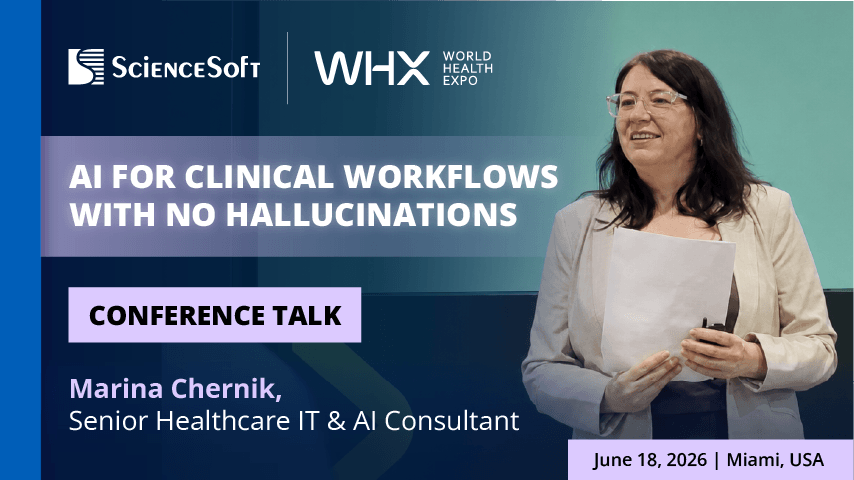
Building Trustworthy AI for Care Delivery
See how healthcare providers can reduce the risks of AI hallucinations and improve the reliability of AI-supported clinical workflows through practical engineering safeguards. Marina Chernik, Senior Healthcare IT & AI Consultant at ScienceSoft, explains approaches to making clinical AI outputs more trustworthy and safer for decision-making, with a demo of an AI-powered SBAR handover solution with built-in output verification.
Healthcare IT Services to Modernize, Integrate, and Support Clinical Operations
Healthcare software engineering
Healthcare IT support
- L1, L2, L3 employee help desk
- Monitoring and troubleshooting of medical software (EHR, HIE, PACS, patient-facing apps, etc.) and medical devices
- IT infrastructure management and evolution
- Digital workplace management
- Infrastructure security and compliance management (e.g., to stay in line with HIPAA and 21st Century Cures Act)
IT consulting
- Healthcare software and IT infrastructure consulting
- Digital transformation and cloud consulting
- Healthcare analytics consulting
- Compliance consulting (HIPAA and GDPR compliance, FDA/MDR submission, 21st Century Cures Act information blocking, and FHIR/USCDI readiness)
Cybersecurity
Software modernization and integration
- Application modernization
- Cloud migration services
- Software integration services (e.g., integration with EHR via FHIR/USCDI APIs; support for HL7 v2/v3 and CCDA bridges, XDS/XDS-I, QRDA exports for eCQMs, NCPDP SCRIPT, and HIPAA X12 837/835)
- Data alignment with SNOMED CT, LOINC, RxNorm, ICD-10, and CPT
Our Clients Say

Todd Nilson
MD

We worked with ScienceSoft on the refactoring and modernization of our telehealth web portal and a cross-platform patient application. They created comprehensive project documentation, feature lists, and worked out thorough recommendations to help us improve the stability and performance of our solution. ScienceSoft proved to be a reliable vendor with a solid healthcare background.



Working with ScienceSoft was a pleasure from A to Z. We are grateful for their can-do attitude, responsiveness, and straightforward communication. RIVANNA already witnessed tangible benefits of our cooperation. We have more projects to come and are looking forward to working with ScienceSoft again.


They were very responsive and very knowledgeable when assisting with our Intranet implementation. I recommend ScienceSoft for any needs and will work with the company again if needed in the future!




Insights From ScienceSoft's Healthcare IT Experts
-

Kate Lukina, MD
Healthcare IT & AI Consultant, ScienceSoft

Trend watch
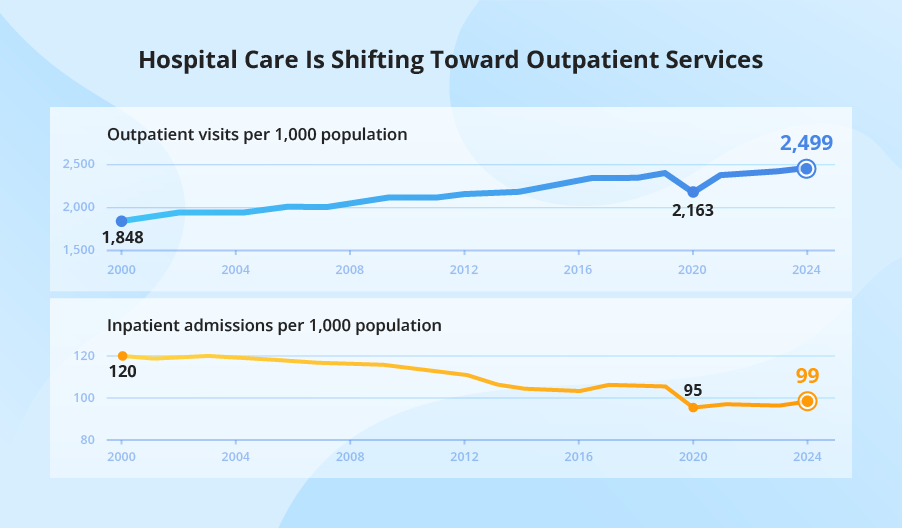
US Hospital Statistics 2026: Outpatient Care Expands
-

Hadeel Abu Baker
Senior Healthcare IT & AI Consultant, ScienceSoft
Trend watch
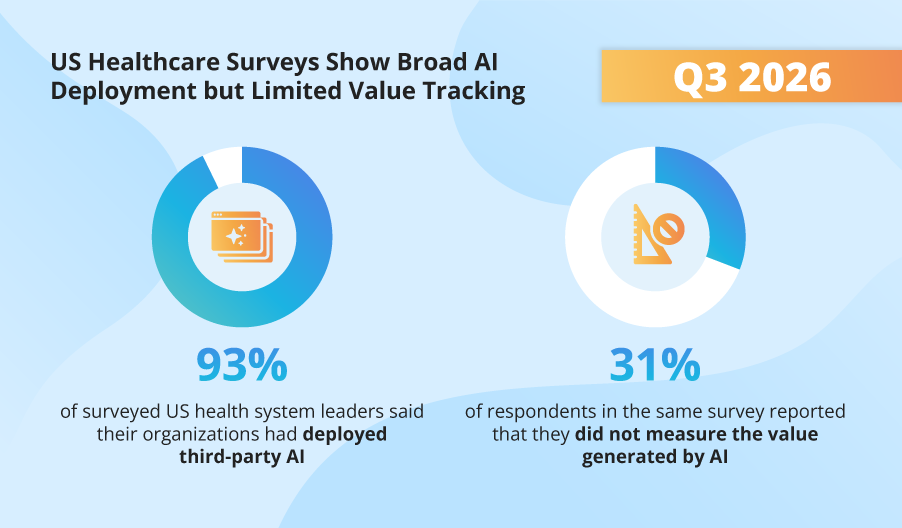
Q3 2026 Healthcare AI Trends by ScienceSoft | Oct 2026
-
Kate Lukina, MD
Healthcare IT & AI Consultant, ScienceSoft
Research
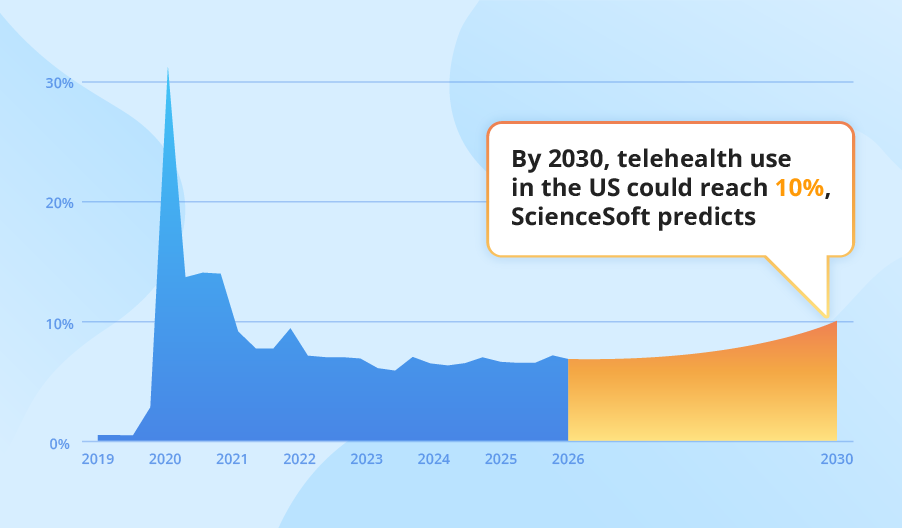
Telehealth to Make Up 10% of US Medical Visits by 2030, ScienceSoft Predicts