 ScienceSoft Global



Artificial Intelligence for Visit Summaries and Care Plan Explainers
An AI transformation company with healthcare IT experience since 2005, ScienceSoft helps healthcare providers implement artificial intelligence for visit summaries and care plan explainers. Our AI solutions reduce repetitive documentation and help patients understand next steps while keeping clinical instructions and treatment decisions under the care team’s control.

Senior Solution Architect, Healthcare, ScienceSoft

Head of AI, Principal Architect, ScienceSoft

Senior Healthcare IT & AI Consultant, ScienceSoft
AI for Visit Summaries and Care Plan Explanations: Overview
Generative AI assistants can help healthcare providers prepare visit summaries and explain care plans to patients in plain language. To do this, AI retrieves relevant information from clinical records and adapts it to the patient's needs using the provider's approved clinical guidance, communication rules, and policies. Rather than making independent clinical judgments, AI assistants stay within these guidelines and refer questions requiring clinical decisions to care staff.
Visit Summary and Care Plan Metrics AI Can Improve
-

Pre-visit chart review time
A JAMIA Open study found that AI-generated clinical summaries reduced chart review time by 49 seconds per visit among clinicians with above-average baseline review times.
-
After-visit summary reading grade level
A randomized clinical trial found that AI-generated, clinician-edited after-visit summaries had an average reading grade level of 8.5, compared with 10.6 for clinician-written summaries.
-
After-visit summary actionability
A Journal of Hospital Medicine study found that AI-generated after-visit summaries scored 70.9% for actionability, compared with 56.7% for physician-written summaries, based on physician evaluations.
-
Patient activation after discharge
A Lancet Digital Health randomized trial found that patients receiving AI-generated, physician-reviewed discharge summaries scored 9.6 points higher on patient activation than those receiving standard discharge summaries.


How AI Can Be Used for Visit Summaries and Care Plan Explanations
-

Preparing pre-visit summaries for clinicians
View demoAI gathers relevant information from the EHR and connected clinical systems and assembles it into a concise pre-visit summary so clinicians can quickly review the patient's history and recent changes without searching through records. AI can also highlight items that may need attention, such as abnormal test results or potential gaps in recommended screenings, with links to the original records.
-
Drafting after-visit summaries
AI can draft an after-visit summary using information documented in the EHR during the encounter, including diagnoses, medication changes, test orders, and follow-up recommendations. Before presenting the draft for clinician review and approval, AI can also flag missing or inconsistent information, such as a recommended follow-up with no specified timeframe or conflicting medication instructions.
-
Explaining and translating care plans
AI can turn approved care plans into easy-to-understand patient instructions and translate them into supported languages. For example, AI can turn an instruction to monitor blood pressure twice daily into simple steps explaining how to take and record measurements, drawing on hospital-approved patient education materials. Predefined rules and automated checks help ensure the explanations stay consistent with the approved care plan, with clinicians reviewing flagged cases when needed.
-
Identifying accessibility needs and barriers to care
AI can check draft AVSs against patients' documented disabilities, functional limitations, and communication preferences. For example, it can flag self-care instructions that may be challenging for a patient with limited mobility or dexterity, or suggest accessible formats for patients with visual impairments. Clinicians can review these flags and determine whether additional accommodations, assistance, or changes to the care plan are needed.
-
Answering questions about approved instructions
An AI assistant in a patient portal or app can answer patients' questions about specific passages in their after-visit summaries or care plan instructions. For example, it can explain an unfamiliar medical term or clarify an existing follow-up instruction using information from the patient's instructions and the provider's approved educational materials. The assistant is restricted from offering new medical advice, and questions about new symptoms or treatment changes are referred to the care team.


How AI Fits Into After-Visit Summary Preparation
AI can save clinicians time by preparing after-visit summaries and care plan explanations directly within existing EHR workflows. The workflow below shows how this works, from data collection to clinician approval and delivery to patients.
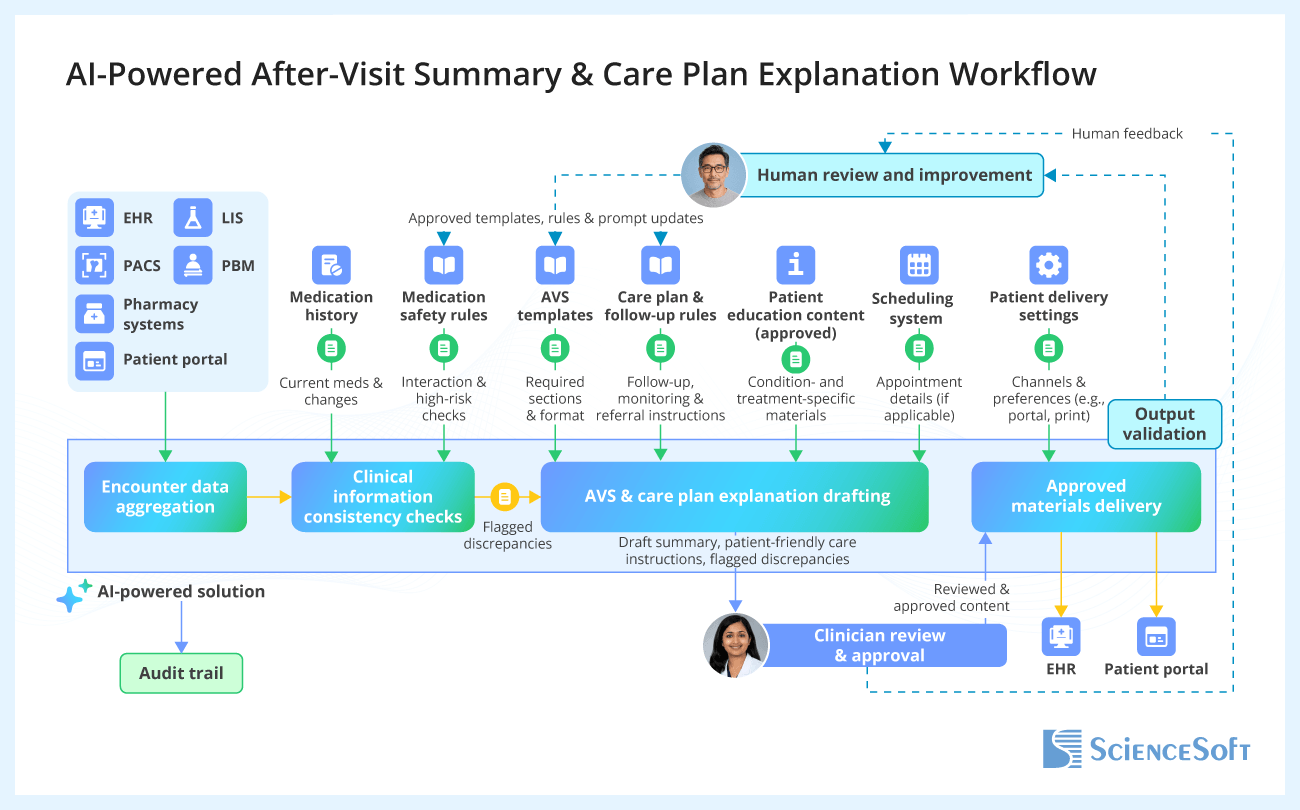
The diagram illustrates three key design decisions we recommend for reliable AI-generated patient instructions:
- Ground AI outputs in trusted sources. Use patient records, hospital-approved templates, and educational materials rather than relying on AI's general medical knowledge. This helps keep summaries consistent with the patient's actual care plan.
- Check information at two stages. Before drafting, the solution should flag missing or conflicting clinical information. After drafting, it should check for errors such as altered medication dosages, missing follow-up instructions, or unsupported statements. Clinicians can then review the flagged issues, correct the draft, and approve it before patients receive it.
- Use clinician feedback to improve accuracy. Record clinicians' corrections alongside the source information and validation results. If the same errors recur, the AI team can identify whether they stem from data retrieval, rules, or prompts, fix the underlying issues, and test the changes before deployment.
Test AI-generated instructions with patients, not just clinicians
A summary can be medically accurate and still leave patients unsure what to do next. Before rolling out AI-generated after-visit summaries, test them with patients who represent your target audience, including those with limited health literacy or different language needs. Ask them to find specific information: when to take a medication, what follow-up they need, or whom to contact if symptoms worsen. If they struggle, revise the explanation templates and test again. The goal isn't just to produce correct summaries but to make sure patients can act on the information.
Key Challenges of Implementing AI for Visit Summaries and Care Plan Explainers
-
Challenge #1. AI may generate incorrect or incomplete instructions
Solution
ScienceSoft targets the causes of AI errors at several stages, from retrieving patient information to generating and validating summaries. We ground AI outputs in clinical records and hospital-approved educational materials, check for missing or conflicting information, and use deterministic rules to verify details such as medication dosages, follow-up dates, and required fields. If a draft fails validation, the system flags it for clinician review or blocks its release rather than allowing AI to guess.
We also test whether AI-generated explanations preserve the meaning of the original instructions, including important precautions and warning signs. Clinicians review and approve the final content before patients receive it.
-
Challenge #2. An AI assistant may answer questions that require clinical judgment
Solution
ScienceSoft works with clinical staff to define which patient questions AI can answer independently and which require human judgment. For example, an assistant can explain an unfamiliar term or clarify an existing instruction, but it shouldn't assess new symptoms, guess the possible diagnosis, or suggest changes to the treatment plan.
We enforce these boundaries through predefined rules and restrictions on the assistant's actions and information sources. We direct questions requiring clinical judgment to the care team, and potentially urgent symptoms trigger escalation based on hospital-approved protocols. Before deployment, we test realistic patient conversations, including cases where a request for clarification turns into a request for medical advice.
-
Challenge #3. AI may expose patient data or process it outside approved environments
Solution
ScienceSoft starts by tracing where protected health information (PHI) may travel and be stored across the EHR, integrations, AI services, patient portals, and monitoring logs. For each workflow, we define what patient information AI can access and who can receive it. Before an AI assistant shares patient-specific instructions, the system verifies the user's identity and access rights. Caregiver access follows the hospital's authorization policies. We enforce these restrictions through software permissions rather than leaving access decisions to the AI model.
To prevent PHI from reaching unapproved services or environments, we establish where patient data may be processed and stored before selecting AI models and vendors. Depending on the hospital's requirements, this may involve HIPAA-eligible cloud services covered by appropriate business associate agreements (BAAs) or AI processing within the hospital's approved cloud or on-premises environment. Where possible, we remove unnecessary identifiers before sending data to AI models. We also check vendor policies on data retention, processing location, and model training, and configure integrations and logs to avoid unnecessary PHI exposure.

Reduce Documentation Work and Improve Patient Instructions With AI
Let’s discuss your needs and limitations to see whether implementing AI can measurably improve your organization’s workflows. The first consultation is free and non-binding.

Technologies We Use to Implement AI for Visit Summaries and Care Plan Explainers
AI implementation and model development
Foundation LLMs and AI services
- Azure OpenAI Service
- Amazon Bedrock
- Meta Llama
- Mistral
- MedLlama
AI application layer
- Python
- FastAPI
RAG, search, and grounding
- Pgvector
- Azure AI Search
AI guardrails and PHI protection
- NVIDIA NeMo
- Microsoft Presidio
- Azure AI Content Safety
Predictive modeling
- XGBoost
- LightGBM
Feature store, MLOps, and AI observability
- Databricks
- Feast
- MLflow
- Langfuse
- Evidently AI
Software engineering, integration, and deployment
Cloud and healthcare data platforms
- Microsoft Azure
- Amazon Web Services
- Google Cloud Platform
- Azure Health Data Services
- Amazon HealthLake
- HAPI FHIR
Web and mobile technologies
- React JS
- Next.js
- React Native
Data, messaging, and event streaming
- PostgreSQL
- Apache Kafka
- Azure Event Hubs
Containers, orchestration, and GitOps
- Docker
- Kubernetes
- Terraform
- Argo CD
- GitHub Actions
Identity, access, security, and monitoring
- Microsoft Entra ID
- Okta
- HashiCorp Vault
- Splunk
- Microsoft Sentinel
Patient communication
- Twilio
Analytics and dashboards
- Power BI
- Innovaccer
Costs of Implementing AI for Visit Summaries and Care Plan Explainers
Implementing AI for visit summaries and care plan explainers may require around 100,000–700,000+, depending on the solution scope. These estimates cover solution design and implementation. Third-party licenses, infrastructure, AI model usage, and ongoing support are calculated separately.
What drives implementation costs?
-
AI capabilities. Implementing a single, well-defined function, such as converting approved care plans into plain-language explanations for clinician review, generally costs less than combining AVS drafting, personalized explanations, multilingual translation, and patient Q&A. Each additional function requires its own processing logic and clinical validation. Interactive Q&A also adds complexity because AI must handle unpredictable patient questions safely.
- Clinical data integration. Generating summaries from information available in one EHR is typically less expensive than gathering and reconciling encounter notes, medication lists, and orders across several systems. The latter requires additional integrations, data mapping, and safeguards for handling missing or conflicting information.
- Variation across clinical settings. Deploying the same AI function across ten clinics using one EHR and standardized AVS workflows may cost less than implementing it at a single hospital with several specialties and different documentation practices that require multilingual support. The main cost driver is the number of distinct workflows and clinical scenarios that need to be configured, tested, and validated.
Why Choose ScienceSoft as Your Healthcare AI Partner
- In healthcare IT since 2005.
- In AI/ML since 1989, with experience building custom AI models and adapting pretrained ones to healthcare use cases.
- 750+ experts, including AI architects, MD consultants, software developers, data scientists, cybersecurity experts, integration specialists, and QA engineers.
- 150+ healthcare IT projects and an in-house PMO for predictable project delivery.
- An Architecture & Solutions Center of Excellence to engineer secure, scalable, and integration-ready healthcare AI architectures.
- Proficiency in HL7 v2/v3 and FHIR.
- Experience supporting compliance with HIPAA/HITECH, GDPR, Saudi PDPL, and other relevant privacy requirements.
- Security and quality management practices backed by ISO 27001 and ISO 9001 certifications.
Certifications, partnerships and awards
-

Featured among Healthcare IT Services Leaders in the 2022 and 2024 SPARK Matrix
-

Named among the Americas' Fastest-Growing Companies by Financial Times, 5 years in a row
-

Claude Certified Services Partner


-

Microsoft Solutions Partner for Data & AI
-

HTN Now Awards 2025/26 finalist in the Best AI Scribe Solution category
-

Recognized for Healthcare Technology Leadership by Frost & Sullivan in 2023 and 2025
-

HIMSS Gold member advancing digital healthcare
-

ISO 13485-certified quality management system
-

ISO 27001-certified security management system

What Our Clients Say


They are reliable, thorough, smart, available, extremely good communicators and very friendly. We would recommend hiring ScienceSoft to anyone looking for a highly productive and solution-driven team.



Working with ScienceSoft was a pleasure from A to Z. We are grateful for their can-do attitude, responsiveness, and straightforward communication. RIVANNA already witnessed tangible benefits of our cooperation. We have more projects to come and are looking forward to working with ScienceSoft again.


Thanks to this collaboration, we were able to launch a practical, secure, and easy-to-use mobile app that can support older adults on their healthy aging journey.

We found ScienceSoft to be dependable and forward-thinking, and we would confidently recommend them for high-responsibility projects.
