ScienceSoft Global







ScienceSoft helps providers plan new telehealth platforms and targeted extensions around existing IT environments. We identify where current systems fragment patient journeys or complicate care, and recommend the optimal mix of system configuration, integration, and custom development. Our experts estimate implementation costs and prioritize initial release scope that resolves critical bottlenecks first without limiting later expansion.
Integrated Telehealth Platform Development Services for Providers
With healthcare IT experience since 2005, ScienceSoft builds and extends integrated telehealth platforms for healthcare providers. We engineer configurable virtual care solutions that connect patient services and clinician workflows with existing EHRs and business systems, adapting to different specialties, locations, and care models.
How You Can Build an Integrated Virtual Care Platform
Integrated telehealth platform development services include building or extending provider-specific software that links existing clinical and business systems to coordinate multi-step virtual care workflows when standard telemedicine products fall short.
Healthcare providers expanding virtual care often already use EHRs, scheduling systems, patient portals, and video consultation tools. The challenge is making these systems support connected workflows for patients and care teams, especially across multiple sites or specialties.
ScienceSoft helps providers determine what to retain, integrate, or develop to close workflow gaps without unnecessary system replacement. Depending on your existing software and care model, we can:
- Extend existing telehealth software
Add missing capabilities, such as specialty intake or between-visit check-ins, without replacing existing telemedicine tools.
- Connect fragmented virtual care tools
Integrate booking, virtual visits, patient communication, e-prescribing, and follow-up into centralized patient and clinician workflows connected with EHR and other enterprise systems.
- Standardize virtual care across sites and specialties
Consolidate separate site- or specialty-specific solutions into a shared platform with configurable forms, service availability, access rules, and care workflows.
- Build a full-scale platform for a distinct care model
Develop custom patient, clinician, and administrative experiences when standard software products and targeted extensions cannot support the required care pathways or integration needs.
Why Choose ScienceSoft or Your Telehealth Project
- Since 2005 in healthcare software engineering.
- 150+ successful projects for providers and life sciences organizations.
- 30+ senior architects with 15–25 years of experience for complex multi-system design.
- Healthcare interoperability expertise across FHIR, USCDI, SMART on FHIR, and HL7; HL7 FHIR-certified implementers on board.
- Hands-on experience with developing HIPAA-compliant telehealth software and addressing HITECH, the 21st Century Cures Act, and ONC requirements for patient access and health data exchange.
- Since 1989 in AI engineering, with expertise spanning AI tools for patient access, communication, clinical workflows, and operational automation.
Certifications and awards
-

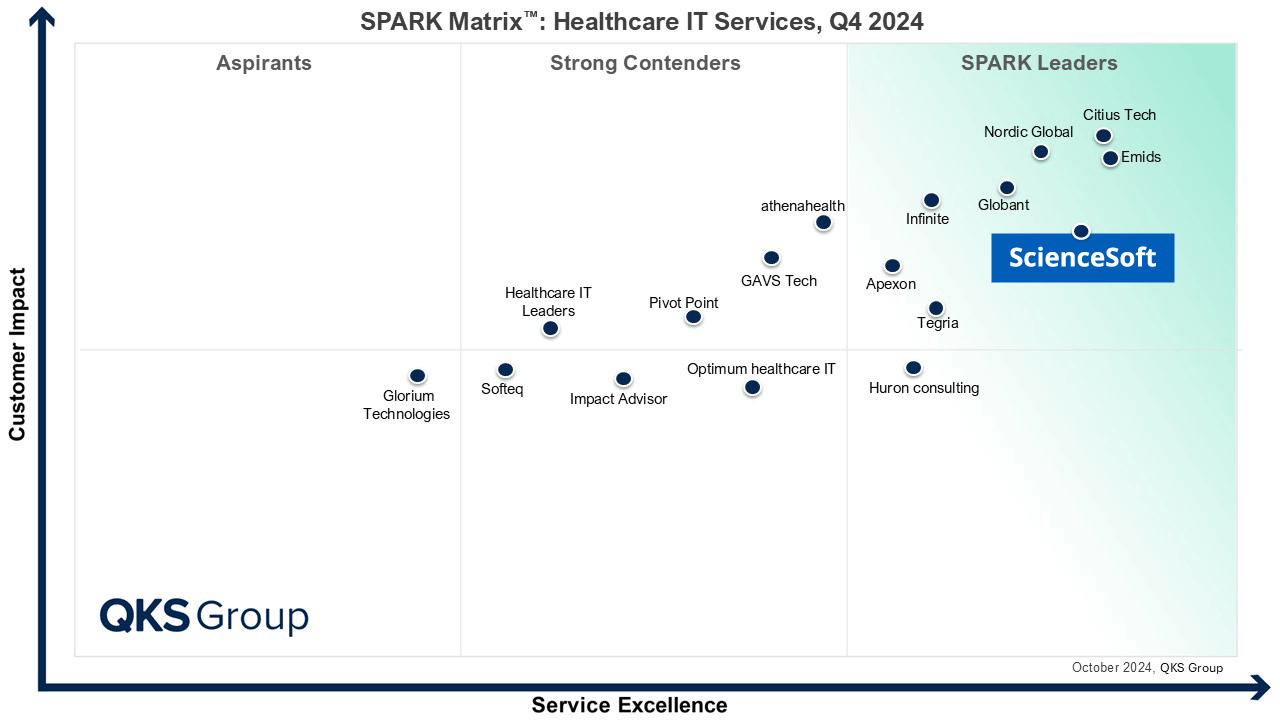
Featured among Healthcare IT Services Leaders in the 2022 and 2024 SPARK Matrix
-

Recognized for Healthcare Technology Leadership by Frost & Sullivan in 2023 and 2025
-

Named among America’s Fastest-Growing Companies by Financial Times, 5 years in a row
-

Four-time finalist across HTN Awards programs
-

Named among Becker’s Telehealth Companies to Know in 2026
-

Named Leading Healthcare Software Provider 2026 at GHP’s Healthcare & Pharmaceutical Awards
-

HIMSS Gold member advancing digital healthcare
-

ISO 13485-certified quality management system
-

ISO 27001-certified security management system
Capabilities of an Integrated Telehealth Platform
Each platform's functionality depends on the provider’s care model and existing software. If your telehealth platform, EHR, or other clinical and administrative systems already support some of this functionality, ScienceSoft can develop only the missing patient and staff workflows and connect them to your software to avoid redundancy.
Clinician and care team workflows
-

Clinician encounter workspace
Clinicians can review patient information, conduct virtual consultations, and document visits in one EHR-integrated workspace, with optional AI assistance for summaries and charting.
-
EHR-connected orders and ePrescribing
Clinicians can initiate lab orders and prescriptions directly through the platform using connected EHR and prescribing systems.
-
Care coordination teams can manage referrals, patient check-ins, and follow-up tasks related to virtual care, with optional AI support for identifying stalled or high-risk cases that need attention.
-
Specialty and recovery workflows
Care teams can follow tailored assessment and treatment workflows for behavioral health, rehabilitation, post-discharge care, and other specialties.
-
Readings from connected monitoring systems help clinicians track patients' conditions, conduct remote check-ins, and determine when follow-up is needed.
Patient access and follow-up
-
Patients can access virtual care through a provider-owned patient portal, mobile app, or an existing telehealth application connected to the platform.
-
Care navigation and booking
Patients can find relevant services, check appointment availability, and book visits, with optional AI assistance in navigating care options.
-
Digital intake and check-in
Patients can complete pre-visit forms, provide insurance details, and review available eligibility and benefits information retrieved through connected systems.
-
Virtual visits and secure messaging
Patients can join video consultations and exchange messages, images, and documents with their care teams before and after visits.
-
Records, results, and follow-up
Patients can access available test results and visit summaries, review care instructions, and complete follow-up tasks in their personal profiles.
-
Billing and payments
Patients can review available cost estimates, see balances after insurance processing, and pay their share online through connected billing systems.
Provider operations
-
Operations teams can monitor virtual appointment capacity and adjust schedules across sites, with optional AI forecasts of demand and no-shows.
-
Multi-specialty and multi-site configuration
Administrators can adjust services, forms, access permissions, and care workflows for different locations and specialties through shared settings.
-
Prior authorization management
Authorization teams can check payer requirements, prepare and track requests through connected systems, and use optional AI assistance to gather supporting clinical information.
-
Billing teams can manage claim preparation, submission, payment tracking, and denial follow-up for telehealth services through connected RCM systems, with optional AI support for potential claim issues.
-
Healthcare leaders can track patient access, staff utilization, and financial performance for virtual care across locations, services, and specialties.
Integrated Telehealth Platform Architecture Supporting Multiple Sites and Care Models

Below is a sample architecture for a multi-site health system centralizing telehealth across its hospitals and multi-specialty outpatient clinics. The organization plans to start with core telehealth services and later add virtual workflows for its behavioral health and post-discharge RPM programs.
I chose this scenario because it demonstrates how three recurring challenges in telehealth software projects can be solved at the architectural level. The portal 1) integrates heterogeneous existing systems with different interfaces and overlapping data, 2) handles site- and specialty-specific workflow differences, and 3) adds specialized care programs without reworking the shared platform foundation.
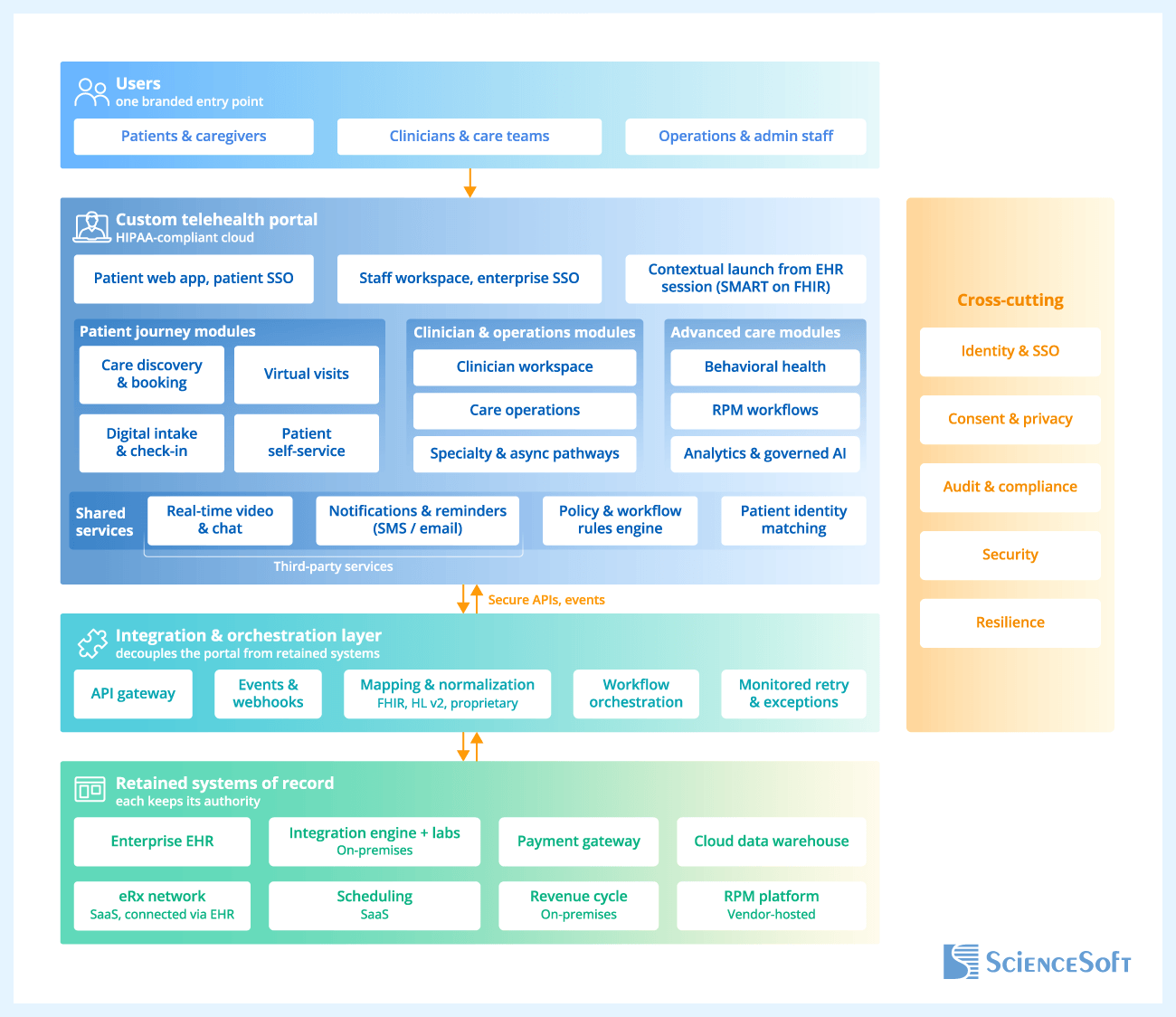
In this integrated telemedicine portal design, the provider’s existing IT environment is separated from the portal by an integration and orchestration layer that handles differences in how the portal exchanges data with heterogeneous existing systems. The layer converts different data formats for portal modules and isolates vendor-specific data exchange connections, so changes to those connections can often be handled without rewriting the portal’s core functionality. If a data transfer times out, the layer checks whether the update was saved before retrying to avoid record duplicates and flags unresolved errors for staff review.
The application is modular, reusing shared services across care modules and coordinating cross-system journeys through workflow orchestration. For capabilities that do not justify custom development in this scenario, such as real-time video, chat, and notifications, the architecture uses licensed third-party services. Variable workflow settings are centralized in a configurable, versioned policy and workflow rules engine. This lets admin staff update rules for service availability, specialties, payer requirements, consent, clinician licensure, and more in one place, rather than across multiple parallel systems.
Cross-cutting controls protect patient data and support service continuity across the telehealth platform's care modules and integration layer. Shared security and privacy measures include role-based access, applicable restrictions on PHI use, encryption, audit logging, and consent capture. Disaster recovery measures help restore services after disruptions. Together, these safeguards support compliance with the HIPAA Privacy and Security Rules and applicable telehealth consent requirements.
Integrated Telehealth Platform Development Services by ScienceSoft
Telehealth strategy consulting
Telehealth platform development and evolution
ScienceSoft can build full-scale telehealth applications, specialized workflow modules, or targeted extensions to existing virtual care portals. We shape complete patient and staff journeys and build modular components around existing clinical systems to limit rework as sites, specialties, or care protocols change. Small-scale releases, change impact analysis, and regression testing reduce the risk of destabilizing existing operations during software rollout.
Telehealth platform integration and data consolidation
ScienceSoft handles EHR integration and connects telehealth platforms with scheduling, revenue cycle, laboratory, and RPM systems. We make systems work together even if they have different underlying data models. Our engineers verify what each interface can read or update, establish how data fields and statuses correspond across systems, and build reusable connections when several workflows use the same information.
Telehealth software modernization
ScienceSoft can re-engineer aging telehealth portals and products, migrate them to supported platforms or cloud environments, and consolidate duplicate solutions. We identify dependencies across booking, visits, documentation, and billing, then fix or replace only problematic components. During migration, we keep the old version available, verify transferred data, move users in stages, and retain rollback to prevent disruptions.
AI transformation for telehealth
ScienceSoft adds AI where it can deliver tangible operational benefits, e.g., to draft visit notes, prioritize patient messages, or extract clinical evidence for prior authorization. We build AI assistants and agents into existing systems with provider-approved limits on data access, allowed actions, and handoffs to staff. For genAI, source grounding and output checks help reduce hallucination risks, while human approval gates block autonomous AI actions when outputs are uncertain, or decisions carry high risk.
Telehealth platform support and maintenance
ScienceSoft provides L1–L3 support and maintenance for telehealth platforms, covering user issues, software defects, security updates, and compatibility maintenance. We also track failed data transfers and vendor-side errors across EHR, video, messaging, and RPM integrations and adapt connections when external changes affect portal availability or data exchange.
How We Handle Common Challenges in Telehealth Platform Projects
-
Challenge #1. Costly platform rework as telehealth regulations change
Federal and state requirements can change access to virtual care, consent rules, and remote prescribing policies based on patient location and type of care. When these rules are embedded across booking forms and visit workflows, one regulatory change can require coordinated updates to multiple software components. Delayed or inconsistent implementation of these changes can interrupt care, create staff workarounds, and ultimately expose the provider to compliance risk.
Solution
-
Challenge #2. Costly customizations across sites and specialties
As healthcare providers expand telehealth across locations and specialties, they need to accommodate differences in intake forms, visit types, staff roles, and follow-up workflows. If these variations are implemented as separate version-specific code, even a common update to appointment booking may require changes and testing across multiple apps. Over time, duplicated functionality increases maintenance costs, slows releases, and makes it harder to launch new services or onboard additional locations.
Solution
-
Challenge #3. Inconsistent data across the telehealth platform and core enterprise systems
The virtual care platform shares patients, visits, and financial events with integrated systems that may use different identifiers, status models, and update sequences. Any delayed or failed synchronization can create data conflicts. For example, an appointment that was canceled in the scheduling system may remain active in the portal and continue to trigger reminders. Staff then have to reconcile records and manually correct downstream tasks, patients receive outdated information, and clinicians may lack complete visit context.
Solution

Connecting to legacy EHR, scheduling, billing, and other old systems isn’t a big issue. You can exchange data correctly even through limited or outdated interfaces, but there’s a catch: this can make a telehealth portal expensive to maintain. If portal workflows inherit connected systems’ data fields, status definitions, or logic, a relatively small system upgrade can force changes across the portal’s entire codebase. That’s why I recommend using dedicated adapters for legacy integrations.
Each adapter is a software component for a particular legacy connection. It maps that system’s fields and status definitions to the portal’s stable data model and converts portal requests into the format the external system accepts. This keeps vendor-specific translation in the adapter rather than in portal workflows, so changes to the legacy connection can often be handled without modifying the portal’s core functions.
What Our Clients in Healthcare Say


In just four months from project kickoff, they successfully migrated us to a modern, modular Microsoft-based telehealth platform featuring virtual consultations, care coordination, and seamless data exchange with partner systems, including robust EHR integrations. ScienceSoft also ensured the solution fully aligns with HIPAA requirements from the outset.


Todd Nilson
MD

We worked with ScienceSoft on the refactoring and modernization of our telehealth web portal and a cross-platform patient application. We are thankful for the meticulous and value-driven approach of ScienceSoft’s team. They created comprehensive project documentation, feature lists, and worked out thorough recommendations to help us improve the stability and performance of our solution.


I am particularly impressed by the cooperative nature of ScienceSoft’s team. Our project required coordination with multiple companies and individuals. ScienceSoft worked well with everyone. ScienceSoft has been a competent partner for medical software development. We would recommend them as a trustworthy vendor. They are reliable, thorough, smart, available, extremely good communicators, and very friendly.


Working with ScienceSoft was a pleasure from A to Z. We are grateful for their can-do attitude, responsiveness, and straightforward communication. RIVANNA already witnessed tangible benefits of our cooperation. We have more projects to come and are looking forward to working with ScienceSoft again.
Let’s Define Your Integrated Telehealth Platform Scope
ScienceSoft’s healthcare consultants are ready to help you clarify specialty and multi-site workflow needs, consider regulatory requirements, and explore impactful AI use cases. Together, we can shape a platform scope that supports your operational goals and fits your budget.