 ScienceSoft Global



Healthcare AI Hallucinations as an Engineering Problem: Five-Layer Architecture for Verified AI Output

Related topics:
6 min read
Last updated:
Editor’s note: At WHX Miami 2026, Marina Chernik presented ScienceSoft’s approach to engineering against medical AI hallucinations. In this article, she expands on her conference talk by explaining seven hallucination failure modes and how they map to safety safeguards, such as source grounding, confidence checks, a clinical rule engine, and reasoning transparency. She also describes a five-layer output verification architecture behind safe clinical AI. If you’re thinking about deploying healthcare AI, you can consult ScienceSoft experts in AI development.
Healthcare organizations already use AI scribes, assistants, decision support tools, and claims automation at a scale that makes their real-world impact visible. One risk the industry now has to account for is hallucinations in generative medical AI. A recent preprint study reports that 91.8% of clinicians surveyed across 15 specialties had encountered AI hallucinations, and 84.7% considered them capable of causing patient harm.
The risk is clear, but for many companies we work with, the harder question is what actually to do with it in practice. Is medical AI worth implementing now? Or maybe we have to wait for more reliable models? Could clinician review make AI output safe? Or would RAG be enough to solve the problem?
At ScienceSoft, we believe medical AI hallucinations are primarily an engineering problem that calls for engineering controls. In this article, I address these concerns and show what a hallucination-resistant healthcare AI solution can look like in practice.
Seven Types of Medical AI Hallucinations
My team reviewed public evidence on hallucinations in medical AI with a practical goal. We wanted to connect each described failure mode to the engineering safeguard that can reduce its risk. This way, we grouped the recurring hallucination patterns into seven types.
Fabrication
The model adds a clinical fact that the source record does not contain. For example, one study found that AI-generated discharge instructions added medications absent from the source summary.
|
Mechanism |
When evidence is missing, the generation process still completes the expected clinical pattern with a plausible detail. |
|---|---|
|
Engineering control |
Context-locked grounding that links every claim to source data and blocks unsupported content. |
A practical system check: Does every clinical claim link to a specific source document? If not, you cannot distinguish grounded output from fabricated content.
Confident wrongness
The system presents a diagnosis, treatment, or recommendation as ready for use despite weak evidence. For example, the model expressed high confidence in its responses to US Medical Licensing Examination questions even when its answers are incorrect.
|
Mechanism |
The model itself does not calibrate its answers to the evidence. |
|---|---|
|
Engineering control |
Confidence thresholds tied to source coverage, source agreement, extraction clarity, and recency. |
A practical system check: Does the system expose an evidence-based confidence level for each output? If no, every output looks equally reliable.
Silent merging
The system flattens several longitudinal records into a single statement and loses their time, source, or clinical status (e.g., suspected, ruled out, current, or resolved). For example, when summarizing EHRs across multiple visits, the model conflated visits or included temporally irrelevant information.
|
Mechanism |
Summarization drops timestamps, source order, and clinical status. |
|---|---|
|
Engineering control |
Record comparison for contradictions and changes; surfacing each relevant source separately. |
A practical system check: Does the system show records with changing or conflicting data separately, with dates and sources? If no, data collected at different time points cannot be distinguished from one another.
Critical omission
The AI leaves out a critical fact that the source record contains. For example, evaluated primary care AI scribes omitted medications that were mentioned in the transcript.
|
Mechanism |
Summarization favors a concise note. |
|---|---|
|
Engineering control |
Completeness check and required-field validation. |
A practical system check: Does the system flag missing required fields? If no, a complete-looking note may hide a safety gap.
Sycophantic confirmation
The system follows the prompt’s implied conclusion instead of the clinical evidence. For example, when a query implicitly assumed that a branded drug and its generic version were different compounds, the evaluated LLMs responded as if the user's false assumption were accurate.
|
Mechanism |
Training can reward cooperative answers even when agreement conflicts with evidence. |
|---|---|
|
Engineering control |
Framing check that reruns the same request under changed wording and compares the AI outputs. |
A practical system check: Can the AI answer survive changed wording with the same facts? If no, the model may just confirm whatever you say.
Stale knowledge
The system answers from old training data instead of current clinical guidance. For example, LLMs provided inappropriate health advice due to memorizing outdated clinical recommendations.
|
Mechanism |
Model training captures knowledge from a fixed period, while guidelines, formularies, and protocols continue to change. |
|---|---|
|
Engineering control |
Enforced retrieval from maintained medical knowledge sources, with version and source traceability. |
A practical system check: Can the AI name the current guideline or protocol behind the answer? If no, it may rely on its outdated memory.
Reasoning chain errors
The system has the relevant facts but reaches the wrong clinical conclusion. For example, LLMs did not follow treatment guidelines or misinterpreted lab results.
|
Mechanism |
The model connects correct facts through an incorrect inference or applies the wrong clinical rule. |
|---|---|
|
Engineering control |
Reasoning transparency to surface the rationale behind the output and a rule engine with deterministic checks for safety errors and AI checks for clinical protocol alignment. |
A practical system check: Can a clinician see the evidence and rationale behind AI recommendations? If no, you cannot distinguish grounded advice from misconceptions.
These failure types can overlap. Their value is practical because each one points to a different verification control.
Five-Layer Verified Output Architecture
When all these safeguards are grouped by their role in the output flow, they form a five-layer output verification architecture. The diagram shows the primary mapping between architecture layers and hallucination types, but real verification works as a pipeline, where every layer helps filter the whole output.
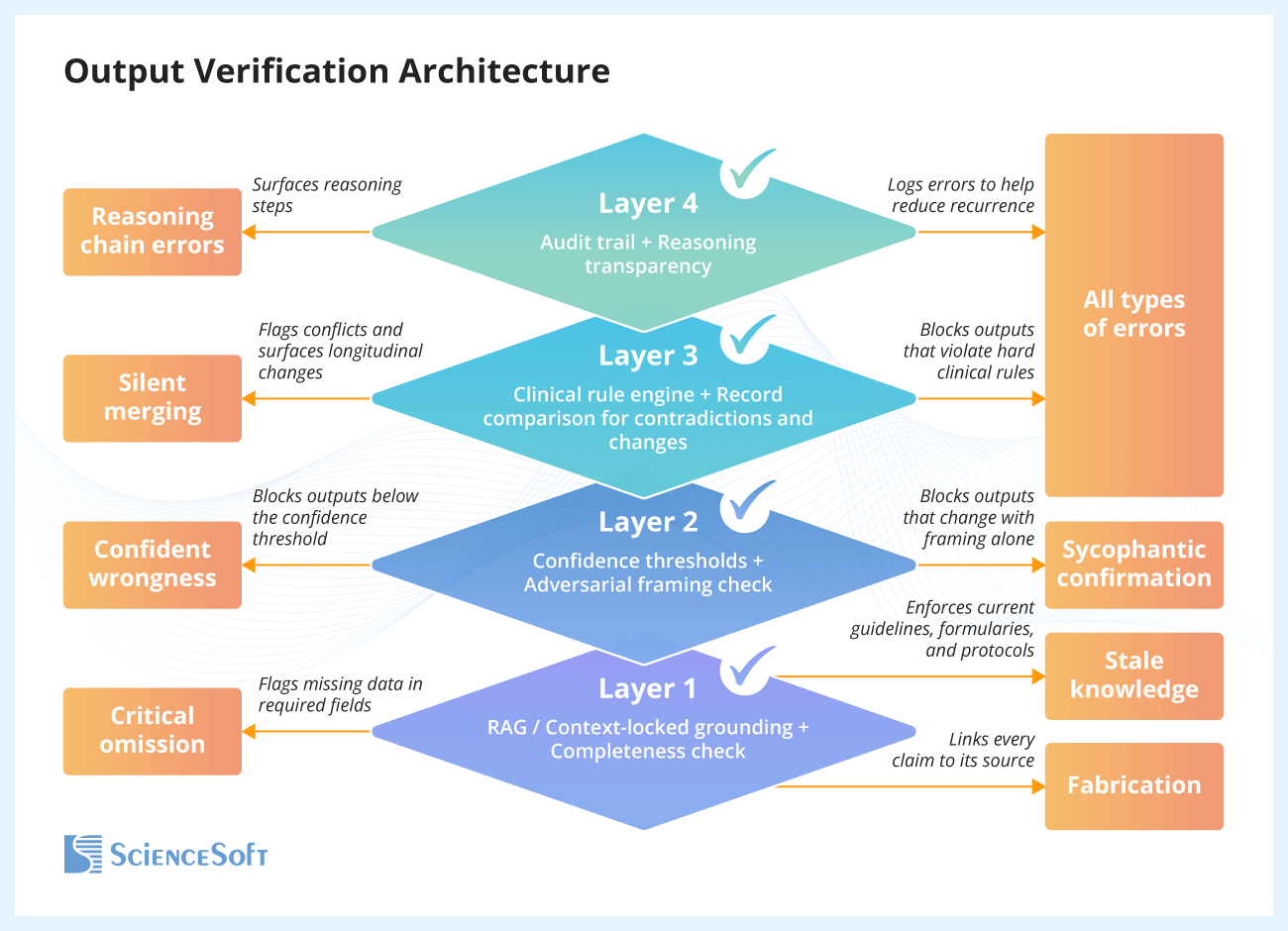
Layer 1: No source — no output
This layer establishes the evidence boundary for every clinical claim. Retrieval-augmented generation, or RAG, pulls relevant patient records, medication data, lab results, and maintained protocols from approved sources.
Context-locked grounding allows only claims supported by retrieved evidence, while completeness checks flag required fields when data is missing. The layer also links each claim to its source so reviewers can verify whether the source supports it.
Together, these controls help prevent fabrications, expose critical omissions, and reduce reliance on stale knowledge.
Layer 2: Low confidence — stop and flag
After Layer 1 sets the source boundary, Layer 2 tests whether the available evidence can support the output. A scoring mechanism measures source coverage, source agreement, extraction clarity, and recency, then compares the result with the configured confidence threshold.
A separate framing check reruns the same request with different wording and compares the clinical conclusions. The layer blocks outputs that fail either test, which exposes confident wrongness and sycophantic confirmation before delivery.
Layer 3. Record conflict — surface and escalate
After Layer 2 confirms sufficient evidence, Layer 3 compares records collected over time for data contradictions and changes. If legitimate clinical changes are detected (e.g., shifts in lab values over time), the system surfaces each fact independently with its source and date.
When the check reveals data conflicts, the conflicting records are escalated for human review and resolution. This layer directly addresses silent merging.
Layer 4: Safety concern — block or flag
Layer 4 applies the clinical rule engine as the output safety gate. It combines deterministic checks for critical safety errors (e.g., contraindicated or conflicting medications) with AI-based checks against current clinical protocols.
The system blocks high-risk rule breaches and flags minor protocol disalignments for clinician review. Together, these controls help catch reasoning chain errors.
Layer 5: No trace — no trust
The final layer preserves the evidence behind every generated output, whether the system delivers, blocks, or escalates it. The audit trail records sources, model versions, rule versions, and confidence scores, while linked records capture escalation results and clinician actions. Reasoning transparency shows which evidence and rules supported the final output.
Monitoring reveals repeated failures and performance drift, which helps the team update thresholds, hard rules, and maintained knowledge sources. I treat Layer 5 as cross-cutting because its records help the team reduce recurrence across all error types.
What Verified Healthcare AI Requires in Practice
In practice, this architecture affects the implementation project budget, solution runtime cost and performance, AI governance workload, and clinical staff time.
Development effort and AI model operating overhead
The first cost is implementation. Development work includes integrating the safeguards with clinical data sources, implementing verification logic, configuring thresholds and safety checks, and instrumenting audit logging. Some safeguards also affect runtime performance.
In our approach, an AI model alone does not make a production-ready healthcare AI solution. Verification controls are a mandatory part of the implementation from the start. However, the safeguard scope can vary with the clinical risk of the workflow.
For example, adversarial framing checks rerun a request under changed wording, so they add latency and model usage cost. That level of checking may be excessive for a low-risk administrative AI assistant. But for patient-facing AI, clinical decision support, or autonomous AI workflows, stronger verification becomes an essential part of risk management and may also support applicable regulatory or certification requirements.
AI governance and maintenance
The safeguards also need an accountable AI governance function with named clinical, IT, compliance, and patient safety owners within the healthcare organization. This function keeps the AI system current through threshold calibration, RAG knowledge base and rule engine updates, log review, incident response, and performance drift monitoring.
I consider this cost necessary because safeguards lose reliability as knowledge sources age, confidence calibration drifts, and clinical rules fall behind current practice.
Clinical staff review time
The third cost is clinical attention. Flags and escalations help safety, but they still take time from medical staff. In my experience, this architecture can reduce the burden compared with asking staff to review unverified AI output. It filters unsupported, low-confidence, and rule-breaking outputs before delivery. It focuses escalation on cases that need human judgment, and each escalation arrives with source links, conflict details, and relevant context.
Without these safeguards, staff may need to verify every AI statement and search through multiple systems to determine whether it’s accurate. Such an approach can turn documentation support into continuous AI defect detection and increase staff workload rather than reduce it. That’s why clinician review alone cannot be the answer to hallucinations.
From AI That Generates to AI That Verifies
The hallucination evidence we discussed earlier brings a common healthcare AI design gap into focus. Many currently used AI solutions were adopted before clinical safety validation and oversight could catch up. AI scribing makes it especially visible. A recent npj Digital Medicine commentary warns that rushed AI scribe rollout may compromise patient safety, clinical integrity, and provider autonomy.
I see this gap pushing healthcare AI design beyond generation toward output verification. US regulations, voluntary frameworks, guidance, and certification programs increasingly emphasize AI auditability, transparency, risk management, and lifecycle validation. Examples include the NIST AI Risk Management Framework, FDA guidance, and Joint Commission and CHAI guidance. These frameworks set the direction. In this article, I translated their principles into specific safeguards and the verified output architecture we recommend for our healthcare clients.
Future models may reduce hallucination rates, but I would not base near-term planning on that possibility. With current systems, I assume some hallucination risk will remain at the generation stage. Verification safeguards are the most practical way I know to make healthcare AI reliable enough for responsible use today. And with the verification-first approach, I expect clinical AI to become routine across many healthcare workflows.
