 ScienceSoft Global



AI Scribes and Ambient Documentation for Healthcare
Architecture and Costs
In AI engineering since 1989 and healthcare IT since 2005, ScienceSoft designs, implements, and integrates customized AI scribes for healthcare providers that need more flexibility and PHI control than off-the-shelf products offer. We combine existing AI services with custom workflows, verification, and EHR integration to automate clinical documentation while keeping clinicians in control of the final record.
Contributors

Senior Solution Architect, Healthcare, ScienceSoft

Senior Healthcare IT & AI Consultant, ScienceSoft
AI scribes, also known as ambient documentation tools, are a medical charting technology that transcribes a clinician-patient conversation using speech recognition and drafts structured notes with generative AI. An increasingly popular tool for clinical workflow automation, AI scribes reduce administrative burden and help clinicians dedicate more time to patients during appointments.
AI Scribes Adoption
Ambient documentation has seen the greatest adoption among AI use cases for healthcare providers. According to Bain & Company and KLAS’s 2025 survey, ~20% of providers had fully rolled out ambient documentation, while 40% were piloting it. Menlo Ventures estimates that ambient scribes accounted for $600 million in healthcare AI spending in 2025. At The Permanente Medical Group, a large-scale deployment reached 7,260 physicians across 17 medical centers in Northern California and over 2 million visits, with estimated documentation time savings of 15,700 hours over 1 year of use.
How healthcare providers adopt AI scribes
Healthcare providers can adopt ambient documentation in several ways, depending on their EHR’s existing capabilities, how well commercial products fit their clinical workflows, and how much control or customization is required. They may:
- Adopt a specialist AI scribe product. Providers can select an established ambient AI product, such as Dragon/DAX Copilot, Abridge, or ThinkAndor, and integrate it with their EHR. This option works well when a commercial product supports the required specialties, languages, workflows, and security model. Customization is typically limited to the configuration options, templates, and workflows supported by the vendor.
- Use ambient AI built into the EHR platform. Providers whose EHR vendor, such as Epic or Oracle, offers native ambient documentation can adopt it within the existing clinical platform, reducing the need to build separate identity management, patient context, and note write-back integrations.
- Build or commission a customized AI scribe. A provider can combine existing speech recognition and LLM services with custom prompts, workflows, validation rules, and EHR integrations. This route is relevant when commercial or EHR-native products do not adequately support particular specialties, languages, legacy systems, PHI-control requirements, data-residency rules, or internal governance requirements. It offers greater customization without requiring the provider to develop or train AI models from scratch.
AI Scribe Solution Architecture
Below, ScienceSoft’s architects present a reference architecture for a customized AI scribe built from individually selected AI components and integrated with the provider’s existing EHR. The speech-recognition and LLM capabilities can use managed clinical AI services under a BAA or self-hosted models, while orchestration, verification, and integration logic are built around the provider’s workflows and requirements. This approach is most relevant when an off-the-shelf AI scribe does not provide sufficient control over specialty workflows, languages, deployment model, or EHR connectivity.
In this architecture, the EHR remains the system of record. AI generation, automated verification, and clinician approval are kept separate so that individual models or vendors can be changed without redesigning the clinical workflow or compromising the verification and approval controls around it.
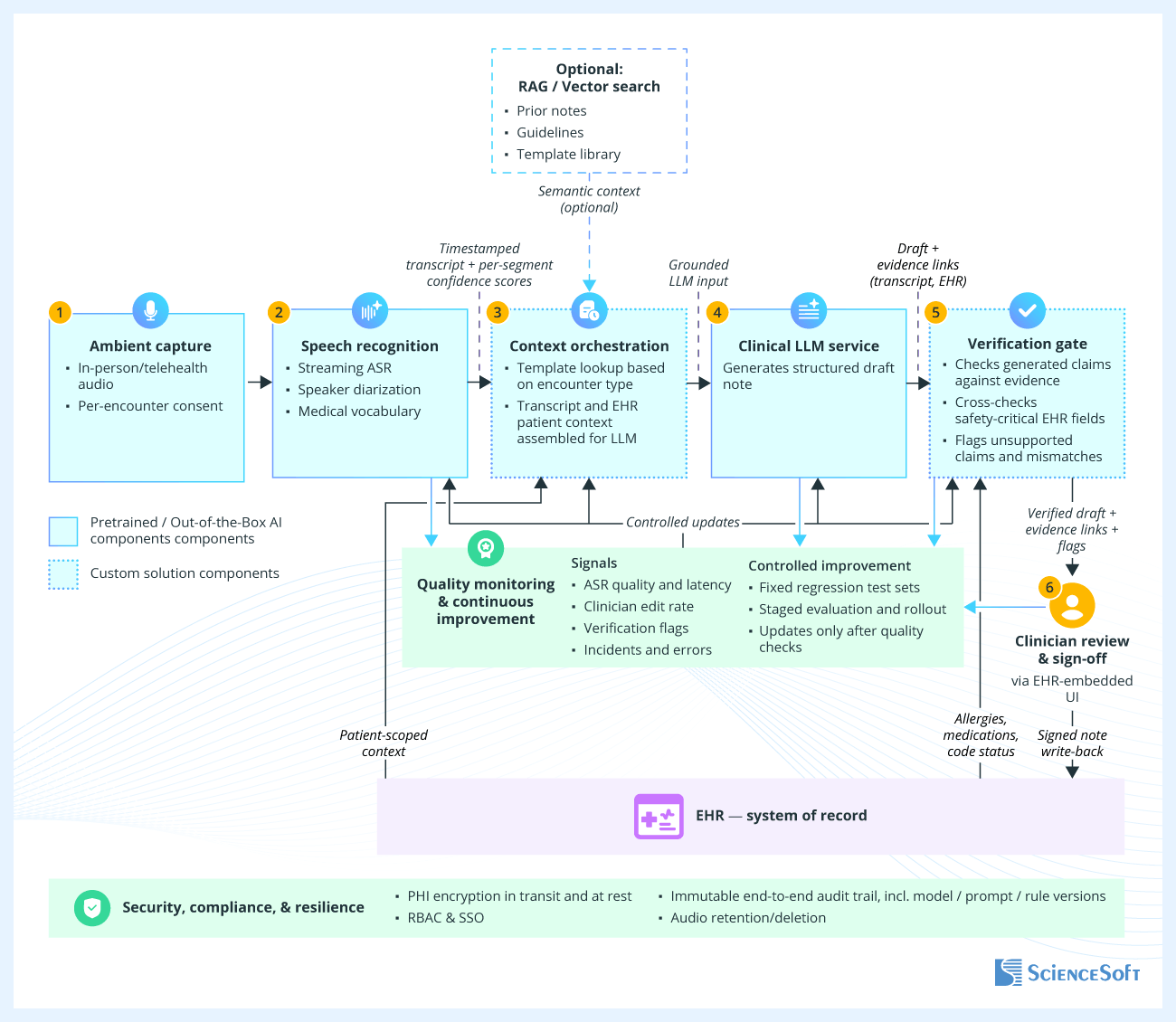
During the encounter, the scribe transcribes the conversation continuously but does not generate the draft note yet. Waiting until the encounter is complete gives the LLM the full conversational context instead of forcing it to form and repeatedly revise conclusions as new information appears.
After the encounter, the transcript is combined with the patient context needed for documentation, such as medications, allergies, and active problems from the EHR. Where the workflow requires broader historical or reference context, optional RAG can retrieve relevant prior notes or approved clinical content. This grounding step is kept separate from generation so the organization can control exactly what context reaches the LLM.
The LLM generates the draft note, but the AI-generated output still requires verification. A separate verification layer checks whether important statements are supported by the transcript or EHR context and applies deterministic checks where structured data allows them. Separating generation from verification makes the safeguards easier to test and audit and allows the underlying LLM to be changed without redesigning the control layer.
The architecture also prevents AI-generated content from becoming part of the medical record without clinician approval. The clinician reviews the draft, investigates flagged or low-confidence content where needed, edits it, and signs it. Only the signed note is written back to the EHR, keeping the AI in a documentation-support role rather than allowing it to make autonomous changes to the system of record.
The workflow is designed to fail safely when critical dependencies are unavailable. If the required EHR context cannot be retrieved or the draft cannot be generated reliably, the clinician falls back to manual documentation. If EHR write-back is temporarily unavailable, the signed note can be queued for later delivery.
After launch, I recommend continuously tracking clinician edits, verification flags, and operational incidents to see where the AI starts to underperform. This is not a one-time exercise: even if the scribe performs well at deployment, that can change as patient populations, workflows, clinical protocols, or language patterns evolve. Based on these signals, your team may adjust prompts or templates, refine verification rules, tune ASR settings, or switch models. Any change should be tested against representative clinical cases and a fixed regression set before broader rollout.
Technologies Used to Build an AI Scribe
ASR and speaker diarization
- Parakeet
- Canary
- pyannote.audio
- Amazon Transcribe Medical
- Google Cloud Speech-to-Text
Healthcare-specialized language models
- MedGemma
General-purpose LLMs
- OpenAI GPT
- Anthropic Claude
- Google Gemini
- Meta Llama
AI platforms and model services
- OpenAI API Platform
- Anthropic Claude API
- Microsoft Foundry
- Amazon Bedrock
- Google Vertex AI
- Hugging Face Inference
- OCI Generative AI
- NVIDIA AI Enterprise
AI orchestration and retrieval
- LangChain
- LangGraph
- RAG
- Graph RAG
- Faiss
- Pgvector
- Qdrant
- Weaviate
- OpenSearch
EHR integration and interoperability
- HL7 v2
- HL7 FHIR
- SMART on FHIR
- C-CDA
The Cost of Implementing an AI Scribe

The cost of implementing an AI scribe solution such as one shown above can range from $300,000 to over $700,000, depending on supported specialties and languages, EHR integration depth, and functional scope.
A production-grade AI scribe for one specialty and one language, with cloud-hosted AI and integration with one EHR, starts at around $300,000. Multi-specialty or multilingual implementations, and projects with expanded capabilities such as coding suggestions, referral drafting, or clinical summaries, generally cost $500,000–$700,000+ to build.
The estimates are illustrative and cover implementation only. They exclude ongoing cloud and AI usage, third-party licenses, and post-launch support and maintenance.
Need a custom estimate for your case?
What affects the cost
- Languages and localization. Additional languages, dialects, mixed-language speech, local clinical terminology, and ASR evaluation or tuning.
- Clinical breadth. Additional specialties, note types, templates, specialty terminology, clinical rules, and specialty-specific validation.
- Functional scope. Capabilities beyond core documentation, such as coding assistance, after-visit summaries, referral or order drafting, and structured EHR field population.
- EHR integration and grounding. The number of EHRs to connect to, integration depth, patient context retrieval and RAG mechanisms, SSO, and support of additional clinical workflows such as coding suggestions.
- Safety and validation scope. The more extensive the verification rules, source attribution, specialty-specific checks, clinician review functionality, and quality monitoring, the higher the implementation effort.
What Safe AI Scribe Adoption Requires
In this interview, Hadeel Abu Baker explains why successful AI scribe adoption depends on more than transcription accuracy. She covers specialty-specific workflows, clinician review, EHR integration, data residency, and the limits of AI autonomy — including where custom development may be preferable to a standard product.
Why Healthcare Organizations Choose ScienceSoft for AI Initiatives
- Since 1989 in AI development and since 2005 in healthcare software engineering.
- 150+ successful healthcare IT projects.
- 750+ IT specialists on board, including in-house MD consultants, AI/ML engineers, healthcare integration specialists, compliance consultants, and cybersecurity experts.
- In-house Architecture and Solutions CoE with 30+ senior architects who design AI solutions for interoperability, security, and measurable operational gains without unnecessary complexity and costs.
- Experience with regulatory requirements for privacy and data protection (HIPAA/HITECH, GDPR, Saudi PDPL, and UAE PDPL) and health information access and exchange (21st Century Cures Act and ONC rules).
- Proficiency in healthcare interoperability standards, profiles, and specifications (HL7 v2, HL7 v3/CDA, HL7 FHIR, C-CDA, IHE XDS/XDS-I, USCDI), as well as clinical terminologies and code sets (SNOMED CT, LOINC, RxNorm, ICD-10, CPT).
Certifications and awards
-

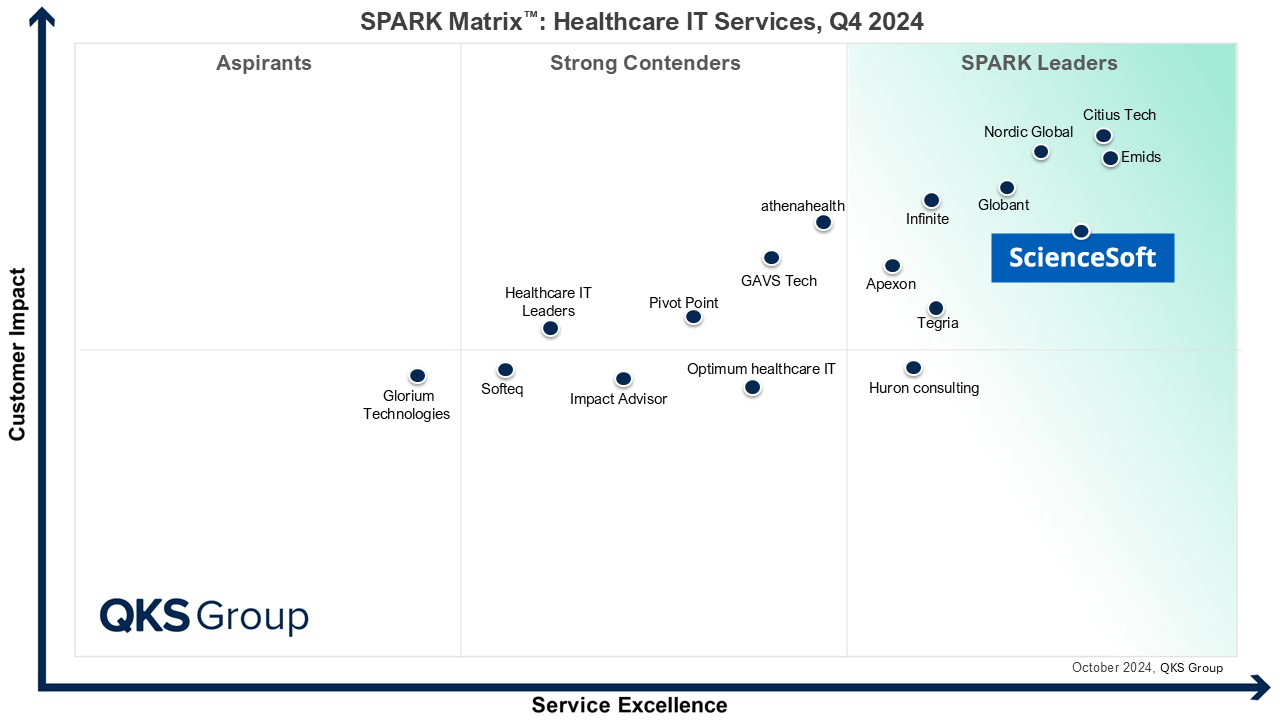
Featured among Healthcare IT Services Leaders in the 2022 and 2024 SPARK Matrix
-

Recognized for Healthcare Technology Leadership by Frost & Sullivan in 2023 and 2025
-

Named among America’s Fastest-Growing Companies by Financial Times, 5 years in a row

-

Four-time finalist across HTN Awards programs
-

Named among Becker’s Telehealth Companies to Know in 2026
-

Named Leading Healthcare Software Provider 2026 at GHP’s Healthcare & Pharmaceutical Awards
-

HIMSS Gold member advancing digital healthcare
-

ISO 13485-certified quality management system
-

ISO 27001-certified security management system



Our Clients Say


I’m genuinely grateful to ScienceSoft for their hard work and would absolutely recommend them to anyone looking for top-notch results in health tech.


I am particularly impressed by the cooperative nature of ScienceSoft’s team. They are reliable, thorough, smart, available, extremely good communicators and very friendly.

We found ScienceSoft to be dependable and forward-thinking, and we would confidently recommend them for high-responsibility projects.
