 ScienceSoft Global



Drug Delivery Device Software Development Services
Companion Apps and Connected Device Platforms
With healthcare software development experience since 2005, ScienceSoft supports companies developing connected drug delivery products. We design and implement companion and device-connected software that fits clinical and home-use workflows and remains maintainable as devices, integrations, and product requirements evolve.
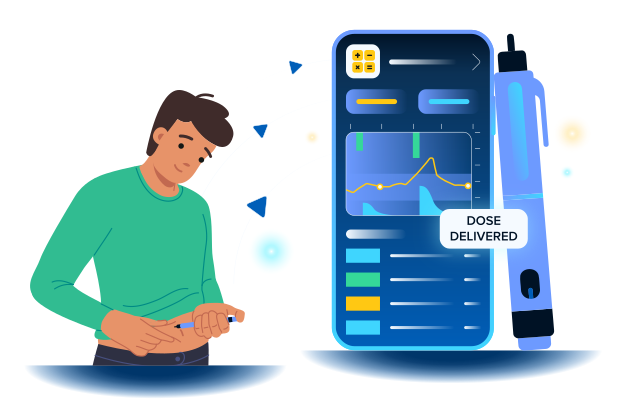
Drug delivery device software development services cover the engineering, modernization, and support of standalone software products that complement connected medical devices used for drug delivery in clinical and home settings. These may include patient companion mobile apps, clinician-facing monitoring and therapy management software, and device management platforms for the product teams.
Why Product Companies Choose ScienceSoft for Medical Device Software Development
- Since 2005 in healthcare IT, with 150+ successful projects in the field.
- 9 principal architects with 15–25+ years of experience to balance the security, cost-efficiency, and longevity of IoMT architectures.
- Hands-on experience with achieving and maintaining compliance with the requirements of HIPAA/GDPR, IEC 62304, ISO 13485, FDA QMSR, 21 CFR Part 11, and more.
- Healthcare interoperability experience with FHIR, HL7 v2/v3, C-CDA, SNOMED CT, and RxNorm, supported by HL7® FHIR® certified implementers on the team.
- Healthcare IT consultants with Doctor of Medicine degrees and HIMSS-aligned knowledge.
- An official partner of Microsoft and AWS.
Certifications and awards
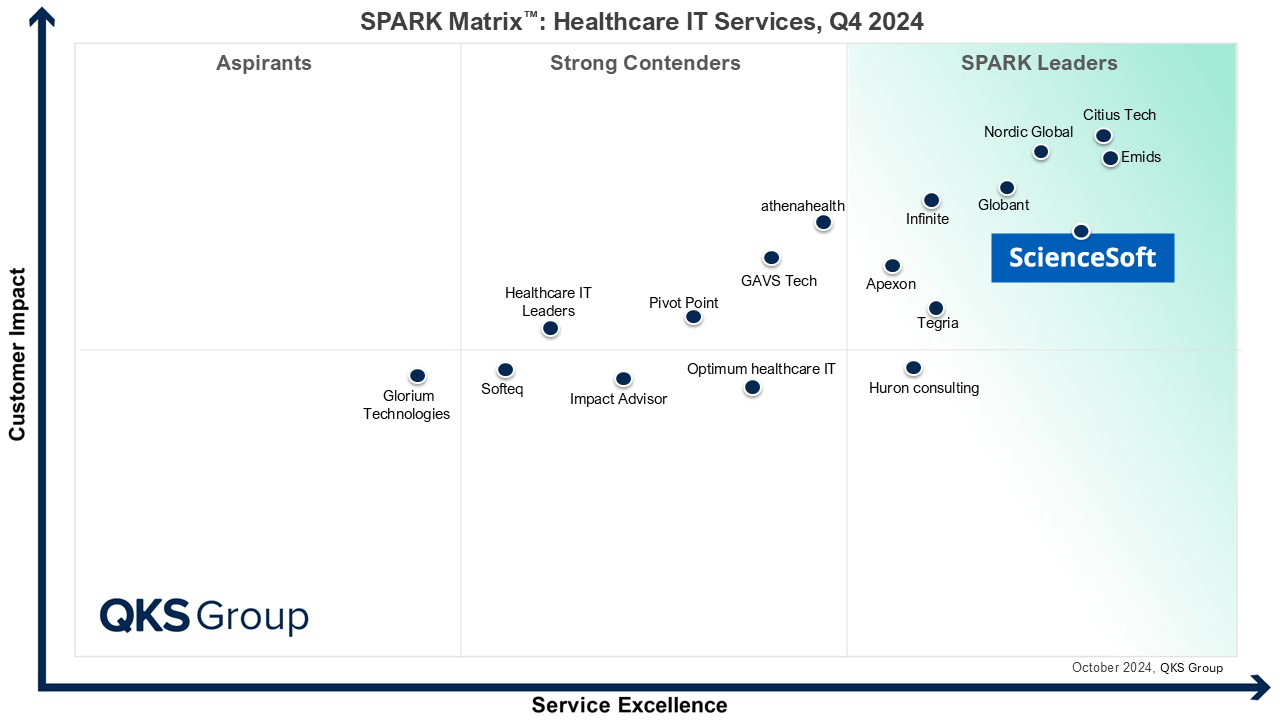
Featured among Healthcare IT Services Leaders in the 2022 and 2024 SPARK Matrix

Recognized for Healthcare Technology Leadership by Frost & Sullivan in 2023 and 2025

Named among America’s Fastest-Growing Companies by Financial Times, 5 years in a row
Four-time finalist across HTN Awards programs
Named among Becker’s Telehealth Companies to Know in 2026
Named Leading Healthcare Software Provider 2026 at GHP’s Healthcare & Pharmaceutical Awards
HIMSS Gold member advancing digital healthcare

ISO 13485-certified quality management system

ISO 27001-certified security management system
Capabilities We Enable for Connected Drug Delivery Device Software
ScienceSoft can develop full-featured companion apps and device-connected platforms or individual modules for patient, clinician, device management, and support workflows.
Patient companion functions

Education, support, and guidance
For onboarding, device use instructions, treatment reminders, and troubleshooting support.

Symptom diary
For recording symptoms, side effects, and treatment context that the device does not capture automatically.

Drug delivery status monitoring
To see delivery progress where applicable, completion or interruption status, and device indicators such as battery level and connectivity.

Drug delivery control
To let patients select predefined drug delivery modes and start or pause delivery within safety limits established for the device and therapy.
Clinician functions

Therapy event and adherence monitoring
To review device-recorded dose events, missed or interrupted deliveries, and medication adherence history in patient timelines or cohort summaries.

Regimen programming and dose control
To configure dosing parameters, schedules, limits, and delivery modes and confirm that updated settings reach the device.
Device operations and support

Device management
To provision, assign, configure, update, and track connected devices throughout their lifecycle.

User support and post-market monitoring
To review device logs, faults, battery trends, and connectivity issues during complaint investigations and post-market monitoring.
High-Level Architecture of a Connected Drug Delivery Platform
ScienceSoft’s architects prepared a sample high-level reference architecture for a connected drug delivery platform operated by a device manufacturer, pharma sponsor, or another product owner. The design assumes centralized management of the connected device fleet, while therapy data processing and sharing can vary depending on provider involvement, privacy requirements, and other deployment constraints.
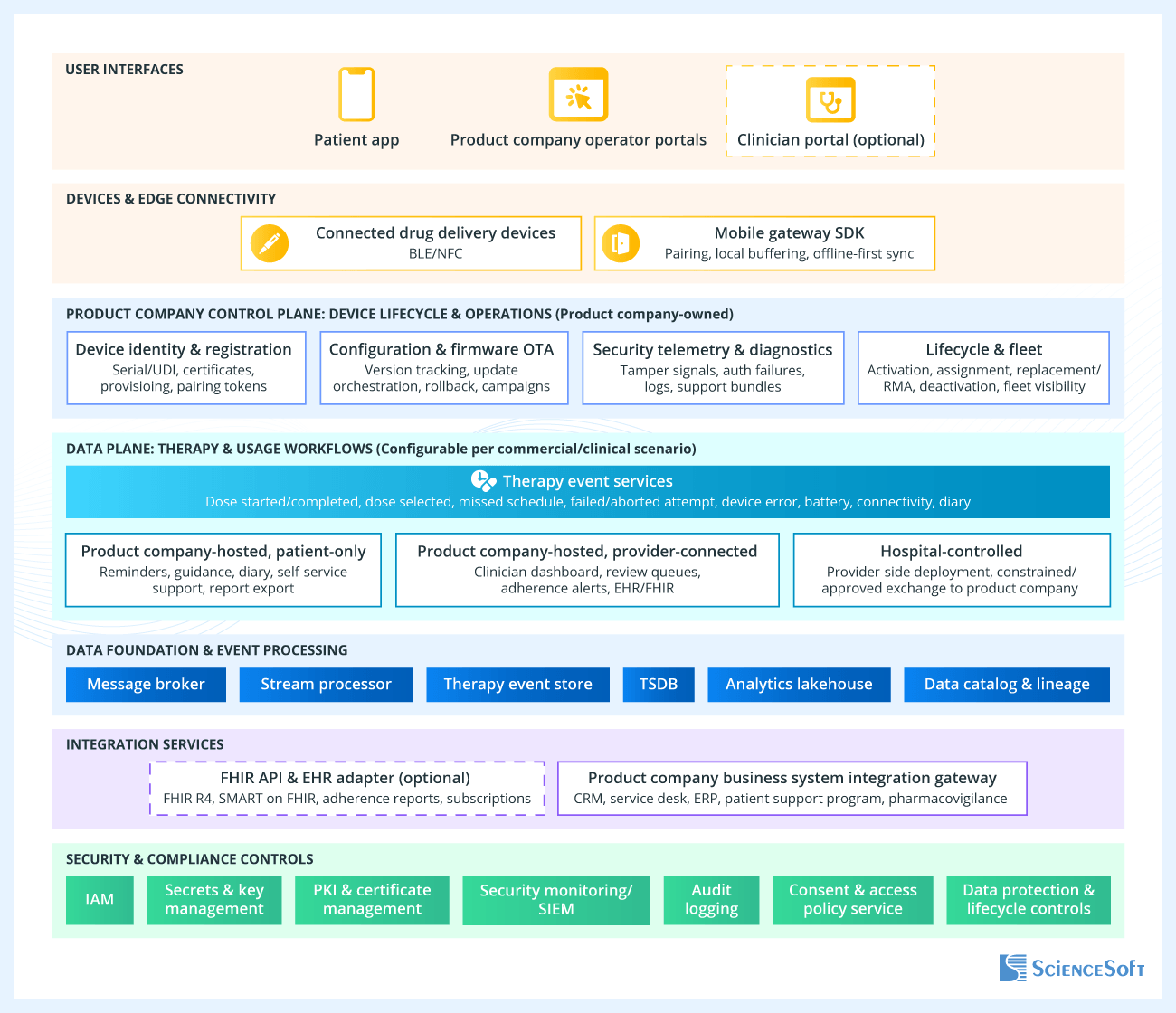
Connected drug delivery devices use a mobile gateway SDK embedded in the patient or partner app to exchange data with the product owner’s cloud when direct internet connectivity is unavailable. The SDK buffers therapy events locally and forwards them when connectivity is restored, helping preserve complete event histories without adding power-intensive WAN connectivity to the device.
A shared control plane handles device registration, provisioning, configuration, firmware updates, diagnostics, and lifecycle operations across the entire fleet. This gives the product owner a consistent operational foundation for activating and supporting devices in the field, managing replacements, and rolling out firmware updates and security patches. For products that support remote programming or delivery control, ScienceSoft designs separate authorization, confirmation, device-state verification, and audit controls around command workflows.
The therapy data plane is configured according to the product’s access, integration, and hosting requirements. Common scenarios include:
- Product company-hosted, patient-only. Therapy data is processed primarily for patient-facing workflows, including dose tracking, reminders, adherence feedback, and self-service support. No clinician portal or provider-facing data flow is required, which reduces integration needs and operational complexity.
- Product company-hosted, provider-connected. Therapy data is processed in the product company-hosted platform and can be accessed by authorized clinicians through the clinician portal or connected EHR workflows. FHIR-based APIs, provider identity and consent controls, review queues, and patient-provider messaging add clinical oversight without changing the shared device management platform.
- Hospital-hosted. Patient-level therapy processing can run within a hospital-controlled environment when organizational policies or privacy requirements restrict the use of the product company’s cloud. The exact division of responsibilities is defined for each implementation: the hospital may retain all patient-level data within its controlled environment, while the product company receives only approved operational, pseudonymized, or aggregate information. In stricter deployments, data exchange with the product owner may be further limited or removed.
An event-driven data foundation supports real-time workflows, long-term records, and analytics without tightly coupling devices, applications, and downstream services. Therapy events and technical telemetry can be processed and stored separately, based on their operational, retention, and analytical needs. The exact component set and processing environment depend on the operating model: patient-level processing may take place in the product company’s cloud, a hospital-controlled environment, or be split between the two.
Security and compliance controls apply across devices, applications, data stores, and exchange pathways. They protect device integrity and patient data, enforce consent and access rules, and preserve traceable records of critical technical and operational actions. Together, these controls support regulatory compliance, audit and investigation readiness, post-market surveillance, and the evidence trail required for complaint handling, corrective actions, and regulatory reporting.

Don’t overbuild your first release
Teams often come into drug delivery software projects with a long list of ideas, trying to pack as much as possible into the first release. Without careful prioritization, an overloaded scope can delay delivery of a working solution and bloat project investments. To prevent that, ScienceSoft typically starts with a focused first release whose workflows can be fully specified, implemented, and verified: for example, letting a clinician see a patient’s recent dose history. We work with product teams to sort features by value and effort, identify technically complex parts upfront, and plan releases that deliver useful value early while keeping long-term goals in sight.
Drug Delivery Device Software Services by ScienceSoft

Software consulting
Our consultants and architects help establish a workable software concept for your connected drug delivery product. We define intended use, operating environments, product boundaries, and key regulatory assumptions, then shape the feature scope and architecture around them, including device-app-cloud responsibilities, connectivity, safety and cybersecurity controls. We also identify implications for verification and validation planning.

Software development
We design and build companion apps for drug delivery devices across the entire software development lifecycle. Our teams engineer the device-app-cloud stack, enable device connectivity, integrate the software with provider and product company systems, and conduct risk-based verification and testing. We also assemble software-related documentation required for regulated environments, including technical descriptions, verification artifacts, and change records.

Software modernization
We modernize existing companion apps and device-connected software when legacy architecture, interfaces, or technology choices start limiting reliability, interoperability, scalability, or further development. Modernization services may include cloud enablement and architecture refactoring, API and integration upgrades, migration to current data exchange formats, and replacement of outdated platform components.

Software product support and evolution
We help device product companies maintain and evolve existing drug delivery software products after deployment. This may include issue resolution, performance improvements, dependency upgrades, and updates to interfaces as workflows change. We can also help product companies extend functionality over time, while keeping change documentation aligned with validation and compliance expectations.
How ScienceSoft Tackles the Challenges of Building Companion Medical Device Software for Drug Delivery
Interpreting device events correctly across real-world scenarios
In connected drug delivery systems, a device-reported “dose delivered” event may not tell the full story. Patients can restart failed attempts, receive only part of the medication, or upload data days after the event occurred. These cases raise questions about what counts as a valid dose, whether the patient was adherent, and how to resolve discrepancies when reviewing therapy histories or investigating complaints.
Solution:
ScienceSoft helps clients define precise rules for interpreting dose events during the discovery and system design phases. We analyze how different devices represent delivery attempts, completions, and failures, and we outline how to distinguish valid doses from retries, partial injections, or time-window violations. Our architects design event-correlation logic that links related signals into meaningful therapy episodes and apply idempotency safeguards to handle duplicate records from offline uploads. We also make sure the transformation steps between raw events and adherence metrics are traceable, explainable, and defensible in clinical or support contexts. This structure reduces ambiguity, improves reporting quality, and supports audit readiness.
Scaling device onboarding and lifecycle management without support overload
As connected drug delivery solutions move beyond pilots, operational tasks can quickly become a bottleneck. Provisioning devices, pairing them with patients, handling replacements, resolving connectivity issues, and managing configuration or firmware differences across deployments all require ongoing coordination. Without clear lifecycle workflows, support teams might spend more time resolving preventable issues, and device behavior might vary across sites or patient groups.
Solution:
ScienceSoft helps product companies design clear and maintainable device lifecycle workflows. We work with product teams to define provisioning and pairing steps, track device identity and ownership, and manage configuration states across deployments. We also help structure operational telemetry such as connectivity status, battery levels, and error signals so support teams can identify issues early rather than react to incidents. Where the device ecosystem supports it, we design controlled firmware update workflows with status tracking and auditability, aligned with regulated change control requirements.
Managing compliance and change control throughout the project lifecycle
Software that supports drug delivery devices often operates in a regulated context. Changes that seem minor at the product level, such as adjustments to workflows, data handling, or user roles, can still affect validation scope or regulatory expectations. Without an explicit approach to compliance and change control, product companies risk rework, delayed releases, or gaps discovered late in audits.
Solution:
ScienceSoft plans compliance considerations alongside functional development from the start. We work with clients to establish practical controls for access management, data protection, audit logging, and risk assessment within the development process. As features evolve, we help assess changes for potential regulatory impact and document them accordingly, including updates to traceability and validation artifacts. This approach helps teams adapt requirements over time while maintaining a clear and manageable path toward compliant releases.
Choosing where AI belongs in the product
Drug delivery product teams may encounter the need to identify useful AI opportunities even when AI was not part of the original product concept. The challenge is separating use cases that are a good fit for probabilistic AI models from those better handled with conventional rules, search, or analytics. The consequences of an AI-produced error also vary considerably between, for example, summarizing a support case and influencing a therapy-related decision.
Solution:
ScienceSoft starts with the workflow rather than the model: what decision or task AI would support, what data it would use, who would rely on the output, and what happens if the output is wrong. This helps select an appropriate approach: machine learning for bounded classification or anomaly detection, or retrieval-supported generative AI for working with approved documentation. Patient-specific recommendations, dosing logic, or autonomous actions require stronger evidence that the model performs reliably and tighter controls over how its outputs are used. In these cases, AI may not be worth using if simpler methods can achieve the same goal.
Technologies We Use for Smart Drug Delivery Software Development
Device connectivity
- Wi-Fi
- 5G
- Bluetooth
- Bluetooth Low Energy
- NFC
- Zigbee
- NB-IOT
- LoRaWAN
Cloud services
- Amazon Web Services
- Microsoft Azure
- Google Cloud Platform
Real-time data streaming
- RabbitMQ
- Apache Kafka Streams
- Apache Storm
- Apache Flink
- Apache Spark Streaming
- Amazon Kinesis Data Streams
- Azure Event Hubs
Data lakes
- HDFS
- Azure Data Lake
Databases / data storages
SQL
- Microsoft SQL Server
- MySQL
- Oracle
- PostgreSQL
NoSQL
- Apache Cassandra
- Apache Hive
- Apache HBase
- Apache NiFi
- MongoDB
Cloud databases / data storages
AWS
- Amazon RDS
- Amazon Redshift
- Amazon S3
- Amazon DocumentDB
- Amazon DynamoDB
- Amazon ElastiCache
Azure
- Azure SQL Database
- Azure Blob Storage
- Azure Cosmos DB
Google Cloud Platform
- Google Cloud SQL
- Google Cloud Datastore
IoT data analytics
AWS
- AWS IoT Analytics
- Amazon Redshift
- Amazon DynamoDB
Azure
- Azure Stream Analytics
- Azure Synapse Analytics
- Azure Cosmos DB
Others
- Apache Cassandra
- Apache HBase
- Apache Hadoop
- Apache Spark
Front-end programming languages
Languages
- HTML5
- CSS
- JavaScript
JavaScript frameworks
- Angular JS
- React JS
- MeteorJS
- Vue.js
- Next.js
- Ember.js
Mobile
- iOS
- Android
- Xamarin
- Apache Cordova
- Progressive Web Apps
- React Native
- Flutter
- Ionic
Containerization tools
- Podman
- Docker
- LXC
- Container Registry
- OpenVZ
Orchestration
- Orkes
- Microsoft Autogen
- LlamaIndex
- Haystack
- GitHub Actions
- Jenkins
- GitLab
- Apache Airflow
- Amazon SageMaker AI
- Databricks MLflow
- AWS Glue
- Weights & Biases
- TensorFlow Extended
- Azure DevOps
- NVIDIA TensorRT
- ONNX Runtime
- Docker
- Kubernetes
- nginx
- HashiCorp Terraform
- Ansible
Our Clients Say



They bring top-quality talents and deep knowledge of IT technologies and approaches in accordance with ISO 13485 and IEC62304 standards. I would also like to point out that ScienceSoft's team demonstrated a great engineering culture, a proactive approach to work, and the communication was easy and clear.


I am particularly impressed by the cooperative nature of ScienceSoft's team. They are reliable, thorough, smart, available, extremely good communicators and very friendly. We would recommend hiring ScienceSoft to anyone looking for a highly productive and solution-driven team.


Working with ScienceSoft was a pleasure from A to Z. Their deep knowledge of the healthcare industry specifics and DICOM standard helped us create the back end of the software for our ultrasound scanner.

They collaborated with our medical professionals with great professionalism and care, respecting the research environment and its unique challenges. We found ScienceSoft to be dependable and forward-thinking, and we would confidently recommend them for high-responsibility projects.
