ScienceSoft Global



Medical Device Tracking Platforms
Architecture, Tech Stack, Costs
With 15 years of experience in IoT and a portfolio of 150+ successful healthcare IT projects, ScienceSoft engineers efficient, low-latency software for tracking medical devices, helping device manufacturers deliver hospital-grade tracking platforms for their equipment.
A Brief Look at Medical Device Tracking Software
Medical device tracking platforms provide real-time visibility into the operational status, location, and utilization of connected hospital equipment. For OEMs, such systems offer a way to expand their portfolio with digital services, lower support overhead, and build stronger, longer-term relationships with hospital clients. Demand for these solutions continues to grow as providers look for smarter ways to manage increasingly complex device fleets.
Medical Device Tracking Market
The global market for hospital asset tracking and inventory management systems is projected to grow from $31.05 billion in 2025 to $40.58 billion by 2030, representing a compound annual growth rate (CAGR) of approximately 5.5%. Key drivers behind this growth include hospitals’ increasing need for real-time visibility of medical equipment, rising costs associated with misplaced or underutilized devices, and the broader adoption of enabling technologies such as IoT.
This growing demand creates an opportunity for medical device manufacturers to enhance their offerings with digital services that help hospitals manage their expanding fleets more efficiently. Hospitals are under significant pressure due to rising labor costs and staff shortages, so they actively seek solutions that help reduce manual labor and equipment downtime. The expectations are shifting toward connected devices that not only perform reliably but also support real-time visibility and faster issue resolution. These trends make IoT-enabled medical inventory tracking platforms a timely and relevant addition to the broader medical device ecosystem.
High-Level Architecture of a Hospital-Facing Medical Device Tracking Platform
Below is a reference architecture developed by ScienceSoft for an OEM that wanted to ship a connected device management platform alongside its hospital equipment products. The architecture reflects the common needs and expectations of hospital systems and device manufacturers but can be adapted to fit specific product visions, hospital IT environments, and regulatory constraints.
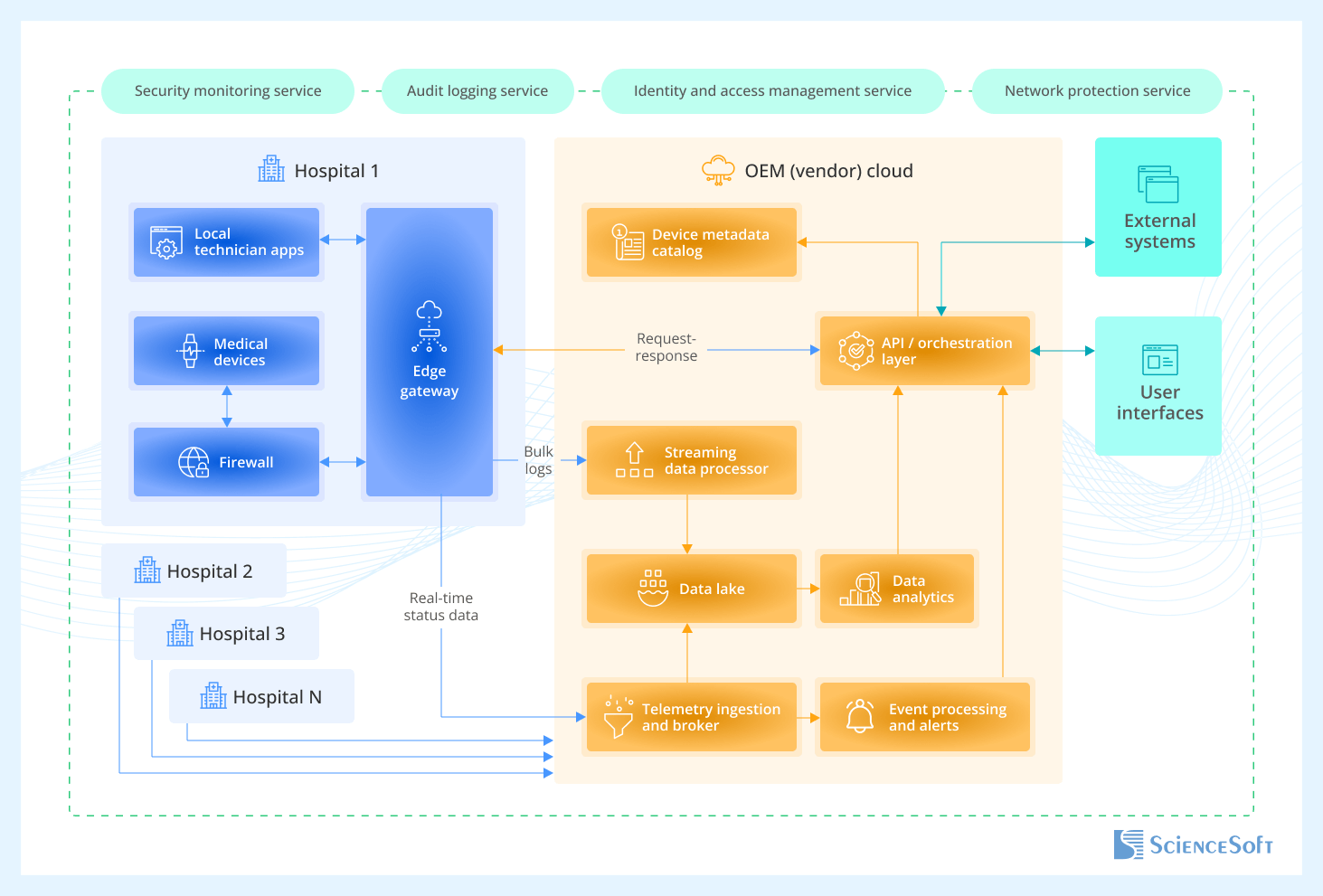
Within each hospital network, protected by a firewall, medical devices connect to an on-premises edge gateway via Wi-Fi, Bluetooth Low Energy (BLE), RFID, GPS, or other supported protocols. Local technician applications interface with the gateway to allow on-site staff to register new devices, initiate syncs, or conduct diagnostics without requiring direct cloud access.
The gateway also aggregates device data (status, battery levels, connectivity metrics, etc.) and transmits it securely to the OEM’s cloud. The gateway can temporarily cache data if the internet connection is unavailable and perform basic preprocessing to reduce package size before transmission. The gateway-cloud communication is purposely limited:
- To maintain a secure network boundary, only the hospital-owned gateway can initiate communications with the device vendor’s cloud; the OEM only receives device status data or returns responses to the hospital’s queries. This means the hospital retains full control over access to its data, and security-conscious providers can use a “kill switch” if they want to fully shield their networks from external traffic.
- No PHI (such as patient IDs or recorded vitals) is shared with the OEM’s cloud, which reduces compliance risks under HIPAA and other data privacy regulations.
Multiple hospitals can be connected in the same way, allowing the platform to serve many client organizations within a single, multi-tenant deployment.
In the vendor-managed cloud layer, the platform ingests and processes both structured metadata and real-time device data from all connected hospitals. Real-time telemetry is routed through a broker component into the event processing module that detects issues related to low battery or connectivity. The system then notifies responsible users or systems. At the same time, high-volume batches pass through the streaming data processor. All data is then stored in the data lake and is made available to a data analytics layer that supports role-specific dashboards and reporting.
The API orchestration layer connects all components of the platform. It manages device provisioning and configuration workflows, routes data between internal modules, and serves as the main connection point for external systems (e.g., public key infrastructures, maintenance tools, or enterprise facility management software at the hospitals). This layer also interfaces with the device metadata catalog, which maintains the system of record for all managed devices: device types, models, serial numbers, assigned locations, and more.
Authorized users access the platform through dedicated interfaces where clinical staff can monitor device status and report issues, while admins can manage incidents and analyze performance data across assets. The platform can also include a separate interface for the OEM, enabling device manufacturers to monitor fleet performance across sites and support medical device lifecycle management (e.g., for post-market surveillance).

For some device classes and industry fields, storing device data in the OEM’s cloud would not work due to privacy concerns or technical hurdles. In such cases, it makes sense to ship the platform as a fully on-premises software product, hosted and controlled by hospitals. To scale this approach, it’s crucial to make deployments repeatable, maintainable, and scalable across multiple client environments. ScienceSoft recommends packaging the system as a containerized or virtualized bundle so that every hospital receives an identical, easy-to-audit setup. This eliminates the need for error-prone manual configuration steps (e.g., environment setup, dependency installation, or custom network adjustments) and helps ensure that all deployments run the same software version and infrastructure baseline. Keep the API design and data model identical to what you would use in a cloud-based version. This approach allows you to maintain a single codebase and opens the door for hybrid or cloud migration scenarios later, without a full redesign.
Best Practices for Healthcare Device Tracking Software Development

Use MQTT for telemetry and HTTPS for control
A reliable hospital asset tracking platform must support both telemetry streaming and control-layer communication efficiently. ScienceSoft recommends using different protocols for different purposes. MQTT works best for transmitting frequent, lightweight device updates such as battery levels, location pings, or connectivity status. It’s specifically designed for low-bandwidth, unreliable networks and supports retained messages, allowing the platform to display the latest known state of a device even after temporary disconnections. HTTPS, by contrast, is better suited for control-plane interactions (provisioning, configuration changes, or data retrieval by authenticated users), thanks to its request-response structure and compatibility with standard security mechanisms.

Design integrations around hospital systems and workflows
Fast and easy onboarding is often a dealbreaker for hospitals adopting a new platform, so providing pre-built integrations is a major advantage. ScienceSoft recommends including out-of-the-box support for widely used maintenance and ticketing systems (e.g., Nuvolo, ServiceNow). At the same time, building a well-documented public API layer gives hospitals the flexibility to connect other internal systems: procurement, inventory management, or equipment lifecycle tools. In designing these integrations, it's important to align data exchange patterns with common hospital workflows and standards, rather than locking into proprietary protocols. This helps reduce friction during deployment and enables smoother long-term interoperability as hospitals scale their use of your platform.

Apply AI to streamline support tasks and detect data issues
AI can bring measurable improvements to device fleet operations, even without deep learning infrastructure or sensitive data processing. ScienceSoft recommends starting with retrieval-based assistants that help IT admins and support staff find relevant documents faster (e.g., device manuals, configuration instructions, or SOPs) based on natural language questions. These assistants can be built on approved content with no need to generate new information, making them both low-risk and low-lift. Another high-impact use case is duplicate detection, where AI models can flag devices with overlapping metadata (e.g., same serial number or conflicting location updates) for admin review. These tasks don’t require complex training or access to PHI but provide tangible gains in efficiency, especially when scaled across multi-hospital environments. With clear boundaries and explainable outputs, these AI capabilities can be added incrementally while delivering visible value.

Implement tenant isolation strategies for cloud-hosted deployments
If you're building the platform as a cloud-native multi-tenant solution, it's important to think through how you’ll separate resources and responsibilities between clients. ScienceSoft recommends using a bridge model as a practical default. In this setup, infrastructure components like APIs, compute services, or queues (which don’t handle sensitive data) are shared across tenants, while each tenant’s storage is isolated using either dedicated databases or strong logical partitions. This keeps things efficient on the vendor side while offering the data protection hospitals expect. For clients that require stricter isolation (e.g., for compliance, internal policy, or procurement reasons), you can offer tiered options, such as fully siloed storage or even dedicated compute environments. These choices should also be reflected in how you monitor usage and allocate resources to avoid performance interference between tenants. It’s a model that gives you room to grow without locking yourself into rigid patterns from day one.
Tools We Employ for IoT-Based Asset Tracking
Cloud databases, warehouses, and storage
AWS
- Amazon S3
- Amazon Redshift
- Amazon DynamoDB
- Amazon DocumentDB
- Amazon RDS
- Amazon ElastiCache
Azure
- Azure Data Lake
- Azure Blob Storage
- Azure Cosmos DB
- Azure SQL Database
- Azure Synapse Analytics
- Kinect DK
- Azure RTOS
Google Cloud Platform
- Google Cloud SQL
- Google Cloud Datastore
Other
- Microsoft Fabric
IoT data analytics and machine learning
- Apache Cassandra
- Amazon DynamoDB
- Apache HBase
- Apache Hadoop
- Apache Kafka
- Apache Storm
- MATLAB
- GNU Octave
- R
- Apache Mahout
- Caffe
- Apache MXNet
- Torch
- Theano
- Apache Spark MLlib
- Gensim
- SpaCy
- Amazon Machine Learning
- Amazon SageMaker AI
- Azure Machine Learning
- Google Cloud AI Platform
- Einstein
AWS IoT services
- AWS IoT Device Management
- IoT Things Graph
- AWS IoT Core
- AWS IoT Events
- AWS IoT Greengrass
- AWS IoT Device Defender
IoT platforms
- ThingsBoard
- ThingSpeak
Connectivity
- NFC
- Ethernet
- GSM Network
- Bluetooth
- Wi-Fi
- GPRS/2G/3G/4G/4G LTE/5G
- Zigbee
- RFID
- SigFox
- LoRaWAN
- NB-IOT
Supported communication protocols
- HTTP
- TCP/IP
- WebSockets
- iBeacon
- LoRaWAN
- XMPP
- UDP
- CAN/CANopen
- MQTT
- CoAP
- AllJoyn
- AMQP
Programming languages
Front end
- HTML5
- CSS
- JavaScript
- Angular JS
- React JS
- MeteorJS
- Vue.js
- Ember.js
- Next.js
Mobile
- iOS
- Android
- Xamarin
- Apache Cordova
- Progressive Web Apps
- React Native
- Flutter
- Ionic
Data visualization
- Microsoft Excel
- Power BI
- Grafana
- Tableau
Containerization tools
- Podman
- Docker
- LXC
- Container Registry
- OpenVZ
Orchestration
- Orkes
- Microsoft Autogen
- LlamaIndex
- Haystack
- GitHub Actions
- Jenkins
- GitLab
- Apache Airflow
- Amazon SageMaker AI
- Databricks MLflow
- AWS Glue
- Weights & Biases
- TensorFlow Extended
- Azure DevOps
- NVIDIA TensorRT
- ONNX Runtime
- Docker
- Kubernetes
- nginx
- HashiCorp Terraform
- Ansible
Why Develop Software for Tracking Medical Devices With ScienceSoft
- Since 2005 in medical software engineering.
- Since 2012 in IoT and cloud technologies.
- Mature quality management and security management systems backed by ISO 13485, ISO 9001, and ISO 27001 certifications.
- Proficiency in achieving and maintaining compliance with the requirements of IEC 62304, ISO 13485, 21 CFR Part 820, 21 CFR Part 11, and more.
- An official partner of Microsoft and AWS.
- 9 principal architects with 15–25+ years of experience each to balance the security, cost-efficiency, and longevity of IoMT architectures.
Certifications and awards
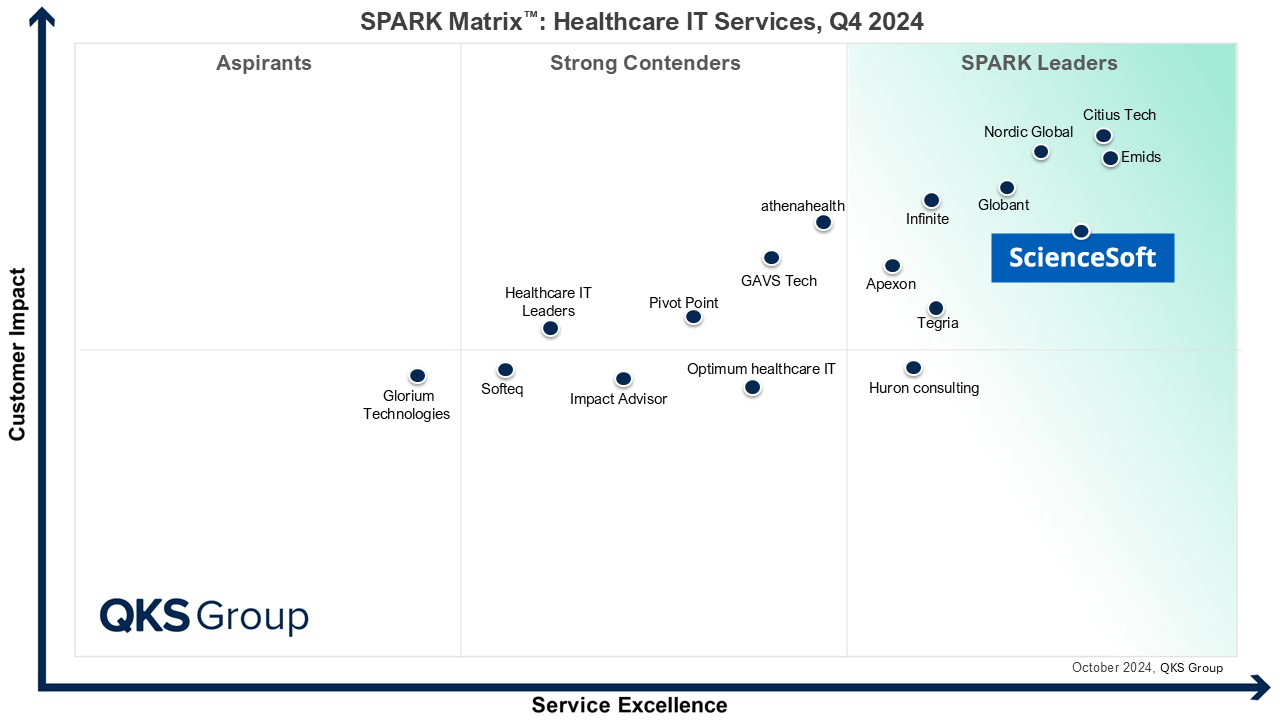
Featured among Healthcare IT Services Leaders in the 2022 and 2024 SPARK Matrix

Recognized for Healthcare Technology Leadership by Frost & Sullivan in 2023 and 2025

Named among America’s Fastest-Growing Companies by Financial Times, 5 years in a row

Four-time finalist across HTN Awards programs
Named among Becker’s Telehealth Companies to Know in 2026

Named Leading Healthcare Software Provider 2026 at GHP’s Healthcare & Pharmaceutical Awards

HIMSS Gold member advancing digital healthcare

ISO 13485-certified quality management system

ISO 27001-certified security management system
Our Clients Say

Todd Nilson
MD

We are thankful for the meticulous and value-driven approach of ScienceSoft's team. They created comprehensive project documentation, feature lists, and worked out thorough recommendations to help us improve the stability and performance of our solution. ScienceSoft proved to be a reliable vendor with a solid healthcare background.



During our cooperation, ScienceSoft proved to have vast expertise in the Healthcare and Life Science industries. They bring top-quality talents and deep knowledge of IT technologies and approaches in accordance with ISO13485 and IEC62304 standards.

Our project required coordination with multiple companies and individuals. ScienceSoft worked well with everyone. <…> They are reliable, thorough, smart, available, extremely good communicators and very friendly. We would recommend hiring ScienceSoft to anyone looking for a highly productive and solution-driven team.



Development Costs of Medical Device Tracking Software
Based on ScienceSoft’s experience, the costs of building a medical device monitoring platform typically range from $350,000 to $750,000.
Learn the Cost of Your IoMT Solution
Want to know how much it will cost to develop an IoMT solution? Answer a few simple questions, and our experts will get back to you with a custom cost estimate.