 ScienceSoft Global
 Insurance
 Investment


Agentic AI Solution for P&C Insurance Claims Automation
About Our Client
The Client is a US property and casualty (P&C) insurance company focused on personal auto, homeowners, and specialty commercial lines. The company ranks among the top 50 US P&C insurers.
Manual Claims Coordination Limited Adjusters’ Capacity
The Client already used customer and agent self-service tools for first notice of loss (FNOL) and evidence reporting, along with specialized applications for claims intake and adjustment. However, adjusters still had to validate claims, coordinate processing workflows, and arrange repairs and payouts manually, even for relatively simple personal claims. This workload was particularly difficult to manage during periods of high claim volumes.
The Client saw artificial intelligence (AI) as a way to streamline claims processing but was unsure which AI capabilities would add the most value and how to integrate them into existing workflows. To scope the solution and define a realistic implementation path, the company turned to ScienceSoft, a domestic insurance AI transformation partner with domain experience dating back to 2012 and specialist competencies in claims AI solutions.
P&C Claims AI Solution Design and Implementation Planning
ScienceSoft's insurance AI consultants analyzed the Client’s claim processing operations, technology setup, and improvement targets. The consultants recommended an agentic AI solution as a strong fit for the Client’s target claims workflow. AI agents would coordinate the tasks required to process a claim and involve human adjusters only for uncertainties and complex cases. For relatively straightforward claims, the solution could automate the entire process from intake to repair scheduling.
Specialized AI agents for narrow claims tasks
ScienceSoft proposed structuring the agentic AI solution around several specialized agents, each responsible for a distinct part of claims processing. This separation would contain the impact of individual agent errors and simplify agent controls. It would also let the Client build, test, update, and replace agents independently without affecting the entire solution.
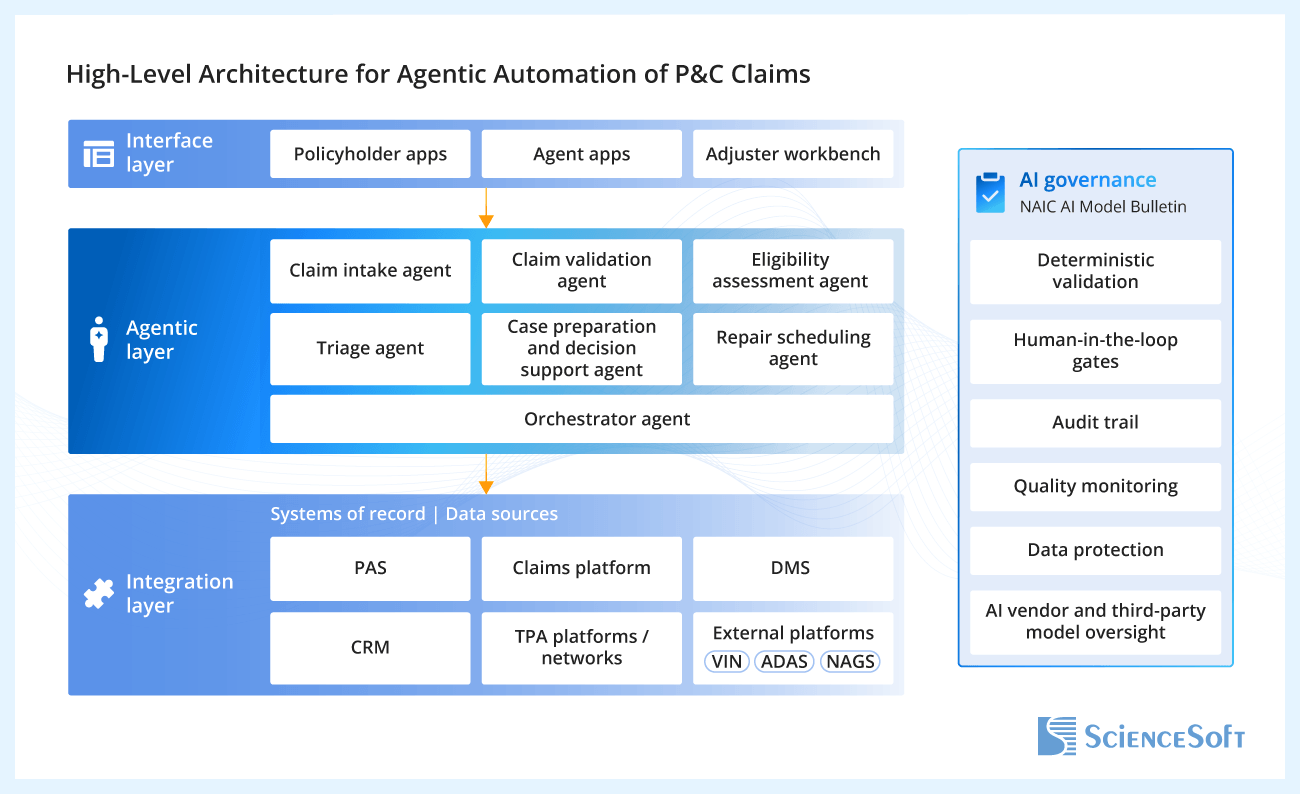
The proposed solution combined the following specialized agents:
- The claim intake agent, integrated with the Client’s existing digital self-service channels, would guide policyholders and agents through damage reporting in a conversational format. It would collect claim data and evidence, check submissions for completeness, and ask follow-up questions when data was missing.
- The claim validation agent would cross-check submitted information against available policy documents and historical claims data and identify gaps requiring clarification. It could also analyze damage photos, assess damage severity, and flag fraud signals.
- The eligibility assessment agent would analyze policy documents, interpret coverage terms, exclusions, and endorsements, and match them to the reported damage. Based on these findings, it would suggest whether the claim is covered.
- The triage agent would determine the processing sequence based on the claim type and characteristics and route the case through the relevant processing pipelines.
- The case preparation and decision support agent would compile claim data, evidence, assessment results, and identified issues into a case summary. For simple, low-risk claims, the agent would approve the claim automatically based on the Client’s rules. When human input was required, it would pass the prepared case and relevant context to an adjuster.
- The repair scheduling agent would coordinate fulfillment after claim approval. It would identify an appropriate provider within the Client’s repair network, schedule the service, and communicate the details to the policyholder.
- The orchestrator agent would coordinate the specialized agents and track the claim workflow end to end. Based on the results at each step, it would determine whether processing could continue automatically or an agent needs to hand the case over to an adjuster.
Rule-based guardrails and human oversight
To align agent actions with the Client’s claims workflows and limit AI behavior to approved procedures, ScienceSoft proposed adding rule-based guardrails around agent actions. The rules would reflect the Client’s claim handling policies and operating guidelines, as well as applicable state regulator requirements for claims settlement. The rules would also define when coverage is valid and which conditions qualify a claim for straight-through processing.
ScienceSoft suggested embedding agent behavior rules into pre-engineered prompts so agents followed the required instructions from the start of claim processing. To enforce mandatory business and compliance rules, ScienceSoft proposed adding deterministic validation. A dedicated validator service would check each agent’s output against approved rules before the workflow could proceed. It would score the output for confidence and determine whether it met the predefined threshold for automated processing. Valid outputs could move automatically to the next step, while uncertain or inconsistent cases would be routed to an adjuster for review. Unlike probabilistic AI validation, deterministic checks would apply the same rules consistently and produce reproducible outcomes, providing a predictable control layer for AI-supported claims actions.
Another guardrail ScienceSoft proposed was clear boundaries for autonomous claims processing. Complex cases, such as large or multi-party losses, bodily injury, and litigated claims, would remain entirely with claims specialists. The consultants also recommended keeping final decisions on claim denials, fraud, and payouts under human control. This approach would reduce routine work for adjusters while retaining human judgment for claims that require deeper expertise or carry greater financial, legal, or policyholder impact.
Secure architecture for claims AI agents
The consultants proposed a modular, layered architecture design for the agentic claims solution. Modularity would make specialized agents independent components with access only to the data and tools they need for their tasks. It would also allow each agent to use the AI model best suited to its function and production cost requirements. For example, the solution could use smaller encoder models for data extraction, computer vision models for damage photo analysis, and generative AI models for complex reasoning. This way, the Client could optimize AI performance and inference costs and retain the flexibility to replace models and providers as better options become available.
The layered structure would allow separating AI-driven processing from deterministic controls, preventing probabilistic AI outputs from directly triggering claims actions. A dedicated integration layer would isolate agents from the Client’s core claims and policy systems and provide controlled interfaces for data retrieval and write-backs. This would allow the solution to work with the Client’s existing applications without embedding AI logic into them, minimizing changes to current systems and simplifying future integrations.
For security, ScienceSoft proposed deploying the solution and keeping sensitive claims data within the Client’s cloud environment. Encryption and secrets management would protect data and system credentials. The consultants also specified design options for AI-specific safeguards, including prompt injection protection, input/output filtering, and prompt-level masking of sensitive data.
The architecture also included audit trail components to record agent actions and interactions. This would provide the Client with end-to-end traceability for monitoring agent behavior, investigating incidents, and conducting compliance reviews.
Line-of-business focus and concept validation
ScienceSoft’s consultants suggested initially introducing AI into a bounded claims workflow within a single line of business. This would reduce implementation complexity and upfront investment, simplify the setup of appropriate controls, and give adjusters time to gain experience with AI-assisted workflows before broader adoption.
The team reviewed the Client’s lines of business and identified windshield auto claims as a strong starting point. These claims were relatively high-volume and consumed substantial adjuster capacity, while their standardized processing made many cases suitable for straight-through agentic handling. Automating this workflow could provide tangible early benefits while keeping the initial AI scope manageable.
To further reduce implementation risks, ScienceSoft recommended starting with a proof of concept (PoC). The PoC would test the proposed agents and workflows on a limited set of windshield claims, validate their interaction with the Client’s systems and data, and measure the quality and reliability of automated processing. It would also help identify integration constraints and refine rules, confidence thresholds, and escalation logic before production rollout. This would allow the Client to validate the technical feasibility and business value of agentic claims automation before making a larger investment.
Risk-Aware, Scalable Path to Agentic Claims Automation
The Client received a practical functional design, architecture, and implementation roadmap for an agentic AI solution for claims processing. With clearly defined agent capabilities, automation boundaries, and human controls, the Client could automate suitable claims tasks while retaining human oversight over material claims decisions. The proposed architecture would let the Client establish consistent controls over agentic workflows, flexibly add new agents, and adopt best-performing AI models without reengineering the entire solution. A phased implementation approach would help contain implementation risks.
Once implemented, the proposed solution would reduce manual workload for the Client’s adjusters, enhance capacity for claims requiring professional judgment, and significantly shorten processing times for straightforward cases. With elastic agentic processing capacity available during claim volume spikes, the Client could reduce the permanent staff it used to maintain for peak workloads.
Technologies and Tools
Amazon Bedrock, Amazon Bedrock AgentCore, LangGraph, LangChain, Amazon Textract, Amazon SageMaker, Amazon S3, FastAPI.

