 ScienceSoft Global
 ScienceSoft Finance



Robo-Advisory Software Development Services
ScienceSoft creates secure robo-advisory tools for smooth investor experiences and compliant wealth management automation. Our principal architects and consultants engineer strategic solutions that combine high accuracy with cost-efficiency, scalability, and strong data governance.

Robo-advisory software development services are meant to create digital platforms that deliver personalized, algorithm-driven wealth planning and investment management services at scale. These services may span the design, engineering, support, and modernization of robo-advisory tools.
- For wealth management firms, creating a custom robo-advisor is a way to offer affordable investment advisory options for individuals who aren’t ready to pay for full-scale expert guidance.
- For fintech companies and startups, building a robo-advisory software product is a way to enter the rapidly growing digital advisory market with a brand-new technology solution.
Sources: Fortune Business Insights, Deloitte, Statista
Why Develop Robo-Advisory Software With ScienceSoft
- Since 2007 in software engineering for the investment industry.
- Financial IT and compliance (SEC, GLBA, NYDFS, GDPR, SOC 2, etc.) consultants with 5–20 years of experience.
- Principal architects proficient in designing complex investment automation systems and driving secure implementation of value-adding technologies (AI/ML, blockchain, and more).
- 45+ certified project managers (PMP, PSM I, PSPO I, ICP-APM) with experience in large-scale projects for Fortune 500 firms.
- Established practices for financial software accuracy and transparent, predictable development processes.
Partnerships and recognitions









Winning Features for Web and Mobile Robo-Advisory Platforms
ScienceSoft engineers robo-advisory solutions with functionality tailored to the specific needs of each client. Below, we list the core robo-advisor features and value-adding capabilities that can further enhance profitability and investor experience.
Core features

Account management for investors
Investors can create an account with the robo-advisory platform and add the necessary information (personal data, billing details, proofs of identity and residence, beneficiary information, IRA/ISA, preferred payment methods, etc.) using a step-by-step self-registration form. The solution automatically localizes the form’s language, app time zone, and KYC/AML questions based on the investor’s declared residency, nationality, and verified geolocation data.

Investor pre-qualification
The platform can use image analysis technology to extract and structure investor data provided in the submitted forms. It will then validate the investor data against trusted external sources (e.g., ID registries), internal eligibility policies (investor age, residency, etc.), and jurisdiction-specific KYC/AML requirements. Qualified accounts are approved automatically, while non-standard and edge cases are routed for manual review.

Investor profiling
Verified investors are navigated to an interactive questionnaire that gathers inputs on their investment goals, time horizon, financial capacity, risk appetite, and preferences (e.g., ESG, sector-specific investing). The robo-advisor automatically processes responses, composes investor profiles, and segments investors based on demographic, financial, and behavioral criteria.

Capital market screening
The robo-advisor can scrape and screen asset-specific market data in real time or according to a preset schedule. Custom robotic tools can be connected to any chosen market data platforms and liquidity venues and automate investment research across various asset classes (stocks, bonds, ETFs, including fractional shares, crypto tokens, etc.). Screening results are stored for background analysis and can be presented in investor dashboards.

Portfolio composition
The robo-advisor’s portfolio management engine analyzes investor profiles and investment options and constructs optimal baseline portfolios for each investor, taking into account pre-defined asset selection, diversification, and position limit rules tied to supported investment strategies. Custom advisors can automate conventional approaches like passive indexing and buy & hold, as well as alternatives like smart beta, direct indexing, and factor-based investing.

Portfolio rebalancing
Discretionary investor portfolios are rebalanced automatically based on pre-configured triggers, e.g., when an asset drifts beyond target bands or when returns for a particular lot decline during a certain period. Custom rebalancing logic can incorporate portfolio- and sleeve-level statistical algorithms that draw on MPT, PMPT, mean-variance optimization, risk parity, Black-Litterman, and other portfolio optimization frameworks.

Curated investing
Investors can configure specific criteria and constraints for the robo-advisor, e.g., to invest only in blue-chip stocks, to prioritize units matching environmental, social, and governance (ESG) goals, or to adhere to particular rebalancing methods. The solution automatically applies each investor’s individual settings when executing portfolio actions.

Trade execution
Trades are executed automatically, with order timing, buy/sell size, venue, and execution algorithm choices guided by preset best execution policies and investor instructions. Prior to trade, the robo-advisor validates each order for accuracy and compliance. It can connect to brokerages and trading venues for instant order placement, execution, and continuous trade monitoring.

Tax-loss harvesting
The robo-advisor evaluates investment positions for their potential tax implications, taking into account allocation dates, asset cost basis, sale prices, and FX rates. It automatically identifies tax-efficient lots to invest in, constructs portfolios for minimal tax liability, adjusts holdings through tax-aware rebalancing, and generates investor tax forms (e.g., IRS Forms 1099 and 8949). The platform can also recommend the best timing for withdrawal to further reduce the investor’s tax burden.

Portfolio performance monitoring
The platform calculates and tracks key investor portfolio metrics like total portfolio value, time- and money-weighted returns, volatility, standard deviation, Sharpe ratio, and more. Interactive dashboards provide investors with a real-time overview of portfolio KPIs, transactions, and balances (by asset class, period, etc.). Benchmarking tools allow investors to compare their portfolios against market indices and anonymized, aggregated portfolio cohorts.

Account balance maintenance
Custom robo-advisors can support multiple investor account top-up methods, including ACH transfers, cards, digital wallets, and crypto. Deposits and withdrawals are instantly processed via the connected payment gateways. Digital advisory tools can also be configured for automated funding via direct debit, recurring payouts to designated investor accounts, and cash sweep.

Fee management
Robo-advisory fees are calculated automatically based on the advisory scope and the platform’s charging models (e.g., an annual flat fee, a wrap fee based on assets under management, a percentage of order amount per trade). The solution can be designed to support automated billing and custodian-authorized, scheduled fee auto-withdrawal from investor accounts.

User support
Investors can submit support requests through embedded forms or use a live chat to reach out to support agents. AI agents automatically process support inquiries 24/7 and assist users in handling routine issues. A built-in knowledge base with FAQs and educational content helps users troubleshoot common concerns independently.

Platform analytics
Configurable dashboards provide robo-advisor admins with insight into investor account activities and essential platform KPIs, such as the number of new investors, the volume of investment deals, AUM, and revenue. The solution supports automated report generation and trend-based analytics to forecast investor behavior and platform performance.

Compliance controls
The solution should capture and log all investment-related activity in an audit-ready ledger, which can be centralized or decentralized (e.g., blockchain-based). Custom compliance modules can be designed to continuously vet robo-advisory operations for compliance with internal policies and regulatory rules (e.g., SEC, FINRA, CMA, MiFID II). Any anomalies and policy breaches are immediately flagged and escalated to platform admins.

Security
Investment data and the robo-advisory software are protected via role-based access control, multi-factor authentication, data encryption at rest and in transit, data minimization, data masking, key rotation, automated threat detection, and other robust security mechanisms. Custom solutions can be engineered for compliance with GLBA, SOX, CCPA, NYDFS, SOC1/SOC2, GDPR, PDPL, and other regulations.
Value-adding capabilities (post-MVP stage)

Intelligent capital market analytics
Machine learning (ML) can be applied to analyze large volumes of capital market data in real time, spot trends and latent signals (behavioral, risk, market), and forecast any required metrics and events, from time-sensitive technical indicators to long-term asset fundamentals to market-level corrections. The revealed insights can inform rule-based portfolio allocations.

AI-supported investment optimization
When powered by artificial intelligence (AI), robo-advisors can dynamically analyze investment strategies and suggest refinements. AI engines automate asset correlation and performance attribution analysis, identify return and loss drivers, and can auto-adjust diversification bands, allocations, order timings, and investment styles for higher portfolio profitability.

Smart arbitrage
AI-powered robo-advisors for institutional investors can be designed to sense real-time asset prices across execution venues and spot minor price discrepancies on identical assets, which may not be apparent to human traders. Smart algorithms can immediately enforce arbitrage trades to capitalize on micro-profit opportunities, e.g., buy low on one brokerage and sell high on another.

Natural language communication
Robo-advisors can be equipped with large language models (LLMs) to enable natural language software-investor conversation. LLM-powered tools can instantly process textual and voice investor inquiries about portfolio performance, account status, or market data and communicate the requested information in regular human language.

Robo-advisors can include financial modeling tools to evaluate liquidity needs and visualize financial goal fulfillment across the investment cycle. Investors can input yield targets, recurring income, liabilities, and projected spending, simulate time-framed cash flows from investment activities, and assess investment sufficiency for their goals.

Hybrid advisory support
A robo-advisor can be built to combine automation with human guidance to cater to investors who need reassurance or want expert input at key decision points. Such software will require live collaboration tools for investors and human wealth advisors, as well as tailored logic for investor routing to human experts based on portfolio size, goals, and risk profile.

AI-powered fraud detection
Deep-learning fraud detection models can be added to recognize emerging fraud schemes that may go unnoticed by traditional engines, like investor identity deepfakes produced using generative AI. They also help detect model and data tampering and prompt injection attacks across robo-advisory AI components.

Mobile robo-advisory solutions can incorporate biometric user authentication (e.g., facial or fingerprint recognition) to minimize risks of third parties accessing an investor account. Biometric matching can be proposed as a standalone login method or combined with other factors to enhance the protection of investor accounts.
Secure and Scalable Architecture for Robo-Advisory Software
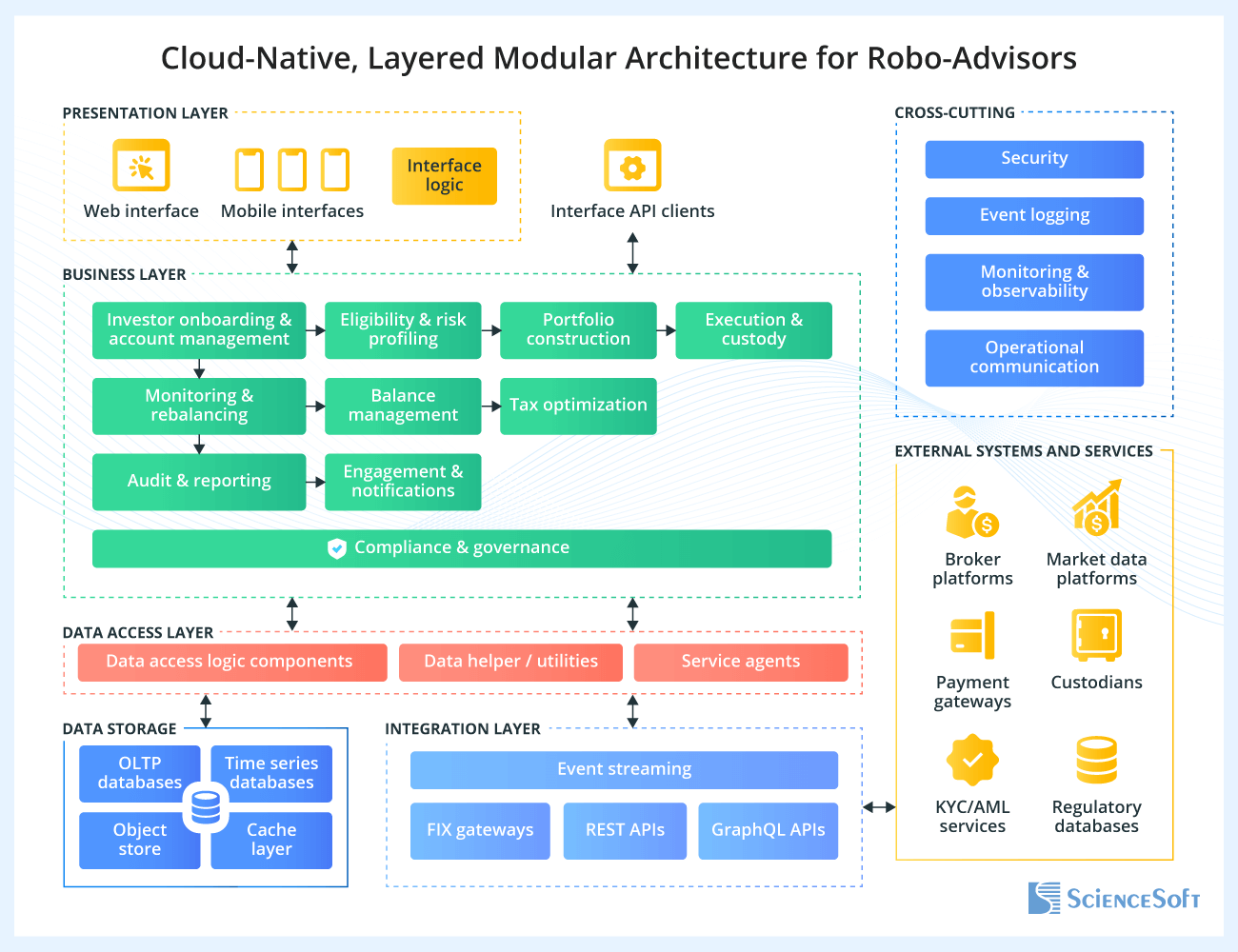
Below, ScienceSoft’s principal architects share a sample architecture we use to create robo-advisory solutions. The concept applies to scalable (1M+ accounts), commercial robo-advisors that offer rule-based and AI-supported personalized investment advice to retail investors while meeting institutional regulations (SEC, CMA, MiFID II, etc.).
Component-level flexibility and fast development
In the proposed cloud-native, modular architecture, the robo-advisory solution is divided into distinct layers, each responsible for a specific operational aspect. The layers are further broken down into separate components that can be built, deployed, reused, and scaled independently, without cross-impact. This design contributes to quicker delivery and supports incremental solution growth from a lean core to a feature-rich product.
Scalability, low latency, and reduced coding costs
Business logic components are presented as distinct functions (investor risk profiling, portfolio construction, trading, etc.). Each function is deployed as a scalable microservice, with the ability to build custom logic or employ third-party services (e.g., AWS’s Step Functions for user onboarding, Entrust’s Onfido for eKYC, Kavout’s Kai Score for intelligent asset picking) to optimize development costs. Architects at ScienceSoft suggest that event-driven microservices setups work best to minimize latency for algorithmic advisory operations that draw on rapidly changing data.
App-agnostic user interface
The proposed architecture allows the robo-advisor to be packed as a standalone web or mobile app or an embedded module within your existing software product via interface APIs. You will need the same APIs if you plan to sell your robo-advisor as a white-label product to investment and fintech firms, so that your partners can quickly add the features from your solution to their own apps.
Integrations for standardized, clean data exchange
The robo-advisory solution integrates with third-party systems (broker platforms, market data platforms, payment gateways, regulatory databases, custodians/clearing, and more) to exchange data. We apply integration components like FIX gateways, REST APIs, GraphQL APIs, and event‑based messaging to exchange data in near-real time and ensure consistent, standardized communication between the connected systems.
Data accessibility and cost-effective storage
Data storage is organized based on data types. Our architects typically employ online transactional processing (OLTP) databases for structured data on positions, orders, and trade details, time series databases for time-framed tick and reference data, scalable object stores for trade algos and unstructured data (raw market feeds, user documents, reports, etc.), and low-latency cache datastores for live session data. Such segmented storage ensures quick and efficient data retrieval and balanced storage expenses.
Secure data access boundaries
ScienceSoft’s architects typically host integration components in the integration layer and separate data access logic and related components (data utilities, service agents, etc.) into a dedicated data access layer. This separation ensures that internal data models and data storage are never directly exposed to external systems, limiting privacy risks.
Controllable, compliant performance
Governance, security, and compliance mechanisms underpin multiple robo-advisor components, enforcing auditability, data protection, and regulatory compliance. Here, we use monitoring and observability tools, event logging engines, and security mechanisms like SIEM, identity and access management, key management, data encryption, and data residency controls.
Robo-advisor performance metrics you can hit with the proposed architecture
Robo-Advisory Software Development Services by ScienceSoft

Robo-advisory software consulting
Our consultants can define a winning niche for your solution and assist with market entry planning. We will design the optimal feature set, architecture, UX and UI, and tech stack for the system and advise on security and compliance. You will also get a detailed project plan with time and cost estimates and risk mitigation steps.

End-to-end development of robo-advisory solutions
ScienceSoft’s software engineers can handle the entire process, including solution design, coding, integration, and testing. You get a lean MVP of your app in 4–6 months and can release it right away; we stay with you to iteratively evolve the robo-advisor with new features. We can also take over solution maintenance and support.

Modernization of legacy robo-advisory tools
ScienceSoft can redesign the architecture, UX/UI, and tech stack of your existing robo-advisory tool, revamp legacy codebase, and establish new integrations. In addition, we can upgrade your solution with the required features to boost its value for investors. Compared to development from scratch, you get a modern solution faster and at a lower cost.
Costs of Robo-Advisory Software Development
Based on ScienceSoft’s experience, developing custom robo-advisory software may cost from $150,000 to $1,200,000+, depending on the solution’s functional scope, the number and complexity of integrations, as well as performance, scalability, security, and compliance requirements.
The sourcing model your company chooses — build in-house, outsource entirely, or hire dedicated developers — is another factor that impacts the project cost. For example, it can be up to 3x cheaper to outsource the development to a managed nearshore or offshore team than hire, train, and maintain in-house robo-advisor experts.
Sample cost ranges

$150,000–$300,000
A lean version of a robo-advisory solution with core features.
- A web or mobile app with basic dashboards.
- Rule-based automation of core robo-advisory workflows (goal-based portfolio construction, asset rebalancing, trade execution).
- Support for 1–2 traditional asset classes (e.g., ETFs, equities).
- 1–2 mainstream investing strategies (e.g., passive indexing, buy & hold).
- Single-jurisdiction regulatory compliance (e.g., US- or KSA-only).
- 2–5 core integrations (a single brokerage/custodian, one market data provider, basic payment gateways).
- Batch statistical analytics and forecasting.

$500,000–$1,200,000+
A fully-featured robo-advisor with advanced capabilities.
- Web and mobile interfaces; responsive, segment-specific UX.
- AI/ML-driven and rule-based automation of investor onboarding, portfolio management, and trading operations.
- Support for 4–6+ asset classes (ETFs, equities, bonds, mutual funds, alternatives, crypto).
- 4–6+ investing strategies, including advanced types like factor-based, ESG, thematic, and tax-aware.
- Multi-jurisdiction compliance (e.g., US, EU, UK) with localized onboarding, KYC/AML, and tax logic.
- 5–10+ integrations, including multiple custodians and brokerages, several data vendors, and local regulatory databases.
- ML-powered predictive analytics and intelligent optimization suggestions.
Learn the Cost of Your Robo-Advisory Solution
Please answer a few simple questions prepared by ScienceSoft's consultants — within 24 hours, our team will carefully review your project details and calculate a free custom quote.

Challenges of Building Robo-Advisory Software — And How to Tackle Them

Challenge #1. Achieving and maintaining regulatory compliance
In the US, robo-advisors hold the same legal status as human investment advisors. This means your software must comply with the SEC, FINRA, and other relevant regulations and remain adaptable to regulatory changes.
Check the solution

AI-powered robo-advisors require specific architecture and logic arrangements to have the explainability that regulators want. Traceable storage for model inputs and outputs, rule‑based logic overrides, interpretability mechanisms (SHAP, LIME, ICE plots), and bias check tools (we recently used Clarify for AWS-based rollouts) are a minimal stack of components to ensure transparent and auditable intelligent operations.
Challenge #2. Ensuring the accuracy of algorithmic advisory logic
If robo-advisory algorithms fail to capture the nuances of financial data or investment goals, the platform risks offering inconsistent advice that may lead to poor investment outcomes and, as a result, loss of client trust.
Check the solution
Challenge #3. Incorporating high-quality market data feeds
Robo-advisory algorithms are only as good as the data they use to evaluate the market and predict yield and risks. Inconsistent, gapped, delayed, and tampered inputs can distort the relevance and reliability of advice.
Check the solution
Challenge #4. Delivering smooth experiences for diverse investor segments
A robo-advisory platform should accommodate users with varying needs and experience levels, from beginners to seasoned investors. Failure to meet these diverse needs can lead to user frustration and low adoption rates.
Check the solution

Early usability testing with representative user personas allows you to validate whether the UX/UI design choices for the robo-advisory solution resonate with target investor segments. With the gathered insights, you can swiftly refine the content, navigation, and interaction patterns, avoiding costly fixes during coding. Another smart move is to implement user feedback loops with the live robo-advisor. This will let you promptly uncover real-life pain points and agilely improve the solution.
Challenge #5. Accelerating the solution’s time-to-market
Complex investment software products like robo-advisors often get stuck in development as new hurdles and concerns keep surfacing during the project, delaying the planned release date and inflating the budget.
Check the solution
Our Clients Say



ScienceSoft brought to the table truly customer-centered approach to app design. We especially appreciate their professional approach to security issues, which were among our main concerns due to strict regulations.



ScienceSoft came up with a go-to architecture, features, and tech stack and introduced a roadmap for app implementation. We appreciated their approach to consulting and mature project management culture.

Our collaboration was a true partnership. The team was open, attentive to our requirements, and accurate in addressing them. The delivered solution is exactly what we needed.


ScienceSoft are true engineers who think long-term and propose strategic decisions instead of micro-fixes, and, what is equally important, they carry them out as planned.
