ScienceSoft Global
 ScienceSoft Finance



Performance Attribution Analysis Software
Features, development steps, and costs
ScienceSoft’s clients get custom performance attribution solutions that address the common pain points of ready-made tools, such as generic models, limited asset coverage, predefined integrations, and rigid feature scope. We focus on analytics accuracy from day one, bake compliance controls into solution design, and apply API-first modular architectures to deliver interoperable software that scales with your business. ScienceSoft can build performance attribution software for investment portfolios.

Performance Attribution Analysis Software in a Nutshell
Performance attribution analysis software is used to identify granular drivers for investment portfolio performance and assess their impact on returns. Such software automates composite construction, performance data aggregation, benchmarking, multi-level attribution measurement, and reporting.
Custom performance attribution software is a preferred choice for investment firms that want to automate multi-step workflows across their proprietary attribution analysis practices. Custom solutions can be built to support any required asset classes (equity, funds, derivatives, etc.), benchmarks (market indices, bespoke setups), and attribution analysis models, including multi-level Brinson, factor-based, fixed income, and tailored risk and ESG attribution models.
Investment firms often prioritize custom attribution analysis software to integrate performance and benchmark data from internal and third-party sources. Custom solutions can be connected to any required systems, including legacy software, and provide tailored data processing logic with embedded analytics for reference data validation, lineage tracking, and outlier detection.
Another strength of custom software is the ability to leverage artificial intelligence (AI) features without the privacy and accuracy tradeoffs of ready-made tools. Custom systems can accommodate attribution AI models trained on the company’s proprietary data. Such AI-powered software delivers accurate attribution insights aligned with the firm’s unique strategy while offering greater control over the security and transparency of intelligent operations.
Moreover, custom solutions can be natively designed in compliance with any necessary investment regulations (e.g., SEC, FINRA, MiFID, CMA) and attribution reporting standards (GIPS, PRIIP, GRESB for ESG attributions, etc.). When your needs or regulatory frameworks change, such software can be quickly extended with new features, interfaces, and controls.
- Key integrations: portfolio management software, an order management system, financial data platforms, an investor portal, and more.
- Implementation time: around 9–15 months (core modules).
- Development costs: $150,000–$700,000+, depending on solution complexity. Use our free calculator to estimate the cost for your case.
Companies That Benefit From Performance Attribution Software










ROI of Tailored Solutions for Investment Attribution Analysis
A recent study by S&P Global found that nearly 50% of investment managers struggle to get the look-through granularity and adequate explanations for return sources with their legacy performance attribution tools. Moreover, 33%+ of companies cite extensive manual routines as their biggest hurdle for effective attribution analysis.
A custom attribution software that embraces rule-based and AI-powered automation can effectively address these pain points and bring the following measurable benefits:

Up to 10x growth
in attribution analysts’ capacity
90%+ quicker
preparation of reference data
40–50% faster
creation of attribution reports
More accurate
identification of return drivers
Sources: Datagrid, Finantrix, FactSet, S&P Global.

Granular, timely attribution reporting is a proven driver for investor trust and a servicing bottom line. While the exact uplift varies by case, my clients say that adopting comprehensive attribution reporting tools helped them confidently justify the value of active management, boost investor retention, and increase lifetime investor value. Seasoned firms that have weathered multiple market crises also note that better attribution software reduced churn during downturns, as it enabled investment managers to clearly show the rationale behind drifting results.
Functionality of Investment Performance Attribution Software
Below, ScienceSoft’s consultants list the core and intelligent features that lay the foundation for robust performance attribution software for the investment industry:
Core features

Composite formation
The software automatically groups funds, portfolios, and accounts into composites based on user-defined rules (e.g., pooling based on portfolio size, shared investment strategy, or investment mandate). Analysts can apply standardized composite construction rules by GIPS, EIPC, or other selected frameworks. For multi-currency composites, distinct portfolio and asset currencies are auto-converted to the base currency of the user’s choice.

Benchmark management
Analysts can construct custom hierarchical benchmarks, apply market indices (e.g., the S&P 500, the Nasdaq Composite), and create blended proxies for cross-benchmarking. Benchmark mappings can be set at the ticker, sector, asset class, portfolio, and composite levels so that each unit is accurately paired with the benchmark constituents. The system automatically imports up-to-date reference data from the connected internal databases and market platforms.

Attribution model management
Data scientists and investment analysts can deploy pre-built statistical models for performance attribution, e.g., classic equity attribution models that quantify allocation, selection, and interaction effects. Custom solutions can incorporate proprietary models with tailored return factors like trade style, timing, exposures, investment duration, yield curve, and spread. The software provides centralized workspace for model creation, version control, rollout, and governance.

Performance data aggregation
The software automatically gathers performance-related data, such as holdings, transactions, valuations, and market events, from multiple data sources. It consolidates the data, validates it for accuracy and completeness, and maps it to the firm’s data models (links equity to sectors, transactions to portfolios, etc.). The data can be pulled in batches according to a user-defined schedule or in real time for intraday insights (critical for assessing trade timing contribution).

Performance measurement
The system calculates and monitors lot-, portfolio-, and composite-level returns (time-weighted and money-weighted, gross and net of fees, before and after taxes, income and capital returns, and more) across user-defined periods. Additionally, risk metrics like volatility, standard deviation, Sharpe ratio, VaR/CVaR, and FX rate exposures are quantified to feed risk and risk-based profit & loss attribution analysis.

Benchmarking and variance tracking
The software automatically matches return metrics against pre-defined benchmarks and flags the areas of poor and superior investment performance. Excess returns and return divergence are calculated based on user-defined formulas and are updated as new performance data appears. Configurable alerts notify analysts about performance drifts, e.g., when returns are dropping below or exceeding preset thresholds.

Attribution factor decomposition
Applying a pre-defined attribution model, the software automatically dissects returns into their constituent sources and estimates each source’s contribution to the return. For this, it compares multi-level investment returns and return factors (e.g., asset selection, asset class weights, allocation size, investment duration, trade momentum) to those of the benchmark, spots differing points, and quantifies the impact of variance on returns.

Risk attribution analysis
Using risk factor attribution models and position data, the software can quantify what percentage of investment risk comes from asset-specific exposure, sector exposure, market drifts, interest rate duration, changing credit spreads, currency fluctuations, or tracking error. It can also attribute risk at the asset level, showing which holdings are the top contributors to total volatility or to active risk vs. benchmark.

ESG attribution analysis
Users can deploy custom environmental, social, and governance (ESG) attribution models that isolate return contributions across chosen ESG-rated assets, ESG-aligned strategies (e.g., low-carbon, impact investing), and thematic exposures (e.g., clean energy, gender diversity). The software quantifies the contributions of ESG-specific allocation, selection, and interaction effects and calculates the impact of ESG-focused positions on overall returns.

Analytical data presentation
Performance metrics and attribution analysis results are displayed in interactive dashboards with multi-level slice-and-dice capabilities. Users can apply tailored visualization formats for various data types, e.g., use waterfall charts for contributions, bar charts and scatter plots for allocation variance, time-series graphs for time-framed portfolio performance, heat maps for contribution magnitude, and pivot tables for aggregated KPIs.

Attribution reporting
The software automatically generates and distributes attribution reports according to a preset schedule. Users can create custom report templates with structure, content, and language tailored for various audience segments (investors, regulators, internal management). The reports can be designed to show attributions at the asset class, geography, sector, and other levels, as required by compliance standards (GIPS, PRIIP, GRESB, etc.).

Corrective action planning and triggering
The software communicates attribution analysis insights to the connected systems (e.g., portfolio management, ordering) to inform investment strategy refinements. Custom solutions can comprise scenario analysis tools for investment teams to simulate factor adjustments and their impact on risk-return profiles. They can also include tailored optimization engines for data-driven planning and automated enforcement of corrective investment steps.

Data storage and navigation
Attribution analysis results, reports, and source data feeds are timestamped and stored in centralized repositories (e.g., a data warehouse, a data lake) accessible to the authorized parties. The software automates data lineage, tagging, and versioning and maintains a complete audit trail for data manipulations. Intuitive search by tags and metadata lets investment teams easily find the required information.

Security
Investment data and the software are protected via role-based access control, multi-factor authentication, data encryption, automated fraud detection, and other security mechanisms. Optionally, analytical results can be hashed and recorded on the tamper-resistant blockchain ledger for enhanced protection. Custom solutions can provide compliance with SEC, GLBA, SOX, SOC 1/2, GDPR, NYDFS, CCPA, and more.
AI-supported features

Intelligent performance attribution analytics
The software can be powered by machine and deep learning to dissect investment returns at a granular level, capture emerging factors not recognized by traditional models, spot nuanced dependencies between disparate factors (e.g., market and sector exposure factors for multi-asset composites), and identify what caused under- or overperformance. Intelligent algorithms can also predict future attributions and alert investment teams about potential exposures.

Data-driven optimization of investment strategies
Intelligent systems can continuously analyze performance, attributions, and market events and provide data-driven suggestions on investment strategy adjustment at various levels, from individual securities to multi-portfolio composites. For example, if a sudden market event hits a particular sector, the software might proactively suggest rebalancing sector weights and positions to maximize returns, as well as guide users on optimal order sizes, timings, and venues.

Smart assistants for investment analysts
Generative AI copilots can assist investment analysts in searching, compiling, and interpreting performance attribution information in an accurate and compliant manner. They instantly process textual and voice user inquiries and communicate the requested information in regular human language.

LLM-supported report generation
When powered by large language models (LLMs), the solution can automatically summarize attribution data, structure it according to user guidelines, and generate non-standard reports and memos ad hoc. LLM-supported attribution reporting engines also offer straight-through report localization.

Automated transaction labeling
AI-powered engines can automatically categorize investment transactions by strategy and return factors and tag trades with attributes like “sector rotation”, “duration hedging”, or other custom labels. Such intelligent tagging streamlines granular mapping and analysis of contribution factors.

Intelligent fraud detection
AI algorithms can analyze user manipulations across performance and attribution records and flag suspicious activities indicating fraud. For example, they can reveal investment managers’ attempts to conceal losses, misreport contributions, or hide deviations from the agreed strategy.
Important Integrations for Performance Attribution Systems
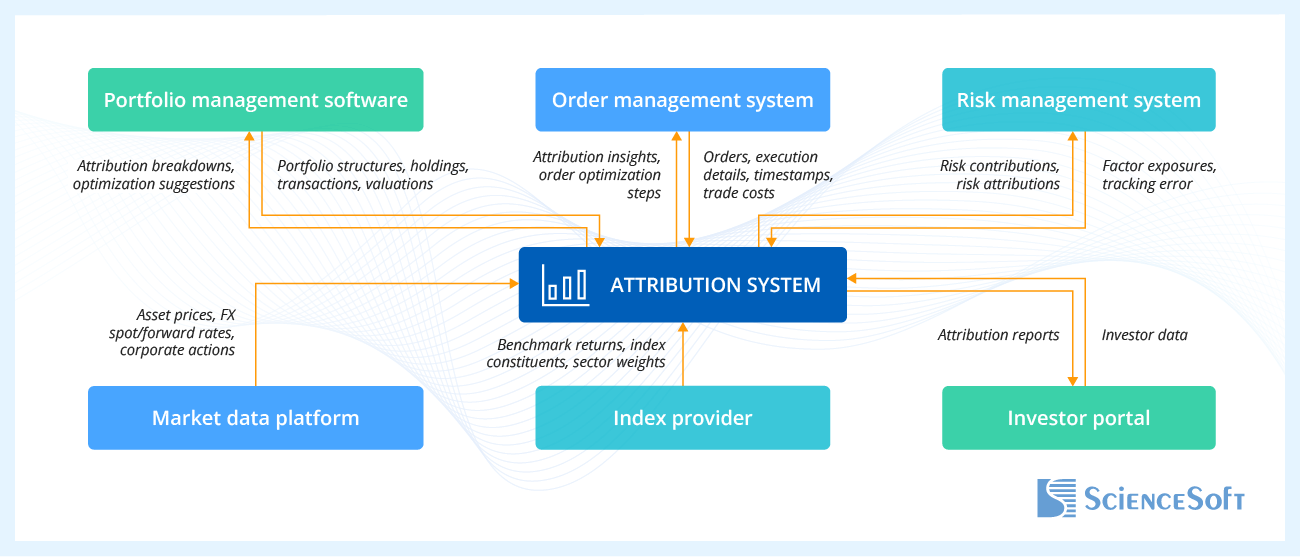
- To align composite design and portfolio attribution analysis with preset portfolio structures.
- To quickly access performance data required for attribution estimates.
- To feed attribution insights into portfolio optimization decisions.
NB: If you manage valuations and IBOR/ABOR in a dedicated accounting system, you’ll require integration with that software as well.
- To factor trade timing, costs, and venue choices when assessing transaction-level asset allocation attribution.
- To share analytical results and optimization suggestions for higher-return investment ordering.
Risk management system
- To swiftly aggregate data on live factor exposures.
- To fuel risk models with up-to-date attribution insights and support proactive risk mitigation strategies.
Financial market data sources
E.g., Bloomberg, Refinitiv, ICE platforms
- For consistent asset pricing and FX rates across investment return calculations.
- To consider market behavior in attribution analytics.
- To estimate currency contributions for multi-currency portfolios.
Benchmark data sources
E.g., MSCI, FTSE Russell, S&P, Dow Jones databases
- To attribute returns and analyze allocation and selection effects against up-to-date benchmark data.
- For streamlined composition of tailored benchmark blends.
- To auto-populate personalized attribution reports with investor data.
- For quicker delivery of attribution reports to investors.
- To provide dynamic attribution reporting via in-portal dashboards.
NB: If you don’t offer a portal, consider integrating the solution with your CRM.
Steps to Develop Software for Performance Attribution Analysis
Below, ScienceSoft’s Project Management Office shares a roadmap and best practices for implementing custom attribution software within predictable timelines and budget limits.
1. Software requirements engineering
Investment software consultants interview an investment company’s project stakeholders to elicit requirements for the capabilities of the new performance attribution solution. They analyze the firm’s current performance and attribution analysis workflows to discover pain points and opportunities for improvement. This often involves auditing the company’s analytical toolkit and data models. Consultants at ScienceSoft additionally interview target business users of the solution (portfolio managers, investment analysts, etc.) to grasp users’ real operational hurdles and needs and define high-value features.
At this stage, it’s also essential to map out compliance requirements for the performance attribution solution. Compliance consultants surface relevant data protection standards (e.g., GLBA, NYDFS, GDPR) and operational regulations (e.g., SEC, GIPS, FINRA, MiFID II) to ensure compliant software design from the outset.
Based on the collected information, consultants compose a detailed software requirements specification (SRS). The SRS comprises all functional requirements (automated attribution workflows, configuration options, etc.), data requirements (e.g., reference data sources, frequency of updates), and non-functional needs like data traceability and user access controls.
|
|
A well-documented SRS creates a clear vision of the attribution software for project participants and ensures everyone is on the same page about the project’s goals. Here’s how ScienceSoft approaches documenting important project decisions to prevent misaligned visions and moves. |
2. Data architecting
Data architects design how data will flow through and reside within the performance attribution system. This includes defining how the software will collect raw input data (e.g., transactions, asset prices, benchmark indices) from internal systems and third-party sources, how it will cleanse, validate, and enrich that data, and where the analytics-ready data and analytical results will be stored. ScienceSoft opts for tailored storage spaces for various data types (e.g., a data warehouse for pre-processed data, a time-series database for time-stamped attribution outputs) to reduce storage costs and enhance data retrieval speed. Establishing data lineage pipelines ensures each data point across the system can be tracked back to its origin.
Security must be baked into the data architecture by design to protect sensitive investment and client data. At ScienceSoft, this stage includes planning data encryption (for data at rest and in transit), user authentication, role-based access control, and network safeguards.
|
|
Methods for integrating data that powers attribution analysis can vary depending on the data type and source. Our data architects prepared an overview of best practices for selecting the optimal data integration strategies for faster, cheaper, and more accurate analytics. |
3. Analytical model design
Data scientists design the analytical algorithms that will perform performance attribution calculations. Using pre-built attribution models and formulas where possible helps ensure the analysis is grounded in recognized methodology and accelerates logic design.
Yet ScienceSoft’s experience shows that out-of-the-box components alone rarely fully meet attribution analysis needs, especially in factor-based attributions where return drivers vary among investment firms. In this scenario, we construct custom models with bespoke attribution logic and configurable input and output parameters. Our data scientists configure calculation frequency (intraday, daily, multi-period, etc.) and optimize the algorithms for smooth performance across potentially large portfolio and benchmark datasets.
If you want AI-supported insights, this stage also covers designing machine and deep learning models for performance attribution analysis. Addressing the need for transparent model logic, data scientists at ScienceSoft create explainable AI algorithms that provide clear, traceable reasoning behind their analytical outputs.
|
|
Feedback from investment SMEs can reassure data scientists that the attribution analysis results make business sense. For example, portfolio analysts can review model assumptions and confirm their alignment with industry conventions, or check sample intelligent outputs and challenge logic clarity. Involving domain SMEs in logic validation is how ScienceSoft ensures the accuracy of complex financial solutions such as investment attribution analysis software. |
4. Technical design
During this stage, solution architects design the overall architecture of the performance attribution software, including its integrations with the required systems. ScienceSoft’s architects often recommend layered modular designs for investment analytics solutions. With such architectures, solution components (data import, analytics engine, reporting UI, etc.) can be built, deployed, and upgraded independently. For example, in a microservices design, a benchmarking engine might be containerized so it can be scaled horizontally if computation needs spike, and a reporting module might be built as a plugin that can be swapped out for a more advanced one later. By supporting easy software scaling and evolution, modular architectures help extend the useful life of attribution analysis solutions.
The interactions between solution components and with external systems are defined through reusable APIs and messaging workflows. Since investment attribution software requires connectivity to multiple data sources, it makes sense to opt for an API-first design, where integrations are planned before any other software parts. Such an approach promotes solution interoperability and optimizes integration efforts.
The tech stack is chosen to fit specific non-functional (performance, scalability, latency, security) requirements for the attribution solution. Architects at ScienceSoft also consider the specifics of the client’s IT ecosystem. For example, if the investment firm’s IT environment is primarily Microsoft-centric, we favor .NET technologies and Azure cloud services that would ensure less integration complexity and lower licensing costs. Check how applying this approach helped us cut the TCO of the analytics system for a US hospitality investor.
|
|
Using out-of-the-box logic building blocks, third-party cloud services, pre-built APIs, and OOTB deployment scripts where possible can minimize the share of costly custom code and speed up attribution software engineering. Discover ScienceSoft’s dedicated page for more details on this and other proven practices to optimize development cost. |
5. UX and UI design
UX and UI designers map out user journeys and create interfaces tailored to the needs of specific user roles. Prioritizing straightforward navigation and clean layouts ensures users can quickly switch between data views, dashboards, and report sections. In practice, this means applying configurable modal windows and context-aware widgets, providing toggles and drill-downs, and using visual cues like color coding and contextual tooltips. Most of these components can be reused from all-purpose UI libraries like Microsoft Power BI. As for specific cases like visualizing performance metrics and attribution waterfalls, ScienceSoft’s UX/UI designers usually customize ready components from specialized libraries like Highcharts and Syncfusion to minimize design overhead.
Our designers also involve actual users in the design process through usability testing with clickable prototypes. By getting early user feedback, the team can discover if proposed data hierarchies, navigation flows, and layouts align with user expectations and work habits and can further refine them for higher convenience.
|
|
By the end of the UX/UI design phase, project managers have enough insights to scope software engineering tasks, compose the team, and precisely estimate development time and cost. Explore ScienceSoft’s knowledge base on PM best practices to learn how to organize project management properly and drive consistent and predictable delivery. |
6. Development and quality assurance
Developers code the back end of the performance attribution system (including analytics engines, data integration pipelines, APIs, and connectors), create user interfaces, and set up tiered storage for reference and analytical data. Following secure coding standards like OWASP ASVS helps minimize bugs and reduce vulnerability risks.
The development process is usually iterative, with every iteration covering the testing (functional, security, usability, etc.) of the newly built attribution features. To support this iterative, test-driven approach and leverage test automation, it’s important to adopt DevOps practices. Development automation ensures frequent, reliable releases and contributes to higher software quality since issues are caught early. At the same time, DevOps engineers at ScienceSoft always look at the economic side: if certain rare tasks are costly to automate, we opt to handle them manually to optimize development budget.
During this stage, the team also integrates the attribution analysis solution with the required systems. Rigorous integration testing is a must to confirm that investment data retains its accuracy and integrity when moving between systems. ScienceSoft’s engineers validate each integration for specific issues like missing and mismapped data, API rate limits, and failed encryption on data transfers so that no silent failures are undermining the analytics.
|
|
Iterative development methodologies let you adapt to changing requirements midway without costly rebuilds, but you need robust change control mechanisms to protect against scope and schedule creep. Check how ScienceSoft approaches change request processing to agilely implement feasible adjustments while preventing project time and cost inflation. |
7. Deployment and support
Engineers configure performance attribution software infrastructure, set up application performance monitoring, event logging, and security monitoring tools, and deploy the ready-to-use solution in production. ScienceSoft technical teams usually conduct a pre-launch compliance audit to confirm that all access controls, technical safeguards, and data management policies are implemented correctly.
Running user acceptance testing (UAT) before go-live helps verify that the attribution software works as intended in a real context. At ScienceSoft, we focus on test cases that reflect regular user workflows (e.g., loading a new set of portfolio data, generating a monthly attribution report) and include edge cases (e.g., handling a portfolio with no history, entering atypical attribution factors) to ensure the system behaves reliably in non-standard, error-prone scenarios.
Once your attribution analysis solution is launched, you need to set up its maintenance and support to ensure smooth software functioning and quick resolution of user issues. Explore ScienceSoft’s dedicated guide to learn the key steps, necessary skills, and sourcing options for organizing smooth support and maintenance processes.
|
|
Loss of project knowledge drastically complicates software maintenance and evolution, so it’s critical that your development vendor shares all critical technical information with the support team before leaving the project. To help you understand what to expect from the vendor during handover, here are some knowledge transfer best practices that our teams follow. |
Costs of Investment Performance Attribution Solutions
Developing custom software for investment performance attribution may cost from $150,000 to $700,000+, depending on the solution’s functional scope, the number and complexity of integrations, as well as performance, scalability, security, and compliance requirements.
Here are ScienceSoft’s sample cost ranges:

$150,000–$250,000
Basic attribution analytics software that:
- Estimates historical performance attribution across one asset class, e.g., funds or equity.
- Supports standard-only attribution measurement models.
- Integrates with 1–2 key data sources.
- Offers batch data processing (e.g., every 12 hours).
- Features pre-built customizable attribution report templates.

$250,000–$400,000
A custom attribution analysis solution that:
- Calculates performance and attribution across 2–7 asset classes.
- Integrates with 3–5 corporate and external systems.
- Enables batch and real-time data processing.
- Enables attribution analytics using tailored statistical and non-neural-network ML models.
- Provides a no-code template builder to create custom attribution report forms from scratch.

$400,000–$700,000+
A large-scale analytics system that:
- Supports 7+ asset classes and multi-asset composites.
- Covers the entire scope of performance attribution metrics, as well as risk and ESG attributions.
- Integrates with multiple back-office and third-party systems, including blockchain solutions.
- Features real-time analytics for instant attribution calculation.
- Offers intelligent attribution analysis using deep learning models.
- Provides interactive data visualizations and automated generation of complex reports.
Wondering how much your project will cost?
Use our online calculator to share your needs, and we'll get back to you shortly with an estimate. It’s free and non-binding.
Why Build Performance Attribution Software With ScienceSoft
-
Since 2007 in engineering custom solutions for the investment industry.
- Since 1989 in data analytics and AI to deliver intelligent software for financial performance measurement and attribution.
- Investment IT and compliance (SEC, FINRA, GLBA, GDPR, SOC 2, etc.) consultants with 5–20 years of experience.
- 45+ certified project managers (PMP, PSM I, PSPO I, ICP-APM) with experience in large-scale projects for Fortune 500 companies.
- Principal architects with hands-on experience in designing complex investment analytics solutions and driving secure implementation of AI technologies.
- 550+ software engineers, 50% of whom are seniors or leads.
- ScienceSoft served one of the world's top 3 asset managers with $5T+ in AUM.
Partnerships and recognitions









ScienceSoft’s Clients Say


Our collaboration was a true partnership. The team was open, attentive to our requirements, and accurate in addressing them. The delivered solution is exactly what we needed.



ScienceSoft came up with a go-to architecture, features, and tech stack and introduced a roadmap for app implementation. We appreciated their approach to consulting and mature project management culture.


ScienceSoft brought to the table truly customer-centered approach to app design. We especially appreciate their professional approach to security issues, which were among our main concerns due to strict regulations.