ScienceSoft Global



Artificial Intelligence (AI) for Insurance Policy Administration
Capabilities, Implementation Best Practices, Costs
In artificial intelligence since 1989 and in insurance IT since 2012, ScienceSoft helps insurers identify high-value AI opportunities and implement practical AI transformation programs across their policy administration workflows.
Contributors

Senior Insurance IT & AI Consultant, ScienceSoft

Head of AI, Principal Architect, ScienceSoft
AI for Insurance Policy Administration: Short Summary
Artificial intelligence (AI) for insurance policy administration is uniquely positioned to automate complex policy issuance, billing, endorsement, renewal, customer servicing, and portfolio analytics operations that have historically relied on human judgment and couldn’t be handled by static tools.
Modern AI technologies can process unstructured data, interpret context, deliver on-demand conversational assistance to policy administrators and policyholders, and coordinate multi-step policy workflows involving judgment, exceptions, and incomplete information.
Insurers increasingly pursue AI solutions for policy administration to accelerate policy processing, deliver faster and more consistent policy servicing, and scale policy operations without proportional growth in administrative costs.
- Key integrations for policy administration AI solutions: core insurance systems (policy administration, underwriting, claims), customer and producer servicing channels, the insurer’s knowledge bases, governance tools, and more.
- Implementation timelines: 3–8 months for a task-specific policy administration AI solution, 9–24+ months for broader workflow transformation.
- Engineering costs: $150,000–$1,500,000+, depending on the scope of AI transformation. Use our free calculator to estimate the cost for your case.
AI Technologies Insurers Use to Transform Policy Administration

Assistive AI
Technology powering copilots, chatbots, and voice assistants for policy administrators, customers, and producers. AI assistants can retrieve policy data, answer coverage and billing questions, draft policy inquiries, documents, and communications, and recommend next steps during policy servicing.

Agentic AI
Technology that combines large language models (LLMs) with workflow automation to coordinate and execute multi-step policy administration processes with limited human involvement. AI agents can enforce policy lifecycle events, automate omnichannel customer outreach, and trigger actions across systems.

Analytical AI
Traditional (non-generative) machine learning technology that powers predictive analytics and optimization across policy administration tasks. ML models can forecast policy volumes and servicing workloads, predict risks and payments, identify upselling opportunities, and support portfolio and operational planning.
Agentic automation of policy workflows is rapidly becoming the target operating model for many insurers. What sets agentic AI apart is its ability to complete end-to-end policy administration processes rather than isolated tasks. This minimizes the friction and delays typically associated with manual handoffs between employees and systems. AI agents can also build on your existing AI copilots, machine learning models, and rule-based engines, allowing you to preserve and expand your technology investments.
Many carriers we work with are already exploring how to transform policy administration with agentic AI. Yet in our projects, we rarely recommend starting with fully autonomous agentic workflows. A safer approach is to introduce AI progressively, from assistive capabilities to increasingly autonomous agentic processes. This allows AI controls and employee trust to mature alongside the technology, creating a sustainable path toward end-to-end policy automation with lower operational risk.
Business Impact of AI in Insurance Policy Administration
From ScienceSoft's experience, early financial outcomes of AI adoption in policy administration typically come from the following:

Operational cost avoidance
Fast and accurate AI-supported processing of policy data and requests helps insurers cut costs of potential manual errors and delays.
Greater employee capacity
With AI automation, policy administration teams face less routine and can handle more complex work with the same headcount.
Premium retention
Consistently responsive AI-powered servicing and proactive renewal outreach improve policyholder satisfaction and reduce lapse risk.
Here's how AI transformation has translated into measurable results for early adopters:
- Encova Insurance achieved a 98% reduction in time spent on policy data intake and a 95% reduction in commercial-line endorsement processing time by implementing an AI platform that combines intelligent document processing with workflow automation.
- A US insurer working with WNS (part of Capgemini) achieved 99% data extraction accuracy and 57% faster turnaround for customer-initiated policy adjustments with a proprietary AI/ML solution that automatically captures and processes ACORD 175 and policy change request forms.
- Case studies from ASAPP, a provider of commercial voice AI agents, show that agentic AI can autonomously handle more than 60% of data-heavy policy servicing tasks, including updating customer data, policy reissuance, and renewal outreach, and cut operational cost per policy update by up to 50%.
Insurance Lines of Business That Benefit From Policy Administration AI






What AI Can Do in Insurance Policy Administration
Below are the key activities AI can support across insurance policy administration workflows. ScienceSoft can engineer selected AI components and integrate them into your existing policy administration system (PAS) or deliver a standalone, scalable AI layer that transforms administration tasks across the entire policy lifecycle.

Policy issuance
Policy administrators can configure custom triggers for policy issuance, such as underwriting approval, binder issuance, or premium payment arrival. AI agents can capture these business events and initiate automatic policy issuance. They retrieve binding data from connected systems and generate policies, declarations, certificates of issuance, and specialized coverage documents using standard forms (e.g., ACORD forms) or carrier-specific templates. Agents then either route the policy package for approval and e-signing or complete straight-through issuance, depending on the insurer's rules. Once a policy is approved, the agents activate it in the PAS and distribute issued documents to customers and producers.

Policy change and endorsement processing
AI agents can automatically intake and process multi-format policy adjustment requests arriving through multiple digital channels, including emails, portals, and call center systems. The requests can be related to endorsements, policyholder information updates, beneficiary changes, insured object modifications, cancellations, and other policy amendments. The agents validate requests against policy and product rules, identify and collect required documentation, and coordinate change approvals when necessary. For eligible adjustments, the agents update policy and customer records across systems, initiate billing adjustments, generate revised policy documents, and notify customers, brokers, and internal teams.

Policy renewal
AI agents can continuously monitor policy expiration dates and orchestrate the entire renewal workflows. They can coordinate risk reassessment and underwriting activities, generate personalized renewal offers and quotes from preset templates, and proactively engage policyholders through their preferred communication channels (send in-portal messages, make consented calls, etc.). Depending on the policyholder’s decision, agents then activate renewed policies or cancel coverage. During the renewal process, agents can invoke machine learning engines to analyze customer behavior, coverage utilization, and risk profiles, predict renewal likelihood, and identify cross-sell and upsell opportunities.

Policy billing
Depending on the policy lifecycle event, agents can calculate initial and prorated premiums, refunds, commissions, taxes, and other policy-related charges. To prevent financial errors and hallucination risks associated with LLMs, we design billing agents to use rule-based engines and insurer-specific formulas. The agents can also generate invoices, distribute them on schedule, and initiate payment collection through supported payment methods. After payment arrival, they reconcile transactions, resolve routine gaps automatically, and escalate complex cases to billing specialists. Machine learning models can be involved to predict payment delays and recommend practical collection actions.

Document and communication drafting
Policy administrators can ask AI copilots to draft tailored templates for policy documents, renewal packages, customer and producer communications, and other insurance content. The copilots adapt the language to different insurance products, jurisdictions, audiences, and communication channels while following case-relevant regulatory requirements, approved content templates, and brand guidelines. Employees receive the content in the requested format and retain the authority to review and finalize it before distribution. Agentic assistants can also trigger automatic distribution of approved documents and messages across insurance systems and interaction channels.

Policyholder servicing and assistance
Customer-facing AI assistants can handle routine policy servicing requests across digital channels (websites, customer portals, email) and call centers through chat and voice interactions. They can interpret free-form questions about policy terms, premiums, renewals, endorsements, and cancellations and deliver responses in plain language. When an assistant doesn’t have an answer or isn’t certain enough, it summarizes conversations and escalates requests to human representatives based on preset handoff rules and confidence thresholds. Agentic assistants can automatically create service tickets, schedule callbacks, and execute authorized service requests.

Policy analytics
Machine learning analytics engines can analyze policy portfolios and identify performance trends across insurance products, lines of business, customer segments, and jurisdictions. Predictive ML algorithms can dynamically forecast policy volumes, renewals, lapses, premiums, servicing workloads, and operational capacity requirements. Based on these insights, they can identify opportunities to improve portfolio profitability, optimize policy administration operations, and support product expansion. Adding an analytics copilot interface enables policy administrators to query analytics, interpret model outputs, and compile reports through natural language conversations.

Policy workflow orchestration
Unlike traditional automation tools that follow pre-programmed execution paths, AI agents can dynamically coordinate policy administration workflows based on the available data, business context, and insurer-defined rules. A dedicated orchestration agent determines which specialized agents, copilots, models, rule-based engines, insurance systems, and human specialists should participate at each policy processing stage and enforces interactions between them while adhering to human-defined boundaries and governance controls. AI agents can autonomously prepare the required inputs and call APIs to execute actions across connected systems and business services.

Policy data security
Insurers can apply AI to monitor how policy data is accessed, processed, and shared across administration workflows. AI security engines can verify user identities and permissions, detect unusual data access patterns and potential data leakage, and notify security teams about suspicious activities. They can also enforce insurer-defined data handling policies and case-relevant data protection requirements (GLBA, HIPAA, NYDFS, and more) and monitor the compliance of policy data exchange across connected systems. The same engines can also enforce permission-based access to policy data for AI agents.

Operational compliance
During ongoing policy administration operations, AI-powered compliance engines can monitor the adherence of employee activities, policy documents, and operational logs to the insurer’s internal policies and applicable regulations (NAIC, state DOI, TCPA, and more). The engines can detect issues related to document completeness, policy issuance timelines, disclosures, consents, servicing procedures, and regulatory deadlines and trigger breach alerts. Compliance teams can use AI copilots to explain violations and draft audit reports, investigation summaries, and regulatory submissions in approved forms.
AI agents are remarkably effective at coordinating end-to-end workflows, but they are only one part of the policy workflow execution model. They rely on insurer-defined rules to determine which actions can be executed autonomously, which require deterministic validation, and which must be escalated for human review. Defining these operational controls is one of the first activities in our AI projects because they determine how AI agents are designed, integrated, and allowed to operate throughout the policy lifecycle.
A sample agentic AI workflow
The workflow below illustrates how specialized AI agents handle multi-step policy servicing operations, access the insurer’s systems and proprietary knowledge, validate outputs, and involve human experts when necessary.
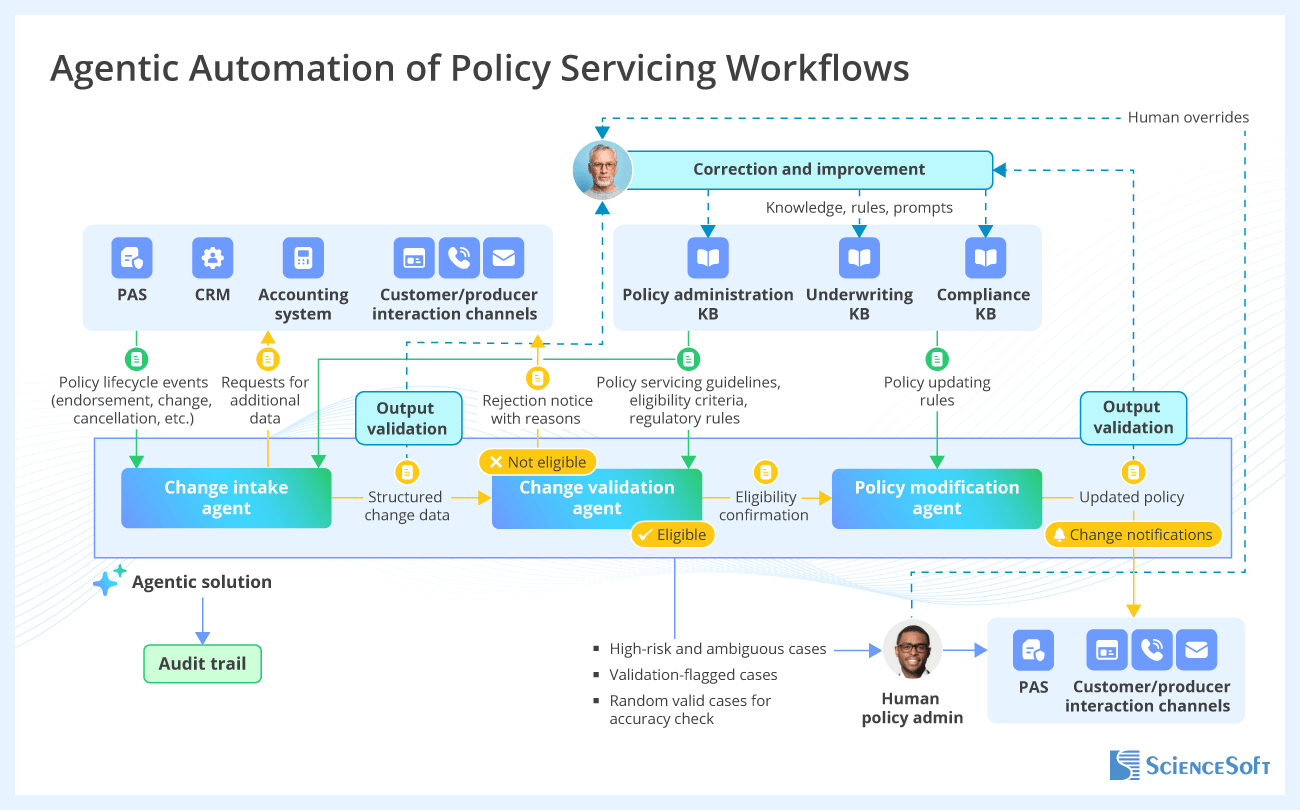
The change intake agent monitors policy lifecycle events and servicing requests originating from the insurer’s operational systems and communication channels. When a policy change is initiated, the agent interprets the request, extracts structured change data, validates input completeness, and requests additional information when needed.
Next, the change validation agent verifies the requested policy change against the insurer's eligibility criteria, business rules, and regulatory requirements. Eligible requests proceed automatically, while those requiring additional attention are routed for clarification, escalated to a policy administrator, or rejected with an explanation, according to the insurer's rules.
For eligible changes, the policy modification agent updates policy records in the PAS, generates revised policy documents and notifications, distributes them through customer and producer communication channels, and closes the servicing request.
To support internal governance and regulatory reviews, the system maintains a complete audit trail of every agentic workflow. Throughout the workflow, output validation mechanisms verify AI outputs and escalate high-risk and randomly sampled transactions for human review. Feedback from policy administrators is used to refine prompts, business rules, and knowledge bases, improving agent performance over time.
Practical Starting Points for AI in Policy Administration
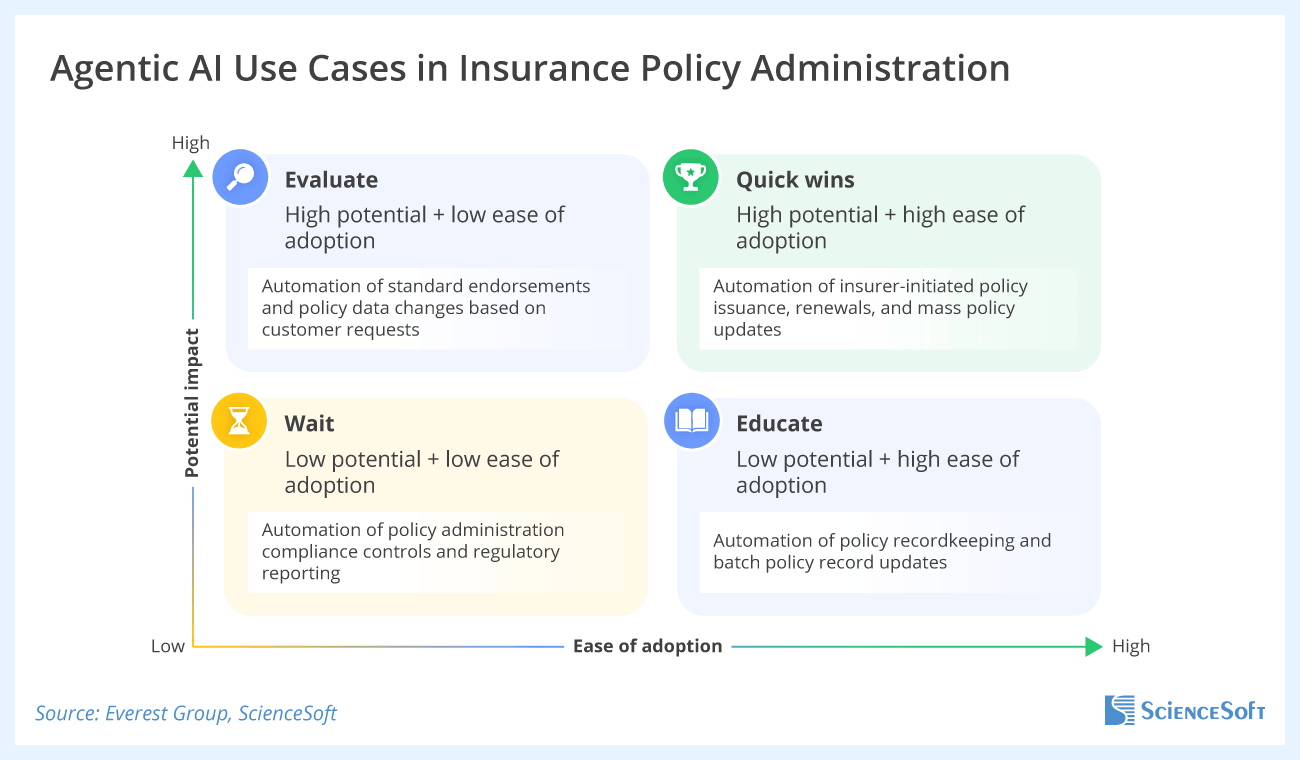
The best entry points for AI automation are routine, internally triggered workflows, such as renewals, scheduled policy updates, and standard endorsements. In these processes, business rules are well defined, the required data is already available across your systems, and the number of exceptions is relatively low. This minimizes operational risk and lets you realize value quickly through faster policy servicing and greater admin productivity.
Customer-initiated policy requests are a more complex area to automate. Here, you need AI to accurately interpret customer intent, verify identity and authorization, collect missing data, and determine when a request should be escalated to a human outright. I recommend introducing these capabilities after you prove mature governance and human-in-the-loop controls for agentic workflows and build admin trust in simpler AI operations.
Compliance use cases should be automated selectively. AI can definitely support compliance control, evidence collection, deadline tracking, and document drafting. At the same time, final reviews, decisions, and submissions must remain with your compliance specialists. These processes have legal and regulatory implications and require explicit human accountability.
The matrix below is based on an agentic AI adoption framework originally developed by Everest Group and expanded by ScienceSoft's consultants. It categorizes agentic AI use cases in policy administration by potential business impact and ease of adoption, providing a practical roadmap for prioritizing AI implementation.
Important Integrations for Policy Administration AI Solutions
ScienceSoft typically recommends integrating policy administration AI solutions with the following groups of systems to support end-to-end policy workflows. The actual integration scope depends on the AI capabilities you implement and your existing technology landscape.
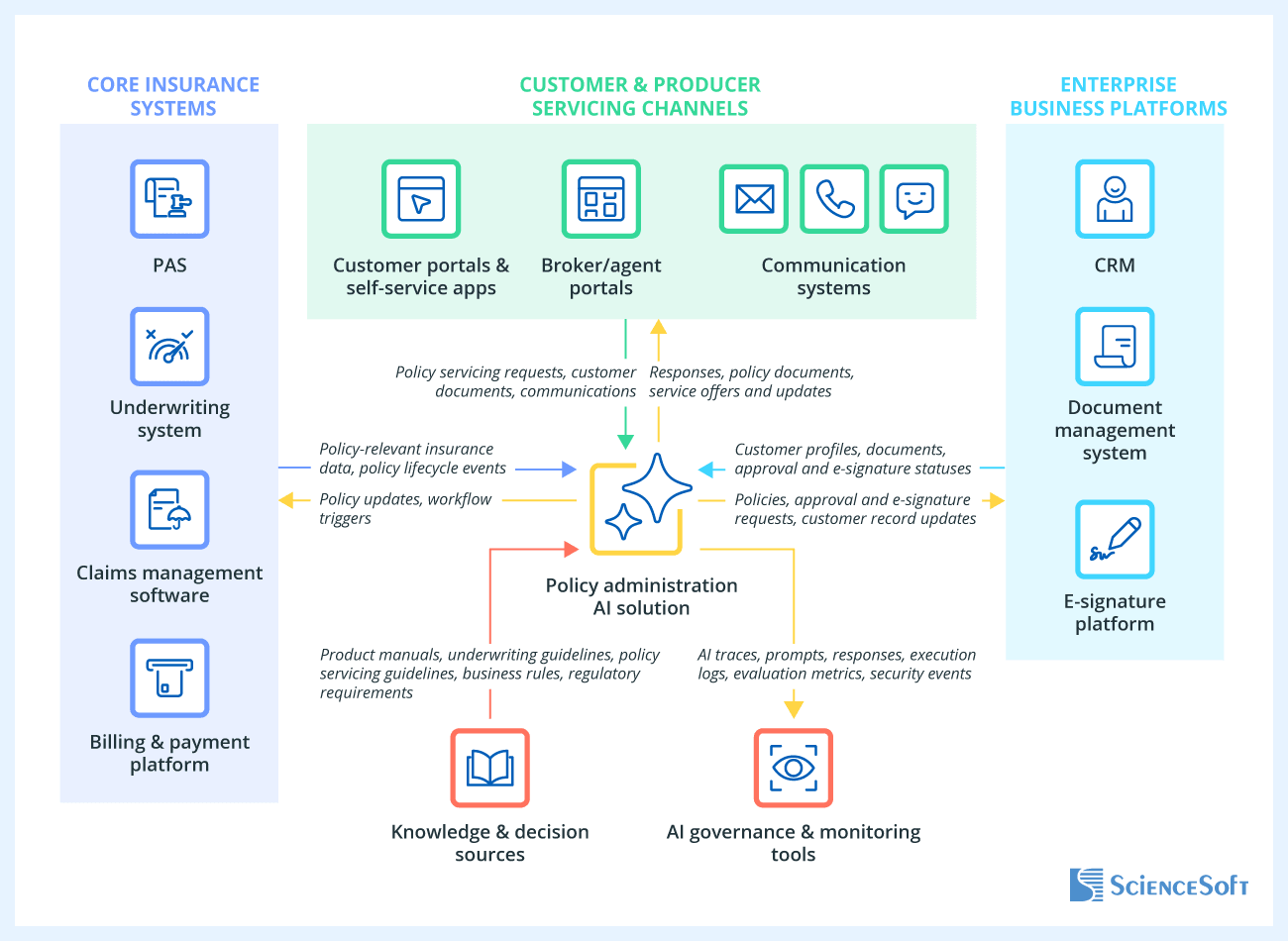
- Core insurance systems (a policy administration system, an underwriting system, claims management software, a billing and payment platform) – to retrieve policy-relevant insurance data, capture policy lifecycle events, execute policy administration transactions, and synchronize policy updates across core insurance operations.
- Customer and producer servicing channels (customer portals and self-service apps, broker/agent portals, email systems, call center systems, IVR bots, chatbots, SMS services) – to intake policy servicing requests, communicate with policyholders and producers, and deliver AI-generated responses, policy documents, renewal offers, and service notifications.
- Enterprise business platforms (CRM platforms, document management systems, e-signature platforms) – to access customer data and business documents required for policy operations, route approval and e-signature workflows, reflect policy changes in customer records, and store policy documents.
- Knowledge and decision sources (product, policy, underwriting, and compliance knowledge bases, business rule engines) – to ground AI responses in the insurer’s proprietary knowledge, validate policy decisions against insurer-specific business rules, and generate compliant policy documents and communications.
- AI governance and monitoring tools (AI observability platforms, prompt management tools, audit logging tools, security monitoring systems) – to monitor AI performance, backtrace agentic execution paths, evaluate output quality, detect security risks, and maintain audit evidence.
Ways to Get AI Into Your Policy Administration Workflows
|
|
Deploying commercial AI tools |
Building custom AI capabilities |
|---|---|---|
|
Essence
|
You adopt AI capabilities available with your PAS suite (e.g., Guidewire, Duck Creek) or deploy a specialized AI product (e.g., UiPath Agentic Automation, Salesforce Agentforce) and integrate it with your systems. |
You engineer a target AI solution (an agentic layer, an AI assistant, etc.), governance mechanisms, and integrations specifically for your policy administration processes, business rules, and technology landscape. |
|
Benefits
|
Fast implementation, relatively low upfront investment, proven functionality, vendor support, and continuous AI product updates. |
Tailored AI capabilities, support for your specific products and workflows, full control over governance and integrations, and the flexibility to evolve AI in line with your business needs. |
|
Limitations
|
AI capabilities, workflows, and integrations are defined by the vendor. Customization can be costly or technically constrained, especially for end-to-end policy workflows. |
Higher upfront investment and longer implementation. Responsibility for AI testing, governance, maintenance, and continuous improvement remains fully on your side. |
|
Best for
|
Insurers looking to automate standard policy administration tasks or introduce AI with customization-only effort. |
Insurers seeking highly specific AI capabilities or pursuing complete transformation of policy administration through AI. |
Going custom doesn't mean building every AI component from scratch.
There are mature AI frameworks and managed services that provide reusable components and prebuilt integrations with leading LLMs for developing tailored agents and assistants. For example, we often use LangGraph and Amazon Bedrock AgentCore to build multi-agent systems and Microsoft Copilot Studio or the OpenAI Agents SDK to engineer AI assistants. For AI controls, we rely on specialized observability frameworks like OpenTelemetry. Reusing proven AI building blocks wherever appropriate lets us minimize unnecessary custom engineering, deliver faster, and focus on the capabilities that create lasting business value — custom automation rules, AI guardrails, integrations, and governance mechanisms.
Best Practices for Policy Administration AI Engineering
Below, ScienceSoft’s experts share their best practices for engineering reliable and cost-effective AI solutions for insurance policy administration.

Layered AI architectures simplify integration with existing systems
A layered AI architecture introduces AI as a separate layer on top of your insurance systems instead of embedding AI logic into one or more enterprise applications. This allows you to add, replace, and scale AI capabilities independently of your core systems, minimizing the need for application changes or costly system replacement.
To further simplify AI integration, ScienceSoft typically implements a dedicated integration layer between AI components and insurance systems. Acting as a single gateway, this layer connects AI agents, copilots, and models with multiple insurance platforms, minimizing point-to-point integrations and making it easier to maintain and add integrations.
Check the layered AI architecture ScienceSoft demonstrated at the Insurance Tech & Innovation Conference 2026 in Chicago to see how this setup facilitates AI deployment across established insurance operations.
Design AI governance alongside intelligent automation
AI governance expectations for insurers continue to grow as more US states adopt the NAIC AI Model Bulletin and introduce local AI legislation. The core governance capabilities you need include human approval checkpoints for high-risk actions, role-based access controls, deterministic validation of AI outputs, audit trails, AI observability, prompt and model versioning, and continuous monitoring for model and workflow drift.
ScienceSoft recommends implementing these capabilities as a separate AI governance layer, decoupled from AI components. This centralizes control mechanisms and makes governance easier to maintain as AI adoption expands and regulatory requirements evolve.
Splitting policy tasks across niche AI agents strengthens governance
Rather than building one AI agent with broad access to all policy administration functions, engineers at ScienceSoft use multiple specialized agents and assign each a narrow responsibility with only task-relevant data and tool access permissions, prompts, and business guardrails. This makes agentic automation easier to govern and minimizes the risk of unauthorized actions.
Taking the sample policy servicing workflow above, a change intake agent would never have permission to update policy records, while a policy modification agent would only work with validated requests. Applying automated redaction of prompt contexts ensures the algorithms behind an agent never see more than they need to perform the task.
Costs of AI Transformation in Insurance Policy Administration
The cost of implementing tailored AI capabilities for insurance policy administration may range from $150,000 to $1,500,000+, depending on the scope of AI transformation, the AI solution’s functionality, the complexity of integrations, as well as performance, scalability, and security requirements.
Below are ScienceSoft’s sample cost ranges for common policy administration AI transformation scenarios. These ranges cover the design and implementation work and exclude third-party component licenses, network fees, cloud hosting, and AI model usage:

$150,000–$250,000
Early AI rollout: assistive capabilities for policy servicing
Solution: A conversational AI assistant that handles routine, low-risk policyholder interactions, such as guiding customers through policy change requests, capturing service requests, collecting missing data, and presenting approved renewal offers. This range assumes one primary digital channel and a limited set of integrations (an existing PAS, CRM, document repository, and a target communication system).

$300,000–$600,000
Transformation of one policy administration workflow
Solution: An agentic system that orchestrates a particular workflow, e.g., policy issuance, renewal, or endorsement processing. It coordinates data and document collection, validation, task routing, and updates across connected systems and routes exceptions and approvals to policy administration staff. The solution includes a copilot workspace, operational monitoring, AI evaluation, and audit trails.

$600,000–$1,500,000
Transformation of multiple policy administration workflows
Solution: The first production release of a multi-agent enterprise AI and orchestration layer supporting several selected policy workflows. It captures and analyzes policy events, recommends next-best actions, executes permitted steps, and initiates automation through the connected systems, adhering to the insurer’s business rules, exception-handling guidelines, and human approval gates.
Wondering how much your AI project will cost?
Use our online calculator to describe your needs, and we'll get back to you shortly with a tailored estimate. It’s free and non-binding.
* The estimates are for midsize insurance organizations (<2,000 employees) serving 1–3 major lines of business. The final implementation cost will depend on the insurer’s specific needs and the maturity of the organization’s IT, data, and governance environments.
Why Implement Policy Administration AI With ScienceSoft
- Since 1989 in AI consulting and implementation.
- Since 2012 in delivering digital transformation for the insurance industry.
- Insurance IT, AI, and compliance consultants with 5–20 years of experience and expertise in insurance regulations (NAIC, state DOI rules), data exchange and interoperability standards (incl. ACORD data models and messaging standards), and data protection frameworks (NYDFS, CCPA/CPRA, GLBA, HIPAA, GDPR).
- Principal architects with hands-on experience in designing complex insurance automation systems and driving secure implementation of AI technologies.
- 350+ software engineers, 50% of whom are seniors or leads.
- 45+ certified project managers (PMP, PSM I, PSPO I, ICP-APM) who succeeded in large-scale projects for Fortune 500 firms.
- Established practices to ensure the high quality of insurance AI solutions and their delivery on the agreed timelines and budget, despite project constraints or uncertain requirements.





ScienceSoft’s clients say


ScienceSoft are responsive, technically sharp, and they communicate well with our people. When we've needed to move fast, they've stepped up and delivered. What I appreciate most is their proactive approach. They don't just wait for us to identify issues. They bring solutions to the table and help us prioritize what matters most. That kind of partnership is hard to find.


Partnering with ScienceSoft has been an excellent experience. Their team transformed our underwriting platform into a well-oiled machine. They identified and fixed several longstanding issues that had been causing us persistent difficulties. Their communication was exemplary; unlike our previous experiences with outsourcing, we never had to chase them for updates, and they were always prompt in responding to our queries.

Damien Sewell
Head of IT Projects

ScienceSoft’s quick buy-in and readiness to take the initiative made the project faster and less stressful for everyone involved, from Capital IM’s insurance specialists to leadership. At the end of a short yet highly productive two months, we got a secure and wholly owned property insurance solution that is fully adapted to Capital IM’s corporate practices and brand book. We couldn’t have asked for a better IT partner.