 ScienceSoft Global



Insurance Agency Management Software
Capabilities, Development Best Practices, Costs
ScienceSoft engineers custom insurance agency solutions that address the functional and compliance limitations of off-the-shelf platforms. Our clients get secure, interoperable solutions that can quickly adapt to evolving products, distribution models, and regulations while supporting efficient agency workflows and predictable TCO.

Contributors

Senior Insurance IT & AI Consultant, ScienceSoft

Insurance IT & AI Consultant and Lead Business Analyst, ScienceSoft
Insurance Agency Management Software: Key Aspects
Insurance agency management software (AMS) automates core agency operations, such as quoting, policy and claim servicing, commission tracking, and renewals. ScienceSoft can develop custom insurance agency management software with commission management functionality.
Such solutions can provide a centralized workspace for managing customers, policies, transactions, and agent activities and include self-service features for customers and agents. ScienceSoft can develop custom insurance agency management software to help agencies manage policies and clients.
- Key integrations for an insurance agency management system: application platforms, carriers’ systems, rating engines, CRM, accounting software, and more.
- Implementation time: around 7–15 months for the first release (core software modules).
- Development costs: from $120,000 for a focused process improvement module to $2,000,000+ for a large-scale agency management platform. Use our free calculator to estimate the cost for your case.
Why Insurance Agencies Go for Custom AMS Solutions
Popular insurance agency management platforms like Applied Epic, Vertafore, and EZLynx provide robust out-of-the-box capabilities, but growing agencies often face operational challenges that require non-standard functionality: connecting with multiple carriers, managing commissions across diverse distribution channels, documenting E&O-sensitive activities, supporting customer self-service, and establishing governance for emerging AI tools. Some agencies encounter a different problem: their legacy custom AMS has become difficult to extend, integrate, or scale, prompting digital transformation initiatives.
When off-the-shelf AMS platforms or legacy custom tools cannot fully support an agency’s distribution models, carrier relationships, servicing workflows, or integrations, midsize and large firms pick one or several of these custom development paths:
- Build a targeted custom module to fix the costliest operational issues first. This approach lets agencies automate high-friction processes like submission intake, quoting, renewal handling, or commission reconciliation without replacing the entire AMS and compromising logic customization.
- Launch self-service solutions for agents and customers to cut servicing load. Agencies often take this path to transition to digital-first distribution and servicing models. This is also a common path for agencies that want to deploy artificial intelligence (AI) for multi-modal assistance and automated communication.
- Add a workflow orchestration layer that automates the agency’s digital operations across multiple platforms. For example, when you have a bunch of good internal systems you don’t want to replace, but the data exchange between them is still largely manual, you can just tie them all together into cross-system automated workflows instead of building new solutions.
- Build integrations and shared data flows to synchronize insurance data across agency, carrier, customer-facing, and market-making systems and support real-time operations. Custom integration layers allow you to connect an existing AMS to any necessary software, including legacy agent and carrier systems, rating services, and niche distribution facilities.
- Engineer a full-scale custom insurance agency software when off-the-shelf suites appear too rigid or too expensive to adapt to the agency’s products, distribution programs, carrier arrangements, MGA/wholesale workflows, service models, commission hierarchies, legacy system constraints, or compliance requirements.
- Gradually modernize a legacy AMS, which can include refactoring legacy code, re-architecting the system, moving it to the cloud, improving data quality, and building APIs. Agencies often choose this path when their existing custom platform still supports core operations but creates bottlenecks for innovation, integrations, growth, or digital servicing.
Major ROI Drivers for Insurance Agency Software Solutions
Drawing on previous insurance software projects and proprietary research, ScienceSoft’s consultants forecast the following results from custom AMS implementations for midsize and large P&C insurance agencies:
Sources: McKinsey, BCG (1, 2), ScienceSoft.
Functionality of Insurance Agency Management Software
Below are the core capabilities of an insurance agency management platform. ScienceSoft can add these functions to your existing AMS, build a module or a standalone solution for a specific task area, or develop full-featured software for end-to-end automation of agency workflows.

Agency operations management
Agency managers can set up agent task templates for common processes, schedule sales and servicing activities, and automatically distribute tasks based on employee role, qualification, workload, and location. Then, your AMS platform can track tasks and deadlines in real time and trigger reminders and escalation flows for overdue actions. AMS can also automate agent onboarding, certification tracking, training assignments, and progress monitoring following the agency’s internal workforce policies.

Insurance application processing
AMS solutions can automatically capture insurance applications across digital sales channels, extract and structure applicant and risk data, and auto-populate internal submission forms. Branch and field agents can also manually file application forms and upload supporting documents ad hoc based on customer input. In both cases, data validation engines flag any missing information and trigger data requests. A custom AMS can also pre-screen submissions against carrier appetite rules and eligibility criteria to help agencies filter out ineligible risks early.

Rate discovery and quoting
For independent agencies, AMS platforms can retrieve rates from multiple carriers across comparative rating platforms and third-party databases by applying predefined risk and coverage criteria. They can build side-by-side rate comparisons and show optimal carriers and coverage structures based on preset selection rules. Agents can generate quotes from custom templates, auto-convert carrier quotes into branded proposals, and instantly deliver quotes to prospects. For captive agencies, an AMS can automate submission placement with the parent carrier and import quotes from the carrier’s systems.

Bind requesting, confirmation, and billing
AMS solutions can automatically detect accepted quotes, compile requests for bind confirmations and documents (policy declarations, premium invoices, etc.), and submit them to selected carriers or MGAs. Then, they check the received documents for accuracy and completeness, generate certificates of insurance (COIs), and deliver complete policy packages to customers. A custom AMS can also automate agency billing workflows, including premium invoicing, payment tracking and collection, and remittance to carriers based on preset settlement schedules and commission structures.

Commission management
With a custom AMS, agencies can automate the calculation and tracking of expected commissions based on their rules for specific carriers, products, and agent hierarchies. The software aggregates carrier commission statements, extracts financial and transactional data, and matches it against issued policies, expected earnings, and received commissions. It can flag discrepancies and notify agency managers and carriers about outstanding balances. Such solutions can also incorporate payroll engines to auto-calculate agents’ commission shares and trigger payouts.

Policy lifecycle servicing
Agency management platforms can automatically capture and segment omnichannel customer requests for policy servicing (endorsement, cancellation, coverage adjustment, and more). They can validate the requested changes against policy and eligibility terms, compose change request forms, and route them to carriers together with supporting documents. The software tracks change progress, updates policy records based on carrier response, and issues revised COIs, automating status notifications to customers throughout the change management process.

Renewal management
Agents can design and plan focused renewal outreach strategies in a dedicated collaborative workspace. AMS tools can track policy expiration dates and trigger automated outreach workflows based on a preset schedule. They can send renewal reminders to policyholders, request up-to-date customer information, initiate remarketing campaigns, and automate quoting and binding for confirmed renewals. Demand forecasting engines can predict renewal likelihood and prioritize high-value and at-risk accounts for engagement.

Claim intake and tracking
For agencies providing claims assistance, AMS solutions can automatically intake FNOLs and multi-format loss evidence (documents, images, videos, etc.) across digital channels. Agents can also manually file claims and upload evidence through customizable claim forms. The AMS then gathers the claim data, validates coverage, assembles claim packages, and submits them to carriers. It can also track claim progress and automatically communicate milestones (acknowledgment, validation, assessment, settlement, etc.) to agents and customers.

Bigger agencies can choose to build all-in-one AMS platforms with insurance CRM functions to manage sales, upselling, servicing, customer interactions, and marketing workflows within a single system. Smaller agencies can add lightweight modules for pipeline tracking, customer profiling, account segmentation, customer experience, or targeted outreach to their existing AMSs to avoid buying a separate CRM system.

Agency data management
Agency management platforms provide centralized storage for agency data, documents, and correspondence. They can index and tag documents for fast retrieval and link them to relevant entities (policies, clients, transactions, etc.) based on user-defined rules. Master data management and E&O risk management capabilities in custom AMS let you set up proprietary logic for automated data validation, lineage, and governance workflows.

Agency management platforms can track performance across sales, servicing, renewals, claims, and commissions, including standard KPIs (e.g., quote-to-bind ratios, retention rates, average premium per account) and proprietary metrics (portfolio quality, claim expedition efficiency, agent tier productivity, etc.). Users can monitor these metrics at the agent, carrier, product line, and portfolio levels through customizable dashboards. AMSs can also include automated reporting engines to produce analytical reports from tailored templates on a preset schedule.

Operational compliance
You can monitor workflow compliance with internal servicing guidelines, communication standards, approval hierarchies, licensing requirements, and line-of-authority rules. Since the centralized AMS keeps a complete log of agency activities, it can detect non-compliant actions across the entire service cycle and alert compliance teams about violations. The system can verify adherence to the relevant operational regulations (e.g., NAIC/state DOI, TCPA, UTPA, NIPR), documentation and data exchange standards (e.g., ACORD, LIMRA), and data protection standards (GLBA, CCPA, NYDFS, HIPAA, GDPR, etc.).
Self-service extensions

Customer self-service
Self-service portals and apps let insurance customers submit quote requests, view their policies, initiate policy changes and renewals, and file claims without agent involvement. Customers can track submission processing statuses and key milestones in dynamic dashboards. Guided submission workflows, AI assistants, and live chats with human staff can be added to help customers complete actions and receive support faster.

Agent self-service
Agent portals enable agents to track their sales pipelines, tasks, and commissions, view marketing materials and policies, generate quotes, and monitor submission statuses. Agents can also use portals to upload licenses and certificates, track education requirements, and pass assigned trainings. Using mobile agent apps, field agents can record lead and claim details onsite, collect customer signatures, create and submit applications and FNOLs, and upload media directly from mobile devices.
How AI Can Reinforce Insurance Agency Management
According to the 2026 report from The Big “I” Agents Council for Technology, 68% of independent insurance agencies plan to increase the use of AI in the next 12 months. Generative and agentic AI are increasingly gaining traction as the next big value drivers: early adopters report results such as 50% faster document and communication drafting, 15%+ higher agent productivity, and a 10–15% uplift in premiums.
ScienceSoft can enhance software for insurance agency management with the following AI capabilities:

Agency management systems can combine multimodal AI and OCR to capture data from multi-format insurance documents, including scanned images, IVANS and ACORD forms, and unstructured correspondence. Large language models (LLMs) then normalize the extracted data, map it to structured agency records, flag missing or inconsistent information, and prepare follow-up requests for agent review.

GenAI copilots for agents can answer product, policy, and compliance questions using the agency’s internal knowledge. They can help search for task-relevant data, suggest coverage options and servicing steps, and draft customer communications. On the customer side, text and voice AI assistants can answer coverage questions, collect quote, policy, or claim requests, and hand off any complex cases to human staff with a conversation summary.

Agentic workflow automation
Agentic AI solutions are more autonomous than regular GenAI assistants. They can orchestrate multi-step workflows (e.g., new business placement, renewal remarketing, claim submission), dynamically switch to different predefined rails based on new data, and perform actions in the agency’s software and connected external systems (e.g., record submissions, request binding, notify customers). Agencies can control the degree of AI autonomy via task-specific workflow rules, allowed action lists, access permissions, confidence thresholds, and transaction limits for each agent. Any regulated or exception-related decisions should still require human approval.

AMS platforms can use machine learning (ML) models to forecast lead conversion, renewal likelihood, cross-sell potential, churn risk, and expected premium growth. Separately, diagnostic algorithms can reveal why performance changes across products, carriers, agents, or customer segments, helping agencies spot where they lose time and revenue. To keep model outputs reliable in changing market and portfolio conditions, we add model monitoring and drift detection components that flag accuracy degradation, data shifts, and potentially non-compliant recommendations.
AI should optimize producer capacity, not blindly cut headcount
Agencies get the safest and clearest value from AI when they start with routine, repeatable work: collecting data, preparing submissions, and drafting standard communications. These tasks are easier to automate and do not require expensive AI reasoning at every step. Judgment-heavy work like complex commercial binding demands stronger models (and thus higher token cost), better data, and more human review, which can make automation more expensive than expected. If agencies push too much of this work to AI too early, they may weaken customer trust, put quality under risk, and ultimately lose human expertise they will later need to rebuild.
Rather than replacing human input, AI can absorb much of routine work and create a shift in how human capacity is used. Agencies can redeploy human agents into higher-value segments like commercial P&C, specialty, and high-net-worth personal lines, where product advisory, coverage structuring, and carrier negotiation remain inherently human. They can also expand into new servicing directions where customers still expect human advocacy and reassurance at critical moments, like complex claims support.
Essential Integrations for Insurance Agency Management Systems
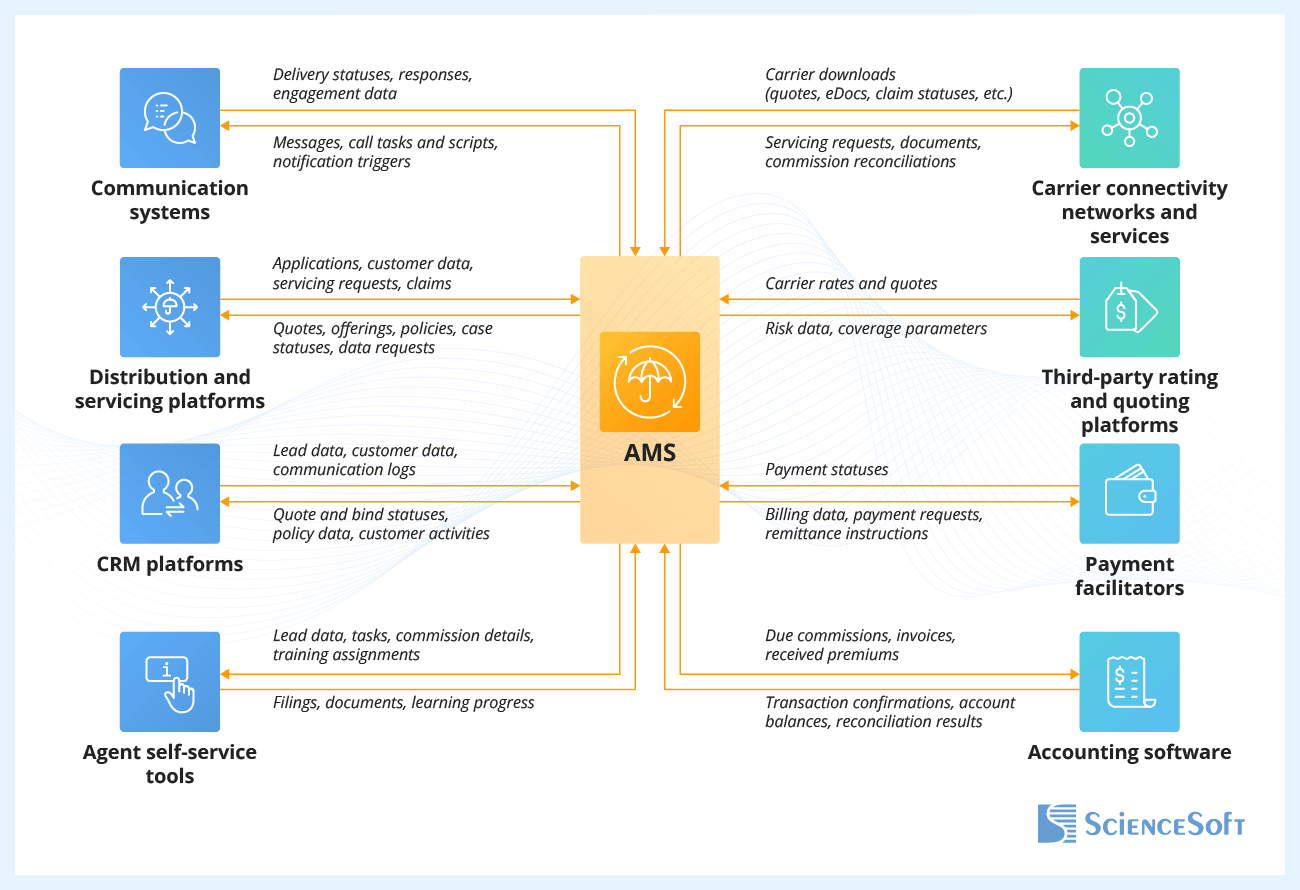
|
Distribution and servicing platforms |
E.g., an agency’s website, a customer portal, third-party insurance marketplaces. To capture sales and servicing requests, share quotes, personalized offerings, and insurance documents, and keep customers updated on submission statuses. |
|
|
To maintain unified customer profiles across front-line agency systems, align insurance sales and servicing workflows, and use customer insights for marketing campaigns. |
|
Carrier connectivity networks and services |
E.g., IVANS, Ebix. To standardize and automate insurance data exchange with multiple carriers and speed up sales and servicing workflows. NB: Captive agencies may integrate their AMS directly with the parent carrier’s underwriting, billing, policy administration, and claim management systems. |
|
Third-party rating and quoting platforms |
E.g., rate aggregator platforms, rate databases, insurance market-making facilities. To accelerate multi-carrier rate discovery, option comparison, and quoting for independent agencies. |
|
Payment facilitators |
E.g., payment gateways, banks, ACH networks. To streamline premium payment processing, remittance, and transaction control under agent bill models. |
|
Agent self-service tools |
E.g., an agent portal, field service apps. To speed up agent task assignment, centralize performance control, and quickly feed inputs from individual agents into agency workflows. |
|
|
To automatically record commissions and agency bill transactions in the agency’s books, control payment statuses, and streamline reconciliation. |
|
Communication systems |
E.g., email, SMS, and messaging platforms; call center, CTI, and IVR systems. To automate customer and agent communications across channels and quickly deliver application, policy, and claim updates. |
Best Practices for Insurance Agency Software Development
Below, ScienceSoft’s insurance IT experts share their best practices for engineering reliable and cost-effective agency management software for insurance.

Integrations should be built for minimal impact on AMS performance
Poorly designed integrations can delay synchronization, overload system resources, break data consistency, and expose security gaps. In one of ScienceSoft’s recent agency software projects, an unstable integration between an agent app and the NMO’s operating platforms and services led to app performance degradation and data integrity issues. Our engineers applied API request batching to reduce the number of external calls, asynchronous processing to prevent integrations from blocking user actions, load balancing to distribute traffic evenly, and rate limiting to protect systems from overload and third-party throttling. Together, these measures supported stable app performance even under peak loads.
Integration testing is equally critical. Test scenarios should reflect real transaction volumes, peak loads, and edge cases across data exchange flows to ensure the integration performs smoothly in production. DevOps consultants at ScienceSoft suggest that implementing continuous integration pipelines can speed up the detection and resolution of issues in live software.
Early mapping of logic and exceptions is critical for automation
In insurance agency workflows, the highest operational risks often hide in exceptions: endorsements, cancellations, rewrites, commission adjustments, and manual process overrides. If these scenarios are not defined upfront with clear permissions, approval rules, and audit requirements, blanket automation can cause inaccuracies and compliance gaps.
At ScienceSoft, consultants first document the agency’s requirements and applicable regulatory rules for who can initiate, approve, override, and reprocess each action and what data and evidence must be captured. Later, when they design exception-handling workflows based on this data, they validate them with the agency’s stakeholders to confirm the logic’s accuracy and prevent costly re-engineering later.
Early logic mapping also makes it easier to design functional test cases and naturally encourages test-driven development, resulting in streamlined QA, faster issue detection and fixing, and, ultimately, higher reliability of the solution.
Treat data migration as a business-critical workstream
Policy records, customer profiles, notes, commission data, document links, and carrier info often reside in multiple systems and follow inconsistent data structures. Whether you're modernizing a legacy AMS, replacing an off-the-shelf platform, or consolidating multiple systems, data gaps can complicate the transition and carry over into the new solution.
Data engineers at ScienceSoft audit source data and define migration rules early in the project. They identify which records should be migrated, archived, merged, or removed and establish data mapping and validation procedures for each data domain. Before the full migration, the team performs trial conversions and reconciles the results with business users to verify data completeness and accuracy. This approach preserves data integrity and prevents costly operational disruptions after the new solution goes live.
UX/UI design should fit role-specific tasks and operating conditions
Agency analysts and managers need data-rich dashboards to support decision-making. Branch agents benefit from clean layouts, reducing cognitive load during face-to-face interactions. Field agents prioritize mobile-first design: in ScienceSoft’s app project for roofing insurance agents, the design team introduced simple, prefilled forms and quick document capturing so agents can operate efficiently in time-pressured remote environments.
Although every role would benefit from unique UX/UI, you can save money and avoid designing multiple different dashboards and interfaces by making a smaller number of highly customizable UI modules. Customization options like draggable and resizable widgets, saved views, and quick-action shortcuts allow users to tailor interfaces to their daily workflows.
How Much It Costs to Develop an Insurance Agency Management Solution
Developing custom insurance agency management software may cost from $120,000 to $2,000,000+, depending on the solution’s functionality, the scope of supported product lines and jurisdictions, the number and complexity of integrations, as well as performance, scalability, and security requirements.
Here are ScienceSoft’s sample cost ranges for common development scenarios. These ranges cover the design and implementation work and exclude third-party AMS platform licenses, third-party network fees, cloud hosting, and AI model usage:

$120,000–$450,000
A focused process improvement module, such as submission processing, quote comparison, renewal reminders, commission reconciliation, or customer self-service, integrated with 1–3 agency and external systems.

$200,000–$600,000
A custom solution that automates a specific agency workflow end-to-end (e.g., application intake, quoting, renewals, claims tracking). We can implement it as a module in the existing AMS or as a standalone tool integrated with relevant systems.

$500,000–$1,200,000
A multi-module modernization initiative covering core agency operations (lead capturing, placement, policy servicing, commission management, etc.) across one-two lines of business. We deliver the new modules in phases and integrate them with distribution channels, carrier systems, rating platforms, accounting software, and communication tools.

$800,000–$2,000,000+
A full-scale custom AMS for multiple insurance products, omnichannel distribution models, and complex agency and partnership workflows. It can support real-time analytics, AI-assisted workflows, and agentic automation, along with multiple integrations with the organization’s operating platforms, carrier ecosystems, and third-party services.
* The final implementation cost will depend on the insurance agency’s operational scale, specific needs, the maturity of the firm’s IT ecosystem, and the complexity of data migration procedures.
Why Develop Insurance Agency Software With ScienceSoft
- Since 2012 in engineering custom software solutions for the insurance industry.
- Insurance IT and compliance consultants with 5–20 years of experience in insurance regulations (NAIC, DOI, TCPA, etc.), data protection standards (GLBA, NYDFS, HIPAA, GDPR, etc.), data exchange standards (ACORD, LIMRA, etc.), and more.
- 45+ certified project managers (PMP, PSM I, PSPO I, ICP-APM) who succeeded in large-scale projects for Fortune 500 firms.
- 30+ senior and principal architects with hands-on experience in designing complex insurance automation systems and driving secure implementation of innovative technologies.
- A team of 750+ professionals, including software engineers, testers, data scientists, and DevOps engineers. Over 50% of our engineers are senior or lead specialists.
- Established practices to ensure the quality and predictable delivery of insurance solutions despite time and budget constraints or uncertain requirements.








ScienceSoft’s clients say


ScienceSoft are responsive, technically sharp, and they communicate well with our people. When we've needed to move fast, they've stepped up and delivered. What I appreciate most is their proactive approach. They don't just wait for us to identify issues. They bring solutions to the table and help us prioritize what matters most. That kind of partnership is hard to find.


Partnering with ScienceSoft has been an excellent experience. Their team transformed our underwriting platform into a well-oiled machine. They identified and fixed several longstanding issues that had been causing us persistent difficulties. Their communication was exemplary; unlike our previous experiences with outsourcing, we never had to chase them for updates, and they were always prompt in responding to our queries.

Damien Sewell
Head of IT Projects

ScienceSoft’s quick buy-in and readiness to take the initiative made the project faster and less stressful for everyone involved, from Capital IM’s insurance specialists to leadership. At the end of a short yet highly productive two months, we got a secure and wholly owned property insurance solution that is fully adapted to Capital IM’s corporate practices and brand book. We couldn’t have asked for a better IT partner.
