 ScienceSoft Global



Artificial Intelligence (AI) for Insurance Fraud Detection
Capabilities, Implementation Best Practices, Costs
In AI since 1989 and in insurance IT since 2012, ScienceSoft helps insurers pinpoint where AI can deliver measurable gains in fraud detection and investigation. We turn these opportunities into controlled AI transformation programs with clear business targets.

Contributors

Senior Insurance IT & AI Consultant, ScienceSoft

Head of AI, Principal Architect, ScienceSoft

Financial Technology & AI Researcher, ScienceSoft
AI for Insurance Fraud Detection: Short Summary
Artificial intelligence (AI) for insurance fraud detection helps insurers identify suspicious activity across applications, claims, transactions, and multi-party interactions and automate investigation work that has traditionally required extensive manual analysis and verification.
Insurers increasingly adopt AI to identify fraud earlier and more accurately, accelerate investigations, and increase fraud analysts' capacity while keeping operational costs down. More recently, AI adoption has also become more urgent as insurers work to counter a rising wave of fraud enabled by generative AI.
- Insurance fraud schemes AI helps recognize: false and inflated claims, staged losses, duplicate billing, identity fraud, forged documents, altered media files, risk misrepresentation, network collusion, GenAI-enabled fraud (deepfake evidence, synthetic identities, voice impersonation), and more.
- Key integrations for fraud detection AI solutions: insurance fraud detection platforms, core insurance systems (claims, underwriting, policy administration), communication channels, the insurer’s knowledge bases, and more.
- Implementation timelines: 3–8 months for a task-specific fraud detection AI solution, 9–24+ months for broader workflow transformation.
- Engineering costs: $150,000–$1,500,000+, depending on the scope of AI transformation. Use our free calculator to estimate the cost for your case.
AI Technologies for Fraud Detection in Insurance

Machine learning (ML)
Traditional (non-generative) AI technology that powers continuous fraud monitoring, anomaly detection, and predictive fraud risk analytics. ML models can spot suspicious transactional and behavioral patterns, including coordinated fraud rings, and score fraud probability and severity.

Generative AI
Assistive technology powering copilots, chatbots, and voice assistants for risk managers and special investigation units (SIU). AI assistants can analyze documents and communications, retrieve case details, summarize and explain fraud signals, prepare fraud reports, and recommend next-best investigation steps.

Agentic AI
Technology that combines large language models (LLMs) with workflow automation to coordinate multi-step fraud detection and investigation workflows. AI agents can utilize LLMs, ML algorithms, and rule-based engines to complete tasks, escalate suspicious cases, and trigger approved actions across systems.
Where agentic setups outperform familiar AI tools
Fraud detection is a race against time. The longer a suspicious event takes to identify and investigate, the greater the chance that faked claims are paid out or connected fraud goes unnoticed. Machine learning has already made the analytical side quite fast. But everything that happens before and after that analysis — collecting and cross-checking evidence, following up on inconsistencies, preparing cases, and so on — is still a major bottleneck.
You can’t use rule-based automation for workflows that require case interpretation or don’t follow a predefined path. That’s where agentic AI shines: it combines the predictability of traditional automation with the flexibility of LLMs. Most of ScienceSoft’s clients with mature fraud analytics are now exploring AI agents to automate these more context-dependent workflows.
Business Impact of AI in Insurance Fraud Detection
Insurers are already seeing material financial gains from AI in risk functions, where real-time fraud detection remains a major investment priority for 78% of firms. The 2025 study by EY-Parthenon found that 74% of insurers achieved at least 5% cost savings in risk and compliance from generative AI over the past 1–2 years, and 56% expect savings to exceed 10% as they scale AI over the next 1–2 years.
From ScienceSoft's experience, the biggest financial outcomes of AI adoption in insurance fraud detection typically come from the following:

Improved fraud detection rates
Greater investigator capacity
AI automation streamlines evidence collection, cross-checking, case preparation, and other time-consuming investigation tasks, letting SIU teams process more cases without added headcount. ScienceSoft’s discovery estimates suggest that agentic fraud detection can boost SIU analytical capacity by up to 5x.
Reduced fraud-related losses
Earlier and more accurate fraud detection helps insurers stop suspicious claims before settlement and reduce leakage from fraudulent and inflated payouts. Deloitte estimates that AI-driven multimodal fraud detection could help P&C insurers save $80–160 billion in fraudulent claims by 2032.
Insurance Lines of Business That Employ Fraud Detection AI







What AI Can Do in Insurance Fraud Detection
Below are the key operations AI can support across insurance fraud detection. ScienceSoft can engineer selected AI components for specific tasks or build a scalable AI layer that transforms the entire fraud management process.
Data gathering and fraud detection

Real-time fraud monitoring
Machine learning engines can continuously analyze insurance events and detect suspicious patterns as they emerge. Compared to case-level vetting, continuous ML-powered analytics can reveal broader fraud signals, such as sudden increases in claims linked to one provider or abnormal payment destinations. Investigation teams can use an AI analytics copilot to query analytical findings and generate reports.

Insurance data and document validation
LLMs can extract and cross-check data across unstructured documents, e.g., compare an accident description with a repair invoice or medical diagnosis with a billed procedure. Image analysis and natural language processing algorithms can validate media evidence and flag likely altered, reused, or fabricated (including AI-generated) content for human review.

Entity matching and fraud network detection
Entity resolution ML models, supported by LLMs for complex unstructured records, can match case-relevant entities (customers, assets, providers, producers, etc.) across systems, despite differences in identifiers and records. ML-driven graph analytics engines can then analyze relationships between matched entities and flag suspicious connections and potential network collusion.

Third-party data cross-checking
AI agents can automatically verify submission data against trusted external sources. They determine which checks are relevant for each particular case and query the appropriate sources. These agents can then use LLMs, machine learning, and computer vision to compare external findings with information in the insurer's systems and flag material discrepancies.

Conversational fraud verification
Voice AI agents can conduct consented verification calls with policyholders, producers, and loss handling partners. They can verify responses against previously submitted data and available evidence and follow up on unclear answers. After the call, these tools can analyze conversation transcripts for factual contradictions that may indicate fraud and escalate suspicious conversations to investigators.
Fraud investigation and response

Fraud scoring and case triage
Machine learning models can consolidate fraud signals across sources and calculate explainable fraud risk scores, accounting for multi-party behaviors and known fraud patterns. AI agents can use the resulting scores to determine which cases warrant investigation and prioritize them by risk and expected financial impact, applying the insurer's triaging rules.

Fraud case preparation
AI can assemble structured investigation packs with case details, fraud scores, and evidence. Using copilot interfaces, investigators can instruct AI to apply specific case templates (e.g., for claims or underwriting), include specific evidence types, find previous related cases, and highlight the strongest fraud indicators.

Investigation decision support
Fraud investigators can use AI assistants to explore cases through natural-language queries. An investigator can ask the assistant to explain why a case received a high fraud score, identify contradictory evidence, compare the case with historical fraud patterns, or retrieve supporting data. Based on available evidence and the insurer's investigation guidelines, the assistant can recommend next steps, such as requesting additional evidence or expanding network analysis.

Fraud response and communications
AI agents can automatically enforce insurer-authorized fraud response for low-severity cases. For example, they can place a claim on hold, notify the claim owner, or flag related claims for enhanced monitoring. Agents can also handle routine communications, such as notifying internal teams and sending approved case status updates to customers and partners. We apply dedicated rules so agents route sensitive and adverse communications for human review before distribution.

Fraud reporting
Upon investigator request, AI assistants can compile case findings into internal fraud reports, case summaries, and regulatory filings using approved templates and applicable reporting requirements. For example, AI can use case data to populate regulatory forms such as the NAIC Uniform Suspected Insurance Fraud Reporting Form or applicable state-specific forms. Final report approval remains subject to human authorization.
Cross-functional utilities

Dynamic workflow orchestration
Unlike pre-programmed automation tools, agentic AI systems can dynamically adapt multi-step fraud detection and investigation workflows based on case context and insurer-defined rules. A dedicated orchestration agent determines which activities should run next and which specialized agents, models, tools, insurance systems, data services, and people should participate at each stage. It can initiate permitted actions across systems and route AI-processed cases to human specialists for review.

Operational AI compliance
Custom fraud detection AI agents and models can be designed to operate in line with applicable insurance regulations (by NAIC, state DOI, etc.), AI-specific frameworks (the NAIC AI Model Bulletin, the EU AI Act), data privacy laws (e.g., HIPAA, GLBA, CCPA, GDPR), communication and AI disclosure rules (by TCPA, FCC, state regulators), and more. We also implement dedicated controls for data access, model testing and documentation, explainability, human oversight, audit trails, and communications.
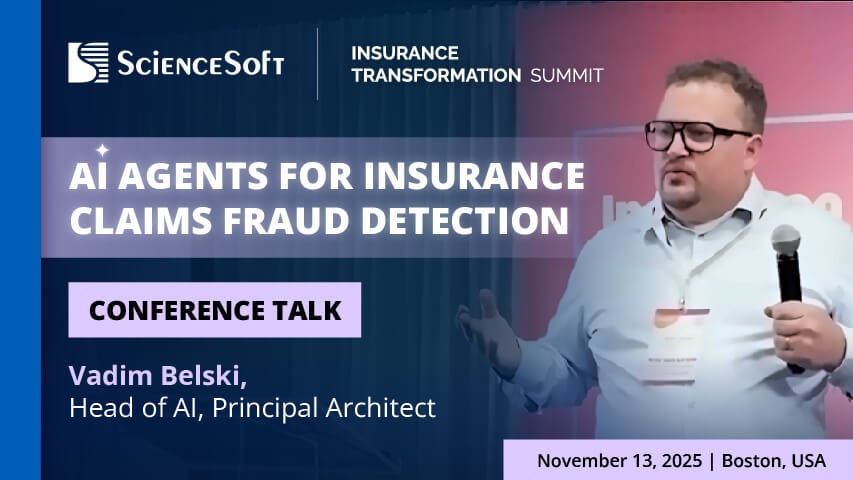
Agentic Fraud Detection as the Next Big Value Driver for Insurance Claims
Fraud investigation is a natural fit for agentic AI: it involves extensive evidence checks and follow-ups that still consume significant human effort. In this talk from the 2025 Insurance Transformation Summit in Boston, ScienceSoft’s Head of AI, Vadim Belski, explains where AI agents can take over this routine and what it takes to deploy them safely in existing insurance workflows.
How to Introduce AI Into Insurance Fraud Operations
The right way to introduce AI depends on what your current fraud setup can already do. Below, ScienceSoft maps four common starting points to the AI implementation approach that usually makes sense next.
The most expensive mistake is rolling out new AI tools before checking whether the existing fraud stack is actually the problem. For example, poor detection quality may come from missing data or weak integrations. Or if your investigation process is slow, it is often a result of fragmented workflows and manual evidence gathering. Neither problem will be fixed by adding a smarter AI fraud detection model. So, diagnose the bottleneck first and then decide what to keep, buy, or build.
| Your current fraud setup | What usually makes sense next |
|---|---|
|
Your current fraud setup
Fraud detection is mostly manual or rules-based |
What usually makes sense next
Buy a mature fraud platform first. The platform will supply the packaged machine learning models for fraud scoring and analytics. ScienceSoft can help select the platform, connect it to your claims, policy, and case systems, unify the data model, and configure the product around your fraud scenarios and investigation workflow. On your side, the fraud team will need to provide the rules, historical cases, and acceptance criteria that will be used to set up and validate the system. |
|
Your current fraud setup
You have a fraud platform, but its detection quality is poor |
What usually makes sense next
Find out whether the problem is the platform or the data it consumes. If important data (claims, policy, customer details) is missing or poorly mapped, ScienceSoft can fix those data feeds, and the existing platform can keep doing the scoring. If the data is right, but your platform doesn’t recognize specific fraud patterns, ScienceSoft can train an additional ML model on your historical cases and pass its scores or alerts back into the existing platform. |
|
Your current fraud setup
Detection works, but investigators still spend too much time on cases |
What usually makes sense next
Keep the fraud platform and add a GenAI investigation copilot. If your platform already provides a copilot for the required workflow, ScienceSoft can help configure and integrate it. But if there isn’t an AI feature that meets your investigation needs, ScienceSoft can build a tailored assistant on a commercial LLM and securely connect it to case documents and knowledge through retrieval-augmented generation (RAG) and to structured case data through APIs. |
|
Your current fraud setup
Detection and investigation work well, but staff still manually coordinate multi-system workflows |
What usually makes sense next
Consider agentic AI for those specific workflows. Where traditional automation cannot reliably coordinate the work between your systems or teams, ScienceSoft can build an agentic orchestration layer using commercial LLMs and agentic frameworks. This also includes establishing governance: AI permissions, human approval rules, monitoring, and fallback mechanisms. Typically, you can start by adding an agent for one localized process, then expand the agentic foundation to a broader process once it proves its stability. See in-depth examples in the next section. |
How Agentic AI Fits Into Insurance Claim Fraud Detection Processes
Machine learning models and AI assistants usually handle defined tasks within established workflows. Agentic AI goes further: agents can choose the next step dynamically and act across systems. This naturally raises the question of how to control their behavior without taking away the flexibility that makes them useful.
Localized process: Conversational claim verification
Call-based claim verification is a strong use case for agentic AI, but it also brings some of the biggest control concerns. Here, the agent interacts directly with customers and needs to behave much like a human representative. To control it, we need to give AI access to the insurer’s communication policies, use rule-based agent output validation, and enable human handover for complex calls.
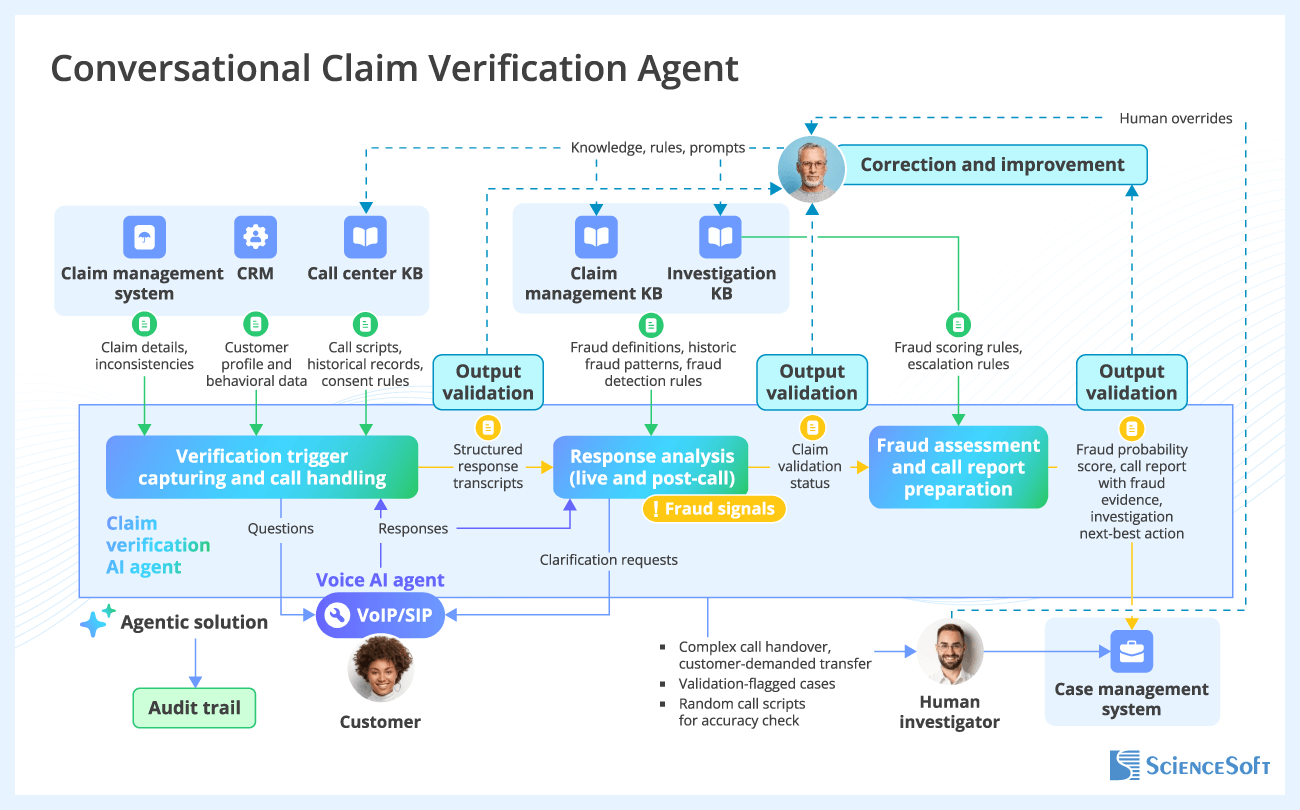
See how it works
At the start of the workflow, the claim verification AI agent receives the verification requests and detais on inconsistencies from the claim management system. It invokes a dedicated voice AI agent to call customers via a VoIP/SIP service. The voice AI agent uses claim data, customer information, approved call scripts, and consent rules to guide the conversation and adapt it in real time. When the agent detects inconsistencies or unclear statements, it asks follow-up questions and requests clarification.
If the conversation becomes too complex or the customer requests a transfer, the agent can hand the call to a human specialist with a conversation summary and full context. It also records and transcribes the call for further analysis.
After the call, the claim verification agent invokes the response analysis model to compare the call transcript to claim details, known fraud patterns, and investigation rules and identify mismatches that may indicate fraud. It then routes those findings to the fraud assessment model, which evaluates fraud probability using the insurer’s fraud models and rule engines. Next, the agent compiles model outputs into a case report and draws recommended next steps (e.g., additional verification or a claim hold) based on the insurer’s investigation policies. It routes the outputs to the case management system for investigator review.
Built-in deterministic validation mechanisms check every AI output against insurer-specific rules and confidence thresholds and catch unreliable outputs before the agent takes further action. We use these checks as a predictable control layer: unlike GenAI inference, they produce static, certain results (learn more). The validator services pass valid outputs and approved actions to automated workflows and route validation-flagged cases and selected cases for accuracy control to human investigators, who can correct or override AI outputs. Investigator overrides and feedback on AI accuracy are recorded in the case management system and can be used to refine prompts, fraud handling rules, and knowledge bases.
To support internal governance and regulatory reviews, the agentic system maintains a complete audit trail of call activity, AI outputs, and human actions.
Hide
See Conversational Fraud Verification Agents in Action
Watch Vadim Belski, ScienceSoft’s Head of AI, try to fool the voice AI agent with a “fraudulent” homeowners claim — and quickly get caught. ScienceSoft’s consultants estimate that a production solution can increase investigator capacity by 40% and improve fraud detection rates by 20% through conversational checks.
Broad process: Claim validation and fraud detection
Once you have a workable control foundation for one agent, you can extend much of the same controls to other agentic workflows and eventually create a multi-agent system. While more agents can naturally create more handoffs and potential validation-flagged cases, you shouldn’t expect human involvement to grow proportionally. In contrast, as agentic workflows get refined over time, more cases can be handled autonomously, leaving humans to focus on exceptions and high-risk decisions.
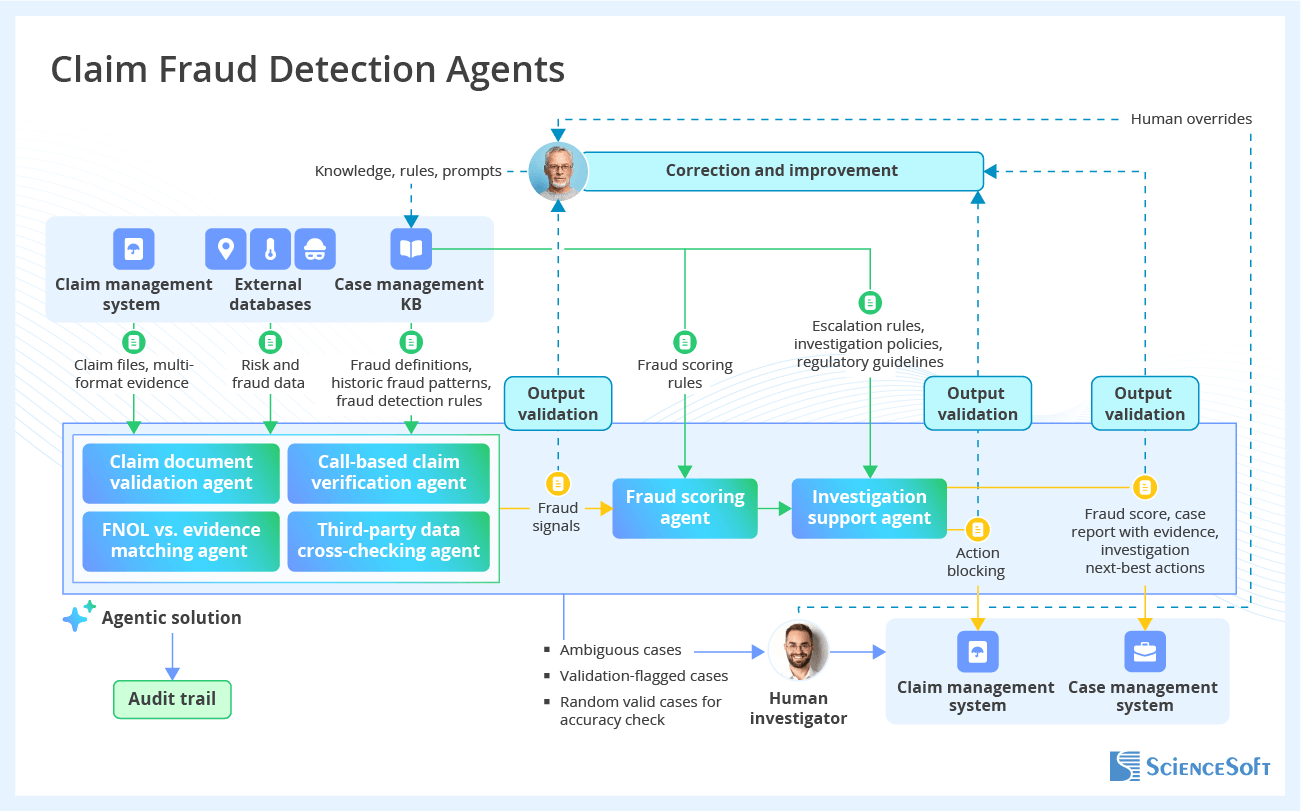
See how it works
In a multi-agent setup, specialized validation agents can work in parallel to detect claim inconsistencies and potential fraud indicators. In our example, one validates claim documents, another matches FNOL data against submitted media evidence, the third verifies claim details through customer interactions, and the fourth cross-checks submissions against third-party sources. Architects at ScienceSoft recommend splitting these tasks between several independent agents for better control over AI actions and higher output accuracy (learn more).
Once the validation work is completed, the fraud scoring agent consolidates the detected fraud signals and evaluates them using the insurer’s fraud models and scoring rules. In multi-agent setups, ScienceSoft usually keeps this agent separate so it scores each validation area separately and then aggregates the results into a case-level fraud score. We can also build a separate agent without involving generation-capable LLMs to protect complex scoring logic from hallucinations and make scores reproducible.
The scoring agent then combines the score with fraud evidence and passes them to the investigation support agent. This agent uses a decoder LLM to generate a case report and develop recommendations for investigators on the next verification and remediation steps based on the insurer’s policies. It routes the outputs to the case management system for investigator review.
The same deterministic validation, human oversight, and audit controls as in the localized workflow apply across every agentic workflow in the broader multi-agent setup.
Hide
Important Integrations for Fraud Detection AI Solutions
The actual integration scope depends on the AI capabilities you implement and your existing technology landscape. From ScienceSoft’s experience, agentic AI platforms meant to coordinate multi-step fraud detection workflows typically require the following integrations:
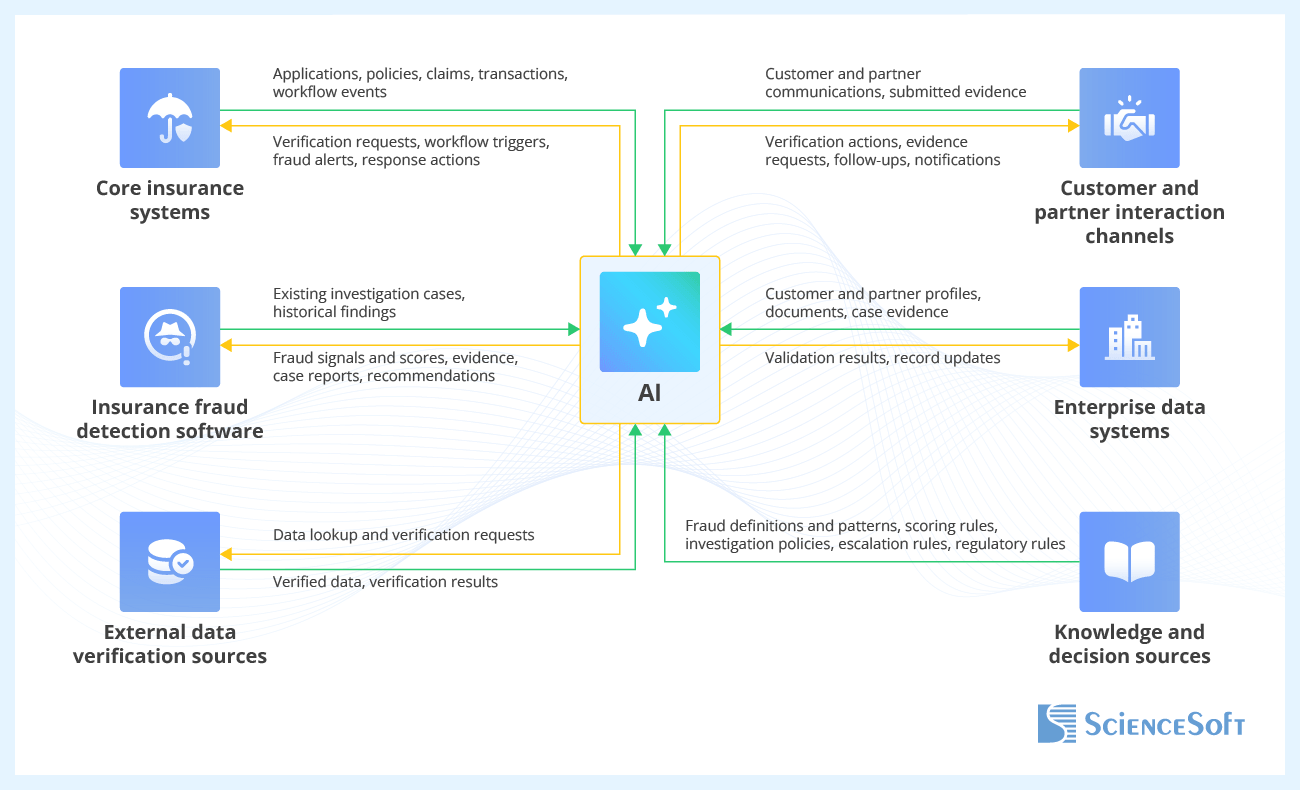
Core insurance systems
Claims management software, a policy administration system, an underwriting system, a billing and payments platform.
To access the insurance data and events required for fraud analytics, trigger fraud checks at relevant workflow stages, and enforce approved fraud response actions.
Insurance fraud detection software
E.g., fraud analytics systems, SIU case management platforms, investigation tools.
To give AI access to relevant past and ongoing investigation data and pass AI-flagged suspicious cases, supporting evidence, and recommended next steps to investigators.
External data verification sources
E.g., insurance claims and fraud databases, identity and sanctions services, vehicle and property databases, medical data sources, telematics platforms, weather and geospatial services.
To cross-check customer, producer, and provider submissions against independent sources and enrich fraud analytics with external signals that may not be visible in the insurer’s own data.
Customer and partner interaction channels
Call center and VoIP/SIP systems, customer portals and self-service apps, broker/agent portals, email, SMS, chatbot services.
To conduct automated verification, collect additional evidence, and handle permitted fraud-related communications with insureds and partners.
Enterprise data systems
CRM platforms, vendor management systems, document management systems, media repositories.
To give fraud detection AI access to the evidence required for document, media, and behavioral fraud analytics and store validation results for investigation.
Knowledge and decision sources
Fraud, investigation, and compliance knowledge bases, fraud scoring models, business rule engines.
To guide AI-supported fraud detection and investigation according to the insurer’s specific rules and regulatory requirements.
Best Practices for Engineering Insurance Fraud Detection AI
Below, ScienceSoft’s experts share their best practices for building reliable and cost-effective AI solutions for insurance fraud detection.

Narrow agent specialization improves fraud detection speed and control
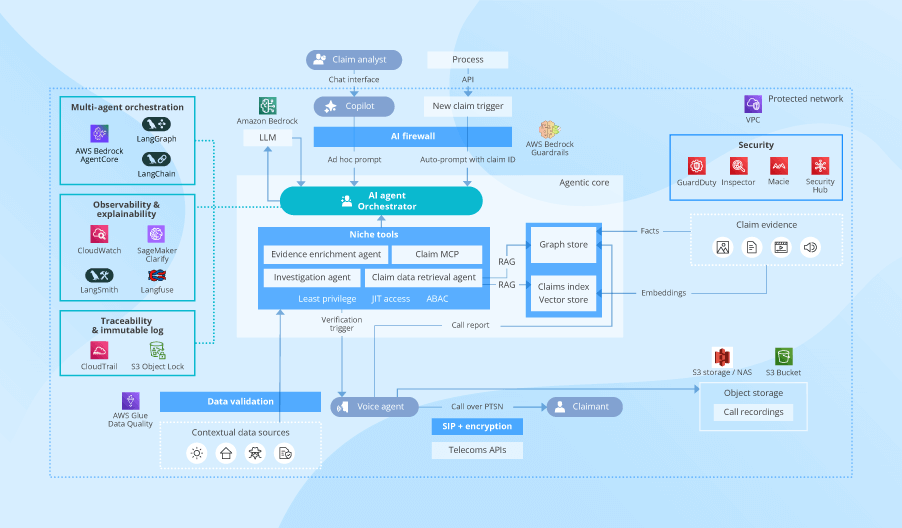
Instead of giving one AI agent broad access to the entire fraud detection workflow, ScienceSoft recommends assigning narrow responsibilities to multiple specialized agents (for document validation, conversational verification, fraud scoring, etc.). Each agent receives only the data, tools, and permissions required for its task. This makes individual agents easier to build, test, and control and limits the impact of potential agentic errors or unauthorized actions.
Specialization can also speed up fraud detection. Agents can execute independent checks, such as document validation, network analysis, and media evidence review, in parallel rather than one after another, reducing idle time between verification stages.
Check ScienceSoft’s reference architecture to see how we distribute insurance fraud detection tasks across specialized AI agents.
Event-driven AI integration minimizes changes to existing systems
With event-driven integration, insurance events like FNOL submission, evidence upload, or investigator action will automatically trigger the relevant AI workflow. For example, when a claimant uploads new damage photos, an AI agent can start analyzing them for fraud signals immediately as they arrive. Once the investigation work is complete, AI sends the outputs (fraud scores, alerts, case reports, etc.) back to insurance systems via APIs or dedicated connectors.
This approach lets you introduce AI without deeply embedding it into your existing systems, which could require substantial system changes or rebuilds. Your core platforms remain the systems of record, while AI runs as a separate layer that responds to events and returns results. Find out more about suitable event-driven AI integration options for smaller and larger insurance environments here.
End-to-end AI traceability strengthens internal and regulatory controls
For every AI-produced fraud score, recommendation, or automated action, you should be able to reconstruct what happened: which evidence, models, and rules contributed to the outcome, what the agents did, and where humans intervened. This traceability supports internal reviews and helps you demonstrate that your AI governance meets regulatory requirements (e.g., the NAIC AI Model Bulletin, the EU AI Act). You also need it to detect AI drift early and implement corrections before problems spread.
The traceability setup should cover both AI models and agents. For machine learning models, you need MLOps tools that track model quality, data and feature drift, and changes in false-positive and false-negative rates. AI agents additionally require LLMOps and agent observability tools that track prompts, retrieved evidence, tool calls, handoffs, errors, latency, and output quality.
ScienceSoft’s engineers usually use platforms like LangSmith and Langfuse for end-to-end tracing of LLM and agent workflows. For proprietary ML models, we add explainability tools like LIME and SHAP to show which features influenced individual fraud predictions.
Need Help With Your Fraud Detection AI Initiative?
Whether you're starting a task-focused AI solution or planning large-scale AI transformation, our insurance IT experts are ready to discuss your case and help design a pragmatic, risk-aware path forward.

Costs of AI Transformation in Insurance Fraud Detection
The cost of implementing tailored AI capabilities for insurance fraud detection may range from $150,000 to $1,500,000+, depending on the scope of the AI transformation, the AI solution’s functionality, integration complexity, and performance, scalability, security, and governance requirements.
Below are ScienceSoft’s sample cost ranges for common fraud detection AI transformation scenarios. These ranges cover the design and implementation work and exclude third-party component licenses, network fees, cloud hosting, and AI model usage:

$150,000–$250,000
Early AI rollout: AI-assisted fraud investigation
Solution example: An AI copilot for SIU investigators that analyzes claim documents and case data, summarizes fraud signals, retrieves evidence, and prepares investigation reports. This range assumes LLM-powered document and image validation capabilities and a limited set of integrations (an existing claims system, SIU case management system, and document repository).

$300,000–$600,000
Transformation of one fraud detection workflow
Solution example: An agentic AI solution that coordinates and automates multiple fraud detection steps within a particular workflow, e.g., submission validation or data verification via voice calls. Within this range, you typically get task-specific agents, an agentic orchestration layer, and human review interfaces. Integrations may span 3–6 systems and data sources required for the selected workflow.

$600,000–$1,500,000+
Enterprise-grade fraud detection transformation
Solution example: An AI automation layer spanning 3–5 connected fraud detection and investigation workflows. At this scale, the scope may include GenAI-assisted evidence analysis, agentic automation for diverse fraud and verification scenarios, and integrations with 6–10+ internal and external systems and data sources. The range typically assumes you can reuse some existing fraud analytics; building advanced fraud models from scratch or expanding automation further can push the investment above $1.5M.
Wondering how much your AI project will cost?
Use our online calculator to describe your needs, and we'll get back to you shortly with a tailored estimate. It’s free and non-binding.
* The estimates are for midsize insurance organizations (<2,000 employees) serving 1–3 major lines of business. The final implementation cost will depend on the insurer’s specific needs and the maturity of the organization’s IT, data, and governance environments.
Why Implement Insurance Fraud Detection AI With ScienceSoft
-
Since 1989 in AI consulting and implementation.
- Since 2012 in delivering digital transformation for the insurance industry.
- Insurance IT, AI, and compliance consultants with 5–20 years of experience. Principal architects with hands-on experience in designing complex insurance automation systems and driving secure implementation of AI technologies.
- 350+ software engineers, 50% of whom are seniors or leads.
- 45+ certified project managers (PMP, PSM I, PSPO I, ICP-APM) who succeeded in large-scale projects for Fortune 500 firms.
- Expertise in insurance regulations (NAIC, state DOI rules), data exchange and interoperability standards (incl. ACORD data models and messaging standards), and data protection frameworks (NYDFS, CCPA/CPRA, GLBA, HIPAA, GDPR).
- Established practices to ensure the high quality of insurance AI solutions and their delivery on the agreed timelines and budget, despite project constraints and changing requirements.








ScienceSoft’s clients say


ScienceSoft are responsive, technically sharp, and they communicate well with our people. When we've needed to move fast, they've stepped up and delivered. What I appreciate most is their proactive approach. They don't just wait for us to identify issues. They bring solutions to the table and help us prioritize what matters most. That kind of partnership is hard to find.


Partnering with ScienceSoft has been an excellent experience. Their team transformed our underwriting platform into a well-oiled machine. They identified and fixed several longstanding issues that had been causing us persistent difficulties. Their communication was exemplary; unlike our previous experiences with outsourcing, we never had to chase them for updates, and they were always prompt in responding to our queries.

Damien Sewell
Head of IT Projects

ScienceSoft’s quick buy-in and readiness to take the initiative made the project faster and less stressful for everyone involved, from Capital IM’s insurance specialists to leadership. At the end of a short yet highly productive two months, we got a secure and wholly owned property insurance solution that is fully adapted to Capital IM’s corporate practices and brand book. We couldn’t have asked for a better IT partner.









Insights From ScienceSoft's Insurance IT Experts

Vadim Belski
Head of AI, Principal Architect, ScienceSoft
Agentic AI for Fraud Detection: Engineering A Solution That Insurers Can Actually Trust

Vital Soupel
Senior Insurance IT & AI Consultant, ScienceSoft
Trend watch
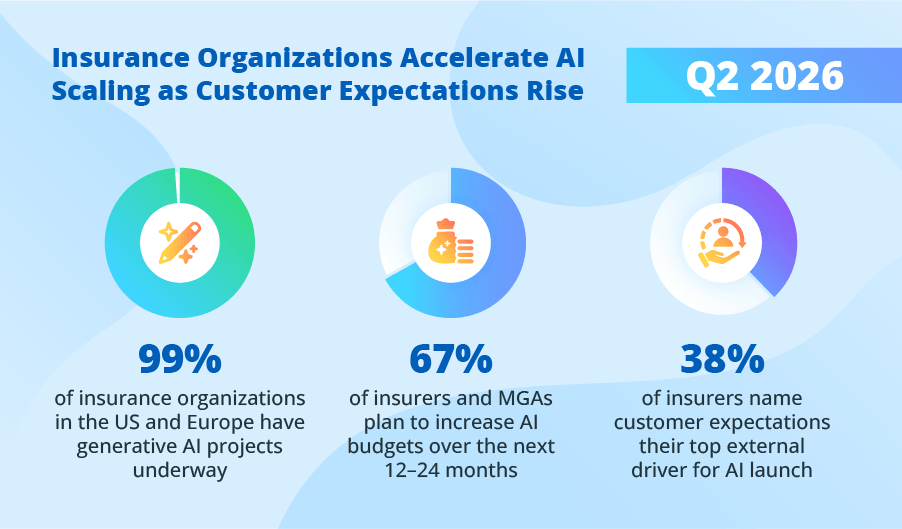
Q2 2026 Insurance AI Trends: Assistive AI Outpaces Agentic AI in Enterprise Deployments, Market Players Invest Heavily in AI Scaling Infrastructures

Stacy Dubovik
Financial Technology & AI Researcher, ScienceSoft

Case study
Fully Digital Insurance Is Already Here. See How It Boosts Sales, Underwriting, and Claims
