ScienceSoft Global
 ScienceSoft Finance



Transfer Agency Software
Features, Development Best Practices, Costs
In investment software development since 2007, ScienceSoft engineers custom transfer agency systems that address the common drawbacks of ready-made tools, such as rigid features, limited integrations, and a narrow scope of supported investment vehicles and jurisdictions. ScienceSoft can build transfer agency software for investor onboarding and share registry management.

Transfer Agency Software: Brief Overview
Transfer agency software is used to automate investor account maintenance, asset ownership transfer processing, fee calculation, and reporting. Such software streamlines the orchestration of transfer activities across diverse investment products, investor types, and jurisdictions.
Custom transfer agency software is the preferred choice for companies that work with non-standard investment vehicles, complex ownership structures, and multiple jurisdictions. Custom solutions can be built to support multiple asset classes, including private equity, index funds, structured instruments, and tokenized assets. They can be designed to support compliance with necessary regulations, including region-specific frameworks (e.g., SEC Rules 17Ad-series for the US, CSDR and AIFMD for the EU, CMA and Edaa for the KSA).
Unlike off-the-shelf tools, custom solutions give transfer agents complete ownership over account administration, transaction handling, recordkeeping, and disclosure logic. It means you can quickly adjust software operating rules when your business needs or regulatory requirements change. Custom software can also include agent tools for no-code rule configuration.
Another advantage of custom solutions is that they can be integrated with any required software, including legacy systems, local distribution and regulatory facilities, and modern wealthtech tools. With the strengthening of regulatory buy-in for blockchain-based transfer rails, some forward-thinking agencies opt for custom setups to secure interoperability with blockchain transfer and recordkeeping systems.
Many transfer agencies also go custom to leverage artificial intelligence (AI). Custom solutions can incorporate AI models that are aware of the agency’s specific operating context. Such AI-powered systems offer response relevance that is non-attainable with generic tools and give agents full control over the transparency and security of AI operations.
- Key integrations for transfer agency software: distribution platforms and utilities, fund accounting systems, payment and custodian systems, regulators’ facilities, and more.
- Implementation time: around 7–15 months for core software modules.
- Development costs: $500,000–$5,000,000+, depending on solution complexity. Use our free calculator to estimate the cost for your case.
Entities That Benefit From Custom Transfer Agency Systems

Transfer agent firms

Fund administration firms

Custodians (banks)





Trustee service providers
Major ROI Drivers for Transfer Agency Solutions
A high degree of automation across transfer agency operations directly translates into ROI through cost savings and efficiency boosts. US fund administrators and asset managers report the following gains:
Sources: AInvest, Citi, Clearstream, Bravura.
Functionality of Transfer Agency Software
Below, ScienceSoft’s consultants list the core and value-adding features that can lay the basis for a robust transfer agency system:
Core features

Transfer workflow configuration
- A no-code console for designing custom transfer workflow automation rules, including robotic process automation (RPA) rules, parameters, and exceptions.
- Configuring task sequences for multi-step digital workflows (onboarding, order processing, reconciliation, etc.).
- Visual modeling of end-to-end transfer transaction lifecycles (at the process, asset, and entity levels).
- A workflow simulation sandbox to test new operational logic before deployment.
- Scheduling recurring activities (e.g., batch transactions, valuation cycles, reconciliations, reporting).
- Defining user and group roles, role-based access permissions, and segregation of duties logic.
- A complete record of modifications across rules and parameters.

Asset data management
- Support for multiple assets and asset structures: corporate equity (stocks), bonds, mutual funds, private equity, ETFs, REITs, and more.
- Adding new assets via customizable templates.
- Configuring asset parameters like issuer, sector, share class (common, preferred, option), currency, issuance limits, lockups, eligibility, and valuation cycle.
- Setting up entitlement and conversion rules for preferred, restricted, and convertible share classes.
- Bulk asset creation and updating.
- Automated coding of instrument, issuer, and currency names using common investment conventions (e.g., ISIN, CUSIP) or the agency’s internal identifiers.
- Dynamic aggregation and tracking of current asset prices (enabled via integration with market data platforms, distribution utilities, and fund accounting systems).
- Automated versioning of asset ownership data.

Investor onboarding and due diligence
- Automated aggregation of data submitted by investors across the issuer’s and third-party distribution platforms.
- Automated content capture from digital investor documents (ID scans, proofs of residence, W-9/W-8 tax forms, etc.) using optical character recognition (OCR).
- Rule-based investor data validation for accuracy and completeness.
- Criteria-based investor pre-qualification against the issuer’s requirements.
- Automated KYC/AML verification for investors, including special checks (e.g., vetting against FinCEN CDD Rule for institutional investors).
- Automated investor screening against FFIEC/OFAC sanctions lists and OFAC 50% rule.
- Automated eligibility checks for investors enrolling in special programs (DRIP, DSPP, ESPP, etc.).
- Investor risk scoring based on custom formulas.
- Dynamic dashboards showing the investor onboarding pipeline status.

Investor account management
- Automated account creation for qualified investors.
- Multi-level account approvals (by servicing teams, compliance officers, etc.).
- Customizable account structure hierarchies reflecting relationships among investors, issuers, fund administrators, and custodians.
- Investor account segmentation based on status (active, suspended, closed), risk category, geography, holding attributes, and more.
- Automated changing of asset ownership across accounts, triggered by new trade transactions, corporate actions, and bonus events.
- Investor position tracking across share classes, portfolios, and linked investment accounts.
- Centralized repository of investor data, documents, correspondence, and transactional records.
- Notifications to transfer agency teams about expiring investor documents that require updating.

Cap table management
- Customizable cap tables (fund, entity, multi-entity) reflecting equity owners, their share types, percentage of ownership, and governance rights.
- Automated recalculation of ownership percentages, entitlements, and fully diluted capitalization based on new trading and corporate transactions.
- A centralized registry of asset transactions (issuances, transfers, redemptions, conversions, and more).
- Daily cap table reconciliation against fund accounting and custody records.
- Cap table modeling for capital-related events (additional stock issuance, new funding rounds, exits, etc.).

Investment order processing
- Automated capture and processing of investors’ subscription, redemption, exchange, and transfer requests.
- Rule-based validation of investor instructions against eligibility, cut-off times, and available balances.
- Automated medallion signature guarantee (MSG) checks via approved verification providers, with exception routing for manual review.
- Automated calculation of order values based on current NAV (taking into account cut-off rules), share class rules, and applicable fees.
- Multi-level order approval workflows.
- Automated creation of electronic settlement instructions in standardized formats and sending them to custodians and trustees.
- Real-time tracking of settlement progress.
- Automated generation and distribution of confirmation notices, ownership certificates, and transaction receipts.
- Automated communication of transaction details to issuers.

Corporate action processing
- Automatically processing declarations of mandatory and voluntary corporate actions (stock splits, spin-offs, secondary issuance, distributions, mergers, acquisitions, etc.).
- Automated validation of issuance requests against share class limits and compliance constraints.
- Maker-checker (four-eyes) authorization controls for large corporate transactions.
- Corporate action calendars with configurable reminders, dependencies, and completion tracking displays.
- Automated voting management for voluntary corporate events via connected proxy and voting services.
- Rule-based allocation of newly issued shares to investors.
- Template-based creation of investor notifications, proxy materials, and transaction confirmations.

Dividend and interest distribution
- Multi-share-class waterfalls with configurable share classes, liquidation preferences, and hurdle rates.
- Automated calculation of dividend and interest entitlements for each investor.
- Calculating and applying withholding taxes based on each investor’s jurisdictional tax rates.
- Multi-currency calculations for cross-border payouts.
- Automated generation of payment instructions and sending them to the connected payment systems.
- Configurable schedules for recurring distributions and coupon payments.
- Monitoring payment processing statuses.
- Automated payment reconciliation.
- Rule-based subscription renewal and cost basis updating for reinvestment transactions.

Fee management
- Calculating performance, trail, management, and carried interest fees based on custom formulas.
- Multi-tiered fee schedules based on investor segment, fund type, distribution agreement, and more.
- Automated fee deduction from distribution amounts.
- Automated billing of transfer agency clients.
- Automated fee withdrawal from client bank accounts by direct debit.
- Rule-based allocation of collected fees across management entities and distribution partners.

- Real-time monitoring of cash inflows, outflows, floats, balances, and positions (by investor, issuer, fund, instrument, etc.).
- Cross-fund, cross-entity netting of cash inflows and outflows across clearing cycles.
- Automated reconciliation of cash records in the transfer agency’s ledger against custodian statements.
- Setting up and monitoring liquidity limits across investor accounts.
- Tracking expected vs. actual cash movements.
- Root-cause analysis of cash variance.
- Trend-based cash forecasting.

- Calculating and tracking chosen metrics across investor activity, asset performance, finance, risks, and operational performance, including specialized KPIs like NIGO rates, market timing, exception STP, lost securityholders, dormancy, and escheat aging.
- Drill-down views by investor, issuer, distributor, geography, instrument, and other user-defined segments.
- Analytics-based anomaly detection (e.g., rapid liquidity shifts, abnormal redemption patterns, payout spikes).
- Statistical modeling and forecasting of chosen transfer agency KPIs.
- Analyzing the contribution of different investor segments, instruments, asset classes, and regions to the financial performance of particular issuers.

- Automated generation of investor reports (account statements, portfolio performance snapshots, fee summaries, tax forms, etc.).
- Automated creation of daily shareholder reports and fund flow summaries for issuers.
- Customizable report templates tailored by report type, entity, region, investment instrument, etc.
- Report conversion to the recipients’ preferred formats (PDF, CSV, XML, encrypted ZIP, etc.).
- Scheduled and ad hoc report distribution to investors, issuers, fund administrators, and internal teams.

Regulatory reporting
- Automated generation of regulatory filings in compliant formats (e.g., SEC’s Forms TA-1, TA-2, TA-W, IRS’s Forms 1099-DIV, 1099-B, 1099-INT, 1042-S, NASAA’s forms for Blue Sky filings, NAUPA II for unclaimed property reports).
- Automated identification of reportable investors for regulatory submissions (e.g., FATCA, CRS).
- Interactive calendars displaying filing deadlines by jurisdiction.
- Scheduled report submission to regulators (via connected reporting gateways or secure communication channels).
- Automated flagging of changes in regulatory reporting forms and rules (via integration with regulatory databases).

- A multi-role, multi-language portal for issuers and investors.
- A self-help knowledge base for portal users.
- A live chat for issuers and investors to communicate with transfer agents and support teams.
- Notifications to issuers and investors about confirmed subscriptions, new reports, data requiring renewal, etc.
- (For admins) Automated processing of servicing cases with account-linked ticket creation and SLA-based resolution tracking.
Investor self-service options:
- Managing personal and business information.
- Initiating investment activity.
- Monitoring holdings, subscription statuses, and transaction history.
- Viewing investment documents (allocations, confirmations, certificates, reports, etc.).
Issuer self-service options:
- Managing business information.
- Publishing asset- and entity-related documents and reports.
- Managing asset offerings, pricing, and the holder register.
- Reviewing and approving investors and transfer transactions.
- Declaring distributions and corporate actions.
- Viewing investment reports and transfer service invoices.

Security
- Permission-based access control.
- Multi-factor authentication, including location- and certificate-based authentication.
- Encryption of stored and transferred investment data.
- Data masking for sensitive fields like investors’ personal identifiers and account numbers.
- Token-based authentication and rate limiting for third-party APIs.
- A full audit trail of user activities.
- Automated workflows for data backup and recovery.
- Continuous system vulnerability scanning and intrusion detection.
- Data controls and activity logging in line with SEC Reg S-P and Reg S-ID, GLBA, SOC 1 Type 2, SOC 2, ISO 27001, NIST CSF 2.0, SOX, GDPR, CCPA, SAMA cybersecurity rules, or other necessary standards and regulations.

- Monitoring the compliance of transfer agency operations against the entity’s internal code of conduct and domain-specific regulations (e.g., SEC Rules 17Ad-2/6/7/17 and 17f-1 for transfer agency registration and servicing quality, SEC, FINRA, and IRS disclosure mandates).
- Automated intermediary transparency and Rule 22c-2 controls, including shareholder information requests (SIR), omnibus account look-through, and distributor oversight (12b-1 and networking data comparisons).
- Tracking confirmation, allocation, and affirmation timelines under SEC Rule 15c6-1 and Rule 15c6-2 to help distribution and custodian partners meet their legal obligations.
- Rule-based detection of compliance breaches.
- Sending compliance violation alerts to the responsible specialists.
- Automated deletion of transfer agency data according to compliant retention and deletion rules.
Value-adding features
In a recent paper by State Street, investment leaders name blockchain and AI technologies among the key drivers for transfer agents’ operational efficiency and better investor experience.
ScienceSoft suggests extending transfer agency software with the following capabilities to drive the solution’s ROI further:

- Automated extraction and validation of data from investor documents using image analysis and machine learning (ML) technologies.
- ML-based diagnostic and predictive analytics.
- Intelligent optimization engines for trade and settlement processing, transfer exception handling, investor servicing, and more.
- Processing multi-format data (including sentiment, earnings call records, and handwritten notes), summarizing insights, and generating investment documents using large language models (LLMs).
- AI-powered anomaly and fraud detection.
- Intelligent virtual assistants for transfer agency teams and investors.
- AI-supported capture and verification of biometrics and digital signatures.
- Autonomous execution of transfer agency operations by AI agents, with explainable logic and human-in-the-loop governance.

- An immutable transfer registry with timestamped transactional records and connectivity to off-chain ledgers.
- Automated T+0 transfer processing for blockchain-native assets (cryptocurrencies, crypto tokens) and tokenized assets.
- Automated on-ramps and off-ramps for cross-border fiat settlements.
- Tokenized ownership certificates providing cryptographically verifiable proof of holdings.
- Automation of multi-step transfer agency workflows (e.g., KYC/KYB, order processing, capital calls, payouts) using smart contracts.
- On-chain dividend and interest distribution (in chosen crypto or fiat currencies) triggered by encoded entitlement logic.
- Consensus-based, multi-signature authorization for high-value transfers.
- Blockchain-based transparent e-voting for corporate actions.
Important Integrations for a Transfer Agency Platform
Based on ScienceSoft’s experience, integrating transfer agency software with the following systems helps achieve an up to 90–98%+ straight-through processing (STP) rate for investment data and transfer transactions.
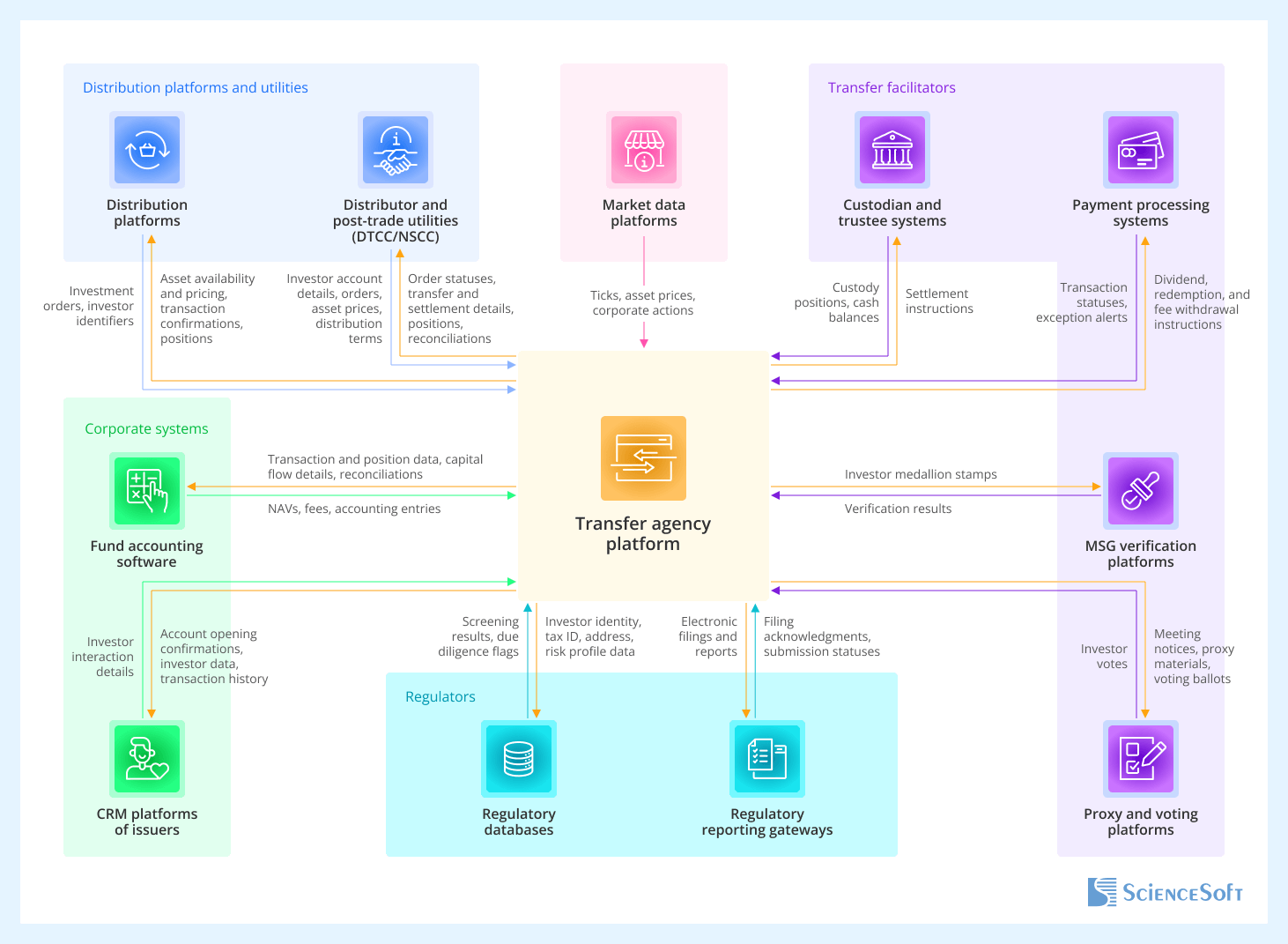
Distribution platforms
E.g., issuer websites and portals, RIAs’ investment platforms (e.g., Fidelity FundsNetwork, Schwab Mutual Fund Marketplace), alternative trading platforms.
- To automatically process digital investor orders and instantly confirm trades.
Distributor and post-trade utilities (DTCC/NSCC)
E.g., Fund/SERV, Omni/SERV, ACATS-Fund/SERV, MFPS II, Networking (SDR, RPR), DCC&S / ToRA.
- To access standardized reference data and enable straight-through investment order processing across established distribution and intermediary channels.
Custodian and trustee systems
- For settlement coordination and reconciliation of the entity’s positions and cash balances.
E.g., bank gateways supporting global payment rails (ACH, SWIFT, Fedwire, FedNow).
- To automate cash movements related to dividend and interest disbursements, redemptions, and fee withdrawals.
- For automated exchange and reconciliation of asset value and transaction registry data between the transfer agency and fund accounting teams.
CRM platforms of issuers (asset owners and managers)
E.g., Microsoft Dynamics 365, Salesforce, Juniper Square.
- To synchronize investor relationship data necessary for coordinated engagement, retention, and compliance activities.
Market data platforms
E.g., Bloomberg, ICE, Refinitiv, Morningstar.
- To quickly obtain market and reference data for asset valuations, transfer transaction planning, and fund performance analytics.
Regulatory databases
Local KYC/AML databases, OFAC/PEP databases, adverse media screening hubs, etc.
- For automated KYC/AML checks and OFAC screening against regulations.
Regulatory reporting gateways
E.g., SEC’s EDGAR, IRS FIRE, FinCEN’s BSA E-Filing, NASAA EFD, and local e-filing portals.
- To automate regulatory report submission to federal and state authorities.
MSG verification platforms
E.g., eSignature Guarantee, MSG Express.
- To validate investor medallion signatures used on transfer forms, account change requests, and asset-movement instructions.
Proxy and voting platforms
E.g., Broadridge, DTC, Mediant.
- For streamlined e-voting and impartial vote tabulation across corporate actions.
Transfer Agency Software Development Best Practices
Below, ScienceSoft’s experts share their proven practices for securing financial software quality and optimizing project costs.
|
|
Modular architectures (SOA, microservices) let you separate key functions of the transfer agency software into distinct components that can be built, deployed, and evolved in parallel and without cross-impact. This way, development teams can iterate faster and upgrade particular features independently, which contributes to solution longevity. Plus, modular patterns support logic reuse, meaning you can share onboarding, approval, processing, reconciliation, and audit features across modules with only minor changes. This is one of ScienceSoft’s primary practices for improving financial software integrity and reducing engineering costs. |
|
|
Applying compliance-by-design principles to the software logic ensures adherence to regulatory rules and minimizes reliance on manual oversight. For example, encoding transfer turnaround SLAs specified by SEC Rule 17Ad-2 into the system’s transaction processing engine allows these obligations to be enforced automatically. ScienceSoft’s consultants map regulatory requirements at early discovery stages to secure compliant logic design and avoid costly retrofits during coding. |
|
|
Test scenarios for transfer agency software should simulate life-like transactional flows, employ real, anonymized transfer data, and cover edge and corner cases. This approach helps verify system behavior under close-to-live operating conditions and spot data- and logic-related issues that can only be captured at scale. QA engineers at ScienceSoft aim for 95%+ test coverage for integration-intensive systems, such as transfer agency software, to ensure the solution produces correct results across all operational variables and data exchange patterns. |


Data validation, lineage, and master data management (MDM) are essential for the accuracy, consistency, and traceability of critical data at transfer agencies. To validate data from external sources, we build QA pipelines that enforce schema conformity and referential integrity checks as data moves to the transfer system. For lineage, you need metadata capture and backtracing pipelines. We usually use pre-built pipeline components from stream processing frameworks like Apache Spark or Airflow to reduce coding overhead. MDM can be handled through established governance platforms (e.g., Apache Atlas, Talend) to avoid costly custom setups.
Transfer Agency Software Development Costs
Developing custom transfer agency software may cost from $500,000 to $5,000,000+, depending on the solution’s functional scope, the number and complexity of integrations, and performance, scalability, security, and regulatory compliance requirements.
Here are ScienceSoft’s sample cost ranges:

$500,000–$1,000,000
- Single-domain transfers (e.g., equities or mutual funds).
- Single-region transfer agency operations.
- 2–7 integrations, including one distributor utility stack (e.g., DTCC/NSCC), payment processor, AML/OFAC database, and e-filing gateway (e.g., IRS FIRE).
- Automation of transfer agency workflows using algorithmic rules, with RPA applied for query routing and data intake tasks.
- Statistical analytics and forecasting.

$1,200,000–$2,500,000
- Multi-domain transfers (e.g., equities, funds, REITS).
- Single-region, T+1-aware transfer agency operations.
- 7–20 integrations, including several asset-specific distributor utility stacks, multiple banks, and regulatory platforms (covers T+1 e-filing gateways).
- Rule-based and RPA workflows for transfer agency task automation, with AI for automated risk management and exception handling (governed by human-in-the-loop checks).
- ML-powered operational analytics, diagnostics, and forecasting.

$2,500,000–$5,000,000+
- Multi-domain, multi-region transfers.
- 20–40+ integrations, including multiple distributor utility stacks across target regions, multiple payment rails, as well as jurisdiction-specific regulatory platforms and reporting gateways.
- Rule-based and AI-supported automation of transfer agency operations, including autonomous intelligent transfer processing (closed-loop auto-checks and governed AI model tuning).
- Real-time, AI-supported predictive analytics and transfer surveillance.
- Blockchain integration for T+0 cross-border transfers.
Wondering how much your project will cost?
Use our online calculator to share your needs, and we'll get back to you shortly with a tailored estimate. It’s free and non-binding.
Why Develop Transfer Agency Software With ScienceSoft
-
Since 2007 in engineering custom software for the investment industry.
- ScienceSoft served one of the top 3 global asset managers with $5T+ in AUM.
- Investment IT and compliance consultants (SEC, FINRA, GLBA, SOC, etc.) with 5–20 years of experience.
- 45+ certified project managers (PMP, PSM I, PSPO I, ICP-APM) with experience in large-scale projects for Fortune 500 companies.
- Principal architects with hands-on experience in designing complex investment systems and driving secure implementation of value-adding technologies.
- 350+ software engineers, 50% of whom are seniors or leads.
Partnerships and recognitions








ScienceSoft’s Approach, As Seen Through Our Clients’ Eyes


Our collaboration was a true partnership. The team was open, attentive to our requirements, and accurate in addressing them. The delivered solution is exactly what we needed.



ScienceSoft came up with a go-to architecture, features, and tech stack and introduced a roadmap for app implementation. We appreciated their approach to consulting and mature project management culture.


ScienceSoft brought to the table truly customer-centered approach to app design. We especially appreciate their professional approach to security issues, which were among our main concerns due to strict regulations.