en flag +1 214 306 68 37

Generative AI (GenAI) Software Development Services

Practical AI for Complex, Regulated Environments

ScienceSoft delivers AI solutions for companies that need measurable, sustainable results and strong risk management. We identify high-value AI opportunities, architect secure solutions, and integrate them into existing products, workflows, and technology environments.

Our strengths come from production AI experience, engineering background across a broad tech stack, and 21 years of work in regulated domains such as healthcare and finance.

Generative AI (GenAI) Software Development Services - ScienceSoft

GenAI software development services help organizations design, build, and integrate generative AI solutions for defined business tasks, connecting them to enterprise systems, data, and governance processes. The goal is to move GenAI from standalone pilots into secure, scalable, and maintainable production software that fits existing workflows and operating requirements.

GenAI Solutions We Develop

ScienceSoft builds GenAI solutions for 30+ industries, including healthcare, insurance, investments, lending, payments, finance, manufacturing, retail, and telecoms, bringing a broad perspective on how AI can be applied within and across diverse business contexts. Our strongest domain expertise is in healthcare and insurance, where we have 20+ years of experience, senior consultants with hands-on sectoral experience, and hundreds of software projects.

Conversational AI assistants

They enable users (customers or employees) to complete tasks through natural-language conversation. Example: a doctor appointment scheduler.

How it works

Conversational AI assistants understands user requests, retrieve relevant context, generate responses, and trigger predefined actions such as scheduling, routing, notifications, or data updates.

Hide

Professional copilots

They assist employees with complex work while keeping humans in control of final decisions and outputs. Example: an insurance operations assistant.

How it works

Professional copilots help analyze information, draft documents, prepare decisions, summarize cases, and suggest next steps within role-specific workflows.

Hide

Knowledge search and document intelligence

These tools make fragmented information and business documents easier to search, interpret, extract, and reuse.

How it works

Knowledge management assistants search across knowledge sources, summarize findings, extract key data from documents, normalize inconsistent inputs, and make information available to users or downstream systems.

Hide

Content and document generation

These tools generate structured outputs from prompts, enterprise data, templates, or source materials.

How it works

Content generation assistants produce structured and branded business documents, reports, emails, knowledge articles, training materials, product descriptions, or images, audio, and video assets.

Hide

Developer copilots and code generation

They support software engineering tasks across the development life cycle.

How it works

Developer copilots can interpret requirements, generate code, create tests, explain legacy code, suggest refactoring options, and support documentation.

Hide

Agentic AI and multi-agent systems

They autonomously run multi-step workflows with defined goals, boundaries, and human oversight points.

How it works

Agentic AI systems can gather information, interpret inputs, make bounded decisions, call tools or enterprise systems, handle exceptions, and escalate cases when human review is needed.

Hide

Composite AI solutions (GenAI + non-generative AI)

They combine GenAI with traditional machine learning, predictive models, optimization engines, simulations, or rule-based systems.

How it works

Composite AI solutions use GenAI to explain results, prepare communications, or guide users, while non-generative AI components preserve the accuracy of calculations or process continuity.

Hide

About ScienceSoft

  • 37 years in AI services: We support companies across the full AI lifecycle covering strategy, solution engineering, governance, user enablement, optimization, and scaling.
  • 1,500 clients: Our project portfolio contains over 4,300 success stories. 62% of ScienceSoft’s revenue comes from long-term and repeat clients who have stayed with us for more than 2 years.
  • Full-stack AI expertise: 750+ specialists, including senior AI architects, data scientists, machine learning engineers, software developers, security experts, and DevSecOps engineers. Over 50% of them are at senior and lead-level specialists.
  • In-house compliance consultants: We help align AI solutions with global standards (e.g., SOC 2, PCI DSS/SSF, NIST), regional privacy rules (e.g., GDPR, Saudi PDPL), and sectoral regulations (e.g., HIPAA, FDA QMSR, SOX, GLBA, NYDFS).

Our Clients

They are reliable, thorough, smart, available, extremely good communicators and very friendly. We would recommend hiring ScienceSoft to anyone looking for a highly productive and solution-driven team.

They collaborated with our medical professionals with great professionalism and care, respecting the research environment and its unique challenges. We found ScienceSoft to be dependable and forward-thinking, and we would confidently recommend them for high-responsibility projects.

They delivered a fully customized AI medical chatbot PoC in just two weeks, which was unbelievable.

The attention to detail in the chatbot design, and especially the pitch deck, was amazing — with this kit on hand, we are ready to go into investor discussions confidently. It’s not often that you find a team that moves this fast without sacrificing quality.

We have cooperated with ScienceSoft on the evolution of our main product, an Al-powered tool that helps detect and fix vulnerabilities in software code. ScienceSoft’s team did a solid job for us. They are extremely competent and committed.

ScienceSoft is dedicated to handling any problem that occurs as a result of hardware or software issues; simply put, they will go the extra mile to support their customers regardless of the time of day these issues arise.

Technologies We Work With

Generative AI

Models

Large Language Models (LLMs)

Small Language Models (SLMs)

Multimodal models

Computer vision models

Image generation models

ASR speech models

TTS speech models

Speech-to-Speech Models

Audio models

Realtime

Model adaptation and efficiency

Training from scratch

Data design

Data labelling/annotation

Fine-tuning

Instruction tuning

LoRA adapters

AI platforms and services

Azure OpenAI Service

Microsoft Foundry

Amazon Bedrock

Google Vertex AI

Google AI Studio

Hugging Face Inference

Oracle Cloud

G42/Core42

NVIDIA AI Enterprise

Agents and Orchestration

RAG

Graph RAG

Agentic workflows

OpenAI Agents SDK

OpenAI Agents (platform/guides)

AWS Agents

Claude Agent SDK

Google Agent Development Kit (ADK)

Microsoft 365 Agents SDK (Copilot Studio)

OpenClaw

LangChain

LangGraph

smolagents

LiveKit

Dify

n8n

Faiss

ChromaDB

Qdrant

Weaviate

OpenSearch

Pgvector

Amazon Neptune

Graph RAG Toolkit

Neo4j

Traditional ML

Platforms and services

Azure Cognitive Services

Azure Machine Learning

Microsoft Bot Framework

Amazon SageMaker

Amazon Transcribe

Amazon Lex

Amazon Polly

Google Cloud AI Platform

Google Vertex AI

Frameworks and libraries

Apache Mahout

Apache MXNet

Caffe

TensorFlow

Keras

Torch

OpenCV

Apache Spark MLlib

Theano

Scikit Learn

Gensim

SpaCy

Programming languages

Services to Support GenAI Implementation

GenAI consulting and roadmapping

GenAI solution engineering

GenAI security, testing, and compliance

GenAI support, optimization, and scaling

GenAI consulting and roadmapping

We can help you identify GenAI use cases that are worth building, understand how to implement them, and validate the idea before committing to a larger rollout.

  • Assessing GenAI readiness across data, systems, workflows, security, and user adoption.
  • Discovering and prioritizing use cases by business value, feasibility, risk, and implementation effort.
  • Advising on architecture, model strategy, hosting, governance, and cost-performance trade-offs.
  • Planning PoC, MVP, or phased implementation scenarios for AI validation and scaling.

GenAI solution engineering

We can design and develop GenAI applications, copilots, assistants, agents, or AI product features that fit your workflows and software ecosystem.

  • Preparing business data, product content, and knowledge sources for GenAI use.
  • Implementing RAG, prompt engineering, model adaptation, and fine-tuning where needed.
  • Developing GenAI applications, copilots, conversational assistants, agents, and multi-agent systems.
  • Integrating GenAI solutions with existing applications, data sources, and APIs.

GenAI security, testing, and compliance

We can help you validate GenAI behavior, reduce reliability and security risks, and align the solution with internal, customer-facing, or regulatory requirements.

  • Testing GenAI outputs for accuracy, relevance, consistency, safety, and behavior in edge cases.
  • Setting up continuous GenAI evaluation and monitoring practices.
  • Testing and hardening against prompt injection, data leakage, access control gaps, and model misuse.
  • Supporting compliance with PII handling, traceability, explainability, auditability, and human review requirements.

GenAI support, optimization, and scaling

We can help you keep GenAI solutions stable, cost-efficient, and functional after release as usage grows.

  • Monitoring production performance, usage, failures, and user feedback.
  • Improving prompts, retrieval quality, knowledge bases, model behavior, and user experience.
  • Optimizing latency, infrastructure use, model routing, caching, and token costs.
  • Scaling GenAI solutions to new workflows, teams, regions, or product modules while updating governance and operations.

How Much Does GenAI Software Cost to Develop?

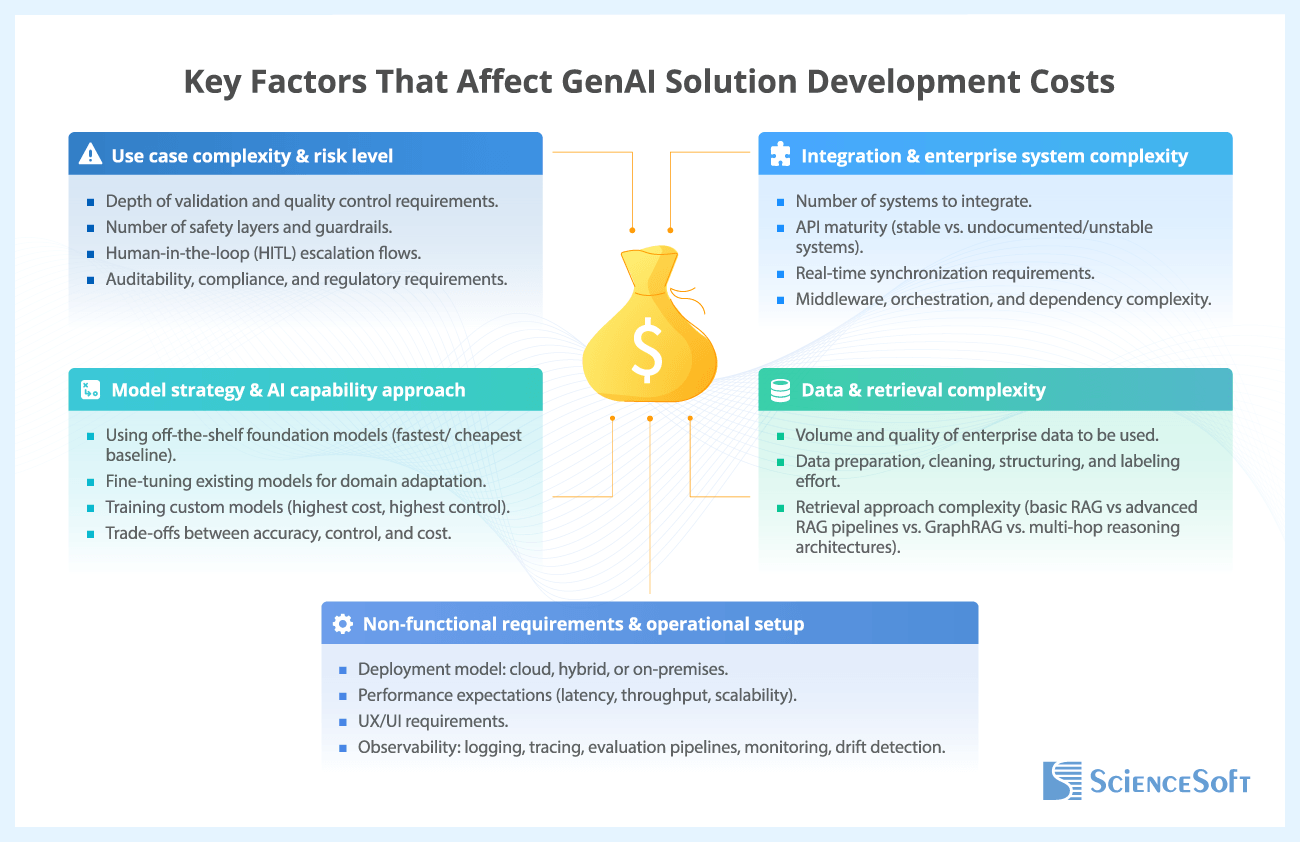
GenAI software development costs can range from $10,000 for a small prompt-based GenAI feature (such as text drafting or summarization) to $100,000–$300,000 for a custom AI assistant or enterprise knowledge search solution, and can exceed $800,000+ for a full-scale GenAI product or a deeply integrated agentic AI system. Costs mainly depend on how much engineering and data preparation is required to make AI outputs reliable, controllable, and useful for real business tasks and workflows.

Head of AI, Principal Architect, ScienceSoft

It’s a common misconception that cost scales with the “scope” of GenAI — e.g., that agentic or multi-agent systems are inherently expensive. In practice, a multi-agent workflow can be relatively lightweight and cost as little as $10K if it involves limited integrations, low risk, and minimal control logic. What actually drives cost is not the label, but the depth of orchestration, validation, and system dependencies behind it.

Key Factors That Affect GenAI Solution Development Costs

FAQ

How do we know GenAI will actually work for our business before we commit serious budget?

We typically don’t ask clients to commit to full deployment without evidence. Most initiatives start with a controlled pilot or proof of concept designed to answer one question: Can this reliably produce measurable business value in your environment? During that phase, we validate both technical feasibility and real business impact.

On the technical side, we test whether the required data can be accessed securely, whether integrations are viable, and whether the model produces outputs that meet quality and safety thresholds. For GenAI solutions, we evaluate performance against realistic user scenarios. That includes checking whether responses are factually grounded in your knowledge sources, whether the system correctly cites supporting data, how often hallucinations occur, and whether automated actions triggered by AI are reliable. We also tie those technical results to operational metrics such as reduction in manual workload, faster response times, or improved customer outcomes. The result is a metrics-backed feasibility and value assessment, plus a recommended rollout plan and a risk mitigation strategy. If the pilot didn’t meet the expected value or reliability thresholds, we recommend pausing or redirecting the initiative to a more viable use case or tech stack.

We’d be using customer or employee data. How do we make sure it doesn’t leak or get exposed through AI?

Tapping into our experience in cybersecurity since 2003 and a strong DevSecOps foundation, we address data security at all levels: storage, processing, retrieval, model interaction, and operational monitoring.

In practice, this means we implement encryption in transit and at rest, strict identity-based access controls, isolated development, testing, and production environments, and detailed audit logging. For GenAI and RAG solutions, we add additional safeguards specifically designed to prevent data leakage or misuse. These include strict access controls for data retrieval, redaction or masking of sensitive information where possible, and protection against prompt-injection attacks.

If sensitive data is required for training or fine-tuning, we use it only in controlled environments. We minimize the amount of data involved and apply anonymization or pseudonymization whenever appropriate. Proprietary data is not shared with public models or external training pipelines without explicit authorization. This includes isolating datasets, tightly controlling fine-tuning workflows, and applying both technical and contractual safeguards around data usage.

We also design consent handling, retention policies, and full auditability so the solution supports regulatory requirements instead of creating new compliance risks.

GenAI can be biased or produce unsafe results. How do companies realistically manage that risk?

There’s no way to eliminate risk completely, but it can be systematically reduced and monitored. We start by defining unacceptable behaviors and testing models against them. That includes checking outputs across different user groups, testing for harmful or misleading responses, and implementing explainability mechanisms for transparency. We also test how the system behaves when users attempt to manipulate prompts or inject misleading information. We restrict what tools GenAI can access, monitor outputs in production, and implement escalation workflows for anomalies.

Ultimately, generative AI solutions are highly capable but not infallible. Like human experts, they can occasionally produce inaccurate or incomplete outputs. Our approach focuses on minimizing this risk through validation pipelines, retrieval-based architectures, fine-tuning, and human review workflows where appropriate. In regulated environments like finance and healthcare, we design solutions that support decision-making but never replace human accountability.

We rely heavily on legacy systems. Can GenAI realistically integrate with them without breaking things?

We usually introduce legacy integration layers that allow AI components to access data and automate workflows without interfering with core transactional systems. These integrations can be implemented through APIs, middleware, or event-driven orchestration. We also design read-only phases, fallback mechanisms, and gradual rollout strategies to make sure AI improvements do not disrupt day-to-day operations.

If auditors or regulators ask how the AI reached a decision, will we be able to explain it?

Yes, if traceability and explainability are designed into the system from the start. We implement monitoring frameworks that log prompts, retrieved knowledge sources, model versions, and generated outputs. This allows you to reconstruct how specific responses were produced.

How do you handle speed problems in GenAI apps? AI systems often seem slow or expensive to run.

Performance and cost are core design considerations. Typically, we combine efficient retrieval mechanisms, caching, context management (limiting unnecessary context passed to models), and asynchronous workflows. We also implement monitoring so organizations can track cost per request, latency trends, and performance degradation over time.

Head of AI, Principal Architect, ScienceSoft

Finding a middle ground between accuracy and speed

“In one of our recent cases, we achieved 2.5–3.5× faster quality response in a pricing search agent that had to handle frequently changing data. Initially, each search request sent the full dataset and instructions to the model, which led to response times of 10–15 seconds, far too slow for users. To resolve this, we applied embedding-based search: the data was transformed into vector representations and stored in a specialized database. Queries were similarly converted to vectors and searched in the database, reducing raw search time to 0.5–1 seconds.

However, embeddings sometimes produced 10–20% irrelevant matches. To improve result relevance, we further limited the dataset and used GPT to refine and sort results, achieving better accuracy and a total response time of around 4 seconds, which proved to be the optimal middle ground for users.”

Units That Support Reliable GenAI Delivery

Our PMO keeps GenAI initiatives structured and controllable despite evolving requirements, shifting priorities, and diverse stakeholder input. Certified PMs (PMP, PSM I, PSPO I, ICP-APM) with experience in large-scale Fortune 500 projects apply project-tailored Agile practices, maintain clear communication, resolve conflicting requirements, and address delivery risks early.

Our Architecture and Solutions CoE helps ensure GenAI systems are designed for secure integration, maintainability, longevity, and cost efficiency. Led by 9 Principal Architects with 15+ years of experience each, the CoE defines architecture standards, curates proven architecture patterns, and evaluates emerging technologies for practical use in production systems.

The Technology and Competency CoE keeps project teams aligned with emerging technologies, industry requirements, and sectoral shifts in high-risk domains such as healthcare and finance. It supports continuous knowledge sharing and competency development, helping teams integrate faster into client environments and make informed technical decisions.

Explore the Most Requested AI Agent Scenarios

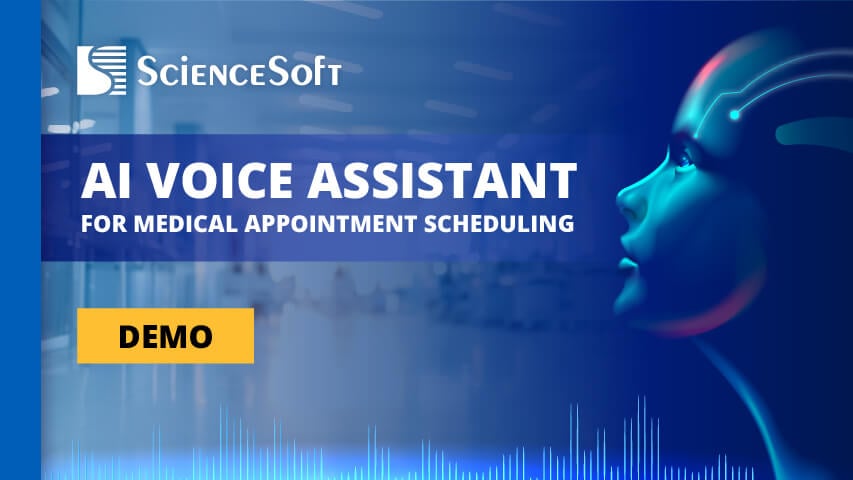
Conversational AI Assistant for Seamless Service Automation

See how conversational AI can be leveraged to automate complex interactions like appointment scheduling in healthcare. Deployed in Amazon Cloud and powered by Amazon’s Nova Sonic Speech-to-Speech model, the showcased agent can cut operational costs by 50%.

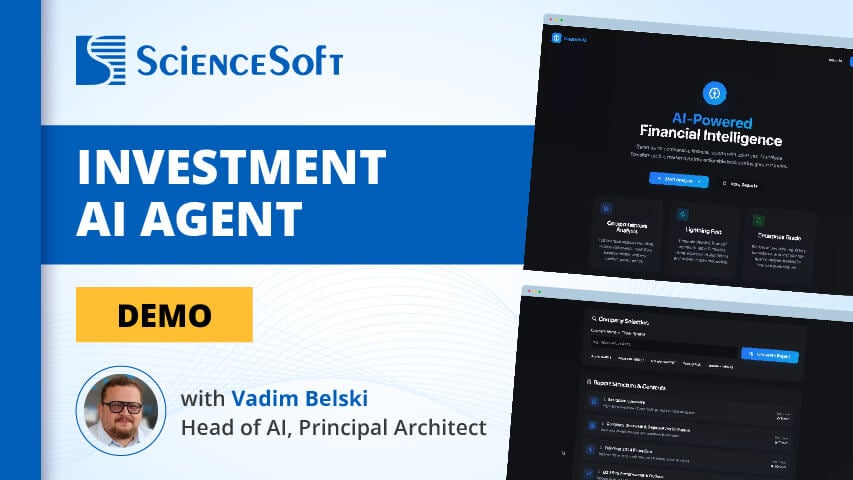
Agentic AI for Transforming Investment Decision-Making

See how agentic AI helps investment teams uncover market insights and make smarter decisions. Built on LangChain and OpenAI LLMs, the agent can speed up investment analysis by up to 70% and boost analyst productivity by over 50%.


Voice AI Agent for Insurance Claim Validation

See how agentic AI helps insurers spot fraudulent claims. Developed on AWS Bedrock AgentCore and OpenAI’s leading LLMs, the solution boosts investigator capacity by over 40% and drives 20%+ higher fraud detection rates through call-based claim verification.

Let’s Discuss Your GenAI Opportunities

Whether you’re just exploring GenAI or already running it, we’re here to listen, challenge your assumptions, and discuss the trade-offs. No predefined meeting agenda — just an honest, practical conversation focused on your questions, concerns, and ideas. It’s free and non-binding.