 ScienceSoft Global



Artificial Intelligence (AI) for Insurance Claims
Capabilities, Architecture, Costs
ScienceSoft brings 37 years of experience in AI engineering and 14 years in custom insurance software development to create accurate, regulator-ready AI solutions for insurance claims.
Contributors

Senior Insurance IT & AI Consultant, ScienceSoft

Principal Architect, AI & Data Management Expert, ScienceSoft

Insurance IT & AI Consultant and Lead Business Analyst, ScienceSoft
Artificial Intelligence in Insurance Claims: Quick Summary
Artificial intelligence for insurance claims helps reduce claim resolution costs by 20–50%, drive an up to 50% increase in claim specialists’ productivity, and achieve 5–10x faster claim cycles due to intelligent process automation. ScienceSoft can implement an AI solution for insurance claims automation.
AI-powered claim management systems can process 70–90% of simple insurance claims in a straight-through manner, with claims decisions delivered in minutes rather than weeks. They enable instant fraud detection, deliver accurate damage estimates, and provide intelligent recommendations on risk mitigation, helping insurers and claims service providers minimize financial losses and elevate customer experience.
Generative AI specifically is estimated to unlock a $100-billion benefit opportunity for insurers in P&C claims through reducing loss-adjusting expenses by another 20–25% and leakage — by 30–50%. ScienceSoft can implement automated claims processing for a P&C insurer.
The Market of AI for Insurance Claims
The global market of AI in insurance is projected to grow from $14.99 billion in 2025 to $246.3 billion by 2035, exhibiting a CAGR of 32.3%. Claims processing is considered one of the largest use case segments for AI in insurance.
McKinsey predicts that by 2030, claim processing will turn into the most important insurance function, with AI being the primary driving force of its digital transformation. Key factors spurring the popularity of AI for insurance claims are the increasing demand for fast claim settlement and personalized customer approach. With the help of AI, insurers and TPAs can eliminate claim fraud and effectively mitigate losses.
Capabilities of AI for Insurance Claims Processing
Below, ScienceSoft’s consultants assembled a comprehensive list of claims AI capabilities most commonly requested by our clients from the insurance industry.

Automated claim intake
Machine learning (ML) algorithms and large language models (LLMs) enable real-time capture and processing of insurance claims and related documents in various formats: standardized formats (e.g., ACORD, EDI), free-form digital text, handwritten notes, image, audio, video, and more. ScienceSoft can build a multimodal claims assistant for insurers.

Automated claim triaging
AI automatically prioritizes insurance claims for processing based on the analysis of policy terms, claim urgency, injury severity, damage extent, financial and reputational risks associated with non-settlement, etc. ScienceSoft can build an AI-powered claims intake and triage solution.

Data-driven claim validation
AI matches the claimants’ loss incident data to the insurance coverage terms and the available data from third-party sources. It instantly identifies fraudulent claim patterns and alerts claim specialists about potential fraud cases.

Intelligent claim decisioning
AI provides analytics-driven suggestions on claim approval or rejection (e.g., rejecting faked, late, wrongly disclosed claims). It flags complex claims that require manual review and automatically routes them to the appropriate claim specialists.

Remote damage inspection
AI-based computer vision technology enables real-time monitoring of insured assets and automated damage inspection even across complex environments like manufacturing lines and offshore drilling rigs. ScienceSoft can build an AI-powered claims automation system with photo-based damage detection, fraud analytics, and policy system integration.

Analytics-based damage assessment
AI automatically evaluates losses and calculates due compensation amounts based on the analysis of claim-supporting documents and the relevant data from external sources.

Intelligent supplier selection
AI recommends the best-fitting damage-handling service providers (e.g., healthcare providers, repair service companies) to claimants based on the analysis of service suppliers’ capacity, location, availability, pricing, etc.

Claim cost forecasting
AI calculates the expected claim costs (by period, customer, region, etc.) based on the analysis of the claim payment history, customer risks, force majeure risks, and more.

Prescriptive analytics for loss mitigation
AI analyzes real-time data on customer behavior and the insured asset state to assess potential loss risks. It offers intelligent suggestions on the proper course of action for policyholders to prevent claim events.

Automated customer communication
AI-powered virtual assistants can handle diverse customer interaction tasks: requesting the missing claim-related data and documents, communicating decisions on claim approval or rejection, providing 24/7 support, and more. ScienceSoft can build an AI assistant for claim processing.
How Agentic AI Works in Insurance Claims
The workflows below illustrate how specialized AI agents collaborate across claims systems, knowledge bases, external data sources, and customer interaction channels to automate repetitive claims tasks, improve adjustment quality, and speed up claim resolution. ScienceSoft can build a claims adjustment AI assistant for insurers.
Human experts remain involved in high-risk, ambiguous, and validation-flagged cases, while human feedback continuously improves agent performance through updated prompts, rules, and knowledge bases. Every action is logged for transparency and auditability.
Claim intake and triage
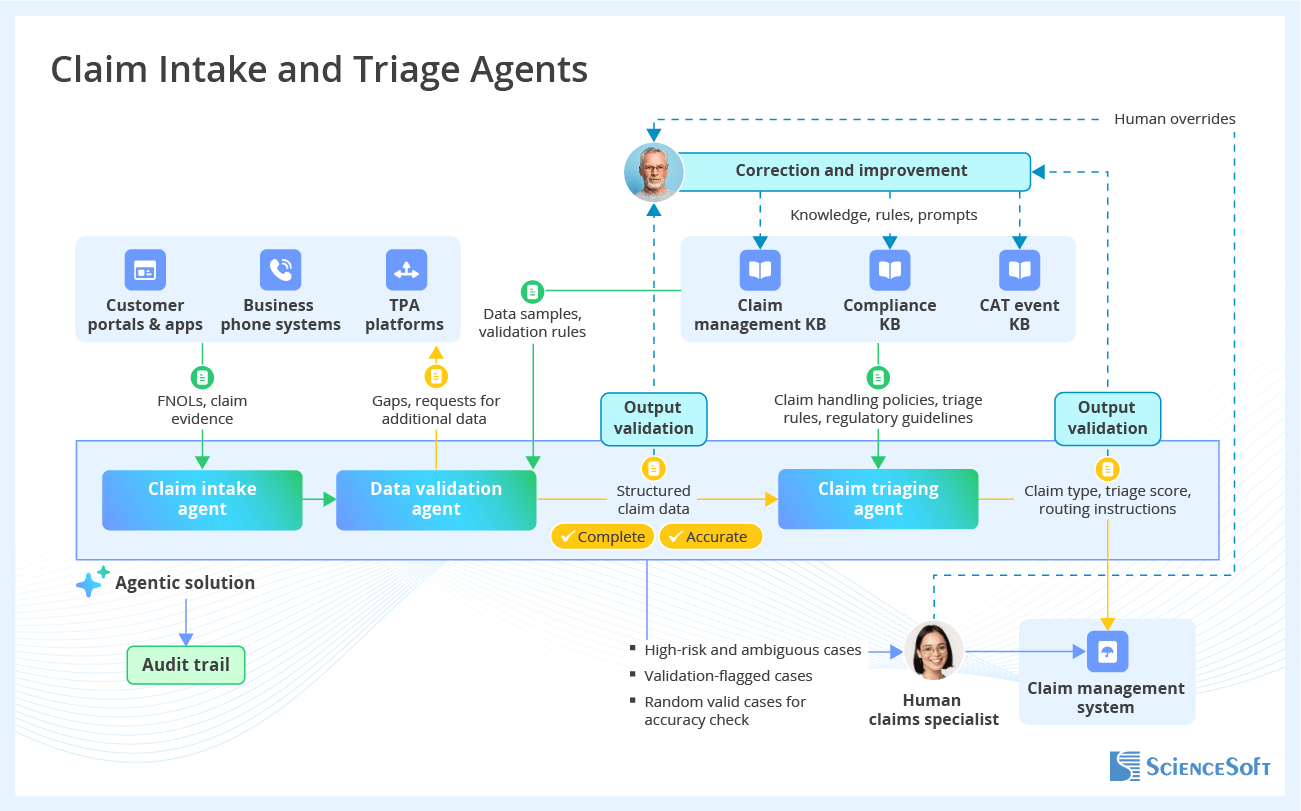
The claim intake agent collects FNOLs and supporting evidence from customer portals, mobile apps, and TPA platforms. The data validation agent verifies the accuracy and completeness of the submission package, identifies gaps, and request additional data when needed.
Once the claim package is complete, the claim triaging agent analyzes the submission using claim handling policies, triage rules, catastrophe event data, internal compliance requirements, and regulatory guidelines and determines claim type, priority, severity, and routing instructions. Built-in validation checkpoints verify the completeness and accuracy of outputs before claims enter downstream processing.
Claim fraud detection
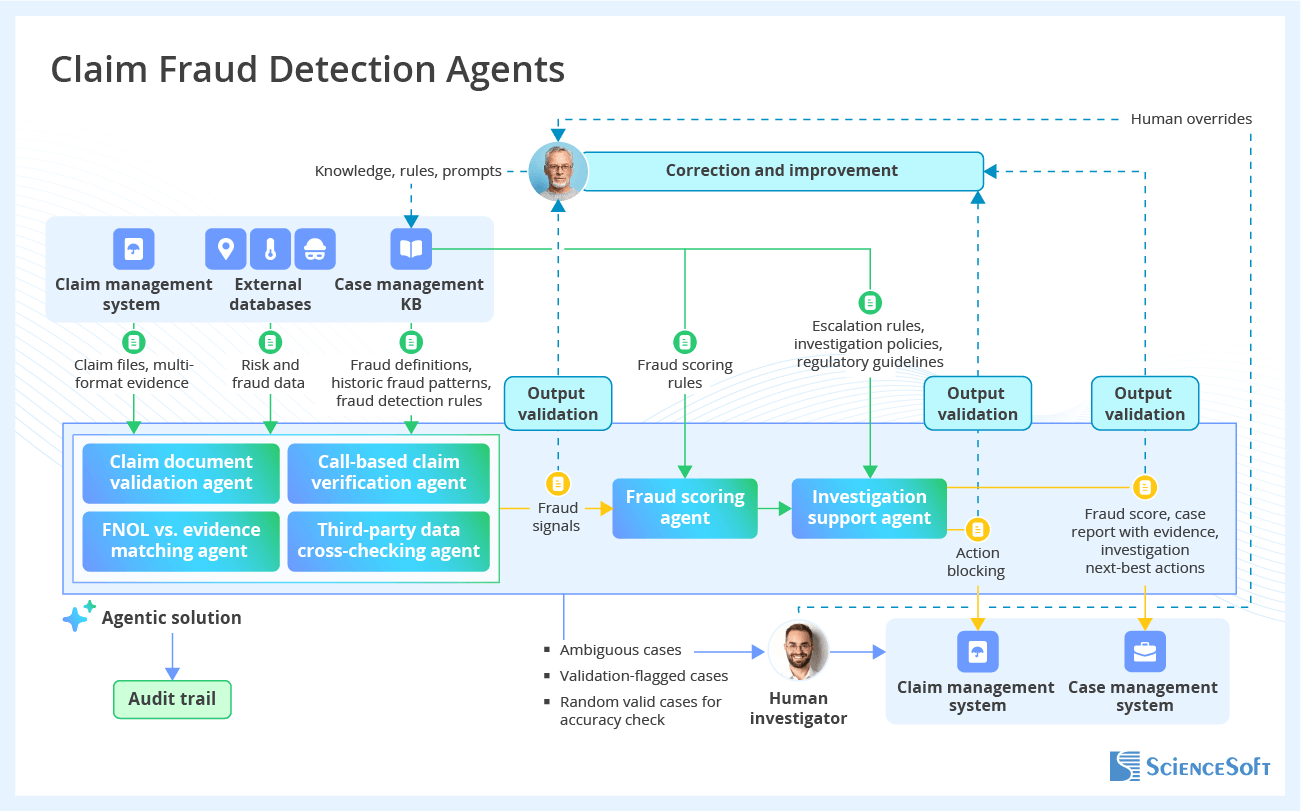
Specialized AI agents work in parallel to detect claim inconsistencies and potential indicators of fraud. They validate document authenticity, compare FNOL descriptions against submitted evidence (images, videos, reports, etc.), verify claims through customer interactions, and match submissions against trusted third-party sources (e.g., telematics, weather, medical, fraud databases).
The fraud scoring agent consolidates the detected fraud signals, evaluates them using the company’s fraud-scoring models, investigation guidelines, and regulatory requirements, and produces fraud risk scores. The investigation support agent generates evidence-backed case reports and suggests next actions, like additional verification steps, claim holds, or investigator review.
Adjustment decision support
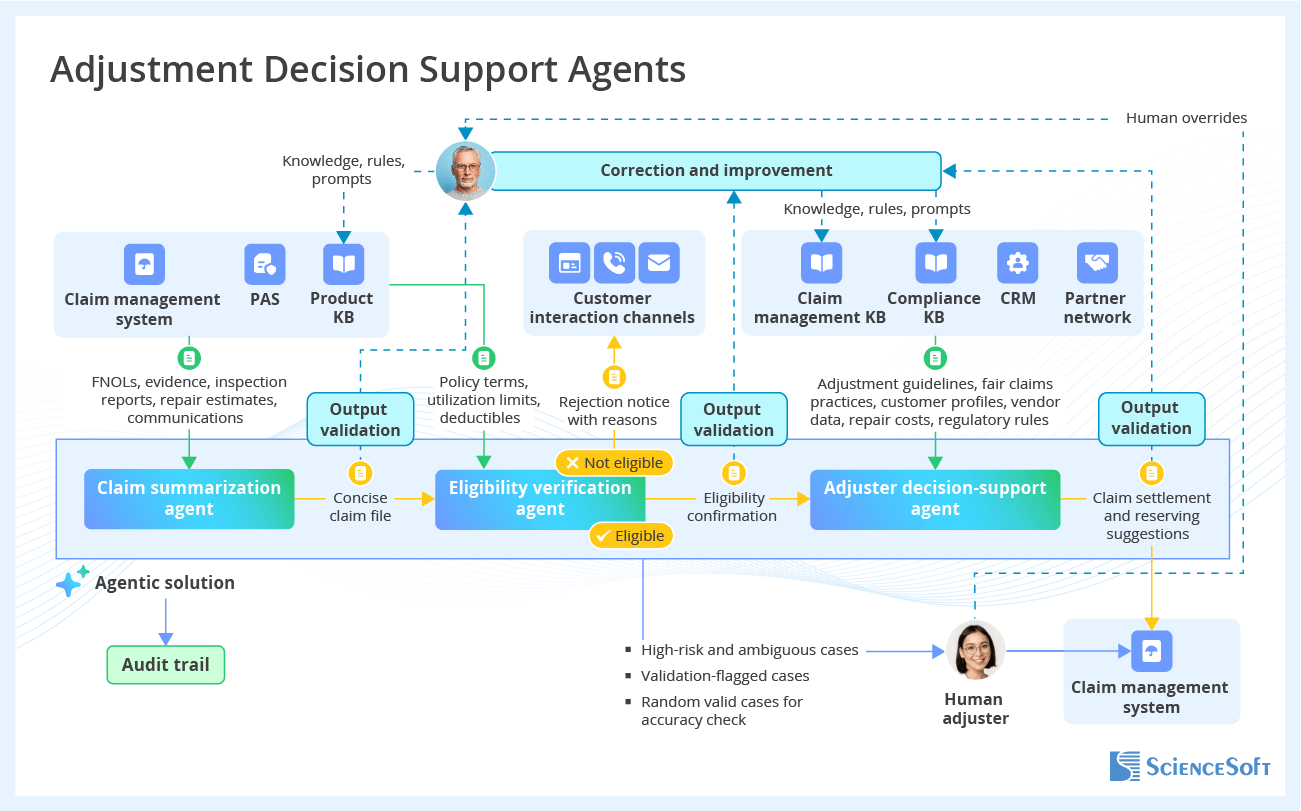
The claim summarization agent consolidates FNOL data, evidence, inspection reports, repair estimates, communications, and policy details into concise case overviews. The eligibility verification agent then checks coverage conditions, policy limits, deductibles, exclusions, and utilization and identifies claims that do not meet coverage requirements. It can also generate eligibility explanations for claimants.
For eligible claims, the adjuster decision-support agent analyzes claim details, aligning with claim management policies, the company’s compliance requirements, and regulatory rules. It checks submissions for fraud and parses claim execution costs across vendor networks. The agent then produces evidence-backed settlement suggestions and reserve estimates while flagging risks and inconsistencies. Human adjusters remain responsible for final decisions.
Watch Insurance Claims AI Agents in Action
Explore demo tours showcasing how specialized AI agents by ScienceSoft accelerate claims processing, improve fraud detection, and help adjusters make more accurate decisions.
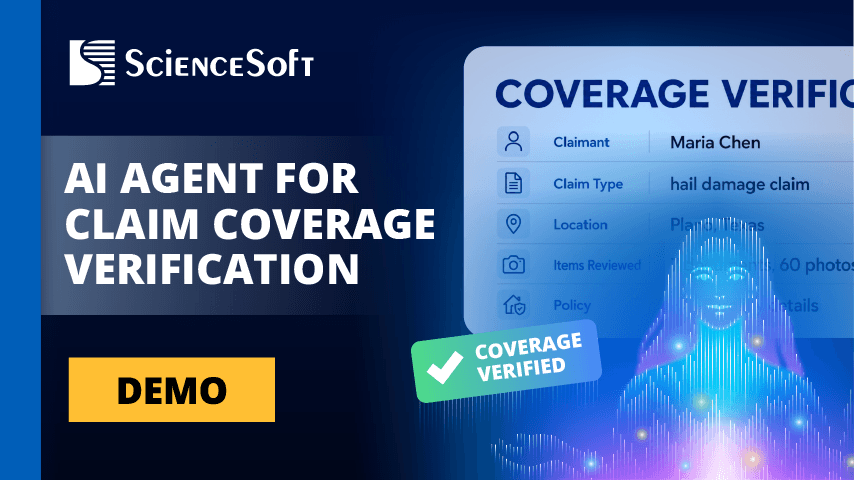
AI Agent for Insurance Claim Coverage Checks
The agent captures claim details, analyzes policy documents, interprets coverage terms, exclusions, and endorsements, and determines whether a claim is covered. Claims teams receive explainable coverage decisions in minutes and can focus on claim adjudication rather than manual policy reviews.
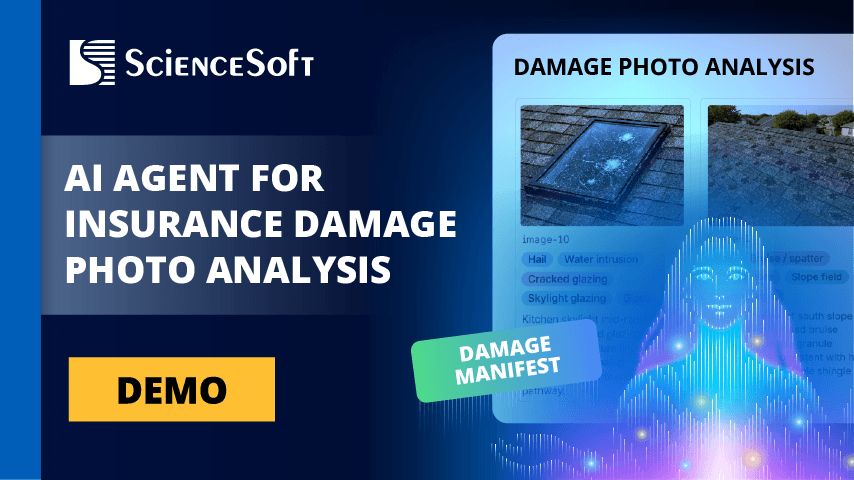
AI Agent for Insurance Damage Photo Analysis
The agent analyzes damage photos, identifies affected asset components, evaluates damage severity, and generates structured findings that can be integrated into downstream claims workflows within minutes. Adjusters can prioritize cases more effectively and complete damage assessments faster.
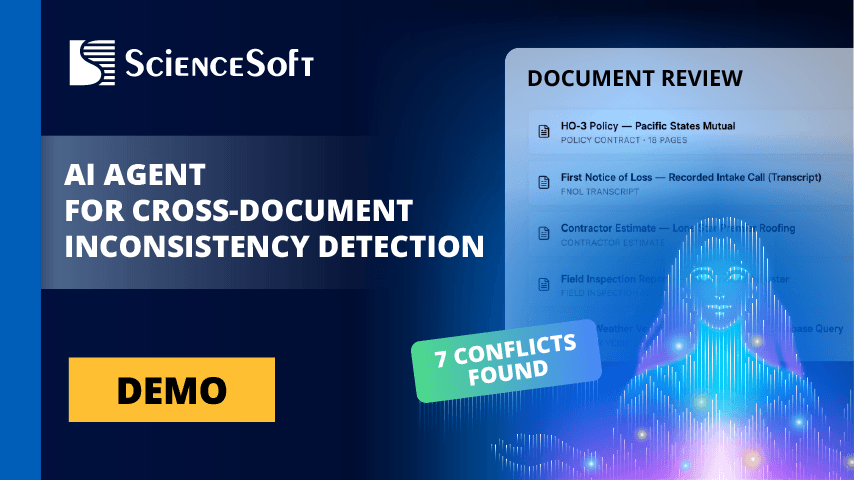
AI Agent for Cross-Document Inconsistency Detection
The agent cross-checks claim forms, repair estimates, invoices, policy documents, and supporting evidence, identifies critical conflicts, recommends SIU referrals, drafts outreach emails, and keeps the full audit trail ready for review. Issues are flagged before claim approval, strengthening fraud prevention.
AI Agent for Conversational Claim Verification
The agent conducts claimant calls, asks context-aware questions, validates responses against claim data, and captures fraud signals throughout the interaction. Claims teams spend less time on routine verification while improving investigation efficiency, fraud detection rates, and claimant experiences. ScienceSoft can create an AI voice tool for brokerages that lets clients report claims by phone with automated fraud screening.
Architecture of Claims AI Analytics Engines
In the reference architecture below, ScienceSoft’s architects show how traditional AI models can be used as a core for a specialized AI analytics solution for the claims domain, outlining the solution’s key components and data processing flows.
|
|
|
|
|
|
|
Follow the links to explore how our architects extend this blueprint with large language models (LLMs) and agentic AI to automate data-intensive, judgement-heavy claims operations in an effective and compliant way. |
|
|
|
|
|
|
|
|

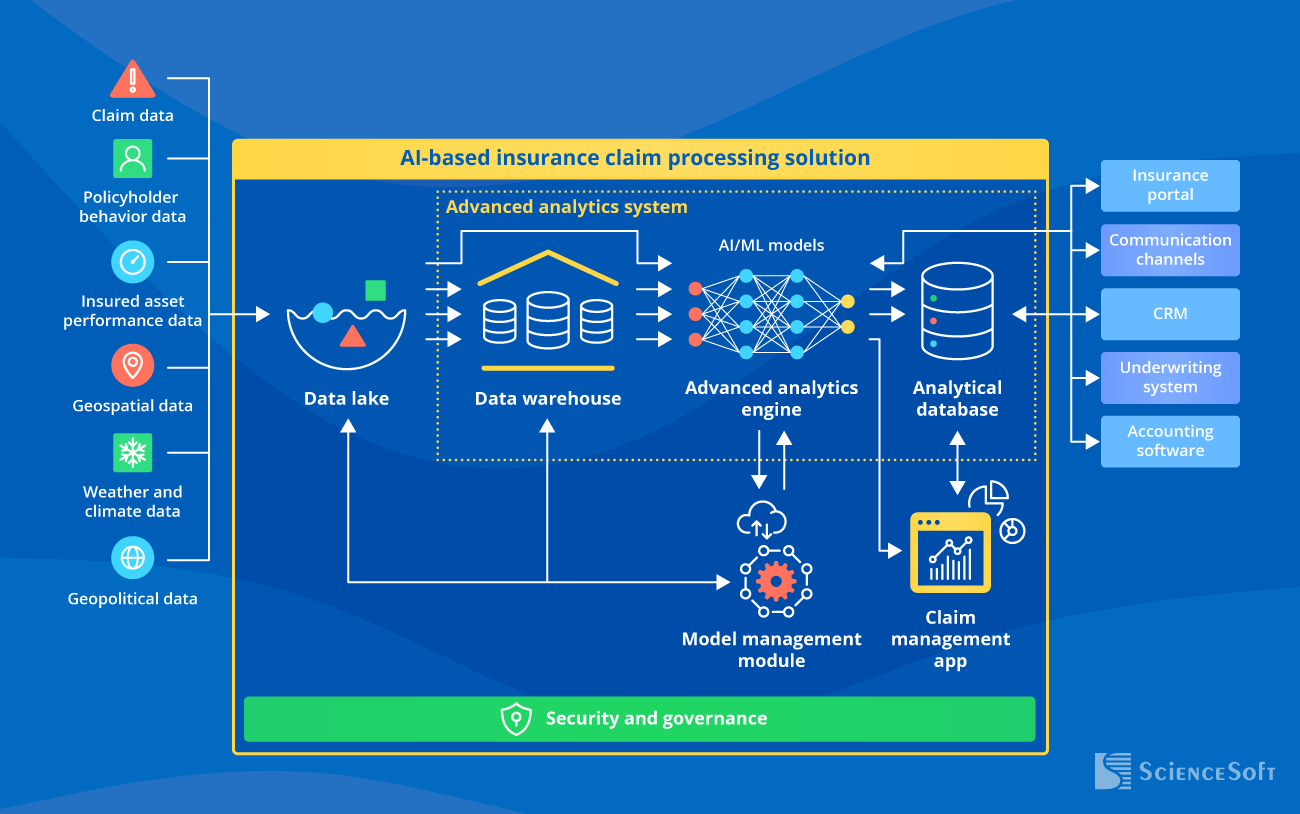
An AI-driven analytics solution for insurance claims integrates with core insurance systems, customer-facing apps, and relevant third-party data sources to capture structured and unstructured claim-related data. It moves the collected raw data to the data lake for storage, then directs it to the advanced analytics system for preprocessing (data sorting, filtering, enrichment, cleansing). The preprocessed data is stored in a data warehouse for further analysis.
An analytics engine with a pre-trained machine learning model at its core analyzes the available claim event details to offer intelligent damage estimates and suggestions on whether the claim should be approved or rejected. ScienceSoft’s data scientists suggest using neural network-based models to ensure precise analysis and forecasting of even the most complex claim cases. A dedicated model management module is needed to design, train, and continuously tune the models, improving their accuracy over time.
Finally, the analytical results are stored in the analytical database to be used by claim professionals (via a claim management app) and for further AI model self-learning. The system instantly communicates claim-related decisions to the relevant systems (e.g., an insurance portal, underwriting software, an accounting system) to make them available for claimants and other insurance teams.
How Insurance Market Players Benefit From Claims AI

ScienceSoft Creates ML Algorithms to Identify Insurance Fraud With 95% Accuracy
In 2023, ScienceSoft helped a health insurance technology startup deliver an ML-powered software product for automated dental insurance fraud detection.
After the 6-month-long engagement, our senior data scientist introduced ready-to-use ML algorithms for the intelligent analysis of claim-supporting dental X-ray images, instant detection of mismatched oral health data, and automated reporting of fraudulent claims.
The ISO 13485-compliant medical image recognition algorithms demonstrated 95% accurate dental insurance fraud detection. The product is now submitted to the FDA for clearance.

Large Car Insurer Benefits From Fast and Cost-Effective Claim Handling
In 2022, Compensa Poland (a part of Vienna Insurance Group, an insurance giant serving 22M clients in 30+ countries) implemented an AI-based claim processing solution to enhance its car damage claim handling processes.
The solution processes insurance claims and delivers intelligent suggestions on claim approval or rejection. It uses deep learning to analyze vehicle damage photos submitted by claimants and instantly produces accurate damage estimates.
With the help of AI, Compensa Poland cut the claim processing costs by 73%, reduced the claim resolution cycle from days to minutes, and significantly improved customer service quality.

AI Insurtech Startup Raises $119M+ Over 8 Years
A UK-based insurtech startup Tractable has developed an innovative AI solution for auto and property claim processing.
The solution automates the entire claim cycle, from FNOL to settlement. It uses deep learning and computer vision to enable remote car and property damage inspection and instant loss assessment. In addition, the software provides analytics-driven recommendations on the required repair operations.
Tractable raised over $119 million in funding from 2014 to 2022. Today, major insurers in the US, UK, Japan, and Europe use Tractable’s product. The solution proved to bring up to a 10x reduction in the claim resolution and damage handling time.
Challenges of AI for Insurance Claims — And How We Address Them
AI poses a few unique challenges that complicate its incorporation into claim resolution processes. Below, ScienceSoft’s data scientists, solution engineers, and security officers share their hands-on experience to address the potential risks and maintain the economic feasibility of AI for claim management.
Challenge #1: Achieving high accuracy of analytical results
“Good” AI model accuracy starts at about 70%, but to reliably automate high-risk processes such as insurance claim management, the accuracy needs to be above 95%. To maximize the precision of AI insights, your AI model must be properly designed and trained on the appropriate data sets. Plus, its decisioning logic must be clear and explainable to avoid unintended bias and ensure compliance with the legal claim disclosure standards.
Solution
Solution
Involving professional data scientists to design and train your insurance claim AI model helps ensure prompt model launch and its maximal accuracy. ScienceSoft’s data science experts with 7–20 years of experience will help compose a representative training data set and fine-tune the AI model’s parameters to guarantee that it produces highly accurate results. They will also implement the optimal combination of explainable AI models and black-box deep learning models to balance the accuracy of the output with the system’s transparency.
Hide
Challenge #2: Sensitive data security
When performing claim validation, AI deals with the policyholders’ sensitive data, including personal/business, financial, and health data. It poses strict security and compliance requirements for the AI-based claim processing solution.
Solution
Solution
ScienceSoft augments AI solutions for insurance claims with multi-factor authentication, data encryption, permission-based access control, and other robust cybersecurity mechanisms to prevent the risk of sensitive data leakage. We also recommend performing periodic infrastructure vulnerability scanning to minimize the risk of external cyberattacks.
In addition, we help our clients achieve and maintain compliance with the relevant data protection and AI governance standards, including NAIC (AI Principles), US state-level regulations (e.g., Colorado AI rules), NIST AI RMF, GLBA, NYDFS, CCPA, HIPAA (for health insurance), GDPR and AI Act (for the EU), IA (for the KSA), SOC 1/2, bank-grade model risk management practices (e.g., SR 11-7), and more.
Hide
ScienceSoft’s Tech Stack to Implement AI for Insurance Claims
Generative AI
Models
- Large Language Models (LLMs)
- Small Language Models (SLMs)
- Multimodal models
- Computer vision models
- Image generation models
- ASR speech models
- TTS speech models
- Audio models
- Real-time
Model adaptation and efficiency
- Fine-tuning
- Instruction tuning
- LoRA adapters
- RAG
- Graph RAG
- Agentic workflows
AI platforms and services
- Azure OpenAI Service
- Amazon Bedrock
- Hugging Face Inference
- Oracle Cloud
- G42/Core42
Agents and Orchestration
- OpenAI Agents SDK
- OpenAI Agents
- AWS Agents
- LangChain
- LangGraph
- smolagents
- LiveKit
- Dify
- n8n
- Faiss
- ChromaDB
- Qdrant
- Weaviate
- OpenSearch
- Pgvector
- Amazon Neptune
- Graph RAG Toolkit
- Neo4j
Traditional ML
Platforms and services
- Azure Cognitive Services
- Azure Machine Learning
- Microsoft Bot Framework
- Amazon SageMaker AI
- Amazon Transcribe
- Amazon Lex
- Amazon Polly
- Google Cloud AI Platform
- Google Vertex AI
Frameworks and libraries
- Apache Mahout
- Apache MXNet
- Caffe
- TensorFlow
- Keras
- Torch
- OpenCV
- Apache Spark MLlib
- Theano
- Scikit Learn
- Gensim
- SpaCy
Standards and regulations we adhere to
NAIC (including AI Principles and Model Bulletin), US state-level regulations (e.g., Colorado AI rules), NIST AI RMF, GLBA, NYDFS, CCPA, HIPAA (for health insurance), GDPR and AI Act (for the EU), IA (for the KSA), SOC 1/2, bank-grade model risk management practices (e.g., SR 11-7), and more.
Security mechanisms we work with
- Data protection: DLP (data leak protection), data discovery and classification, data backup and recovery, data encryption.
- Endpoint protection: antivirus/antimalware, EDR (endpoint detection and response), EPP (an endpoint protection platform).
- Access control: IAM (identity and access management), password management, multi-factor authentication.
- Application security: WAF (web application firewall), SAST, DAST, IAST (security testing).
- Network security: DDoS protection, IDS/IPS, SIEM, XDR, SOAR, email filtering, SWG/web filtering, VPN, network vulnerability scanning.
Our Clients on ScienceSoft’s AI Engineering Practices



ScienceSoft’s team undertook the development of our AI-based software product from scratch and showed deep expertise in the .NET environment and AWS and Azure services. They delivered software on time and with the required quality. The team adhered to consistent communication and was proactive in offering beneficial product customizations for our clients.



ScienceSoft was to cover the end-to-end development of an intelligent invoice processing module for our product. The team used the microservices approach to ensure the system’s scalability, which is critical for us as our user base is growing. We were particularly pleased with neat alignment of the developed module with our requirements.


ScienceSoft’s team identified core errors that prevent efficient solution operations and implemented high-speed convolutional neural networks to fix them. They promptly developed new software functionality fully adhering to our requirements. We are satisfied with our cooperation with ScienceSoft and their skilled development team.
Costs of Implementing AI for Insurance Claim Processing

From ScienceSoft’s experience, developing a niche AI/ML component (e.g., a fraud analytics model) on the existing claims platform may cost $100,000–$250,000.
An AI assistant for claims specialists, adapted to the organization’s specifics, may cost $250,000–$450,000.
A large claims automation system running on traditional AI and LLMs would require a budget of $600,000–$1,500,000+.
Want to understand the cost of your AI-powered software for insurance claim processing?
Below, our consultants provide a list of main factors that may impact the development budget and duration:
- The scope and complexity of the solution’s functional capabilities.
- The number and type of AI models (non-neural network ML models, DNN models, CNN models, etc.) for intelligent process automation.
- Performance, scalability, security, and compliance requirements for the solution.
- The number and complexity of integrations.
- The chosen sourcing model (e.g., outsourced, in-house development) and team composition.
Claims AI Consulting and Engineering Services by ScienceSoft

Consulting on AI for insurance claims
We are here to design the optimal feature set, architecture, and tech stack for your AI solution and deliver a proof of concept to promptly test its viability. Our experts will also deliver a project plan for risk-free AI implementation and help you optimize the cost of your solution.

Implementation of claims AI
Our engineering team is ready to handle the entire process of AI development, from project planning to implementation and support. Depending on your case, our data scientists will design and train proprietary AI models or integrate market-available LLMs, focusing on the accuracy of AI operations.
Why Implement AI for Insurance Claims With ScienceSoft
-
Since 1989 in AI consulting and implementation.
- Since 2012 in engineering custom software solutions for the insurance industry.
- Insurance IT and compliance consultants (NAIC, GDPR, IA, HIPAA, SOC 1/2, etc.) with 5–20 years of experience.
- 45+ certified project managers (PMP, PSM I, PSPO I, ICP-APM) who succeeded in large-scale projects for Fortune 500 firms.
- Principal architects with hands-on experience in designing complex insurance automation systems and driving secure implementation of emerging AI technologies.
- Established practices to ensure the high quality of insurance solutions and their delivery on the agreed timelines and budget, despite project constraints or uncertain requirements.








Featured Expert Talks
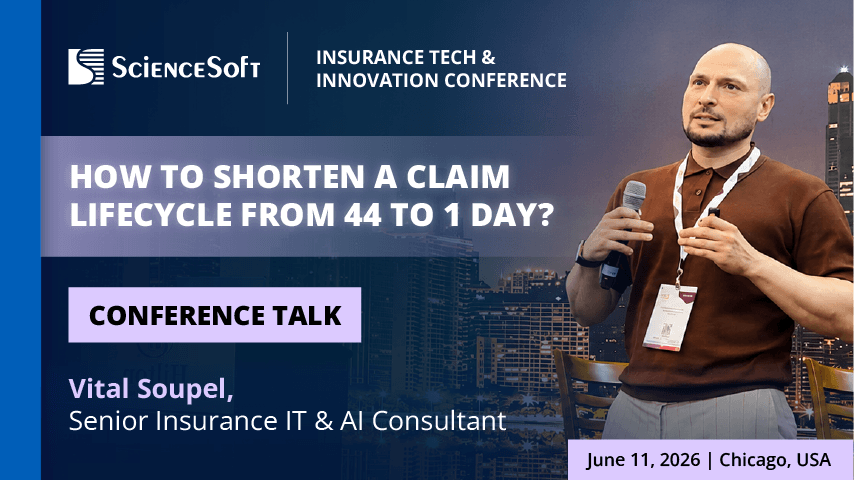
AI to Cut the Claims Lifecycle From 44 to 1 Day | Presentation at ITIC 2026
Presentation by Vital Soupel, Senior Insurance IT & AI Consultant at ScienceSoft, at the 2026 Insurance Tech & Innovation Conference in Chicago. Watch Vital explain how a multi-agent AI system helps insurers shorten the claims lifecycle from weeks to same-day resolution, with live demos of the AI agents.
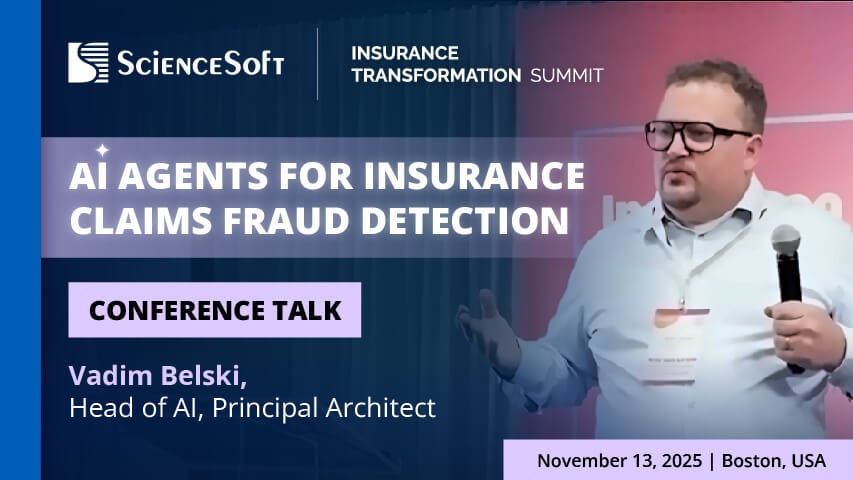
AI Agents for Insurance Claims Fraud Detection | Presentation at ITS 2025
Presentation by Vadim Belski, Head of AI and Principal Architect at ScienceSoft, from the 2025 Insurance Transformation Summit in Boston. Watch Vadim explore what agentic AI technology holds for insurance fraud detection and see our custom claims automation AI agent in action.

About ScienceSoft's AI Practice
ScienceSoft is a global AI transformation and software development company headquartered in McKinney, Texas. We build accurate AI solutions for efficient and secure processing of insurance claims. In our AI projects, we rely on robust quality management and data security management systems backed by ISO 9001 and ISO 27001 certifications.
