 ScienceSoft Global



Artificial Intelligence (AI) for Insurance Compliance Control
ScienceSoft is an AI transformation and software engineering company helping insurance organizations implement AI for compliance. In AI since 1989 and in insurance IT since 2012, we help pinpoint where AI can deliver measurable gains in compliance management and turn these opportunities into controlled transformation programs with clear business targets.

Contributors

Senior Insurance IT & AI Consultant, ScienceSoft

Compliance Officer, Healthcare and Finance IT & AI Compliance Consultant, ScienceSoft

Senior Financial Technology & AI Researcher, ScienceSoft
AI for Insurance Compliance Control: Key Facts
Artificial intelligence (AI) for insurance compliance control helps insurance organizations continuously monitor operations for potential compliance issues, automate regulatory and internal control checks, and streamline evidence collection, investigation, and reporting work.
AI technologies can analyze unstructured insurance data, verify documents and transactions against internal and regulatory rules, and detect risk signals that are difficult to capture with static engines alone. Unlike traditional automation tools that follow predefined execution paths, agentic AI systems can dynamically coordinate multi-step compliance workflows where the next action depends on emerging findings.
AI can be particularly valuable for insurance organizations operating across multiple jurisdictions and entities, where compliance teams need to apply and monitor different regulatory requirements at scale.
Implementing a task-specific compliance AI solution for insurance may take 3–9 months, while broader compliance workflow transformation may require 10–24+ months. AI implementation may cost from $150,000 to $1,500,000+, depending on the transformation scope and solution complexity. Use our free calculator to estimate the cost for your case.
AI Technologies for Compliance Control in Insurance

Machine learning (ML)
Traditional (non-generative) AI technology that supports continuous insurance compliance monitoring, predictive compliance analytics, anomaly detection, and violation risk scoring.

Generative AI
Assistive technology powering copilots, chatbots, and voice assistants that help compliance specialists prepare and investigate cases and provide compliance guidance to insurance teams.

Agentic AI
Technology that uses large language models (LLMs) and workflow automation to dynamically coordinate multi-step compliance controls. AI agents can utilize LLMs, ML algorithms, and rule-based engines to complete tasks and trigger approved actions across systems.
Business Impact of AI in Insurance Compliance Operations
Machine learning has supported insurance compliance analytics for years. With GenAI and agentic AI now expanding what can be automated, insurers are looking for evidence of their business value.
The financial returns from deploying generative AI in insurance compliance functions are already material. A 2025 study by EY-Parthenon found that 74% of insurers achieved at least 5% cost savings across risk and compliance operations from GenAI over the past 1–2 years, and 56% expect savings to exceed 10% as they scale AI over the next 1–2 years. In the same study, 46% of insurers said they currently use or expect to use agentic AI in regulatory and compliance work, making this area a top-3 target for agentic transformation.
Based on ScienceSoft’s estimates, agentic AI can deliver the biggest near-term impact in insurance compliance operations. Agentic systems can dynamically coordinate controls and pass risk signals, evidence, and tasks across workflow steps largely autonomously. This minimizes manual routines and removes the idle time that typically occurs while cases wait for manual actions and handoffs, driving significant speed and efficiency gains.
Other consultancies share this view: Deloitte names agentic automation a game changer for insurance compliance and reports that early adopters achieve 30–60% faster review cycles and 20–40% lower compliance effort. Industry case studies also reflect improved outcomes: Praxi.ai, a provider of a compliance platform with agentic capabilities, shares that one of its clients in insurance cut compliance errors by 60% through faster risk spotting and mitigation.
AI agents are a great destination, but not a universal starting point.
Agentic AI shouldn’t necessarily be your first AI project. In ScienceSoft’s experience, the biggest compliance bottleneck often lies in poor data, limited analytics, or specific manual steps. These are problems that agentic AI alone won’t resolve. The right AI path largely depends on your specific needs and what your current compliance tooling can already do.
Whatever direction you start with, much of the infrastructure, integrations, access mechanisms, and governance built for one AI type or use case can be reused as AI adoption expands. Once the initial setup proves its value in production, you can build on it to expand AI-supported compliance workflows further.
Insurance Lines of Business That Benefit From AI for Compliance







Insurance Compliance Requirements AI Can Help Address
The examples below highlight common compliance requirements for US insurers. Custom compliance AI solutions can be built to support the specific regulations and internal controls relevant to your entity type, jurisdiction, and lines of business.
Internal compliance controls
The insurer’s underwriting and claims authority rules, escalation criteria, approval matrices, customer eligibility criteria, producer oversight rules, internal document and recordkeeping standards.
Operations and market conduct
State DOI regulations; NAIC frameworks (Unfair Trade Practices Act, Unfair Claims Settlement Practices Act, Market Conduct Surveillance Model Law, Market Conduct Record Retention and Production Model Regulation).
Eligibility and due diligence
AML/CFT, OFAC, NAIC Producer Licensing Model Act, FinCEN AML and SAR requirements for covered insurance products.
Documents, disclosures, and reports
State DOI form filing and approval requirements; NAIC frameworks (Market Conduct Annual Statement (MCAS) filing requirements, Annuity Disclosure Model Regulation, Uniform Suspected Insurance Fraud Reporting Form).
Marketing, sales, and communications
NAIC Unfair Trade Practices Act, NAIC Advertisements of Accident and Sickness Insurance Model Regulation, TCPA and CAN-SPAM requirements for outreach.
Data protection and cybersecurity
GLBA; NAIC Insurance Information and Privacy Protection Model Act, NAIC Insurance Data Security Model Law, NAIC Standards for Safeguarding Customer Information; HIPAA; CCPA/CPRA; NYDFS Cybersecurity Regulation.
What AI Can Do in Insurance Compliance Management
Below are the key operations AI can support across insurance compliance control. ScienceSoft can engineer selected AI components for specific tasks or deliver a scalable AI layer that transforms the entire compliance management process.
Turn requirements into controls

Regulatory change management
AI agents can monitor designated regulatory sources across jurisdictions and capture new insurance regulations, amendments, and enforcement updates. They can use LLMs to classify updates by jurisdiction, insurance line, and compliance area, compare new requirements with prior versions, and summarize material changes. The LLMs can identify potentially affected compliance guardrails, operations, and products and draw impact assessments for compliance specialists, who can then map approved changes to affected areas.

Compliance policy and control design
AI assistants can help compliance teams decompose regulatory requirements and supervisory guidance into individual obligations and map them to the organization’s compliance policies, procedures, and controls. Compliance specialists can ask the assistants to highlight requirements with no related control, duplicate controls, and outdated policy provisions. The assistants can also draft proposed control descriptions, testing criteria, and policy updates.
Apply controls in insurance operations

Market conduct and distribution compliance
Triggered at key workflow points across claims, underwriting, and sales, LLMs can vet communications, disclosures, and records for required content and timing and flag issues before regulated actions proceed. They can also verify producer licensing, appointments, and authority and perform line-specific checks, e.g., identify incomplete suitability, best-interest, or replacement documents in L&A workflows.

Document and content compliance review
LLM-powered engines can review internally produced insurance documents and content, including highly specialized pieces like manuscript endorsements and bespoke specialty policy wordings, against the insurer’s product rules, internal compliance policies, and applicable regulations. They can explain the issue to employees in plain language and suggest compliant revisions.

Continuous compliance monitoring
Machine learning (ML) engines can continuously analyze operational logs across insurance systems, spot potentially non-compliant activity, and immediately notify compliance teams. Graph ML algorithms can additionally monitor relationships among insurance producers, customers, and partners and identify network-level compliance violations like hidden beneficial ownership or affiliations.

Compliance risk assessment
Compliance professionals can use predictive ML models to score compliance risk across diverse areas. The models can factor in past violations, control failures, regulatory exposure, and other organization-specific scoring criteria. Predictive analytics systems can dynamically aggregate risk scores and signals into dashboards and highlight risk concentrations and shifts in the entity’s compliance exposure.

Third-party and financial crime due diligence
For third-party relationships, LLM-powered engines can extract compliance-sensitive data (identity, ownership, risk) from submissions and verify it against approved external sources and the organization’s internal policies. The exact checks depend on the insurance products, jurisdiction, and applicable AML/CFT, sanctions, producer, or vendor requirements. AI agents can initiate requests for missing data, escalate high-risk cases for enhanced checks, and trigger repeat reviews when data changes.

Compliance control orchestration
Agentic AI systems can coordinate multi-step compliance controls across specialized models, rule engines, insurance systems, and human reviewers. When a compliance-sensitive event occurs (e.g., a producer is onboarded, a claim payment is authorized), a dedicated orchestration agent can dynamically determine which controls need to run and enforce permitted actions. It can also route non-standard exceptions and approval requests to compliance specialists and record decisions and actions in the audit trail.
Investigate and demonstrate compliance

Compliance investigation support
When investigating a suspected breach, compliance specialists can ask AI copilots to retrieve case records, reconstruct timelines, compare statements across records, and consolidate relevant evidence. They can also explain detected non-compliance signals, draft investigation notes and case summaries, suggest response actions, and answer follow-up questions.

Compliance audit preparation
When preparing for internal or regulatory audits, compliance teams can use AI-powered semantic search engines to locate and extract relevant unstructured evidence. The engines can classify evidence by obligation and control area, link evidence to control tests, and flag missing, outdated, or inconsistent records. They can also compile audit-ready evidence packages and reports for expert review.

Regulatory reporting
For recurring regulatory filings, AI agents can gather data from insurance systems, reconcile information across sources, and populate standard reporting and disclosure forms. The agents can also check already prepared submissions for data quality issues. For non-standard reports, compliance experts can ask AI assistants to draft narrative explanations, map supporting evidence, and generate accompanying documents using approved data.
Support compliant employee decisions

Compliance training design and delivery
Insurance organizations can use generative AI to design tailored educational content and practice scenarios for role-specific compliance training. Employees can then train interactively with AI assistants. For example, a claims adjuster can work through a difficult customer communication or disclosure scenario and receive immediate feedback on their choices. AI assistants can assess learning progress, provide explanations, adapt follow-up questions, and assign additional exercises based on the employee’s responses.

Compliance assistance for insurance teams
Using AI assistants grounded in the organization’s compliance knowledge, insurance operations teams can clarify compliance requirements during day-to-day work without routinely turning to compliance specialists. Such assistants can answer questions about disclosure, documentation, and conduct requirements and explain how they apply to specific products and operational scenarios. When the assistant faces a sensitive query or is unsure about the response, it escalates the case to a human expert.
Wondering If AI Would Fit Into Your Compliance Setup?
ScienceSoft’s consultants can review your current workflows and tools and identify where AI could bring measurable improvements without unneeded risk. The first consultation is free and non-binding.

How to Introduce AI Into Insurance Compliance Process
The right way to introduce AI depends on where you face bottlenecks and what your current compliance control setup can already do. Below, ScienceSoft shows four common starting points and the AI implementation approach that usually makes sense.
| Operational challenge | What usually makes sense |
|---|---|
|
Operational challenge
Manual processing of compliance data and evidence consumes much time and capacity |
What usually makes sense
Automate processing with fit-for-purpose AI. Depending on the task and data type, you may need ML models for document classification, LLMs for extracting data from unstructured sources, computer vision for analyzing scanned forms and images, or a combination of the three. The solution can take the form of a standalone tool, an AI-augmented data processing pipeline, or a specialized AI model. ScienceSoft can integrate ready-made AI models or tools and build the required functionality around them, or train one or several custom models on your historical cases and embed them into existing workflows. |
|
Operational challenge
Breach risk detection quality is insufficient |
What usually makes sense
Find out whether the problem is your analytics solution or the data it consumes. If important data (operational logs, product rules, internal policies, regulations) is missing, outdated, or poorly mapped, ScienceSoft can fix these data feeds, and the existing solution can keep evaluating compliance risks. If the data is right but your analytics solution fails to recognize specific non-compliance patterns, ScienceSoft can implement one or several focused AI models (e.g., predictive ML models for pattern detection and risk scoring or LLMs for identifying risk signals in unstructured data) and pass their findings back into the existing platform. We can integrate commercial models or tools where they fit, or develop custom models. |
|
Operational challenge
Compliance specialists spend too much time finding information, reviewing cases, and preparing documents |
What usually makes sense
Add a GenAI copilot for compliance and investigation teams. The copilot will help employees gather compliance data and knowledge, interpret evidence, summarize cases, and draft documents. If your compliance platform already offers a packaged copilot for the required workflow, ScienceSoft can help configure and integrate it. Otherwise, ScienceSoft can build a tailored assistant on a commercial LLM and securely connect it to case documents, unstructured logs, and compliance knowledge through retrieval-augmented generation (RAG) and to structured compliance-relevant data through APIs. |
|
Operational challenge
Individual control and investigation activities require extensive manual coordination across systems and teams |
What usually makes sense
Consider agentic AI for those specific activities. Where traditional automation cannot reliably coordinate the work between your systems or teams, ScienceSoft can build an agentic orchestration layer using commercial LLMs and agentic frameworks. It typically makes sense to add an agent for one bounded compliance control workflow in one line of business and, once its reliability and value are proven, expand the agentic setup to a broader process. Agent launch also includes establishing governance mechanisms: agent permissions, rule-based and technical guardrails, deterministic validation, and human approval pipelines. See best practices in the next section. |
Best Practices for Engineering Responsible Compliance AI

Reduce AI inconsistency through deterministic validation
AI models inherently produce probabilistic outputs, meaning an LLM reviewing the same due diligence pack may flag a submission as incomplete in one run but mark it compliant in another. For safe and predictable use, AI outputs should never automatically pass to the next compliance workflow step unchecked.
To address AI uncertainty, ScienceSoft typically adds deterministic validation services. Such tools check every AI output against predefined data structures, business rules, and confidence thresholds. They can catch missing, conflicting, or low-confidence outputs and route them for additional checks or human review. This prevents AI errors from propagating to downstream agents and insurance systems.
Deterministic validation keeps compliance experts in control where judgment is needed without making manual review the default AI checkpoint. You can set rules so the agentic system automatically passes low-risk, high-confidence results and involves humans only when risk or uncertainty is genuinely high.
The next section illustrates how rule-based and manual AI accuracy checks work in practice.
Make sure your AI itself is compliant
AI solutions for insurance compliance must themselves comply with applicable regulations: AI-focused frameworks like the NAIC AI Model Bulletin, insurance operational regulations, and data protection standards. The AI design, governance, security, auditability, and control requirements imposed by those regulations can materially affect the AI solution architecture.
ScienceSoft brings regulatory compliance into AI design from the start. Our consultants identify the requirements applicable to planned AI use cases, map them to affected solution components and data flows, and translate legal rules into functional requirements and technical controls. This way, compliance is built into the solution architecture and logic before development starts, helping avoid costly redesigns later. Revisiting compliance requirements as regulations or the solution scope change, and adjusting controls accordingly, helps prevent unnoticed compliance gaps during implementation.
This approach follows ScienceSoft’s established practices for achieving financial software compliance. Check them out to see how we address AI compliance throughout engineering.
Add rule-based and technical controls over agentic work
Just like compliance officers, compliance AI agents shouldn’t have unrestricted freedom to access systems, take actions, or make decisions without approval. You need to define explicit agent permissions and human approval gates so that agents never exceed their authority. In practice, you can enforce these controls using existing enterprise systems: identity and access management (IAM) can restrict what data and systems each agent can access, business rule engines can block or flag actions that break predefined rules, and business process management (BPM) systems can automate human approval workflows.
ScienceSoft typically adds another layer of control through AI technical guardrails. Such services can protect against AI-specific risks like access to prohibited data and tools, manipulated action requests, and harmful content generation. At runtime, they can enforce least-privilege tool access, AI input/output and schema restrictions, and prompt injection controls. Cloud-native services like Amazon Bedrock Guardrails and Azure AI Content Safety provide a good starting point, offering ready-made AI guardrails for common AI-specific risks.
ScienceSoft’s Head of AI, Vadim Belski, suggests that insurance compliance agents may follow largely the same guardrail principles he recently mapped for fraud detection agents.
How AI Guardrails Apply in Agentic Compliance Workflows
The workflow below shows how AI guardrails, validation, and control mechanisms can be applied across an agentic insurance compliance workflow to keep agent actions reliable, auditable, and within defined boundaries.
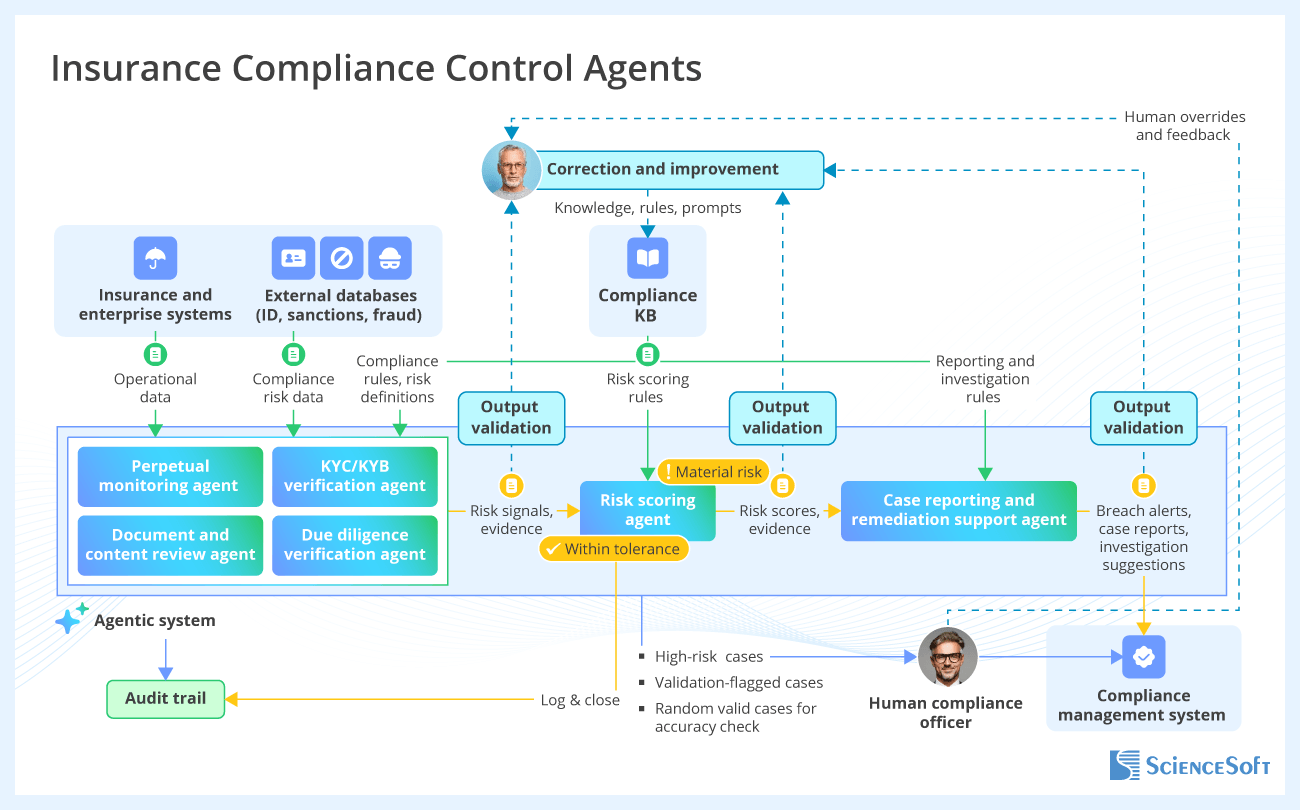
Specialized compliance verification agents can work in parallel across insurance operations (claims, underwriting, policy administration, customer servicing, etc.) and broader enterprise workflows (e.g., vendor management, document management). Separating responsibilities across multiple narrow agents makes agentic controls simpler and reduces the risk of a single agent’s error propagating through the entire workflow.
In this sample workflow, the perpetual monitoring agent continuously analyzes operational events and transactions for potential breaches. The document and content review agent, KYC/KYB verification agent, and due diligence verification agent are triggered at specific workflow points. The agents apply the insurer’s internal compliance knowledge to identify issues and, where needed, cross-check data against approved external sources.
Next, the risk scoring agent consolidates the findings and evaluates the compliance risk level using the insurer’s approved scoring rules and models. For each risk score, it also calculates a confidence score indicating how reliable the assessment is based on the available data and supporting evidence.
Based on the risk and confidence scores, the risk scoring agent determines whether further compliance action is required. It automatically closes high-confidence checks that fall within predefined risk tolerances and records the decision, score, and evidence in the audit trail. Low-confidence cases and likely breaches proceed to the case reporting and remediation support agent. This agent prepares an evidence-backed case report, prioritizes the issue, and recommends the next step according to the insurer’s rules. It passes the prepared case package to the compliance management system, where human compliance officers can review it and make a final decision.
Throughout the workflow, deterministic validation mechanisms check AI outputs for reliability. They pass valid outputs to the next workflow step and escalate challenged and randomly sampled cases for accuracy control to compliance officers, who can correct or override AI outputs. Manual overrides and feedback on AI accuracy from compliance officers are recorded in the compliance management system and can be used to refine prompts, rules, and knowledge bases.
The agentic system maintains a complete audit trail of agent checks, data sources, validation results, human decisions, and permitted actions so the insurer can reconstruct how a compliance issue was handled.
Costs of AI Transformation in Insurance Compliance Control
The cost of implementing tailored AI capabilities for insurance compliance management may range from $150,000 to $1,500,000+, depending on the scope of transformation, the AI solution’s functionality, integration complexity, as well as performance, scalability, security, and governance requirements.
Below are ScienceSoft’s sample cost ranges for common compliance AI transformation scenarios. These ranges cover the AI solution design and implementation work and exclude third-party component licenses, network fees, cloud hosting, and AI model usage:

$150,000–$250,000
Early AI rollout: AI-assisted compliance investigation
Solution: An AI copilot for compliance specialists that searches compliance cases and evidence, summarizes risk signals, and prepares investigation reports. This range assumes LLM-powered search and document analysis capabilities and a limited set of integrations (e.g., with an existing compliance management system, a core insurance plaftorm, and a document repository).

$300,000–$600,000
Transformation of one compliance control workflow
Solution: An agentic AI solution that automates multiple compliance control steps within a particular workflow (e.g., due diligence verification or continuous compliance monitoring). Within this range, you typically get task-specific agents, an agentic orchestration layer, and human review interfaces. Integrations may span 3–6 systems and data sources required for the selected workflow.

$600,000–$1,500,000+
Enterprise-grade compliance management transformation
Solution: An AI automation layer spanning 3–5 connected compliance management workflows. At this scale, the scope may include GenAI-assisted document and evidence analysis, agentic automation for diverse compliance control scenarios, and integrations with 6–10+ internal and external systems and data sources. The range typically assumes you can reuse some existing compliance analytics; building advanced risk models from scratch or expanding automation further can push the investment above $1.5M.
Wondering how much your AI transformation will cost?
Use our online calculator to describe your needs, and we'll get back to you shortly with a tailored estimate. It’s free and non-binding.
* The estimates are for midsize insurance organizations (<2,000 employees) serving 1–3 major lines of business in one jurisdiction. The final implementation cost will depend on the insurer’s specific needs and the maturity of the organization’s IT, data, and governance environments.
Why Implement Insurance Compliance AI With ScienceSoft
- Since 1989 in AI consulting and implementation.
- Since 2012 in delivering digital transformation for the insurance industry.
- Insurance IT, AI, and compliance consultants with 5–20 years of experience.
- Principal architects with hands-on experience in designing complex insurance automation systems and driving secure implementation of AI technologies.
- 350+ software engineers, 50% of whom are seniors or leads.
- 45+ certified project managers (PMP, PSM I, PSPO I, ICP-APM) who succeeded in large-scale projects for Fortune 500 firms.
- Expertise in insurance regulations (NAIC, state DOI rules), AI-specific mandates (the NAIC AI Model Bulletin, the EU AI Act), and data protection frameworks (NYDFS, CCPA/CPRA, GLBA, HIPAA, GDPR).
- Established practices to ensure the high quality of insurance AI solutions and their delivery on the agreed timelines and budget, despite project constraints and changing requirements.







ScienceSoft’s clients say


ScienceSoft are responsive, technically sharp, and they communicate well with our people. When we've needed to move fast, they've stepped up and delivered. What I appreciate most is their proactive approach. They don't just wait for us to identify issues. They bring solutions to the table and help us prioritize what matters most. That kind of partnership is hard to find.


Partnering with ScienceSoft has been an excellent experience. Their team transformed our underwriting platform into a well-oiled machine. They identified and fixed several longstanding issues that had been causing us persistent difficulties. Their communication was exemplary; unlike our previous experiences with outsourcing, we never had to chase them for updates, and they were always prompt in responding to our queries.

Damien Sewell
Head of IT Projects

ScienceSoft’s quick buy-in and readiness to take the initiative made the project faster and less stressful for everyone involved, from Capital IM’s insurance specialists to leadership. At the end of a short yet highly productive two months, we got a secure and wholly owned property insurance solution that is fully adapted to Capital IM’s corporate practices and brand book. We couldn’t have asked for a better IT partner.
