ScienceSoft Global



Insurance Software Modernization Services
Rebuild What’s Outdated. Protect What Works.
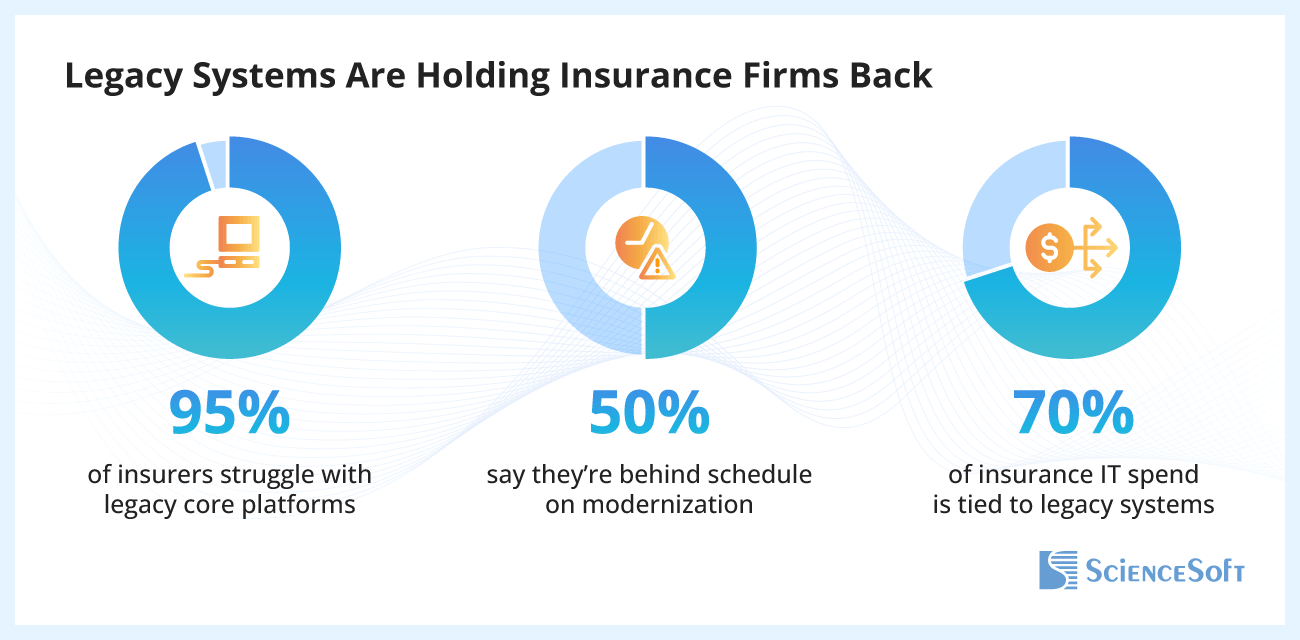
ScienceSoft helps insurance market participants and software vendors modernize legacy software in controlled, value-first phases. We assess what should be preserved, improved, replaced, or re-architected, then plan and implement modernization with tight control over scope, cost, timelines, and operational impact.
Contributors

Project Management Director, ScienceSoft

Senior Insurance IT & AI Consultant, ScienceSoft
Insurance software modernization services are necessary to transform legacy insurance systems into scalable, high-performing solutions. These services may span the reengineering, rearchitecting, migration, and evolution of outdated insurance tools.
- Insurance organizations pursue modernization to improve the agility, performance, interoperability, AI readiness, and compliance of their systems without disrupting business operations. Modernization helps increase operational efficiency, elevate user experience, accelerate the launch of new products, improve data utilization, and cut both operational and IT expenses.
- For insurance software product vendors, modernization is a way to evolve their aging products into cloud-ready, scalable solutions without displacing well-working modules or breaking client operations. With revamped software, vendors can speed up feature delivery, reduce maintenance costs, broaden the scope of integrations, and leverage modern SaaS models.
ScienceSoft: Big Enough to Deliver, Small Enough to Care
- Since 2012 in engineering custom software solutions for the insurance industry.
- Since 2012 in full-cycle cloud migration services.
- Since 1989 in AI services to drive AI transformation in insurance.
- 750+ professionals, including software engineers, testers, data scientists, and DevOps engineers. Over 50% of our engineers are senior or lead specialists.
- 30+ principal and senior architects with hands-on experience in modernizing insurance automation systems and driving safe implementation of AI technologies.
- Insurance IT and compliance consultants (NAIC, GLBA, HIPAA, NYDFS, GDPR, etc.) with 5–20 years of experience.
- 45+ certified project managers (PMP, PSM I, PSPO I, ICP-APM) who’ve brought their established PM practices to succeed in large-scale projects for Fortune 500 firms.
- Partnerships with Microsoft, AWS, Ispirer Systems (a provider of automated migration tools), and other technology leaders.
- Prepared to support long-term modernization initiatives: 62%+ of ScienceSoft’s revenue comes from engagements lasting more than 2 years.






Who We Help With Insurance System Modernization
-
 Insurance carriers
-
Managing general agents (MGAs)
-
Third-party administrators
-
Insurance brokers
-
Insurance agencies
-
Reinsurers
-
Distribution facilitators (NMOs, embedded insurance partners)
-
Insurance software product companies








ScienceSoft’s Insurance IT Modernization Services
Modernization strategy planning
-

Insurance software modernization consulting
ScienceSoft’s consultants assess legacy insurance systems and their infrastructure to identify modernization opportunities, constraints, and risks. We work with you to find realistic, cost-aware strategies for gradual modernization that would minimize business disruption and target the biggest pain points first.
-
ScienceSoft helps insurance organizations upgrade their operations through the strategic adoption of AI, without replacing core systems. We add agentic, assisting, generative, and predictive capabilities around and within existing software environments, targeting workflow gaps where AI can improve speed, accuracy, or staff productivity.


Insurance software transformation
-
Tech stack modernization
ScienceSoft revamps insurance apps built on outdated programming languages, frameworks, and databases by migrating them to modern, scalable, and cloud-optimized technologies. Our engineers apply DevOps practices and tools to enable faster, more reliable transitions and simplified maintenance.
-
Software reengineering
ScienceSoft’s engineers improve the internal structure, logic, and data models of insurance systems without changing their architecture. This may include optimizing data access and storage procedures, reviewing and refactoring software code, repairing integrations, and enabling web and mobile access.
-
Software rearchitecting
ScienceSoft’s architects redesign legacy insurance systems to improve scalability, interoperability, security, and compliance. This may involve strangling monolithic platforms to modular (SOA, microservices) architectures, transitioning databases from single-node to distributed or managed cloud setups, and optimizing architectures for cloud elasticity and higher availability.
-
Data modernization
ScienceSoft’s data architects and engineers consolidate insurance data into centralized, cost-effective storage and implement data integration and data quality validation pipelines. We also deploy scalable data management platforms that support real-time analytics, reporting, and decision-making across areas like underwriting, claims, and risk management.


Functional extension of insurance software
-
ScienceSoft can implement new software features (e.g., automation logic, self-service options, interfaces) to extend the capabilities of the existing systems. Our engineers can develop new modules and components from scratch, build them on selected platforms, or integrate aging systems with chosen ready-made components through custom connectors.
-
ScienceSoft adds agentic, GenAI, and ML capabilities to insurance software ecosystems and implements enterprise AI foundations (AI gateways, integration layers, model deployment and monitoring infrastructure, etc.). We can adapt commercial and open-source models, fine-tune or retrain them on proprietary data, or build custom models where ready options do not fit.
-
Legacy software integration
ScienceSoft’s integration architects connect legacy insurance systems with internal and external software, including modern insurtech platforms, producer systems, asset and risk data platforms, and KYC/AML services. We design custom APIs and connectors, API gateways, and integration layers to support secure data exchange without major changes to core applications.


Cloud enablement
-
ScienceSoft moves insurance apps from on-premises or legacy cloud infrastructure to modern clouds, using rehosting, replatforming, or cloud-native transformation depending on the client’s needs. Our experts design secure, scalable architectures for cloud and hybrid setups, and use Ispirer Toolkits to automate up to 95% of routine migration tasks.
-
Insurance application containerization
ScienceSoft’s engineers isolate insurance software modules or app components and package them into portable containers. Containerization enables granular allocation of computing resources to each component, leading to more efficient resource use at the system level. It also supports identical running of insurance app components on local machines, on-premises servers, and in the cloud.


Security and compliance
-
Security enhancement
ScienceSoft can audit the security of legacy insurance applications, their underlying infrastructures, and the data they operate, define protection gaps, and suggest practical enhancements. The engineering work may cover fixing code vulnerabilities, evolving application security features, implementing data and network protection tools, and refining access control models.
-
Supporting compliance
Compliance consultants, security experts, and software engineers at ScienceSoft work together to assess the compliance of insurance solutions, spot gaps, and align the software’s architecture, logic, data handling workflows, and security toolset with the applicable business policies and regulatory frameworks (NAIC, state DOI, GLBA, NYDFS, GDPR, and more).


User experience evolution
-
UX and UI redesign for insurance apps
ScienceSoft’s experts redesign the UX and UI of legacy insurance apps to improve software usability for target roles (insurance teams, customers, producers, etc.). The focus is on simplifying back-office insurance workflows, enabling faster, error-free interactions for front-line servicing teams, and minimizing friction in digital customer journeys.
-
Improving mobile and cross-platform compatibility
If your legacy insurance apps don’t work smoothly across web and mobile platforms, ScienceSoft studies the issues, provides remediation guidelines, and revamps the apps for compatibility. Where appropriate, we transform web-based apps into progressive web apps to deliver consistent mobile UX without the overhead of native mobile development.
-
Accessibility enhancement
ScienceSoft’s UX/UI consultants and engineers identify and resolve issues in insurance app navigation, content presentation, and interaction design to enhance solution usability for all users, including those with disabilities. Our team has experience with ADA, Section 508, WCAG, and other recognized accessibility standards.
-
Planning or Running a Software Modernization Initiative?
Let’s cooperateLet’s work together to assess the revamp potential of your insurance software, identify what needs to be done first, and plan the most feasible path forward.


Our Clients Say

ScienceSoft transformed our underwriting platform into a well-oiled machine. They identified and fixed several longstanding issues that had been causing us persistent difficulties. Their communication was exemplary; unlike our previous experiences with outsourcing, we never had to chase them for updates, and they were always prompt in responding to our queries.



ScienceSoft doesn't just execute on a task list. They're genuinely invested in understanding what we're building and why it matters. Their team communicates well with our people, moves quickly when we need them to, and they've consistently brought smart, practical solutions to the table. We'd recommend them to anyone looking for a technology partner they can count on.

Damien Sewell
Head of IT Projects

At Capital IM, we constantly improve our insurance systems to make employee and customer experience the very best it can be. Engaging ScienceSoft this way saved us a lot of precious time and resources. Their quick buy-in and readiness to take the initiative made the project faster and less stressful for everyone involved. We couldn’t have asked for a better IT partner.
Insurance Software Solutions We Modernize
By function
-
Insurance automation systems
-
Underwriting software
-
Claim management software
-
Policy administration systems
-
Insurance billing solutions
-
Insurance accounting software
-
Insurance actuarial software
-
Insurance risk management tools
-
Insurance fraud detection solutions
-
Insurance CRM
-
Insurance portals
-
Insurance apps
-
Insurance agency management software
-
Embedded insurance tools
-
Insurance data analytics systems
-
Virtual assistants for insurance
























Challenges of Insurance Legacy System Modernization — and How We Address Them
-
Large costs of software modernization
Revamping legacy insurance software may require significant investment, especially when it involves rearchitecting or transitioning large-scale core platforms to cloud-native architectures.
How we handle this
-
New risks appear in the middle of modernization
Insurance platform modernization programs often span months or years, making it difficult to accurately forecast business value and risks. The failure to address emerging risks midway may escalate project costs and timelines.
How we handle this

Most of ScienceSoft’s insurance modernization engagements that lasted over 12 months needed adjustments to the initial scope at some point in the process. While Agile-Scrum is an obvious staple, we found hybrid methodologies combining Agile delivery with upfront strategic planning to be more effective in large-scale modernization initiatives.
We define and document the long-term modernization strategy, target architecture, budget boundaries, major milestones, and compliance requirements upfront to provide predictability and control. At the same time, we deliver the solution in short iterations, allowing us to adjust implementation priorities, migration sequences, and feature scope as new demands emerge.
This approach helps address one of the common problems of large Agile programs: frequent changes across multiple workstreams may gradually raise costs, create dependency conflicts, or move the project away from its original objectives. Structured planning keeps the project aligned with its goals, and structured change management helps us prioritize changes against business goals and incorporate only those that deliver measurable value.
-
Lack of documentation for legacy insurance software
Insurance systems often evolve over decades, accumulating undocumented logic and hidden dependencies. This raises modernization complexity and risks, since even small changes may trigger unexpected failures.
How we handle this
-
Potential operational freezes and downtimes
Even short hard stops during migration or transformation can disrupt employee workflows, cause financial losses, and hamper customer experience.
How we handle this
Our Tech Stack for Insurance Software Modernization
AI technologies
AI platforms and services
- Azure OpenAI Service
- Amazon Bedrock
- Hugging Face Inference
- Oracle Cloud
- G42/Core42
Agents and orchestration
- OpenAI Agents SDK
- OpenAI Agents
- AWS Agents
- LangChain
- LangGraph
- smolagents
- LiveKit
- Dify
- n8n
- Faiss
- ChromaDB
- Qdrant
- Weaviate
- OpenSearch
- Pgvector
- Amazon Neptune
- Graph RAG Toolkit
- Neo4j
Traditional AI/ML
- Azure Cognitive Services
- Azure Machine Learning
- Microsoft Bot Framework
- Amazon SageMaker AI
- Amazon Transcribe
- Amazon Lex
- Amazon Polly
- Google Cloud AI Platform
- Google Vertex AI
Front-end programming languages
Languages
- HTML5
- CSS
- JavaScript
JavaScript frameworks
- Angular JS
- React JS
- MeteorJS
- Vue.js
- Next.js
- Ember.js
Mobile
- iOS
- Android
- Xamarin
- Apache Cordova
- Progressive Web Apps
- React Native
- Flutter
- Ionic
- Swift
- Kotlin
Low-code development
- Microsoft Power Apps
- Microsoft Power Automate
- App Engine Studio (ServiceNow)
- Bubble.io
Databases / data storages
SQL
- Microsoft SQL Server
- Microsoft Fabric
- MySQL
- Azure SQL Database
- Oracle
- PostgreSQL
NoSQL
- Apache Cassandra
- Apache Hive
- Apache HBase
- Apache NiFi
- MongoDB
- Microsoft Fabric
Cloud databases, warehouses, and storage
AWS
- Amazon S3
- Amazon Redshift
- Amazon DynamoDB
- Amazon DocumentDB
- Amazon RDS
- Amazon ElastiCache
Azure
- Azure Data Lake
- Azure Blob Storage
- Azure Cosmos DB
- Azure SQL Database
- Azure Synapse Analytics
- Kinect DK
- Azure RTOS
Google Cloud Platform
- Google Cloud SQL
- Google Cloud Datastore
Other
- Microsoft Fabric
Big data
- Apache Hadoop
- Apache Spark
- Apache Cassandra
- Apache Kafka
- Apache Hive
- Apache ZooKeeper
- Apache HBase
- Azure Cosmos DB
- Amazon Redshift
- Amazon DynamoDB
- MongoDB
- Google Cloud Datastore
Platforms
DevOps
Containerization
- Docker
- Kubernetes
- Red Hat OpenShift
- Apache Mesos
Automation
- Ansible
- Puppet
- Chef
- Saltstack
- HashiCorp Terraform
- HashiCorp Packer
CI/CD tools
- AWS Developer Tools
- Azure DevOps
- Google Developer Tools
- GitLab CI/CD
- Jenkins
- TeamCity
Monitoring
- Zabbix
- Nagios
- Elasticsearch
- Prometheus
- Grafana
- Datadog
Costs and Timelines of Insurance Application Modernization
Modernizing legacy insurance software may cost from $30,000 to $2,000,000+, depending on the revamp scope, solution type and complexity, non-functional (performance, scalability, security, compliance) targets, and the chosen transformation path.
Sample cost and time ranges
Here are ScienceSoft’s estimates for common insurance software upgrade services:
-
$30,000–$150,000
Rehosting a low-to-medium complexity solution (e.g., a broker portal, a monolithic PAS) to cloud infrastructure with minimal code changes.
Timelines: 2–6 months.
-
$80,000–$300,000
Code refactoring and performance optimization of a medium-complexity insurance automation solution (5–10 modules, 3–7 integrations).
Timelines: 2–8 months.
-

$200,000–$600,000
Deep reengineering (code transformation, tech stack modernization, partial logic redesign) of a core insurance platform (e.g., underwriting, claims) with complex business logic and 5–15 integrations.
Timelines: 6–12 months.
-
$600,000–$2,000,000+
Full-scale modernization of a core insurance system (15+ modules, 10+ integrations) with rearchitecting, integration redesign, and cloud-focused transformation (containerization, orchestration, replatforming).
Timelines: 8–24+ months.


Learn the Cost of Your Insurance Software Modernization Project
Please answer a few simple questions prepared by ScienceSoft's consultants. Within 24 hours, our team will analyze your project details and will send you a free tailored estimate.
Discover our insurance software modernization services in detail.