Healthcare
 Insurance
 Investment



Proof of Concept for an AI Voice Translation App That Helped Attract Investors
About Our Client
The Client is a UAE-based startup pursuing an AI voice translation product. Its main focus was a business-facing tool for multilingual customer support, sales calls, and other business conversations.
Need for an Investor-Ready AI Voice Translation PoC App
The Client needed AI software development services to turn its AI voice translation vision into a working proof of concept (PoC) application for investor and prospect presentations. The core demo scenario covered short spoken exchanges, in which one user records speech, and another hears the translated audio in a different language. The translated audio had to arrive with low delay, preserve translation accuracy, sound natural, and stay close to the original speaker’s voice.
These requirements made service orchestration the core challenge. The PoC app had to coordinate speech recognition, translation, voice synthesis, and audio playback as one smooth user flow. Delivering the required user experience also meant trade-offs between response speed, output quality, multilingual voice support, and external AI service costs.
As the Client wanted to move toward a user-facing communication product, the AI voice translation pipeline had to be integrated with real web communication flows.
From AI Service Feasibility Assessment to a Demo-Ready Voice Translation App
ScienceSoft assembled a team of a project manager and four AI developers. The team shaped the PoC application around two priorities: output quality and flexibility for future product evolution.
To support this strategy, three core design choices were made.
- ScienceSoft split the AI voice translation flow into separate speech recognition, text translation, and voice synthesis components. This modular structure reduced vendor lock-in, so the startup could later replace or tune separate AI services if another option offered better quality, broader language coverage, lower latency, or more favorable costs.
- The pipeline used text as the intermediate layer between speech input and output. After speech recognition, the app translated text rather than audio. This gave the PoC access to stronger text translation capabilities and broader language coverage, and it also made later AI model updates easier.
- ScienceSoft also kept the voice-generation scope realistic for investor demos. Full cloning of any speaker’s voice would have increased the timeline and cost, so the team configured five diverse voice samples for translated playback. This let the Client show a natural-sounding spoken translation experience while keeping the working PoC application deliverable within the planned timeframe.
Then the team compared external AI services for each stage of the voice translation flow. They assessed output quality, response speed, integration effort, customization options, and cost. Based on these criteria, ScienceSoft selected Azure AI services for speech recognition, text translation, and speech synthesis to cover the core PoC flow stages in one cloud ecosystem. For voice generation, the team selected ElevenLabs due to its stronger voice customization options. This provider choice supported automated voice translation across more than 100 languages.
AI speech translation pipeline
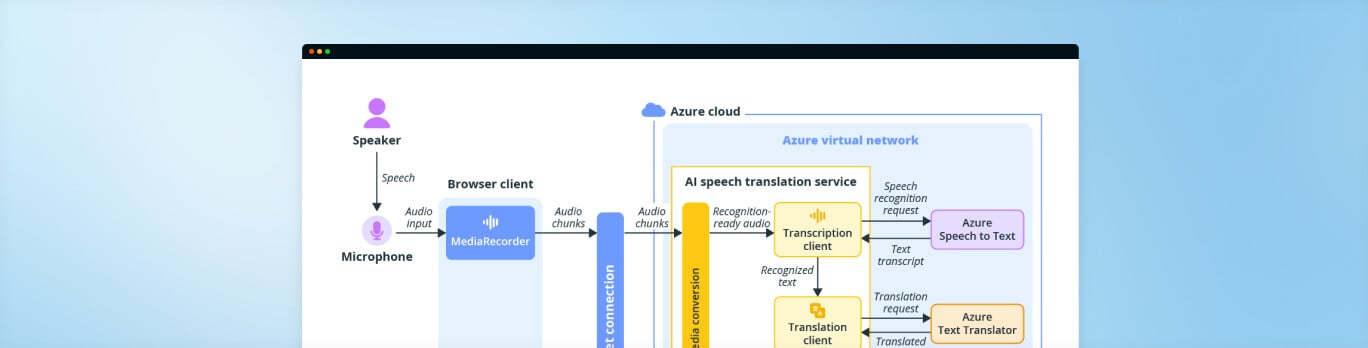
ScienceSoft implemented the PoC as a web application with a back-end AI orchestration layer. As shown in the diagram, this layer controlled the order of operations, data handoffs, and media conversions across the full speech-to-speech flow.
- The orchestration layer passed the prepared audio to the Azure Speech to Text AI service, then routed the transcript to the Azure Text Translator AI service.
- The target-language text was then routed to the Azure Text to Speech AI service and ElevenLabs AI voice generation to apply the selected voice sample.
- After the back end received the generated audio, it used FFmpeg to prepare it for browser playback and returned it through the same WebSocket connection.
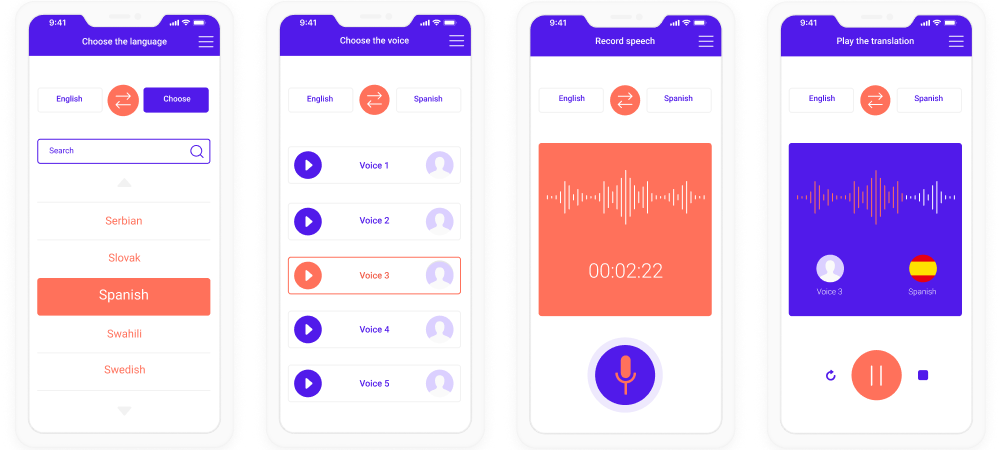
The browser interface enabled users to select source and target languages, choose a voice sample, record speech, and play the translated output.
Pipeline diagnostics for further optimization
ScienceSoft also added diagnostics for the AI orchestration layer. The back end could report timing events for speech recognition, text translation, and voice synthesis as separate stages. This helped the team trace latency bottlenecks, compare AI service behavior, and guide future tuning across MVP development and later product iterations.
AI Voice Translation App PoC Successfully Attracted Investors
ScienceSoft delivered a working proof-of-concept app in 8 weeks. The Client used it in live demos, which helped attract initial investment.
The PoC also supported the next productization steps. Its modular back end gave the startup the flexibility to choose the best mix of AI service providers for target languages, speech quality, response speed, and cost. Stage-level diagnostics turned latency improvement into a measurable optimization task. Together, these capabilities gave the startup the technical foundation for continued product development.
Technologies and Tools
Front end and communication: JavaScript, WebSocket, Mediasoup.
Back end and media processing: Node.js, Golang, FFmpeg, Docker, Docker Compose.
AI and speech services: Azure Cloud, Azure Speech, AzureTranslator, ElevenLabs AI Voice Generator.