 ScienceSoft Global



40% of Adults 55+ Could Use AI-Powered Wearables to Flag Serious Health Risks by 2030, ScienceSoft Predicts


Related topics:
6 min read
Last updated:
ScienceSoft, a Texas-based AI transformation and software engineering company operating in the healthcare IT industry since 2005, has published non-sponsored research on wearable adoption among older adults in the US.
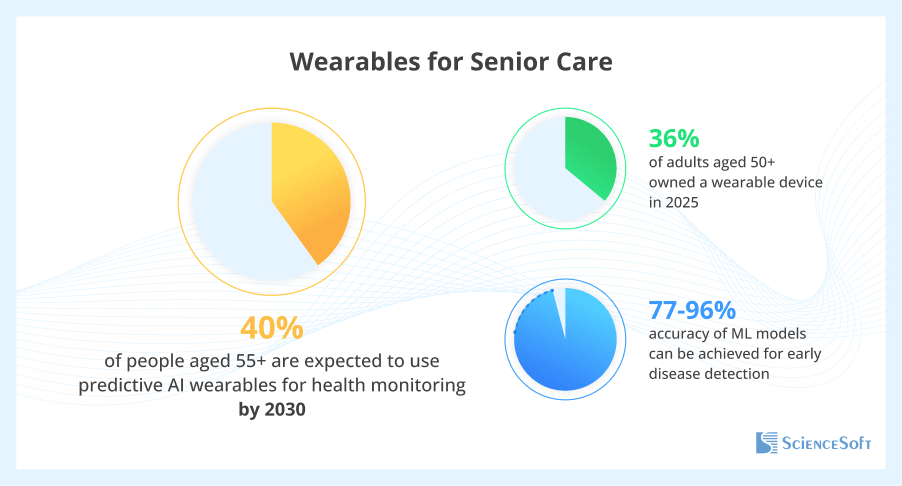
By 2030, around 40% of people aged 55 and older may use wearable devices powered by predictive AI to flag warning signs of serious health conditions. This estimate includes both medical devices and consumer wearables, such as smartwatches, which already track health indicators that may support the early detection of cardiovascular deterioration. While wearables won’t replace a doctor’s diagnosis or automatically trigger emergency services, their alerts can prompt users and their caregivers to seek timely clinical evaluation.
ScienceSoft’s research team assessed the potential for market penetration and adoption of such devices and is sharing an optimistic outlook supported by the growing popularity of wearables and healthcare technology advancements.
The Rise of Wearables: Meeting the Health Needs of Older Americans
Periodic medical appointments provide only snapshots of a person’s health. For older adults, mobility limitations, transportation difficulties, sensory impairments, and the cost of regular visits can make consistent health monitoring even harder. Wearable devices can supplement in-person care by tracking selected health indicators between appointments and helping users identify changes that may require professional attention.
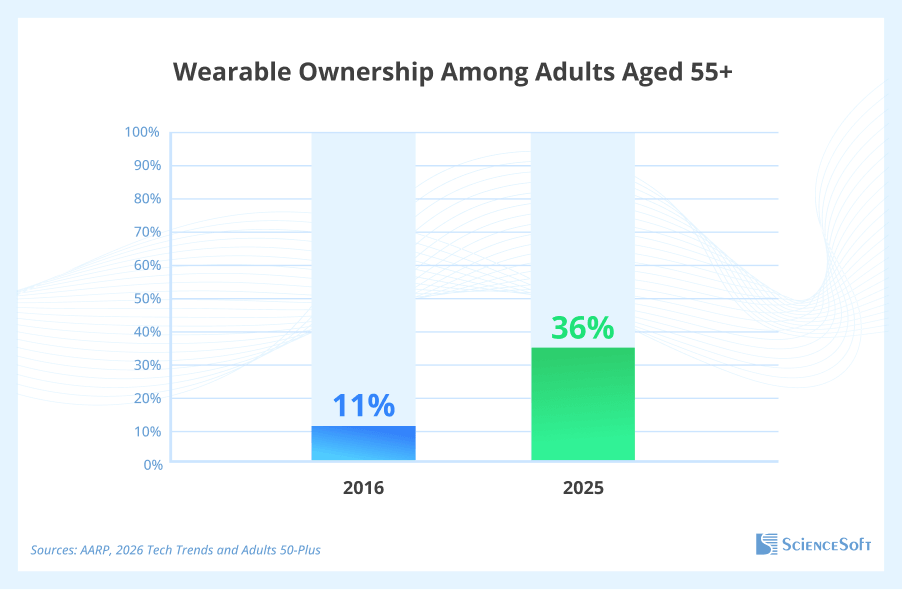
Over the past decade, the popularity of wearables has grown substantially. In 2023, 29% of Americans aged 45–64 used wearables, while adoption among those aged 65 and older reached 25%. AARP’s 2026 Tech Trends report showed that 36% of US adults aged 50+ owned a wearable device. And though older adults may be adopting this technology more slowly than younger people, adoption rates do not necessarily reflect willingness to use it. In a 2026 study of adults aged 60–99 in Northern Portugal, 74.4% said they were interested in using wearable systems for remote health monitoring. While the finding does not directly indicate demand among older adults in the US or other countries, it suggests that interest may be higher than adoption rates alone imply.
Several barriers continue to limit wearable adoption among older adults. Many do not see enough value in these devices, lack confidence in using them, or have concerns about cost, physical safety, and data security. Complex interfaces, accessibility limitations, short battery life, and difficulty interpreting health data can further discourage adoption and continued use.
However, unlike broader healthcare access challenges, many of these barriers are directly related to product usability and user education. This gives wearable manufacturers, healthcare providers, and families clear opportunities to address them.
Manufacturers can broaden their market reach by simplifying device setup and navigation, presenting health data more clearly, extending battery life, and designing for age-related changes in vision, hearing, dexterity, and cognition. These improvements can make wearables easier to adopt and use over time.
Healthcare providers and family members can also influence adoption. They can explain which device functions are relevant to a user’s health needs, help configure settings and alerts, and show users how to interpret trends and individual readings. They can also set realistic expectations about device accuracy, explain when continuous wear is necessary, and clarify when a reading requires professional follow-up.
Affordability of wearable devices remains a separate challenge, particularly for lower-income older adults. The purchase price, subscription fees, compatible smartphone requirements, and replacement costs can put some devices beyond their reach. Wider adoption will therefore depend not only on better design and education but also on whether wearable technology delivers clear, relevant value at an accessible cost.
How Accurately Can Wearables Track Health Indicators?
Continuous health monitoring depends on the quality of the data wearables collect. Consumer devices can already track health indicators such as heart rate throughout the day, providing data that may help reveal changes that periodic measurements could miss. However, their readings are not identical to clinical measurements and can be affected by individual characteristics and the way a device is used.
Recent research suggests that modern consumer wearables can measure heart rate with generally reliable accuracy. In 2026, Apple Watch and Garmin showed an average difference of less than 1 bpm from reference measurements. At the same time, individual readings could differ by around 8–10 bpm in either direction. This means that wearable data can be useful for tracking trends, but individual readings should not be treated as a diagnosis.
Such limitations become particularly important when wearable data is used to identify potential health risks. A single unusual reading may have many explanations, so detecting a developing health problem requires looking beyond one metric or one measurement.
Our comparative analysis of three smart wearable devices — Apple Watch, Oura Ring, and Fitbit — showed that these devices can recognize lifestyle patterns and provide personalized recommendations that support healthier living and active aging. Apple Watch has offered fall detection since 2018, and compatible models can record a single-lead electrocardiogram and classify the recording for signs of atrial fibrillation. However, these readings are intended to supplement rather than replace conventional diagnostic methods or clinical evaluation.
Can Wearable Data Help Predict Health Risks?
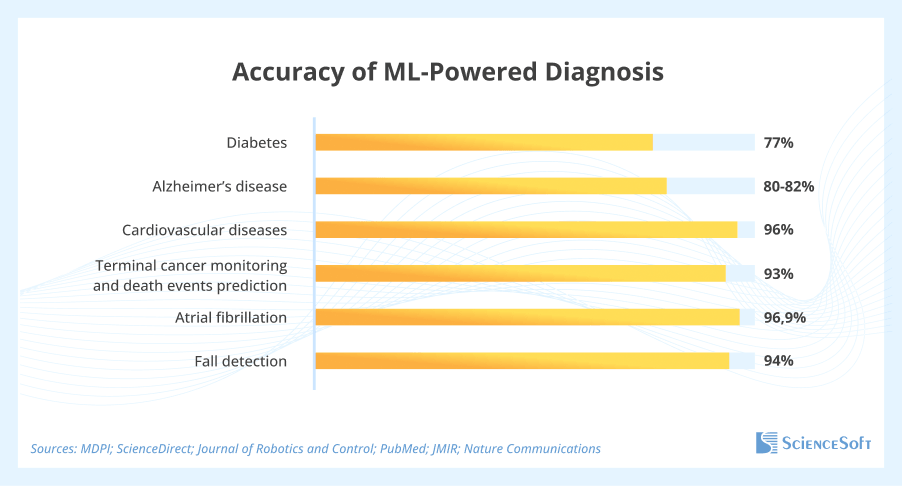
Machine learning algorithms can identify complex relationships between multiple health indicators and other patient data, which makes the technology relevant to disease detection and health risk prediction. Studies published between 2020 and 2025 have tested ML for diabetes, Alzheimer’s disease, cardiovascular disease, terminal cancer monitoring, atrial fibrillation, and clinical deterioration. Reported performance varied considerably depending on the condition, dataset, and prediction task, from 77% accuracy for diabetes diagnosis to 96.9% for atrial fibrillation detection. (MDPI, ScienceDirect, JRC, PubMed, JMIR, Nature Communications)
Consumer wearables already use artificial intelligence to identify patterns in collected data and turn them into health and wellness recommendations. However, this doesn’t mean devices alone can predict serious health conditions.
More advanced predictions become possible when wearable measurements are combined with other health data, such as demographic details, medical history, and medications. A 2025 study applied machine learning to Fitbit data and EHR information to predict all-cause hospitalizations and new cardiovascular disease diagnoses. The best-performing model predicted hospitalizations with an area under the curve (AUC) of 0.95 and 99% accuracy. Prediction of new cardiovascular disease was less reliable, with the best model reaching an AUC of 0.80 and 71% accuracy.
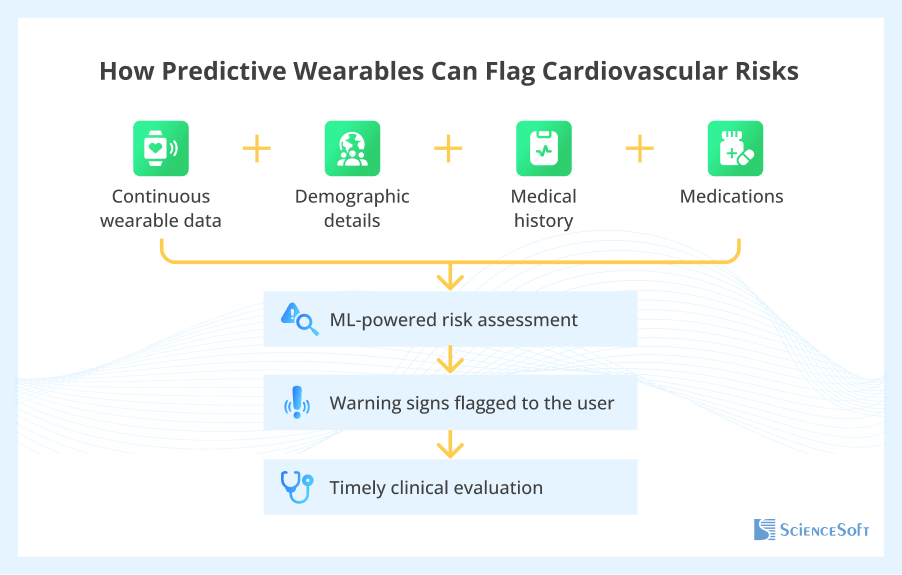
The study illustrates an important distinction between consumer wearables and more integrated predictive solutions. A standalone smartwatch can continuously collect metrics such as heart rate and activity, but predicting clinical outcomes may require combining these measurements with broader patient information. In the 2025 study, researchers used longitudinal Fitbit data together with EHR data rather than relying on wearable measurements alone.
Such predictive functionality is not yet a standard capability of consumer wearables. However, the data generated by these devices can become a useful input for machine learning models designed to identify health risks and support earlier clinical evaluation.
In practice, this type of prediction would likely happen not on the wearable itself but within a health system or a clinical analytics platform working on its behalf. A healthcare provider could combine information from its EHR with data from prescribed medical devices and, where patients choose to connect them, consumer wearables. Third-party technology companies can also process HIPAA-protected data on a provider’s behalf under agreements governing how that information is used and protected. In this model, a smartwatch would be one source of data among many, while the provider or its technology partner would bring those sources together for analysis.
Responding to Predictive Health Alerts
A prediction alone, however accurate, won’t save lives unless a wearable owner acknowledges the risk and takes action to mitigate it. Today’s wearables can help users contact emergency services or notify their family members and caregivers when assistance is needed. Predictive wearables could extend this functionality by alerting users or their caregivers when they detect warning signs that may require attention.
The appropriate response would depend on the severity and confidence of the signal. For consumer wearables, an alert could prompt the user to contact a caregiver or healthcare professional or seek urgent evaluation. In more integrated monitoring systems, concerning alerts could be routed to a care team for review, with emergency escalation reserved for cases where specific warning signs indicate a higher risk.
Wearables would not determine the diagnosis or the appropriate treatment. Their role would be to bring a potential health risk to the attention of users and caregivers earlier and help them decide when professional medical evaluation is needed.
Predictive Wearables: Potential Benefits and Challenges
Older adults
Predictive wearables could help older adults notice concerning changes between medical appointments and prompt them to seek further evaluation when needed. However, continuous access to health data can also create challenges. Cardiology experts note that patients may fixate on heart rate trends or irregular-rhythm alerts and interpret normal physiological changes as signs of a problem. Clear explanations of trends, alert thresholds, and the limits of individual readings can help users understand when a change warrants professional follow-up.
Healthcare providers
For healthcare providers, predictive wearables could provide additional patient health data between appointments. If more older adults respond to early warning signs and seek medical advice before their condition worsens, fewer patients may require intensive treatment. This could help healthcare providers allocate clinical resources more effectively and increase access to care.
Ambulance services providers
The shift towards preventive medicine that wearables will help propel will hopefully result in fewer emergency calls. This could help ambulance services provide faster response and arrival times, reduce the workload, and ease staff shortages.
Consumer wearable manufacturers
If predictive health monitoring becomes a mainstream use case, consumer wearable manufacturers have an opportunity to expand beyond fitness and wellness tracking. Given that nearly 30% of the US population is over the age of 55, older adults are becoming a more important customer segment, increasing the value of features such as longer battery life, accessible interfaces, and sensors capable of collecting health data reliably over long periods.
Predictive functionality could also make consumer wearables more valuable as part of the healthcare ecosystem. Manufacturers that can turn their devices’ measurements into credible alerts (and make those insights easy to share with clinicians) could strengthen the role of their devices in everyday health management.
Medical device and clinical software companies
For medical device manufacturers and developers of clinically validated software, wider wearable adoption creates an opportunity to move predictive monitoring beyond specialized devices and episodic testing. Their products could combine continuously collected wearable data with clinical information to identify deterioration or emerging risks earlier.
This also opens a market for validated predictive algorithms that can be integrated into wearable platforms, remote monitoring programs, and clinical workflows. Companies that can demonstrate reliable performance and limit unnecessary alerts will be better positioned to gain the trust of healthcare providers and patients.
Healthtech and AI companies
For healthtech startups and other technology companies, the opportunity lies in providing the infrastructure that makes predictive wearable products possible. This can include connecting wearable platforms with EHRs and other health data sources, standardizing and securely transferring data, managing patient permissions, and integrating alerts into the applications and systems used by patients and healthcare providers.
As more sensitive data moves between consumer devices, healthcare organizations, and third-party platforms, privacy and consent will become an important part of the product itself. Companies that make these exchanges secure, transparent, and easy for users to control could become important partners to wearable manufacturers, medical software developers, and healthcare providers.
